
The following blog post is for entertainment and informational purposes only. It is not intended to provide medical advice or diagnosis. Please consult your doctor before making any health-related decisions.
A spermidine food supplement provides concentrated doses of a naturally occurring polyamine that declines with age, making consistent intake difficult to achieve from food alone. Research connects it to autophagy, cardiovascular protection, and longevity effects. For a full breakdown of applications and health effects of spermidine, including cellular renewal and anti-inflammatory pathways, the evidence base now extends into human observational data. Wheat germ, legumes, and fermented soy rank among the richest natural spermidine sources.
What foods are highest in spermidine?
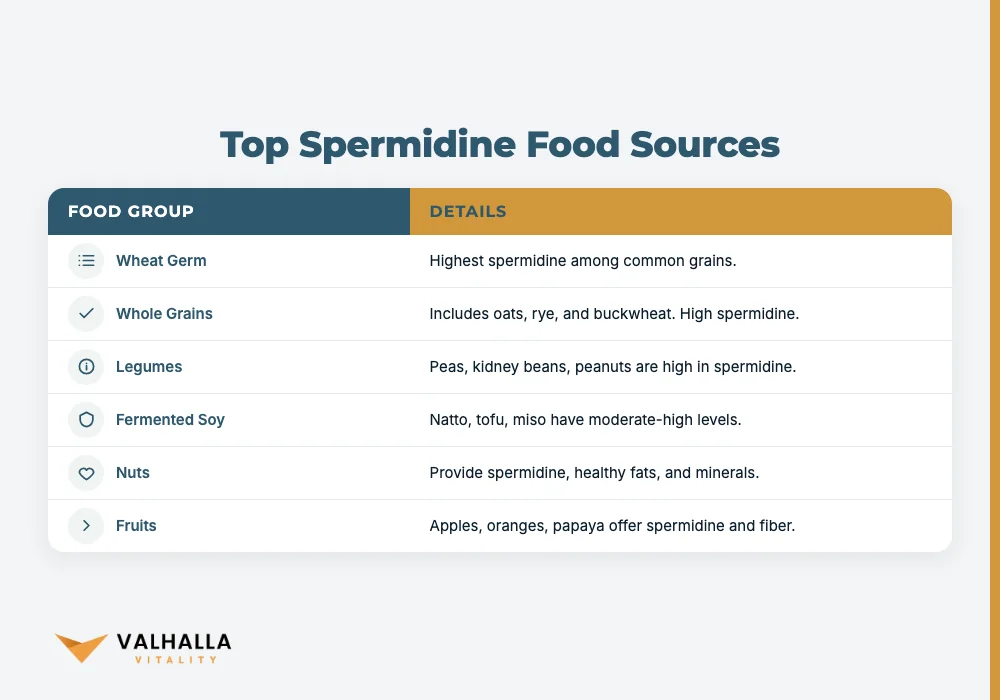
Wheat germ spermidine content is the highest of any commonly consumed grain. It is the single most studied whole food for polyamine concentration, making it the reference point in dietary spermidine research. Foods high in spermidine span several well-documented categories.
| Food group | Examples | Relative spermidine level |
|---|---|---|
| Whole grains | Wheat germ, oats, rye, buckwheat | High |
| Legumes | Peas, kidney beans, edamame, peanuts | High |
| Fermented soy | Natto, tofu, miso | Moderate-high |
| Mushrooms | Various culinary species | Moderate-high |
| Vegetables | Cauliflower, broccoli, Brussels sprouts | Moderate |
| Fruits | Apples, oranges, papaya, melon | Moderate |
| Nuts | Cashews, walnuts, almonds | Moderate |
Nuts provide spermidine alongside healthy fats and minerals including magnesium, zinc, and iron. Fruits combine polyamines with fiber and antioxidant compounds. Fermented products such as yogurt and kefir may increase polyamine availability through probiotic activity in the gut. Soybeans and soy derivatives deserve special attention: fermentation amplifies their polyamine content, making them among the most consistent natural spermidine sources in dietary research. For a side-by-side look at how food sources compare to concentrated supplement options, the research suggests a meaningful gap depending on individual dietary patterns.
Can you get enough spermidine from food alone?
For most adults, probably not at the intake levels associated with documented benefits in research. Body synthesis of spermidine declines with age. A diet rich in spermidine rich foods provides a meaningful baseline, but may not offset the natural reduction in endogenous polyamine production over time.
A 2025 review in Nutrition Research Reviews (Borsky et al.) assessed spermidine alongside urolithin A as complementary autophagy activators. The authors found that supplementation may bridge the gap when food-derived intake falls short of the levels needed to sustain autophagy activity. That conclusion does not dismiss whole food sources. A diet built around legumes, whole grains, and fermented products contributes polyamines alongside fiber, antioxidants, and phytochemicals that interact with the same cellular pathways.
The practical takeaway: natural spermidine sources form the dietary foundation, and supplementation adds consistent, measurable intake on top.
How does a spermidine supplement work?
Spermidine supplement benefits are primarily mediated through spermidine autophagy, the cellular process that breaks down and recycles damaged proteins and organelles. When autophagy runs efficiently, cells clear accumulated debris rather than letting it drive age-related dysfunction. That mechanism is central to most longevity-focused spermidine research. The supplement achieves this by delivering polyamines at concentrations most diets cannot reliably provide.
Beyond autophagy, spermidine supports DNA repair, stem cell regeneration, and may inhibit the production of low-density lipoproteins. A 2019 study by Yamaguchi O in Circulation Journal documented autophagy as a critical protective mechanism in cardiac tissue, connecting polyamine biology to cardiovascular health at the cellular level. A 2026 study by Chen et al. in the International Journal of Rheumatic Diseases described autophagy modulation as a pathway by which spermidine may reduce inflammatory tissue responses. The anti-inflammatory angle is significant. For a thorough treatment of these cellular pathways, this deeper look at spermidine and autophagy covers the molecular biology in detail.
What is the best time to take spermidine?
No single timing recommendation applies universally. Some practitioners align supplementation with fasting windows, given the mechanistic overlap between caloric restriction and spermidine-induced autophagy. Others prioritize consistent daily intake over precise timing. A licensed provider determines the appropriate schedule after reviewing individual labs and health history.
Does spermidine food supplement support longevity?
Yes, and the evidence has grown across multiple disciplines. Spermidine is one of the better-studied natural compounds in aging science. A 2020 paper by Soda K in Amino Acids linked polyamine-rich diets to increased gene methylation, proposing this as a mechanism behind longevity effects observed in model organisms.
Multiple pathways converge here. Autophagy clearance reduces protein aggregation, one of the primary drivers of cellular aging. Anti-inflammatory effects, described by Chen et al. in 2026, may lower the systemic aging burden. This is not a single-pathway story. Cardiac autophagy protection, supported by Yamaguchi's 2019 work, adds a cardiovascular dimension. For a detailed look at spermidine's longevity mechanisms across organ systems, the research points consistently in the same direction.
Spermidine levels in the body fall with age. Maintaining higher levels through diet and supplementation is the logic behind longevity-focused protocols.
Youthavar: antiaging synergy with a spermidine food supplement
Youthavar is a formulated spermidine food supplement built around the idea that spermidine works more effectively alongside antioxidants that address oxidative stress from complementary pathways. The formula draws spermidine from whole food ingredients including sardines and spinach, both recognized for their spermidine content, and combines them with green tea extract, vitamin C, aloe vera powder, and pomegranate extract.
Sardines contribute omega-3 fatty acids alongside polyamines. Spinach adds spermidine with magnesium and other micronutrients. Together, these ingredients target autophagy activation and oxidative load simultaneously. For additional detail on the Youthavar telomere support formula and how it fits the longevity supplement category, the product page covers the full ingredient rationale.
Youthavar is available through Valhalla Vitality, a telehealth and supplements platform offering provider-reviewed health protocols. Availability varies by state.
Ready to explore spermidine supplementation?
Book Your Consultation to connect with a licensed provider who can review your health intake and determine whether supplementation fits your protocol.
FAQ
What foods contain the highest levels of spermidine?
Wheat germ spermidine content is the highest among common grains, making it the reference food in polyamine research. Legumes including peas and kidney beans, fermented soy products such as natto and edamame, and various mushrooms also rank among the top natural spermidine sources. A varied diet across these categories provides the broadest polyamine coverage.
Can a spermidine food supplement replace a spermidine-rich diet?
No. Whole foods deliver spermidine alongside fiber, antioxidants, and phytochemicals that interact with the same pathways a supplement targets. A spermidine food supplement is best used as a complement to a diet already built around spermidine rich foods.
How does spermidine relate to autophagy?
Spermidine activates autophagy, the cell's internal process for clearing damaged proteins and organelles. A 2025 review (Borsky et al.) confirmed that spermidine also activates mitophagy specifically, which targets dysfunctional mitochondria that accumulate with age. These two processes are central to why spermidine is studied in aging research.
Who should consider taking a spermidine food supplement?
Adults focused on supporting autophagy, cellular renewal, and long-term health are the typical users. Starting with a consultation helps clarify fit. A licensed provider reviews labs and health history to determine whether supplementation is appropriate and to guide the protocol.
Sources
- Borsky P et al. (2025). Distinct roles of urolithin A and spermidine in mitophagy and autophagy: implications for dietary supplementation. Nutrition Research Reviews. PubMed
- Soda K (2020). Spermine and gene methylation: a mechanism of lifespan extension induced by polyamine-rich diet. Amino Acids. PubMed
- Chen Y et al. (2026). Therapeutic Potential of Spermidine in Rheumatoid Arthritis: Mechanisms and Future Directions. International Journal of Rheumatic Diseases. PubMed
- Yamaguchi O (2019). Autophagy in the Heart. Circulation Journal. PubMed
You May Also Like
 Spermidine
 Supplement Forms: Pills, Tablets & Tincture
Spermidine supplement forms include pills, tablets, and tinctures. Compare bioavailability, side effects, and how a provider picks the right form for you.
October 30, 2026 ETRead more → Spermidine
 Benefits: Science, Safety, and How It Works
Spermidine benefits include autophagy, cardiovascular support, hair growth, and longevity support. Learn what the science shows and how to start.
October 29, 2026 ETRead more → Spermidine
Best Spermidine Supplement Guide: What the Research Shows
Best spermidine supplement selection starts with understanding autophagy, food sources, and key quality criteria. Here is what the research shows.
October 29, 2026 ETRead more →