
The following blog post is for entertainment and informational purposes only. It is not intended to provide medical advice or diagnosis. Please consult your doctor before making any health-related decisions.
The best spermidine supplement delivers a bioavailable polyamine at a concentration your body can actually use. Spermidine is a naturally occurring compound found in food and produced inside cells; it activates spermidine autophagy, the cellular recycling process consistently linked to spermidine benefits longevity in published research. Product quality varies widely across the market, and knowing what to evaluate before buying matters more than picking a familiar brand. For a deeper look at the biological mechanisms behind spermidine, starting with the science is the logical first step.
What is spermidine good for?
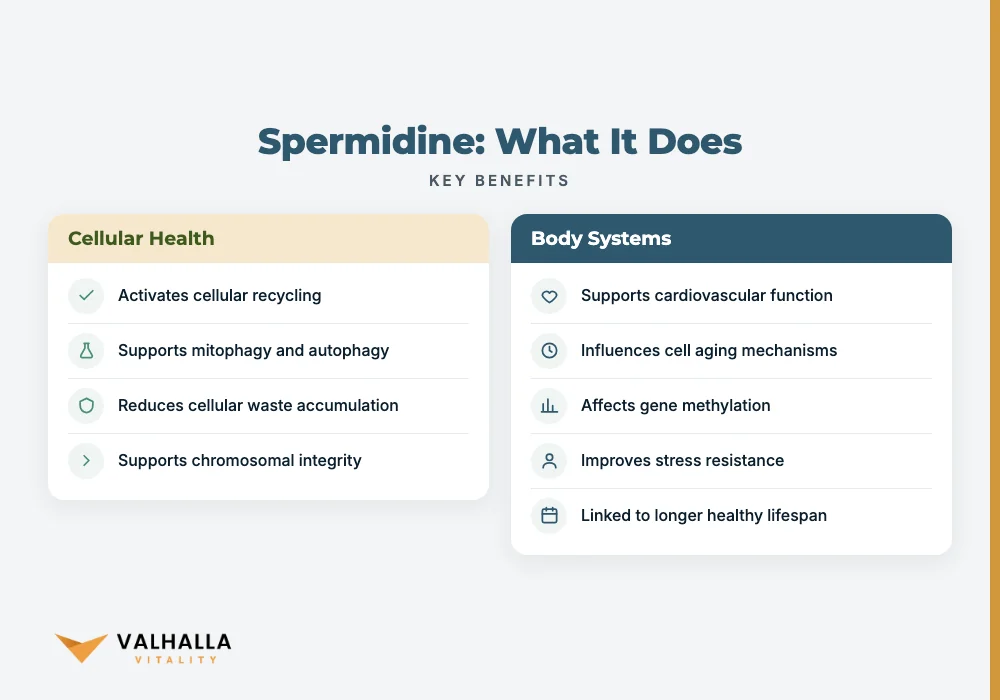
Spermidine is good for activating autophagy, supporting cardiovascular function, and influencing epigenetic mechanisms that govern how cells age. It is a polyamine, carrying two or more amine groups that allow it to bind with DNA, cellular membranes, and other molecules inside cells. That binding capacity drives its wide range of biological effects.
The most studied benefit is spermidine autophagy induction. Autophagy is the cellular recycling process in which cells identify damaged, misfolded, or obsolete components, break them down, and recover usable material. When autophagy slows, cellular waste accumulates. Researchers associate that accumulation with accelerated biological aging. A 2025 review in Nutrition Research Reviews confirmed spermidine's distinct role in mitophagy and autophagy, with direct implications for supplementation decisions [S1].
Cardiovascular effects are also documented. A 2019 paper in Biochemical Society Transactions reported beneficial effects of spermidine on cardiovascular health and longevity, identifying a cell-type-specific import mechanism in cardiomyocytes [S2]. The heart appears to have its own pathway for concentrating and using polyamines.
The spermidine anti-aging picture extends to gene regulation. A 2020 study in Amino Acids found that polyamine-rich diets influence gene methylation, a key epigenetic process tied to cellular aging and lifespan regulation [S3]. A 2019 review in Biogerontology identified spermidine among naturally occurring compounds most consistently linked to improved stress resistance and longer healthy lifespan across multiple model organisms [S6].
Beyond autophagy and gene regulation, spermidine supports chromosomal integrity, growth factor activity, and apoptosis control. Research suggests polyamines including spermidine may function in fibroblast-like roles during cell division, contributing to tissue maintenance over time. That breadth of function is what gives spermidine an unusually strong scientific foundation relative to most longevity supplements.
Why spermidine levels decline with age
The body synthesizes spermidine. Healthy tissues maintain meaningful concentrations throughout life. The problem is that both endogenous production and dietary intake tend to fall with age, and spermidine rich foods like wheat germ, fermented soybeans, and aged cheese are not daily staples for most adults. Older adults commonly consume fewer polyamines than younger cohorts, widening the gap between what cells need and what the body supplies.
Understanding this decline helps explain why selecting the best spermidine supplement, rather than just any polyamine product, matters specifically for adults over 40. A 2020 review in Critical Reviews in Food Science and Nutrition placed spermidine within a broader nutrition-longevity framework, noting that dietary compounds like spermidine become mechanistically more relevant as baseline levels decline with age [S5].
That framing shifts the question from "does spermidine work" to "does your current intake match what your tissues need." For many adults, the honest answer is no. Supplementation is one way to address that gap, and the quality of the supplement determines how reliably it closes it.
What foods are highest in spermidine?
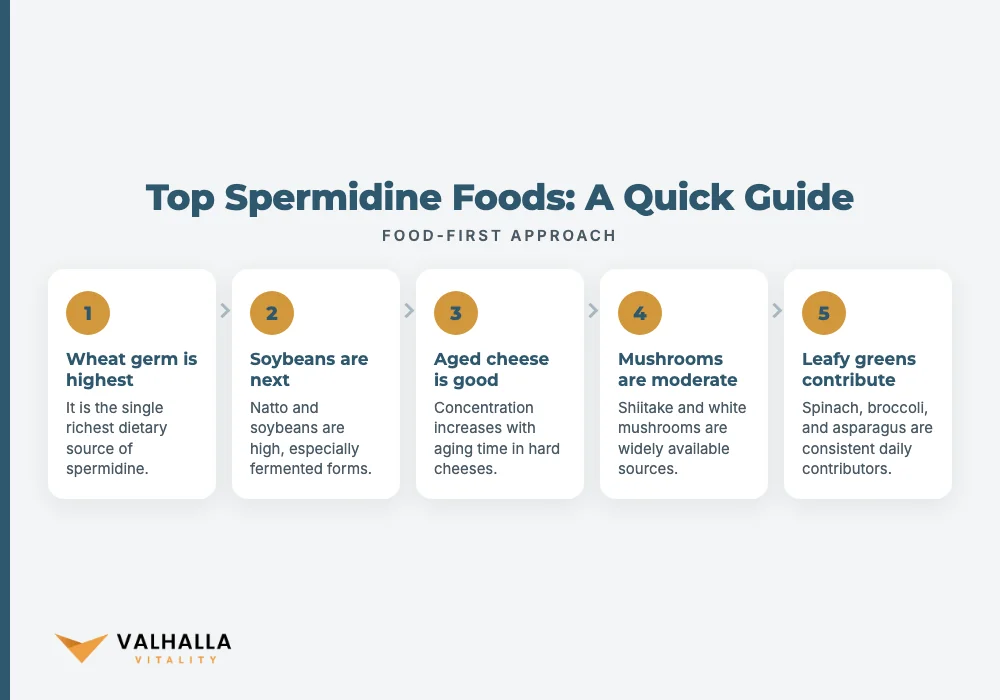
Wheat germ is the single richest dietary source of spermidine, followed by soybeans, aged cheeses, mushrooms, and leafy green vegetables. For anyone taking a food-first approach before committing to a supplement, knowing which sources deliver the most concentrated amounts helps set a realistic baseline.
Here are the key spermidine rich foods ranked by approximate concentration:
| Food | Spermidine level | Notes |
|---|---|---|
| Wheat germ | Very high | Highest known whole-food source |
| Natto and soybeans | High | Fermented forms tend to be richer |
| Aged hard cheese | Moderate-high | Concentration increases with aging time |
| Shiitake and white mushrooms | Moderate | Widely available |
| Chickpeas and lentils | Moderate | Also high in related polyamines |
| Spinach, broccoli, asparagus | Moderate | Consistent daily contributors |
| Citrus fruits | Low-moderate | Easy daily addition |
Wheat germ spermidine is worth particular attention because it is also the foundation for most commercially available spermidine extracts. Cooking and food processing can reduce polyamine concentrations, so raw or minimally processed forms preserve more of the compound.
Consistent diet alone may not maintain optimal levels, particularly if food habits are irregular or if absorption changes with age. That gap is where a well-formulated supplement becomes relevant. For a complete comparison of which whole foods contribute the most spermidine versus what a supplement provides, the breakdown covers both approaches in detail.
How to evaluate the best spermidine supplement
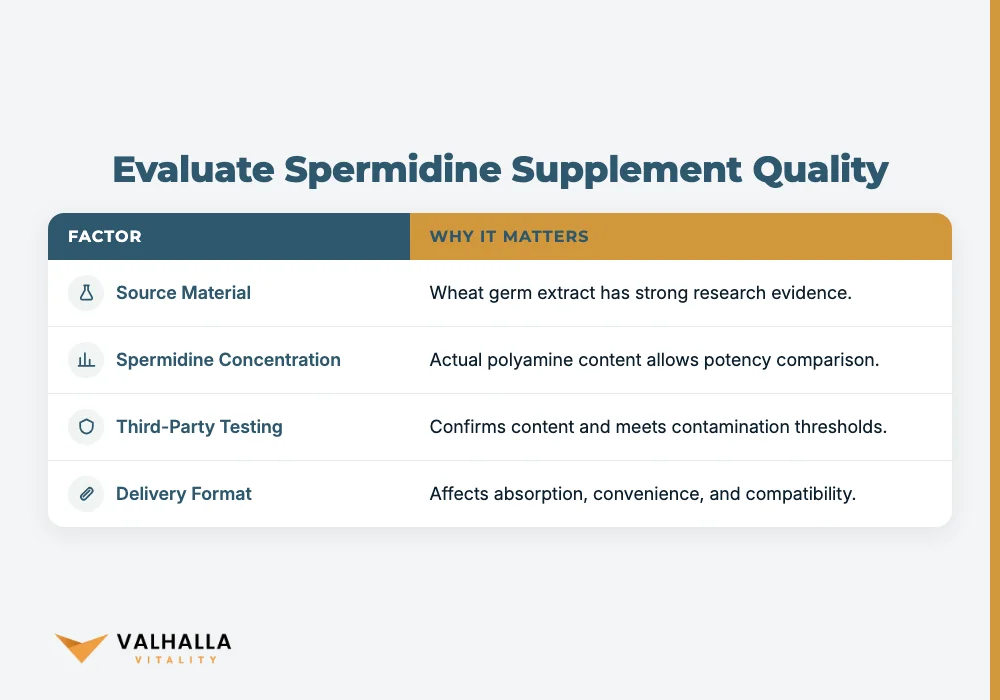
Most reviews focus on brand comparisons or product rankings. Few address the practical criteria that determine whether a product actually delivers what its label promises. Finding the best spermidine supplement requires checking these specific factors before purchasing.
- Source material and extraction method. The majority of quality products use wheat germ extract. Wheat germ spermidine aligns with the food-sourced polyamines studied in longevity research, which gives it a stronger evidentiary basis than synthetically produced alternatives. Check the label for the raw material source rather than assuming all products are equivalent.
- Disclosed spermidine concentration. Some labels list total wheat germ extract weight without specifying the actual spermidine percentage. That makes it impossible to compare potency across brands. The best spermidine supplement options state actual polyamine content per serving rather than obscuring it behind extract totals.
- Third-party testing. The FDA does not evaluate dietary supplements before they reach the market. Third-party testing by recognized laboratories fills that gap, confirming that stated spermidine content matches what is in the capsule and that contamination thresholds are met. A certificate of analysis is a basic quality signal.
- Delivery format. Capsules, tablets, powders, and tinctures each carry different practical trade-offs around absorption, convenience, and compatibility with other compounds. To compare each spermidine supplement format and how it affects real-world bioavailability, that detail matters before making a final choice.
- Synergistic compounds. Some formulas combine spermidine with complementary longevity ingredients. Cycloastragenol, for example, targets telomere maintenance through a separate mechanism. Knowing what else is in the formula helps avoid unintended overlap and lets you assess whether the combination has a coherent scientific rationale.
- Manufacturing transparency. A reputable producer should be willing to disclose ingredient sourcing, processing, and quality controls. Opacity on any of these points is a meaningful warning sign. Transparency is one of the clearest indicators that a company stands behind its product.
Does spermidine really work for longevity?
Yes. The evidence from animal models and observational human data is consistent. Higher polyamine intake is repeatedly associated with longer healthy lifespan and reduced age-related disease risk across study types. The mechanism is well characterized, which separates spermidine from many longevity supplements whose proposed pathways remain speculative.
Every well-studied longevity intervention, including caloric restriction, intermittent fasting, and sauna use, shares a common downstream effect: increased autophagy. Spermidine appears to trigger the same cellular response without requiring caloric restriction. That convergence is what makes it a serious subject of longevity research rather than a peripheral supplement trend.
A 2020 review in Critical Reviews in Food Science and Nutrition identified spermidine as one of the most mechanistically plausible dietary contributors to extended lifespan [S5]. Most of the strongest data comes from animal models and epidemiological studies; human randomized controlled trials are still in earlier stages. For a thorough review of the research connecting spermidine to longevity pathways and aging biology, the cellular and systemic evidence is covered in detail.
The honest summary: the science is genuinely promising. Anyone choosing the best spermidine supplement for longevity reasons is making a decision based on strong mechanistic evidence with growing but not yet definitive clinical support in humans.
How much spermidine should you take daily?
There is no universal standard dose for spermidine supplementation. A licensed provider determines the appropriate spermidine dosage after reviewing your health intake and relevant labs. That individualization matters because baseline polyamine levels vary between people, and factors like age, diet composition, and health status all influence what a meaningful supplemental intake looks like.
What research does establish is that dietary spermidine intake declines with age, meaning older adults face a larger gap between consumption and what tissues require. Supplementation addresses that gap. The spermidine dosage question is best handled by a provider who can evaluate your specific situation rather than applying a population-level average.
Nutritional spermidine from food carries no dosing concern at normal dietary intake levels. The supplementation question is where individualized provider guidance applies.
Is spermidine safe to take?
Spermidine is a compound your body produces and has obtained from food throughout your life. At dietary and supplemental concentrations studied in research, it has a favorable safety profile. A 2023 expert review in Expert Reviews in Molecular Medicine examined the toxicology of longevity compounds including spermidine and found that adverse effects were not a primary concern at typical supplemental concentrations [S4].
Choosing the best spermidine supplement also means prioritizing products from licensed manufacturers with documented quality controls. Dietary supplements are not subject to pre-market FDA evaluation. Manufacturing standards vary considerably across the market. A certificate of analysis and transparent sourcing reduce the quality risk that regulation does not currently address.
Anyone with existing health conditions, who takes prescription medications, or who is pregnant or breastfeeding should consult a provider before starting spermidine or any new supplement. That is standard practice across the supplement category.
Youthavar: spermidine and cycloastragenol
For those researching the best spermidine supplement with a focus on combined anti-aging mechanisms, Youthavar is Valhalla Vitality's spermidine anti-aging formula. It pairs spermidine with cycloastragenol, a compound associated with telomere maintenance, addressing two aging mechanisms that operate through separate pathways. Spermidine handles autophagy and cellular recycling; cycloastragenol targets the telomere-related dimension of cellular aging.
The rationale for combining them is that biological aging is not a single-pathway event. A formula addressing only one mechanism leaves others unaddressed. Both compounds have documented biological activity in published research. For a full breakdown of how Youthavar pairs these compounds and the science supporting each ingredient, the evidence for the combination is covered in detail there.
Youthavar is available through Valhalla Vitality as part of a longevity supplement line. Spermidine supplements are not pharmaceutical products, so no prescription is required. Consulting a provider before starting remains the appropriate path for anyone with active health concerns or who takes medications.
Talk to a provider about the right approach for you
If you want to know whether spermidine supplementation fits your health goals, a licensed provider can review your intake and give you a direct answer. Book Your Consultation to get started.
FAQ
What is spermidine good for?
Spermidine activates autophagy, the cellular recycling process consistently linked to slower biological aging, and research also connects higher polyamine intake to cardiovascular health and epigenetic regulation of lifespan. It is among the most mechanistically well-supported naturally occurring compounds in longevity research. Multiple published reviews confirm its biological activity across organ systems.
What foods are highest in spermidine?
Wheat germ is the most concentrated whole-food source of spermidine, followed by natto and soybeans, aged hard cheeses, mushrooms, and leafy vegetables like spinach and asparagus. Consistent intake of these spermidine rich foods supports baseline polyamine levels. Fermented and minimally processed forms tend to retain higher concentrations than heavily processed versions.
Does spermidine really work for longevity?
Animal models and observational human studies consistently associate higher polyamine intake with longer healthy lifespan, and the primary mechanism, autophagy activation, is shared with all established longevity interventions. Human clinical trial data is still accumulating. The biological rationale is well supported; definitive clinical confirmation in humans remains ongoing.
How much spermidine should you take daily?
A licensed provider determines the appropriate spermidine dosage after reviewing your individual health profile and labs, since baseline polyamine levels and needs vary considerably between people. Nutritional spermidine from food carries no dosing concern at normal dietary intake levels. Supplementation decisions are best made with provider guidance rather than a population-average number.
Is spermidine safe to take?
Spermidine has a favorable safety profile at typical dietary and supplemental concentrations, as confirmed in a 2023 expert analysis of longevity compound toxicology. Manufacturing quality varies across suppliers because supplements are not pre-market evaluated by the FDA. Consult a provider before starting if you have existing health conditions or take medications.
Sources
- Borsky P et al. (2025). Distinct roles of urolithin A and spermidine in mitophagy and autophagy: implications for dietary supplementation. Nutrition Research Reviews. PubMed
- Nilsson BO et al. (2019). Beneficial effects of spermidine on cardiovascular health and longevity suggest a cell type-specific import of polyamines by cardiomyocytes. Biochemical Society Transactions. PubMed
- Soda K (2020). Spermine and gene methylation: a mechanism of lifespan extension induced by polyamine-rich diet. Amino Acids. PubMed
- Kahraman C et al. (2023). Toxicology of pharmaceutical and nutritional longevity compounds. Expert Reviews in Molecular Medicine. PubMed
- Ekmekcioglu C (2020). Nutrition and longevity - From mechanisms to uncertainties. Critical Reviews in Food Science and Nutrition. PubMed
- Gómez-Linton DR et al. (2019). Some naturally occurring compounds that increase longevity and stress resistance in model organisms of aging. Biogerontology. PubMed
You May Also Like
 Spermidine
 Supplement Forms: Pills, Tablets & Tincture
Spermidine supplement forms include pills, tablets, and tinctures. Compare bioavailability, side effects, and how a provider picks the right form for you.
October 30, 2026 ETRead more → Spermidine
 Benefits: Science, Safety, and How It Works
Spermidine benefits include autophagy, cardiovascular support, hair growth, and longevity support. Learn what the science shows and how to start.
October 29, 2026 ETRead more → Spermidine
Foods High in Spermidine: Top Dietary Sources Ranked
Foods high in spermidine include wheat germ, soybeans, mushrooms, and peas. Ranked by content, with practical intake guidance and research context.
October 29, 2026 ETRead more →