
The following blog post is for entertainment and informational purposes only. It is not intended to provide medical advice or diagnosis. Please consult your doctor before making any health-related decisions.
The best time to take enclomiphene is whichever hour you can hold to consistently, every single day. Morning dosing aligns with the body's natural testosterone peak; evening dosing works equally well for men who find daytime side effects disruptive. A licensed provider sets your enclomiphene dosing schedule after reviewing bloodwork and your symptom pattern, so the exact window is part of a personalized plan built through an initial online consultation.
How enclomiphene works and why timing matters
Enclomiphene is the active isomer of clomiphene citrate, isolated from its companion compound zuclomiphene because zuclomiphene can produce estrogenic effects rather than blocking them. Enclomiphene blocks estrogen receptors in the pituitary gland. That action removes a natural brake on the hypothalamic-pituitary axis.
The hypothalamus responds by releasing more gonadotropin-releasing hormone (GnRH). The pituitary then sends luteinizing hormone (LH) and follicle-stimulating hormone (FSH) to the testes, which increase testosterone production in response. The body's own production drives the effect. Nothing is replaced externally.
This matters for timing because the hypothalamic-pituitary-testicular axis follows a circadian rhythm. Testosterone production rises overnight and peaks in the early morning hours.
Enclomiphene's half-life keeps blood concentrations relatively stable over a full 24-hour period with daily dosing, which means pharmacokinetics alone do not strongly favor one window over the other. Practical consistency and side effect tolerance are the deciding factors for most people.
For a fuller picture of what this medication is designed to address, see our guide on male hypogonadism and enclomiphene treatment options.
The best time to take enclomiphene: morning vs. evening at a glance
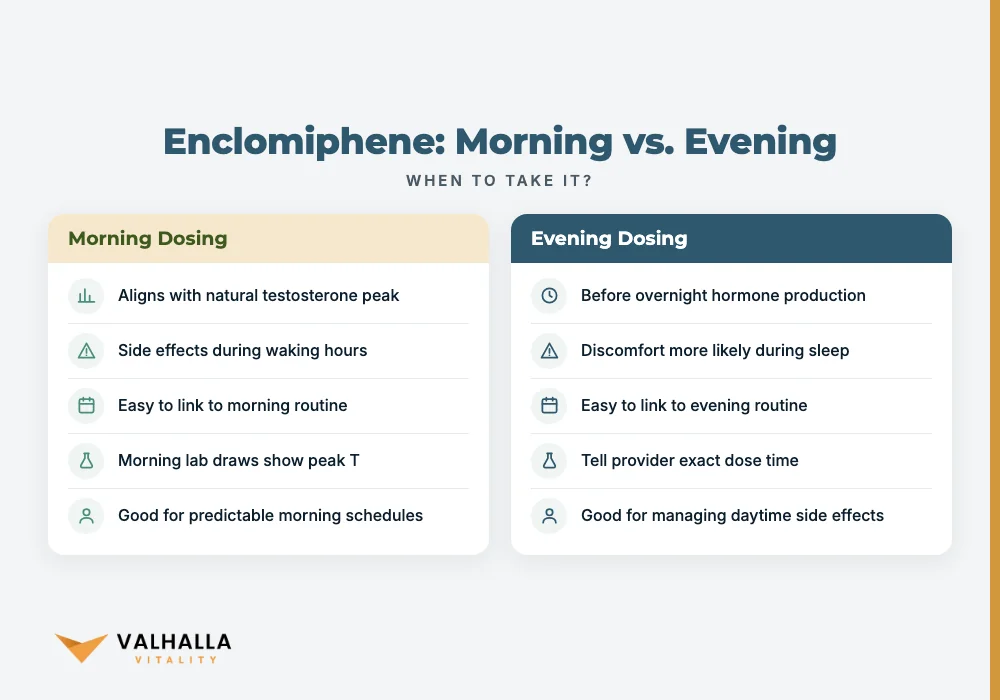
| Factor | Morning dosing | Evening dosing |
|---|---|---|
| Hormonal alignment | Coincides with natural testosterone peak | Precedes overnight hormone production |
| Side effect window | Nausea or headaches during waking hours | Discomfort more likely during sleep |
| Daily anchor | Breakfast, coffee, or brushing teeth | Dinner or bedtime routine |
| Lab draw timing | Morning draws capture testosterone at its peak | Tell provider your exact dose time before draws |
| Best for | Men with predictable morning schedules | Men managing daytime side effects |
Both windows produce comparable clinical results when the chosen schedule is maintained without gaps.
What time of day should I take enclomiphene?
Once daily, at the same time each day. That is the core instruction. The specific hour is far less important than keeping it fixed, because stable dosing produces more predictable hormone levels than erratic timing across weeks of treatment.
Most clinical protocols for enclomiphene citrate timing favor the morning. Testosterone follows a diurnal pattern, rising overnight and reaching its natural peak between roughly 6 a.m. and 10 a.m. Taking enclomiphene within or just before this window positions the medication's receptor-blocking effect during the hormonal system's most active period.
No published trial has demonstrated a statistically meaningful difference in testosterone outcomes between morning and evening dosing with enclomiphene specifically. Provider preference and patient lifestyle carry significant weight. Several situations make evening a reasonable first choice:
- Night shift workers whose sleep and wake windows are inverted relative to a standard schedule
- Frequent long-distance travelers who cross multiple time zones regularly
- Men who find morning pills easy to forget but maintain a consistent bedtime routine
- Anyone whose early-treatment gastrointestinal side effects are disruptive during work hours
The enclomiphene morning or night question ultimately comes down to which timing you will actually maintain. Consistency beats theoretically optimal timing that gets missed half the time.
Your provider will review your testosterone, LH, and FSH results alongside your daily habits before making a recommendation. For a clinical overview of the medication and what the hormone workup involves, see our article on how enclomiphene citrate works and what patients can expect.
Is it better to take enclomiphene in the morning or at night?
Morning is the conventional starting point, but neither option produces clearly better outcomes in the available literature. Here is what separates them in practice.
Morning dosing: aligning with your hormonal clock
Testosterone blood levels peak in the early morning hours, driven by overnight production. Positioning enclomiphene morning dosing alongside this natural peak may support a smoother interaction between the drug's receptor-blocking effect and the hypothalamic-pituitary axis at its most responsive point.
The practical case for morning dosing is strong. Most men have a more predictable morning structure than evening, which supports adherence. Pairing the dose with breakfast, coffee, or brushing teeth removes the decision from daily awareness entirely.
Any gastrointestinal side effects that appear in early weeks tend to settle by midday rather than interrupting sleep. That timing alone is enough reason for many men to start in the morning.
Enclomiphene before bed: the case for evening timing
Enclomiphene at night is a well-established alternative, particularly when daytime side effects are a concern. The core advantage is timing discomfort to occur during sleep rather than during work, exercise, or other daily activity.
Some providers note that the hypothalamus releases GnRH in pulses during sleep, and that taking the medication in the hours before this nocturnal activity might align the drug's effect with that hormonal window. Whether this produces a measurable clinical benefit has not been confirmed in published data.
The practical case for enclomiphene before bed is more grounded than the theoretical one. If side effects are a concern, schedule the medication where they interfere least with daily function.
Can I take enclomiphene at night?
Yes. Taking enclomiphene at night is a clinically accepted option, often recommended when daytime side effects are a concern. The goal is consistent daily dosing, and the time of day is secondary to maintaining the same hour each day.
Night dosing does not impair the medication's mechanism. Enclomiphene's effect on pituitary estrogen receptors builds gradually over days and weeks as the hormonal cascade adjusts. Whether the dose arrives at 8 a.m. or 10 p.m., the downstream effects on GnRH, LH, FSH, and testosterone follow the same pathway. No published evidence indicates that nighttime dosing reduces enclomiphene's therapeutic effect.
One practical note for men who dose at night: tell your provider exactly what time you typically take your medication before any blood draw appointment. The interval between your last dose and the draw changes how hormone concentrations are interpreted. Keeping that detail consistent across visits is what makes follow-up data comparable.
Does enclomiphene timing affect testosterone levels?
Timing has a modest effect on what a single blood draw measures. The overall treatment trajectory, however, depends on daily consistency rather than the specific hour.
Testosterone follows a circadian pattern regardless of medication. Levels are highest in the early morning and fall through the afternoon and evening. A draw at 8 a.m. will typically show higher testosterone than one at 3 p.m., whether or not enclomiphene was taken recently. This is why most providers standardize lab orders to morning draws for both baseline and follow-up monitoring.
Enclomiphene citrate timing also interacts with how results are read across visits. Two scenarios illustrate this clearly:
- Someone who doses at night and draws blood the next morning has had roughly 8 to 12 hours since their last dose.
- Someone who doses in the morning and draws blood the next morning has had closer to 24 hours.
Those different intervals produce different concentration readings. The solution is not to select one timing window on pharmacokinetic grounds alone. The solution is to keep both the dosing time and the draw time consistent from one appointment to the next.
Wide swings in testosterone between follow-up appointments often reflect inconsistent dosing or draw timing rather than an unstable medication response. Standardizing both variables gives your provider a clear picture of how the treatment is actually working.
Should I take enclomiphene with or without food?
Either works. Taking enclomiphene with a light meal reduces nausea for men who find the medication uncomfortable on an empty stomach. Food does not meaningfully change enclomiphene's absorption in ways that alter clinical outcomes.
A small, protein-containing snack or a piece of fruit is sufficient. Men who dose without food sometimes notice mild gastrointestinal discomfort in the first week or two. Adding food at dosing time usually resolves this without requiring a schedule change.
One dietary interaction worth knowing: avoid grapefruit and grapefruit juice around the time of your dose. Grapefruit inhibits CYP3A4 enzymes in the gut and can raise the blood concentration of some medications. Your provider can confirm which specific interactions apply to your complete medication and supplement list.
For men combining enclomiphene with supplements like DIM, our article on combining DIM with enclomiphene covers what the current evidence shows about this pairing.
Building a consistent enclomiphene dosing schedule
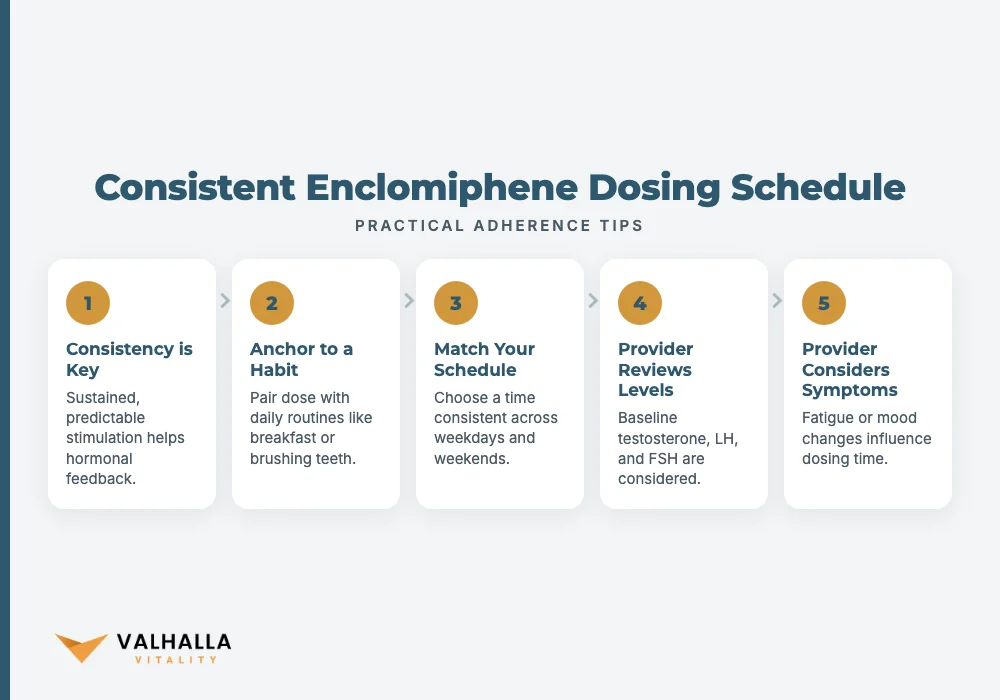
Consistency is the most clinically important element of when to take enclomiphene. The hormonal feedback loop responds to sustained, predictable stimulation. Erratic timing introduces variability that shows up in lab results and makes it harder for your provider to gauge the actual treatment effect.
Anchoring your dose to a fixed daily habit
The most effective timing cue is something you already do at the same hour every day without thinking. Eating breakfast, making coffee, brushing teeth, or showering are all reliable behavioral anchors.
Pairing a new medication with an established daily routine is one of the most practical ways to maintain adherence over a multi-month treatment course. The habit already exists; the pill just tags along. Choosing the best time to take enclomiphene comes down to matching the dose to a reliable anchor, whether that is breakfast at 7 a.m. or a consistent bedtime ritual.
If your schedule shifts significantly between weekdays and weekends, choose the most consistent time across both. Missing the target hour by one to two hours occasionally is not a clinical problem. Missing by six to eight hours regularly introduces variability in hormone levels that distorts follow-up readings.
What your provider reviews before setting the schedule
Before recommending morning or evening for your enclomiphene dosing schedule, a licensed provider typically considers:
- Baseline testosterone, LH, and FSH levels and how they have tracked over previous tests
- Concurrent medications, especially other hormonal agents or anything that affects liver enzymes
- Your symptom pattern: when fatigue, low energy, or mood changes are typically most pronounced during the day
- Any underlying conditions that affect how the medication is metabolized
At Valhalla Vitality, the intake process collects these variables before any provider makes a recommendation. Availability varies by state.
Monitoring after you start
Follow-up labs are scheduled at intervals your provider determines, typically around six to eight weeks after starting and again at three to six months, then adjusted based on your response. Testosterone, LH, FSH, and sometimes estradiol are measured at each checkpoint.
For accurate comparisons across visits, standardize both the time of day for blood draws and the interval between your last dose and the draw. Keeping those two variables constant from appointment to appointment gives your provider the cleanest possible signal.
Document any side effects and note when they occur relative to your dose. That timing detail helps your provider determine whether adjusting the dosing hour, adding a food buffer, or revisiting another element of the plan is the most appropriate next step.
When to revisit your enclomiphene timing
Most men settle into a stable enclomiphene dosing schedule within the first two to three weeks. Three situations make it worth discussing the time of day with your provider:
- Side effects persisting past four to six weeks. Some initial nausea or headaches in weeks one and two are expected. If those effects are still disrupting daily function after a month or more, a shift to evening dosing is a reasonable next step.
- A significant lifestyle change. A new job with different hours, extended travel across time zones, or a move to night-shift work all change what "consistent" means. Update your provider so the schedule can adapt.
- Inconsistent lab results across visits. Wide variation in testosterone readings between appointments often reflects inconsistent dosing or draw timing, not an unstable medication response. Your provider can identify which factor is responsible.
For a closer look at what providers monitor during treatment and what the full safety picture includes, our enclomiphene side effects and safety overview covers those details.
Lifestyle factors that support hormonal health during treatment
Enclomiphene works through a hormonal feedback loop, and several lifestyle factors can support or undermine that loop alongside the medication.
Sleep matters more than many men expect. Testosterone production is tied to sleep architecture: most of the overnight hormone surge occurs during deep slow-wave sleep stages. Men who regularly sleep fewer than six hours per night tend to show lower morning testosterone readings independent of medication.
A 2023 review in Nature Reviews Rheumatology (Irwin et al.) found that disrupted sleep activates systemic inflammatory signaling pathways, which adds another clinical reason to treat sleep quality as a medical variable rather than a lifestyle preference.
Several other factors support the treatment environment:
- Regular resistance training supports the hormonal signaling environment in which enclomiphene operates
- Moderate alcohol intake reduces interference with testosterone production pathways
- A diet adequate in protein, zinc, and vitamin D supports downstream hormonal function
- Adequate hydration supports liver function and general drug metabolism
None of these replace the medication or the provider review process. They are the conditions under which the treatment is most likely to work as designed.
Knowing the best time to take enclomiphene is one piece of the larger picture. Morning or evening, with food or without, the consistent thread running through all of it is the same: keep the schedule, communicate with your provider, and let the follow-up labs tell the story.
Ready to find the right timing for you?
A licensed provider can review your lab results, assess your symptom pattern, and set the enclomiphene dosing schedule that fits your daily routine. Book Your Consultation to start the intake process.
FAQ
What happens if I miss a dose of enclomiphene?
Take the missed dose as soon as you remember, unless it is close to your next scheduled dose. If the next dose is near, skip the missed one and resume your regular schedule. Do not take two doses at once to compensate for a missed one.
Can I switch from morning to evening dosing mid-treatment?
Yes, and the switch is straightforward. Take the next dose at the new time and maintain that time consistently going forward. Let your provider know so follow-up lab draw scheduling can be adjusted to account for the new dosing interval.
How long before enclomiphene starts affecting testosterone levels?
Most men see measurable changes in LH, FSH, and testosterone at their first follow-up lab appointment, which providers typically schedule around six to eight weeks after starting. Individual timelines vary based on baseline hormone levels, overall health, and how consistently the medication is taken.
Should I avoid any foods or drinks when taking enclomiphene?
Grapefruit and grapefruit juice are the main interaction to watch, as they can affect how some medications are metabolized in the gut. No other specific foods are known to interfere with enclomiphene directly, though taking it with a light meal can reduce stomach discomfort.
Does enclomiphene need to be taken at the exact same hour every day?
Taking it within the same hour each day is the goal, but missing by one to two hours occasionally is not a clinical problem. What matters is maintaining a consistent overall pattern so hormone levels remain stable and lab results remain comparable across visits.
Is morning the best time to take enclomiphene for most men?
Morning is the conventional starting point for most clinical protocols, but the right hour depends on your work schedule, sleep pattern, and how early side effects fit into your daily routine.
Sources
- Irwin MR et al. (2023). Heat of the night: sleep disturbance activates inflammatory mechanisms and induces pain in rheumatoid arthritis. Nature reviews. Rheumatology. PubMed
You May Also Like
 Enclomiphene
Enclomiphene Hair Loss: DHT, Follicles, and the Evidence
Enclomiphene hair loss is not a listed side effect, but testosterone raises DHT, which can affect follicles. Here is what clinical research shows.
October 12, 2026 ETRead more → Enclomiphene
Enclomiphene for Gyno: Causes, Prevention & Treatment
Enclomiphene for gyno: how this SERM may help reduce gynecomastia by rebalancing estrogen and testosterone levels. Talk to a licensed provider today.
October 11, 2026 ETRead more → Enclomiphene
Enclomiphene vs Tamoxifen for PCT and Testosterone
Enclomiphene vs tamoxifen: compare how each SERM supports testosterone recovery, PCT protocols, and side effect profiles before talking to a provider.
October 11, 2026 ETRead more →