
The following blog post is for entertainment and informational purposes only. It is not intended to provide medical advice or diagnosis. Please consult your doctor before making any health-related decisions.
Spermidine anti aging research has accelerated sharply over the past decade, and this naturally occurring polyamine is now linked to autophagy activation, cardiovascular protection, and brain health through mechanisms that are well-understood at the molecular level. The evidence base spans yeast, flies, mice, and humans. A 2026 review in Nutrients identified spermidine as one of the natural compounds that most directly targets multiple hallmarks of aging at once (Rzeski et al., 2026). If you are exploring evidence-based anti-aging and longevity support, spermidine is among the best-documented options currently available.
What is spermidine?
Spermidine is a polyamine, a class of small organic molecules present in virtually every living cell. The body synthesizes it from its precursor putrescine and also absorbs it through food. Concentrations are highest in rapidly dividing tissues, which is why researchers first connected it to spermidine cell renewal early in the study of aging biology.
Spermidine levels decline steadily with age. That decline correlates with reduced autophagy activity, rising systemic inflammation, and higher rates of age-related disease across multiple organ systems. Whether supplementing or eating more spermidine-rich food can slow that decline is the central question driving most current research.
The breadth of spermidine aging research now extends well beyond cellular recycling. Cardiovascular protection, brain health, gut microbiome balance, immune regulation, and hair biology have all been linked to spermidine availability. That breadth is what drives sustained interest in spermidine anti aging science today.
Natural spermidine sources: a practical guide
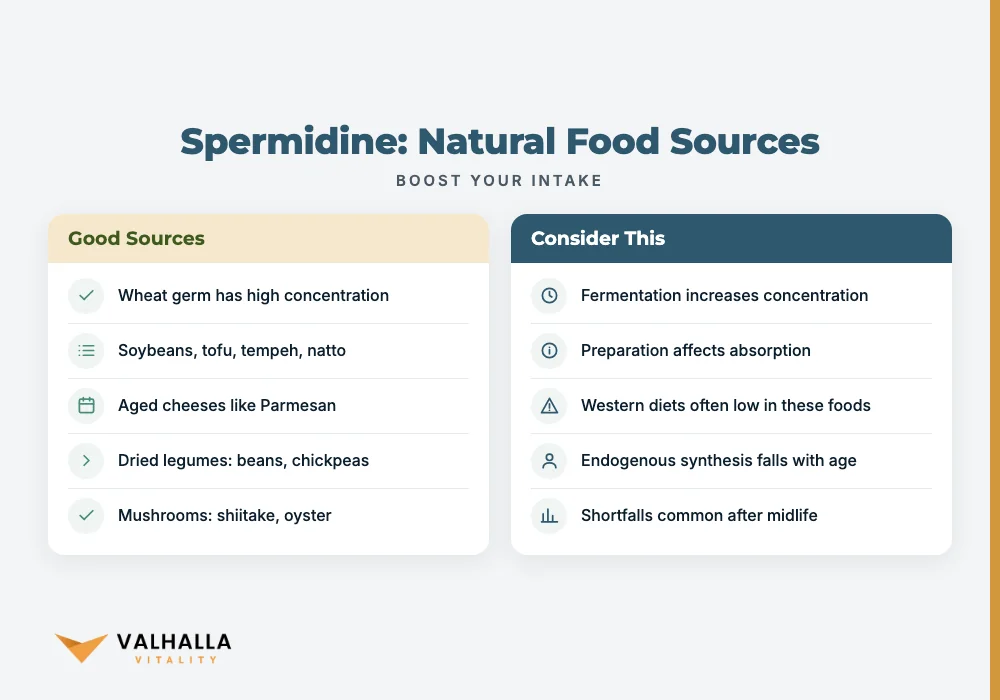
Getting spermidine from food is practical and well-supported. These foods consistently rank highest across the research literature:
| Food source | Key details |
|---|---|
| Wheat germ | Among the highest concentrations per gram of any common food |
| Soybeans and fermented soy | Tofu, tempeh, natto; fermentation increases concentration |
| Aged cheeses | Parmesan, cheddar, brie; levels accumulate during the aging process |
| Dried legumes | Red beans, chickpeas, lentils |
| Mushrooms | Shiitake, oyster, portobello |
| Cruciferous vegetables | Broccoli, cauliflower, peas |
| Whole grains | Brown rice, oats, whole wheat |
For a detailed ranking of spermidine content across common foods and how preparation method affects absorption, the differences between raw, cooked, and fermented forms matter more than most people realize.
Western diets centered on refined grains and processed food tend to be low in all of these categories. That deficit compounds over time as endogenous synthesis also falls with age. Both factors together explain why spermidine shortfalls become increasingly common after midlife.
How spermidine works: the anti aging mechanisms
Understanding spermidine anti aging effects requires looking at three interconnected cellular pathways.
The first is autophagy. Spermidine inhibits a histone acetyltransferase called EP300, which triggers the formation of autophagosomes, the membrane structures that engulf and break down damaged proteins and organelles. This is the primary molecular mechanism behind spermidine cell renewal.
The second is anti-inflammatory signaling. Chronic low-grade inflammation accelerates nearly every aspect of biological aging. Spermidine reduces pro-inflammatory cytokine production and modulates the signaling pathways that drive systemic inflammation.
The third is oxidative stress reduction. Spermidine supports mitochondrial function and reduces reactive oxygen species that damage DNA, proteins, and cell membranes.
Each mechanism would be significant on its own. Together, they explain why how spermidine works at the cellular level has become a defining question in longevity research. All three pathways also decline with age, making spermidine deficiency progressively more consequential over time.
Does spermidine really slow aging?
Yes, based on available evidence, with the caveat that long-term randomized trials in humans are still ongoing. The data from multiple lines of research is consistent and strong.
Animal studies have demonstrated lifespan extension across multiple model organisms: yeast, nematodes, fruit flies, and mice. In mice specifically, spermidine supplementation extended median lifespan and improved multiple age-related biomarkers (Rzeski et al., 2026). Consistent results across biologically distinct organisms carry significant evidential weight.
Human observational data reinforces the animal findings. Higher dietary spermidine intake is associated with lower cardiovascular mortality, better cognitive aging, and reduced overall mortality across large population cohorts. Guarente et al. (2024) reviewed human trial data in Cell Metabolism and identified spermidine as one of the few natural compounds with consistent cross-species data and early human signals pointing in the same direction.
Spermidine anti aging effects also have a clear mechanistic basis. Both the animal and human data can be explained by the known molecular mechanisms of the compound. That coherence, where the same pathways predict both animal longevity and human health outcomes, strengthens the overall case considerably.
Spermidine lifespan research does not claim that aging stops. The question researchers ask is whether the rate of biological aging can be slowed and whether the healthy fraction of a normal lifespan can be extended. On both counts, current evidence is genuinely encouraging.
How does spermidine promote autophagy?
Spermidine promotes autophagy by inhibiting EP300, a histone acetyltransferase enzyme, which triggers autophagosome formation and accelerates the cellular cleanup process. Autophagy is the body's internal quality-control system, used continuously to break down worn-out proteins, clear dysfunctional organelles, and recycle molecular components for new cellular construction.
Without active autophagy, cellular debris accumulates. That accumulation directly drives the cellular senescence and chronic inflammation that accelerate aging. Higher autophagic flux, meaning faster and more complete clearance of damaged material, is one of the clearest measurable effects of spermidine supplementation in research models.
Spermidine autophagy research has revealed significant downstream effects beyond basic cleanup. Autophagy controls mitochondrial quality through a specific subtype called mitophagy, which removes damaged mitochondria before they release reactive oxygen species into the cell. It also clears the protein aggregates associated with neurodegenerative disease and regulates immune cell function and lifespan.
For a closer look at how autophagy activation connects to measurable changes in cellular aging, the pathway from molecular trigger to tissue-level outcomes has been mapped across multiple cell types. The decline in autophagy with age is not subtle. By midlife, autophagic flux in many tissues has dropped substantially from its peak, making spermidine-based restoration a targeted and specific strategy.
Spermidine anti aging and cardiovascular health
The cardiovascular evidence for spermidine is among the most advanced in the field. Nilsson et al. (2019) reviewed the literature in Biochemical Society Transactions and concluded that spermidine reduces arterial stiffness and improves mitochondrial efficiency in heart muscle cells. The mechanism appears to run primarily through autophagy in cardiomyocytes.
Heart cells divide very slowly. Because they cannot readily replace themselves through cell division, keeping existing cells functional through autophagy and reducing oxidative damage matters more for cardiac longevity than in faster-turnover tissues. Spermidine cell renewal in this context means preserving the function of cells that must last an entire lifetime.
Population-level data reinforces the experimental results. Higher dietary spermidine intake is consistently associated with lower cardiovascular mortality across multiple large cohort studies, and this association holds after adjusting for total diet quality. That alignment between mechanistic, experimental, and observational evidence makes cardiovascular protection one of the stronger claims in spermidine anti aging research.
Spermidine and brain health
Cognitive aging is among the outcomes people care about most. Two recent reviews have substantially expanded the case for spermidine in this area. Pandolfi et al. (2026) examined preclinical and early clinical evidence in Molecular Biology Reports and found that spermidine reduces neuroinflammation, supports neuronal mitochondrial health, and may slow the accumulation of protein aggregates linked to Alzheimer's and Parkinson's disease.
Zou et al. (2025) reviewed memory and cognition outcomes specifically in Ageing Research Reviews and found consistent improvements in aging animal models after spermidine supplementation. Small human trials have produced encouraging early signals, though larger controlled studies are still needed.
Spermidine longevity effects in the brain work through at least three pathways:
- Autophagy clears aggregated neuronal proteins before they become pathological.
- Anti-inflammatory effects reduce the chronic neuroinflammation that impairs synaptic function over time.
- Mitochondrial support maintains the energy supply that neurons depend on to function.
All three pathways decline with normal aging. These findings expand the scope of spermidine anti aging research beyond cardiovascular data into one of the highest-stakes dimensions of healthy aging.
Spermidine, gut health, and systemic aging
Yu et al. (2024) reviewed the relationship between spermidine and gut microbiota in Critical Reviews in Food Science and Nutrition and identified a genuine bidirectional connection. A healthy and diverse gut microbiome produces spermidine as a metabolic byproduct. Higher circulating spermidine, in turn, supports microbial diversity and stability.
As the gut microbiome degrades with age, spermidine production from gut bacteria falls alongside it. This creates a reinforcing pattern: lower spermidine reduces microbial support, which further reduces microbiome-derived spermidine production. Restoring spermidine through diet or supplementation may partially interrupt this cycle.
Gut health intersects with immune function, inflammation, metabolic regulation, and brain health through the gut-brain axis. This bidirectional relationship adds a systemic dimension to spermidine anti aging science that the autophagy story alone does not fully capture.
Can spermidine extend human lifespan?
This is the core question. The honest answer: probably yes, to some meaningful degree, but no decades-long randomized trial in humans exists yet to confirm the magnitude.
Animal data is robust. Lifespan extension appears consistently across multiple model organisms in independent laboratories. Human observational data shows that populations with high dietary spermidine intake, including parts of Austria and Japan where wheat germ and fermented foods are dietary staples, have better cardiovascular and cognitive aging outcomes. Guarente et al. (2024) described spermidine as among the most promising candidates for human anti-aging intervention currently under study.
What distinguishes spermidine from many longevity supplement claims is mechanistic specificity. It activates a defined cellular pathway whose role in aging is well-established. That clarity makes the cross-species evidence more credible, because the same pathway operates in yeast, flies, mice, and human cells. For an overview of how spermidine longevity effects extend across multiple organ systems including the heart, brain, and immune system, the whole-body picture is more complete than any single-organ study captures.
What is the recommended spermidine dosage for anti-aging?
No universal dosage applies to everyone. Individual need depends on baseline spermidine levels, age, current diet, gut microbiome health, and overall health status. A licensed provider determines appropriate intake after reviewing labs and a complete health history.
What research does show is that dietary intake in high-consumption populations is associated with measurable health outcomes. Food-based spermidine is meaningful, not merely theoretical. Wheat germ, fermented soy, and aged cheeses provide the highest natural concentrations and contribute substantially to daily intake for people who eat them regularly.
For those considering supplements, the format matters. Absorption profiles and concentrations differ meaningfully across spermidine supplement formats, and understanding those differences supports a more informed conversation with your provider before selecting an approach.
How long does it take for spermidine to work?
Most human studies showing measurable benefits ran for at least several weeks. Spermidine does not produce fast or dramatic changes because autophagy is a continuous background process, and supporting it through higher spermidine availability shifts the rate and efficiency of that process over time, not overnight.
Changes in inflammatory markers and cellular health indicators tend to appear before any subjective differences. Early results show up in labs, not necessarily in how someone feels. This is not a compound that announces itself in week one.
Individual responses vary based on age, baseline diet, gut microbiome health, and cumulative cellular burden. Spermidine lifespan and health benefits in the research literature are consistently tied to long-term intake, not to short-term use or single-episode supplementation.
Spermidine anti aging benefits: skin and hair
Spermidine may improve skin by stimulating collagen synthesis, supporting structure and elasticity, and providing a degree of protection against bacterial colonization that may reduce acne severity. These effects connect directly to spermidine cell renewal at the skin surface. Skin cells turn over relatively quickly, so autophagy and cellular recycling have a direct impact on regeneration quality.
For hair, spermidine extends the anagen (growth) phase of the hair cycle and may elongate the hair shaft. In people experiencing hair thinning that is not caused by an underlying medical condition, this may translate to improved density and reduced shedding over time. When hair loss has a medical cause, a provider evaluation is the appropriate starting point before expecting benefit from spermidine.
Youthavar: spermidine combined with cycloastragenol
Youthavar is a product from Valhalla Vitality that pairs spermidine with cycloastragenol. Both compounds have documented roles in cellular aging biology, and the combination is designed to approach aging from complementary angles. Spermidine addresses autophagy and anti-inflammatory pathways. Cycloastragenol is studied for its effects on telomere maintenance and cellular senescence.
For a closer look at how spermidine and cycloastragenol function together in a combined anti-aging formula, the reasoning behind the pairing draws on two distinct aging pathways that operate independently of each other. All Valhalla Vitality protocols are reviewed by licensed providers and offered as part of a supervised telehealth service, not as standalone retail supplements.
Take the next step
A licensed provider can review your labs, assess your baseline, and help you determine whether spermidine fits your longevity protocol.
FAQ
Does spermidine really slow aging?
Current evidence from animal lifespan studies, human observational data, and mechanistic research consistently supports this conclusion. Spermidine activates autophagy, reduces inflammation, and protects multiple organ systems through pathways directly linked to biological aging. Large-scale human randomized trials are still needed to confirm the precise magnitude of benefit.
How does spermidine promote autophagy?
Spermidine inhibits EP300, a histone acetyltransferase, which triggers autophagosome formation and increases the rate at which cells clear damaged proteins and organelles. Autophagic activity declines with age, so restoring it through higher spermidine levels directly addresses one of the most consistently observed cellular features of biological aging.
What is the recommended spermidine dosage for anti-aging?
No universal recommendation exists. A licensed provider determines appropriate intake based on your labs, diet, health history, and age. Starting with dietary sources including wheat germ, fermented soy, and aged cheeses is a practical first step before considering supplementation.
How long does it take for spermidine to work?
Most studies showing measurable benefits ran for several weeks at minimum. Early changes typically appear in inflammatory markers and cellular health indicators before any subjective improvement. Consistent long-term intake is what the research links to meaningful health outcomes.
Can spermidine extend human lifespan?
Lifespan extension is documented in multiple animal models across independent laboratories, and human observational data links higher dietary spermidine to lower cardiovascular mortality and better cognitive aging. No long-term randomized human trial has measured this directly yet, but the mechanistic case and cross-species consistency are both strong.
Sources
- Rzeski W et al. (2026). Natural Bioactive Compounds Targeting Key Hallmarks of Aging: Functional Food Potential of Spermidine, Fisetin, Berberine, and Urolithin A. Nutrients. PubMed
- Guarente L et al. (2024). Human trials exploring anti-aging medicines. Cell metabolism. PubMed
- Nilsson BO et al. (2019). Beneficial effects of spermidine on cardiovascular health and longevity suggest a cell type-specific import of polyamines by cardiomyocytes. Biochemical Society transactions. PubMed
- Pandolfi S et al. (2026). Spermidine in the aging brain: mechanisms, preclinical evidence, and clinical perspectives. Molecular biology reports. PubMed
- Zou M et al. (2025). The memory- and cognition-facilitating effects of spermidine in aging and aging-related disorders. Ageing research reviews. PubMed
- Yu L et al. (2024). Gut microbiota and anti-aging: Focusing on spermidine. Critical reviews in food science and nutrition. PubMed
You May Also Like
 Spermidine
 Supplement Forms: Pills, Tablets & Tincture
Spermidine supplement forms include pills, tablets, and tinctures. Compare bioavailability, side effects, and how a provider picks the right form for you.
October 30, 2026 ETRead more → Spermidine
 Benefits: Science, Safety, and How It Works
Spermidine benefits include autophagy, cardiovascular support, hair growth, and longevity support. Learn what the science shows and how to start.
October 29, 2026 ETRead more → Spermidine
Best Spermidine Supplement Guide: What the Research Shows
Best spermidine supplement selection starts with understanding autophagy, food sources, and key quality criteria. Here is what the research shows.
October 29, 2026 ETRead more →