
The following blog post is for entertainment and informational purposes only. It is not intended to provide medical advice or diagnosis. Please consult your doctor before making any health-related decisions.
Spermidine longevity research has moved from animal experiments into human population studies, placing this naturally occurring polyamine at the center of serious aging science. Spermidine activates autophagy, the cellular recycling process that slows substantially with age, and higher dietary intake has been associated with a lower risk of all-cause mortality in long-term observational data. For anyone exploring anti-aging longevity approaches grounded in peer-reviewed evidence, understanding how spermidine works is a useful first step.
What does spermidine do for longevity?
Spermidine supports longevity primarily by activating autophagy, the cellular process that clears damaged proteins and organelles and slows the accumulation of age-related cellular debris. It also moderates inflammation, stabilizes DNA, and appears to regulate mitochondrial turnover.
Spermidine belongs to the polyamine family of molecules. Every living cell produces them. They regulate DNA stability, gene transcription, and protein synthesis, making polyamine concentrations a rough proxy for cellular health. Crucially, polyamine levels decline steadily across the lifespan. That decline tracks closely with the established hallmarks of biological aging, including slower cell repair, rising oxidative stress, and chronic low-grade inflammation.
Spermidine longevity effects extend beyond autophagy alone. The molecule also influences histone acetylation, altering gene expression in ways associated with reduced oxidative stress. It stabilizes DNA structure at a molecular level and appears to support mitochondrial quality control.
A 2019 paper by Nilsson et al. in Biochemical Society Transactions reviewed evidence that cardiovascular benefits of spermidine may be driven by cardiomyocyte-specific polyamine import, suggesting the heart is particularly responsive to changes in polyamine availability. A 2026 review by Pandolfi et al. in Molecular Biology Reports summarized preclinical and emerging clinical evidence that spermidine may slow cognitive decline by sustaining autophagy in aging neurons.
These pathways run through fundamental biology.
Spermidine autophagy: the cellular mechanism that matters most
Autophagy means "self-eating" in Greek. Cells consume their own damaged parts. This is maintenance, not self-destruction. Under normal conditions, autophagy runs at a low background level. Under metabolic stress, including caloric restriction, sustained exercise, or elevated polyamine concentrations, it accelerates sharply.
Spermidine autophagy induction works through a distinct route from fasting. Spermidine inhibits an enzyme called EP300, which normally suppresses autophagy initiation. Remove that suppression, and the recycling process accelerates. Fasting activates autophagy through a different pathway, lowering cellular energy signals via AMPK and mTOR. These are complementary mechanisms, and that distinction matters for protocol design.
Spermidine offers something fasting cannot consistently deliver: autophagy activation without caloric restriction. For people who cannot or choose not to fast regularly, this may be clinically relevant. Some researchers study whether combining periodic fasting with spermidine produces additive effects, though controlled human data on this combination remains limited.
Studies confirmed spermidine-driven autophagy activation in liver, heart, and skeletal muscle tissue. The cardiac data is especially significant. A 2019 review by Yamaguchi in Circulation Journal established that autophagy in heart muscle cells is essential for cardiac homeostasis, and that its age-related decline directly accelerates cardiac dysfunction.
Spermidine does not undo aging. What it may do is slow cellular deterioration by keeping the recycling process more active as the years accumulate.
The spermidine autophagy pathway is covered in depth in its own dedicated guide for readers who want the full molecular picture.
Lifestyle factors that complement spermidine longevity
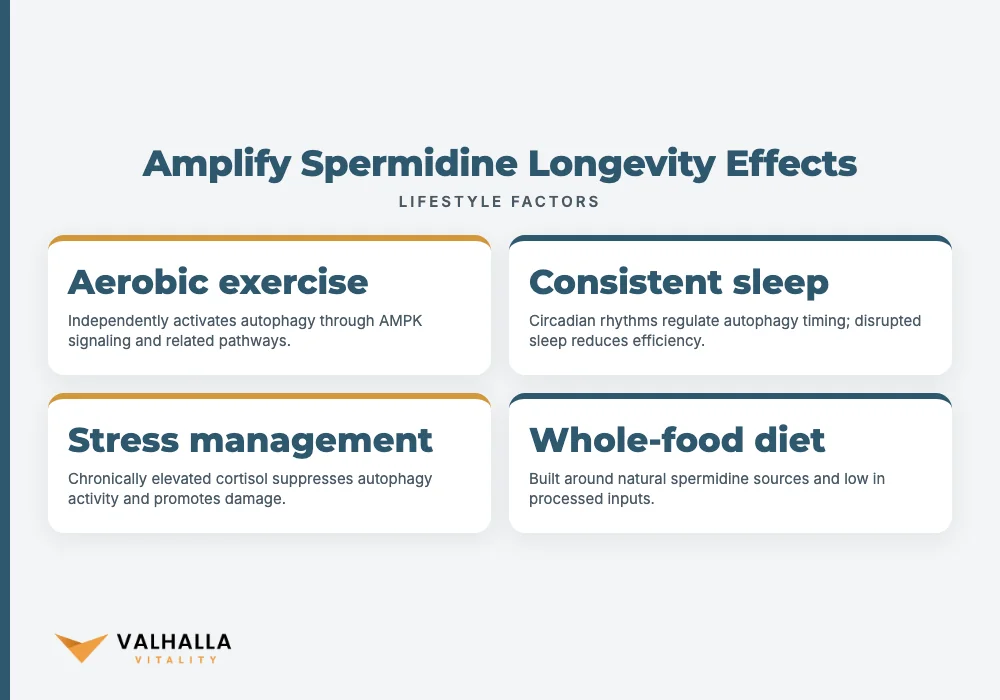
Spermidine works within a broader cellular environment. Its effects are strongest when baseline lifestyle factors also support autophagy. No compound operates in isolation from the conditions surrounding it.
Key factors that may amplify spermidine longevity effects:
- Regular aerobic exercise: independently activates autophagy through AMPK signaling and related pathways
- Consistent sleep schedule: circadian rhythms regulate autophagy timing; disrupted sleep reduces autophagy efficiency
- Stress management: chronically elevated cortisol suppresses autophagy activity and promotes cellular damage accumulation
- Whole-food diet: built around natural spermidine sources and low in processed inputs that drive systemic inflammation
Smoking and excess alcohol introduce oxidative damage faster than autophagy can clear it, directly competing with what spermidine supplementation aims to support. Population-level spermidine longevity research consistently shows its effects in people who generally maintain healthy dietary patterns and physical activity. That context is load-bearing, not incidental.
What foods are high in spermidine?
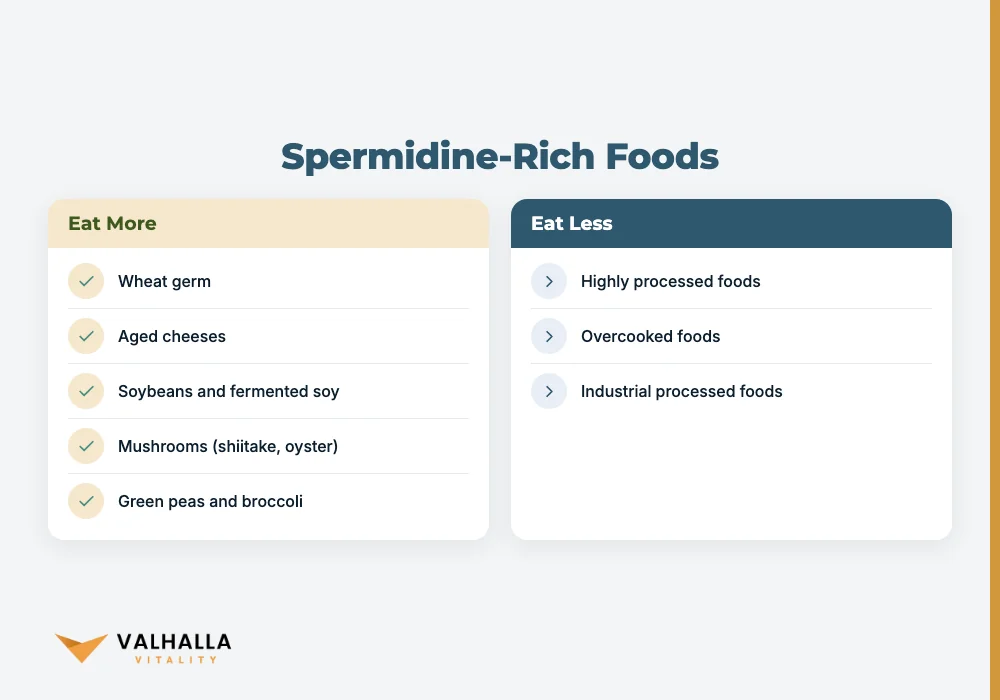
Wheat germ has the highest known spermidine concentration among commonly available foods. Beyond wheat germ, a practical range of plant and animal sources contribute meaningful amounts to daily polyamine intake:
- Aged cheeses: polyamine concentration increases during the cheese-aging process
- Soybeans and soy-fermented products: natto, miso, and tempeh are among the richest sources
- Mushrooms: shiitake and oyster varieties carry notable levels
- Green peas and broccoli: accessible whole-food options well distributed in Western diets
- Hazelnuts: one of the higher-spermidine nut options
- Beef and chicken: moderate polyamine levels; contribute to overall daily intake
Cooking and industrial processing reduce spermidine content. Minimally processed and raw forms deliver more. A diet consistently built around these natural spermidine sources can meaningfully raise baseline polyamine intake, and this forms the dietary foundation of any spermidine longevity approach.
Whether food-based intake reaches the concentrations associated with longevity benefits in research is a separate question, and one that makes supplementation relevant for many people. A full comparison of spermidine-rich foods and their supplement equivalents addresses that gap in detail.
Spermidine aging: what human evidence shows
Most early spermidine longevity data came from simple model organisms. In yeast, fruit flies, nematodes, and mice, dietary spermidine reliably extended lifespan. The mechanisms were consistent across species: autophagy induction, reduced inflammation, and mitochondrial protection. Cross-species consistency like this strengthens the case for human relevance.
Human evidence is primarily observational, but the signal is consistent. The Bruneck Study, a longitudinal cohort conducted in Italy, tracked dietary spermidine intake over years. Researchers found that higher intake was associated with a statistically significant reduction in all-cause mortality, including cardiovascular causes.
This was not a drug trial. It was a population-level observation showing that dietary spermidine aging effects register as measurable differences in mortality risk.
Cardiovascular evidence has the strongest mechanistic support. Nilsson et al. (2019) proposed that cardiomyocytes have specialized import mechanisms for extracellular polyamines, making the heart potentially the most responsive organ to changes in dietary or supplemental spermidine. Yamaguchi (2019) independently confirmed the cardiac autophagy-aging link, establishing that autophagy decline in heart cells directly accelerates age-related cardiac dysfunction.
Neurological aging is an increasingly active area. Pandolfi et al. (2026) reviewed evidence that spermidine concentrations in the aging brain fall measurably with age, impairing autophagy-mediated clearance of protein aggregates in neurons. In preclinical models, spermidine supplementation improved memory function in subjects with deficits linked to reduced neuronal autophagy. Human clinical trials are in early stages, but the mechanistic case is already well supported.
Inflammatory disease is a third pathway. Chen et al. (2026) in the International Journal of Rheumatic Diseases reviewed spermidine's potential in rheumatoid arthritis, attributing observed effects to suppression of pro-inflammatory cytokines including TNF-alpha and IL-6. Those same cytokines drive chronic low-grade inflammation in aging tissue broadly, suggesting spermidine's anti-inflammatory activity extends beyond any single disease context.
The evidence is converging from multiple directions at once.
Spermidine benefits across biological systems
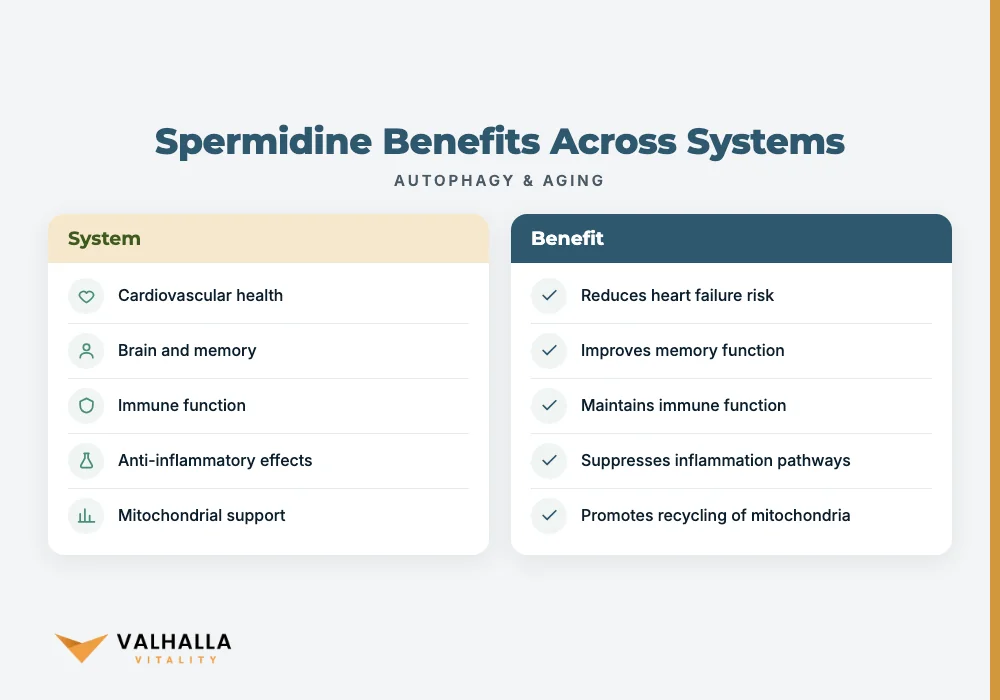
The breadth of spermidine benefits in the research literature reflects how central autophagy and polyamine regulation are to tissue function across the body:
- Cardiovascular: may reduce age-related heart failure risk by sustaining cardiac autophagy and preventing protein aggregate accumulation in cardiomyocytes (Nilsson et al., 2019; Yamaguchi, 2019)
- Neurological: declining brain polyamine concentrations impair neuronal autophagy and memory function; supplementation improved these outcomes in preclinical aging models (Pandolfi et al., 2026)
- Anti-inflammatory: suppresses TNF-alpha, IL-6, and related cytokine pathways relevant to autoimmune disease and chronic aging-related inflammation (Chen et al., 2026)
- Immune function: autophagy is central to immune cell turnover and clearance of senescent immune cells; polyamine support may help maintain immune function through aging
- Mitochondrial: spermidine promotes mitophagy, the targeted recycling of dysfunctional mitochondria, relevant to energy metabolism and oxidative stress management
Multiple independent research groups across different biological systems reached converging conclusions. That pattern is what moved spermidine lifespan research from a laboratory curiosity into a credible area of clinical investigation.
How long does spermidine take to work?
Cellular autophagy changes can begin within hours to days at the cellular level based on laboratory data, but measurable health outcomes emerge over a considerably longer timeframe.
Human studies have linked spermidine aging outcomes to intake patterns measured over months to years, not weeks. Biomarker shifts, where they occur, depend on the outcome being tracked, the individual's metabolic baseline, and whether lifestyle factors are also supporting cellular health. No population-level estimate translates cleanly to an individual spermidine longevity timeline.
A provider monitoring relevant markers before and after a protocol can give you a clearer individual picture than any general estimate. Cellular activity may begin early. Measurable changes in health markers take longer. Keep that sequence in mind before evaluating any protocol against a fixed timeframe.
Is spermidine safe to take long-term?
Dietary spermidine has a well-established safety record, with no significant safety concerns identified at physiologically relevant concentrations in the research literature. Humans produce it endogenously and consume it daily through food.
A 2023 toxicology review by Kahraman et al. in Expert Reviews in Molecular Medicine examined longevity compounds including spermidine and found no significant safety signals at concentrations consistent with dietary exposure or moderate supplementation. Bonetti et al. (2022) reviewed dietary supplements including polyamines and noted a generally favorable tolerance profile across observational research, while calling for more controlled trials to better characterize dose-response relationships.
These are reassuring findings for anyone considering spermidine longevity supplementation as a long-term strategy. Supplement concentrations can exceed dietary levels substantially, and long-term controlled human data on supplemental concentrations is still accumulating. Individuals taking medications that interact with autophagy pathways, or those with conditions affecting gastrointestinal absorption, should discuss spermidine with a licensed provider before starting.
Favorable at dietary levels. Supplemental concentrations warrant individualized oversight.
Spermidine longevity supplements: formats and considerations
For many people, dietary intake of natural spermidine sources does not reliably reach the polyamine concentrations that research associates with meaningful longevity effects. Spermidine supplements address that gap. Most commercial products derive from wheat germ extract, standardized to a defined polyamine concentration for consistency across batches.
Delivery format matters for practical use. Pills offer straightforward dosing and portability. Tablets vary in dissolution rate and coating options. Liquid tinctures may offer faster onset but require careful storage. A guide to comparing spermidine delivery formats covers the practical trade-offs if you are choosing between options.
Some protocols pair spermidine with complementary compounds for broader coverage. Youthavar, from Valhalla Vitality, combines spermidine with cycloastragenol, a compound studied for telomere length support. Autophagy activation and telomere maintenance represent two separate but related aging pathways. Addressing both simultaneously may offer wider cellular coverage than either compound alone.
A detailed breakdown of how spermidine combined with cycloastragenol works in Youthavar explains the mechanistic rationale behind that pairing for readers who want to evaluate the combination before committing to it.
How much spermidine should I take daily?
A licensed provider determines the appropriate amount after reviewing your health history, dietary baseline, current medications, and relevant lab markers. There is no universal dose, and this question comes up often in spermidine longevity discussions for good reason.
Research papers report concentration ranges used in specific study populations. Those figures reflect the study design, not a general prescription. Individual variation in polyamine metabolism, absorption capacity, and health context is significant enough that population averages are an unreliable guide for personal protocol decisions.
The practical starting point is a baseline assessment. Relevant markers may include inflammatory indicators, oxidative stress measures, and in some protocols, direct polyamine profiling from blood or urine. These vary by provider and protocol. The value of establishing a baseline is that it lets you evaluate whether a protocol is doing anything for your specific biology, rather than simply comparing it to what an average study participant experienced.
Polyamine longevity: the bigger picture
Spermidine does not operate alone. It belongs to the broader polyamine family alongside putrescine and spermine. Polyamine longevity research treats these molecules as a system. Their relative concentrations in tissue reflect biological age independently of chronological age, and shifts in those ratios correlate with disease progression in quantifiable ways.
The spermine-to-spermidine ratio changes with aging and disease in patterns that some researchers are beginning to propose as biological age indicators. As researchers develop more accessible polyamine profiling tools, these ratios may become part of routine biological age assessments alongside markers like telomere length and inflammatory cytokines. Understanding where you sit in that system requires measurement, not estimation.
The spermine and spermidine comparison guide is a useful next read for broader polyamine context before making any protocol decisions.
Spermidine longevity science is not settled. But it has moved well past preliminary status. Mechanistic data, animal research, and human observational evidence now converge consistently: higher polyamine activity sustained across aging correlates with healthier cellular function and longer lifespan.
Next steps
Book Your Consultation with a licensed provider to discuss whether a spermidine-based approach fits your health profile and goals.
FAQ
What does spermidine do for longevity?
Spermidine activates autophagy, the process by which cells break down and recycle damaged proteins and organelles, slowing the accumulation of cellular debris that drives age-related disease. It also moderates inflammation and may support DNA stability and mitochondrial function. Higher dietary spermidine intake has been linked to lower all-cause mortality in human observational studies, including the Bruneck Study in Italy.
How much spermidine should I take daily?
There is no universal dose. A licensed provider determines the appropriate amount after reviewing your health history, current medications, and relevant lab markers. Protocols based solely on general online ranges do not account for individual variation in polyamine metabolism.
What foods are high in spermidine?
Wheat germ has the highest known spermidine concentration among commonly available foods. Other natural sources include soy-fermented products such as natto and miso, aged cheeses, mushrooms, green peas, broccoli, and hazelnuts. Cooking and processing reduce polyamine content, so minimally processed forms deliver more.
Is spermidine safe to take long-term?
Dietary spermidine has a favorable safety record based on decades of human food consumption. A 2023 toxicology review by Kahraman et al. found no significant safety concerns at physiologically relevant concentrations. Long-term data on supplemental concentrations is still accumulating, and provider oversight is advisable.
How long does spermidine take to work?
Autophagy pathways can respond within hours to days at the cellular level based on laboratory data. Measurable changes in health markers depend on the outcome being tracked and individual biology. Human studies associate spermidine intake with outcomes measured over months to years.
Sources
- Nilsson BO et al. (2019). Beneficial effects of spermidine on cardiovascular health and longevity suggest a cell type-specific import of polyamines by cardiomyocytes. Biochemical Society Transactions. PubMed
- Pandolfi S et al. (2026). Spermidine in the aging brain: mechanisms, preclinical evidence, and clinical perspectives. Molecular Biology Reports. PubMed
- Bonetti G et al. (2022). Dietary supplements in lymphedema. Journal of Preventive Medicine and Hygiene. PubMed
- Chen Y et al. (2026). Therapeutic Potential of Spermidine in Rheumatoid Arthritis: Mechanisms and Future Directions. International Journal of Rheumatic Diseases. PubMed
- Kahraman C et al. (2023). Toxicology of pharmaceutical and nutritional longevity compounds. Expert Reviews in Molecular Medicine. PubMed
- Yamaguchi O (2019). Autophagy in the Heart. Circulation Journal. PubMed
You May Also Like
 Spermidine
 Supplement Forms: Pills, Tablets & Tincture
Spermidine supplement forms include pills, tablets, and tinctures. Compare bioavailability, side effects, and how a provider picks the right form for you.
October 30, 2026 ETRead more → Spermidine
 Benefits: Science, Safety, and How It Works
Spermidine benefits include autophagy, cardiovascular support, hair growth, and longevity support. Learn what the science shows and how to start.
October 29, 2026 ETRead more → Spermidine
Best Spermidine Supplement Guide: What the Research Shows
Best spermidine supplement selection starts with understanding autophagy, food sources, and key quality criteria. Here is what the research shows.
October 29, 2026 ETRead more →