
The following blog post is for entertainment and informational purposes only. It is not intended to provide medical advice or diagnosis. Please consult your doctor before making any health-related decisions.
Foods high in spermidine include wheat germ, soybeans, mushrooms, peas, and fermented soy products, with content ranging from roughly 2 mg to over 29 mg per 100 grams. Spermidine is a naturally occurring polyamine, and its connection to the cellular self-renewal process called autophagy has made it a focus of longevity research. Concentrations in human tissue fall with age. This guide ranks the top dietary spermidine sources, explains the numbers, and helps you assess what realistic intake from food can look like.
What foods are highest in spermidine?
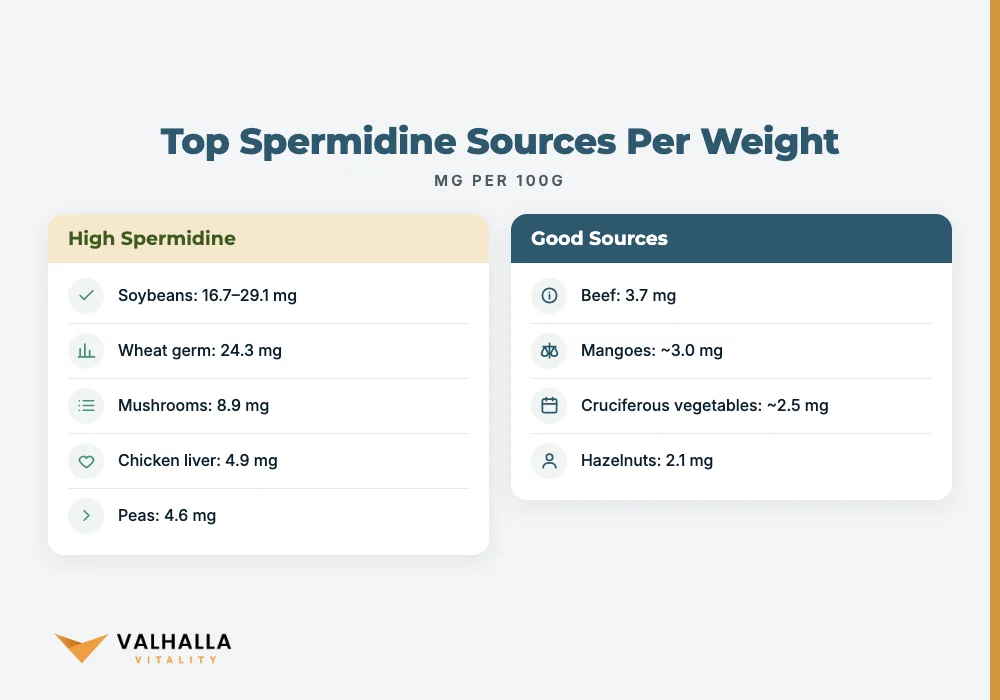
Wheat germ, soybeans, mushrooms, chicken liver, and peas are the foods highest in spermidine on a per-weight basis. A 2026 review in Food Chemistry by Liu et al. confirmed that legumes and cereal germs lead global dietary spermidine sources. Fermented soy products push the ceiling higher still.
The table below compares the most studied foods high in spermidine by concentration. Values are in milligrams per 100 grams. Growing conditions, processing, and preparation shift the numbers, so treat them as reliable estimates rather than fixed figures.
| Food | Spermidine (mg/100 g) | Notes |
|---|---|---|
| Soybeans | 16.7–29.1 | Varies by variety and processing |
| Wheat germ | 24.3 | Lost when grain is milled to white flour |
| Mushrooms | 8.9 | Content varies by species |
| Chicken liver | 4.9 | Also high in biotin and B12 |
| Peas | 4.6 | Fresh, frozen, or dried all count |
| Beef | 3.7 | Varies by cut |
| Mangoes | ~3.0 | Rich in vitamin A |
| Cruciferous vegetables | ~2.5 | Broccoli, cabbage, and similar |
| Hazelnuts | 2.1 | Notable among oleaginous foods |
Fermented soy products such as natto typically exceed plain soybean values and are addressed separately below.
Foods high in spermidine: individual source profiles
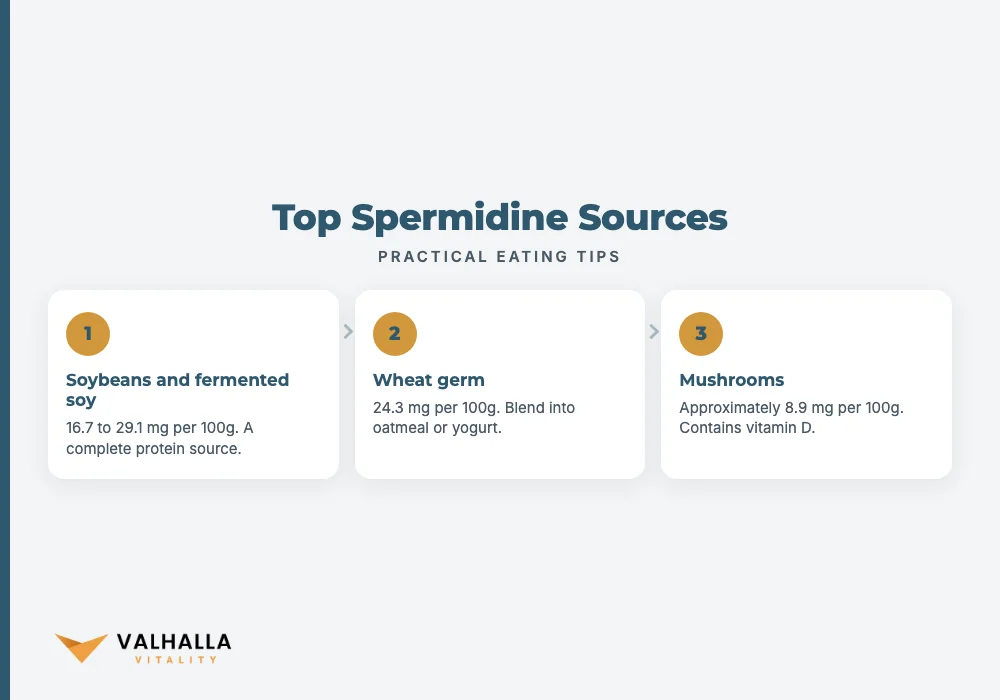
Each food on this list fits differently into practical eating. Understanding those differences matters when you are trying to raise dietary spermidine intake without restructuring every meal.
Soybeans and fermented soy
Soybeans contain between 16.7 and 29.1 mg of spermidine per 100 grams. The range reflects differences in variety, ripeness, and preparation. Edamame, tofu, tempeh, and natto all derive from soybeans. Each form retains meaningful spermidine content. Fermented preparations such as tempeh and natto may reach higher concentrations than plain cooked soy, since bacterial activity during fermentation synthesizes additional polyamines beyond what the raw bean contains.
Soybeans also supply all essential amino acids, making them a complete protein source. This combination of high protein quality and strong spermidine density makes them one of the most efficient single ingredients for anyone building dietary intake deliberately.
Wheat germ
Wheat germ contains 24.3 mg of spermidine per 100 grams. It is the nutrient-dense fragment of the wheat kernel removed when grain is milled into white flour. White bread, pasta, and standard baked goods retain essentially none of it.
Two tablespoons of wheat germ weigh roughly 14 grams. That amount delivers around 3.4 mg of spermidine. The flavor is neutral. Blend it into oatmeal, yogurt, or a smoothie and you will not notice it is there. Consistent daily use accumulates meaningfully across a week without any special preparation.
Mushrooms
Mushrooms contain approximately 8.9 mg of spermidine per 100 grams. That places them above most vegetables in per-weight concentration. They are also one of the few dietary sources of vitamin D and beta-glucan compounds, studied for immune support. Common varieties including button, cremini, and portobello all deliver spermidine without specialty shopping. Sautéing in a small amount of oil preserves more nutrients than prolonged boiling.
Chicken liver
Chicken liver provides roughly 4.9 mg of spermidine per 100 grams. Organ meats tend to carry higher polyamine concentrations than muscle cuts from the same animal. Chicken liver is also rich in biotin, vitamin B12, and trace minerals, making a weekly serving one of the more nutritionally efficient choices among animal-based spermidine food sources.
Peas
Peas deliver approximately 4.6 mg of spermidine per 100 grams. Low in calories and available year-round in frozen form, they work well in large portions relative to other spermidine-dense foods. Peas also carry anti-inflammatory compounds and are among the most practical spermidine rich vegetables to include regularly.
Other notable sources
Beef contributes around 3.7 mg per 100 grams. Dietary guidelines generally recommend limiting red meat to around 500 grams per week for reasons unrelated to spermidine, so relying on it as a primary source creates nutritional trade-offs. Mangoes provide approximately 3 mg per 100 grams alongside strong vitamin A content. Cruciferous vegetables such as broccoli and cabbage offer around 2.5 mg per 100 grams and work well consumed raw or lightly steamed. Hazelnuts, at 2.1 mg per 100 grams, bring antioxidant compounds alongside their spermidine content. Aged cheeses such as cheddar appear on most spermidine food lists as well, though precise concentrations vary significantly by aging process and fat composition.
How much spermidine is in wheat germ?
Wheat germ contains 24.3 mg of spermidine per 100 grams. Among plant sources, this wheat germ spermidine content places it near the very top alongside soybeans. Its consistency makes it a reliable reference point when estimating daily intake from food.
The practical limitation is availability inside most meals. White flour milling removes the germ entirely. Choosing whole grain products preserves some fraction of it, but the most reliable approach is adding raw wheat germ directly to food. Two tablespoons, about 14 grams, contribute a meaningful amount without changing the flavor of whatever they are mixed into.
A diet that includes wheat germ daily, legumes several times per week, and mushrooms or other spermidine rich vegetables regularly can build substantial cumulative intake. Whether that level is sufficient for a given person depends on individual health context that a licensed provider can assess after reviewing labs and history.
Does natto contain spermidine?
Yes. Natto is a traditional Japanese fermented soybean product, and its fermentation process raises spermidine content above plain cooked soybeans. The bacteria involved, Bacillus subtilis var. natto, synthesize polyamines as a metabolic byproduct, adding to the spermidine already present in the raw soy. A 2026 Food Chemistry review by Liu et al. identified fermented soy products among the richest dietary spermidine sources and named fermentation specifically as a concentrating mechanism.
Natto is difficult to source outside Japan and parts of East Asia. Tempeh is a more accessible fermented soy option available at most health food stores across the US. Unfermented edamame and cooked soybeans remain strong spermidine food sources at 16.7 to 29.1 mg per 100 grams even without fermentation.
What is the best dietary source of spermidine?
For practical everyday use, wheat germ and soybeans are the strongest candidates. Wheat germ delivers a consistent 24.3 mg per 100 grams without any cooking requirement. Soybeans and their fermented forms offer 16.7 to 29.1 mg per 100 grams depending on preparation, with natto and tempeh toward the upper end.
The best source of spermidine in practice is the one you actually eat consistently. A food with slightly lower content consumed daily outperforms the highest-ranked option eaten once a month. Mushrooms, peas, and chicken liver make strong secondary choices that prevent the dietary monotony that comes from relying on one or two foods alone.
A 2026 review by Liu et al. in Food Chemistry also noted that gut microbiome biosynthesis contributes to total polyamine levels alongside dietary intake. A fiber-rich diet that supports a healthy gut microbiome complements the direct contribution from spermidine food sources in the table above.
Spermidine rich vegetables: peas, broccoli, and beyond
Among spermidine rich vegetables, peas lead at approximately 4.6 mg per 100 grams. Cruciferous vegetables including broccoli and cabbage follow at around 2.5 mg per 100 grams. Both groups are high in fiber, B vitamins, and sulfur compounds. Research on these foods recommends consuming them raw or lightly steamed to preserve more nutritional content. Both methods are practical for everyday cooking.
Mangoes stand out among fruits at approximately 3 mg of spermidine per 100 grams, alongside significant vitamin A content. For people who find it easier to add fruit than vegetables, mangoes offer a reasonable way to increase intake with a naturally sweet option.
Hazelnuts, at 2.1 mg per 100 grams, fit into snack routines without changing meal structure. They bring antioxidant compounds that research has associated with cardiovascular and metabolic benefits. A small daily portion adds to cumulative spermidine intake without requiring any significant dietary adjustment.
Why dietary spermidine intake may support healthy aging
Spermidine concentrations in human tissue fall as people age. Lower levels are associated with reduced autophagy activity. Autophagy is the process by which cells identify and break down damaged or dysfunctional components. When it slows, cellular waste accumulates over time.
A 2026 paper in Molecular Biology Reports by Pandolfi et al. reviewed preclinical and early clinical evidence suggesting that spermidine may support brain health during aging, citing autophagy regulation and neuroprotective mechanisms as key pathways. That research fits alongside the broader spermidine longevity evidence, providing context for where the science currently stands.
A 2026 review in the International Journal of Rheumatic Diseases by Chen et al. identified potential anti-inflammatory pathways associated with spermidine. The study focused on rheumatoid arthritis, but the mechanisms it described are relevant to understanding how polyamine levels may interact with immune function and chronic inflammation during aging more broadly.
Regular intake of foods high in spermidine maintains dietary polyamine levels that the body would otherwise need to synthesize from metabolic precursors. Whether dietary intake alone is sufficient is an individual question, and one reason the supplement conversation comes up.
Can you get enough spermidine from diet alone?
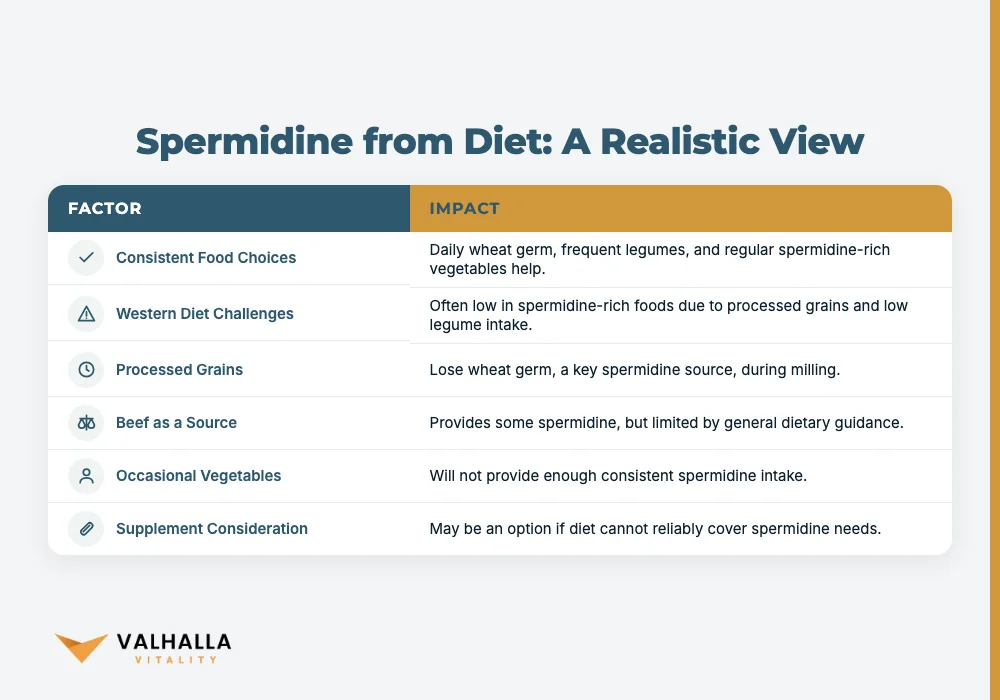
Diet alone can provide meaningful dietary spermidine intake if the right foods appear consistently. That condition is the hard part. Wheat germ, soybeans, mushrooms, and peas need to show up in your meals regularly, not occasionally.
Most standard Western diets are low in foods high in spermidine. Processed grain products lose the wheat germ fraction entirely during milling. Legume consumption is minimal for most people. The foods that are highest in spermidine are the same foods most likely to be displaced by refined carbohydrates, packaged products, and conventional produce.
Beef contributes spermidine at about 3.7 mg per 100 grams, but general dietary guidance caps red meat at around 500 grams per week for reasons unrelated to spermidine. Leaning on it as a primary source creates nutritional trade-offs that limit how far it can carry spermidine goals.
Here is a realistic picture: someone eating wheat germ daily, legumes several times per week, and mushrooms or other spermidine-dense vegetables regularly can reach consistent intake from food. Someone relying on occasional vegetables and standard grains will not. For people whose diets cannot cover that ground reliably, a supplement may be worth discussing with a provider. Reviewing spermidine's documented health research helps frame that discussion with grounding in what the evidence currently shows.
Spermidine supplement vs food: key considerations
Food delivers spermidine alongside fiber, micronutrients, and co-factors that a capsule cannot replicate. That is a meaningful argument for prioritizing food first when your diet allows.
Supplements offer a different advantage. The amount is fixed and predictable. Diet is not. A week with fewer legumes, less wheat germ, and standard grocery produce delivers far less spermidine than an intentional eating week. For people with irregular diets or limited access to specific high-spermidine foods, a supplement provides consistency that food cannot always support. Before choosing one, comparing spermidine supplement formats helps identify which delivery type fits best into a daily routine.
At Valhalla Vitality, Youthavar combines spermidine with cycloastragenol, a compound derived from natural herbs. It is fully vegan and formulated to support autophagy activation and cellular maintenance as part of a broader approach to healthy aging.
A licensed provider determines whether a supplement is appropriate after reviewing your medical intake and labs. The decision between food and supplementation depends on your actual eating patterns, your health goals, and the guidance of a qualified provider who reviews your situation before recommending anything.
Ready to learn more about your options
If you want to explore whether a spermidine supplement fits your health goals, a licensed provider can review your history and current labs. Book Your Consultation to start that conversation.
FAQ
What foods are highest in spermidine?
Soybeans, wheat germ, and mushrooms rank consistently at the top. Soybeans contain 16.7 to 29.1 mg per 100 grams, wheat germ delivers 24.3 mg per 100 grams, and mushrooms contribute roughly 8.9 mg per 100 grams. Fermented soy products such as natto tend to exceed plain soybean values through bacterial polyamine synthesis during fermentation.
How much spermidine does wheat germ contain?
Wheat germ contains 24.3 mg of spermidine per 100 grams, placing it among the most concentrated plant sources available. Because the germ fraction is removed during milling, refined flour and standard bread products retain essentially none of this amount.
Does natto contain spermidine?
Yes. Natto is fermented soy, and the bacterial fermentation process raises its spermidine content above plain cooked soybeans through polyamine synthesis. A 2026 Food Chemistry review by Liu et al. classifies fermented soy products as top-tier dietary spermidine sources.
Can you get enough spermidine from diet alone?
It depends on how consistently you include spermidine-dense foods. A diet built regularly around wheat germ, legumes, mushrooms, and cruciferous vegetables can reach meaningful intake levels, but most standard Western diets fall short without deliberate planning. A licensed provider can help assess whether supplementation makes sense for your specific situation.
Does cooking affect spermidine content in food?
Prolonged cooking and grain processing can reduce spermidine content significantly. Milling wheat removes the germ fraction entirely. For vegetables, light steaming preserves more of the compound than boiling. Fermentation, by contrast, generally increases spermidine through bacterial activity.
Sources
- Liu S et al. (2026). Spermidine in food and health: biosynthesis, dietary sources, production, and biological functions. Food Chemistry. PubMed
- Pandolfi S et al. (2026). Spermidine in the aging brain: mechanisms, preclinical evidence, and clinical perspectives. Molecular Biology Reports. PubMed
- Chen Y et al. (2026). Therapeutic Potential of Spermidine in Rheumatoid Arthritis: Mechanisms and Future Directions. International Journal of Rheumatic Diseases. PubMed
You May Also Like
 Spermidine
 Supplement Forms: Pills, Tablets & Tincture
Spermidine supplement forms include pills, tablets, and tinctures. Compare bioavailability, side effects, and how a provider picks the right form for you.
October 30, 2026 ETRead more → Spermidine
 Benefits: Science, Safety, and How It Works
Spermidine benefits include autophagy, cardiovascular support, hair growth, and longevity support. Learn what the science shows and how to start.
October 29, 2026 ETRead more → Spermidine
Best Spermidine Supplement Guide: What the Research Shows
Best spermidine supplement selection starts with understanding autophagy, food sources, and key quality criteria. Here is what the research shows.
October 29, 2026 ETRead more →