
The following blog post is for entertainment and informational purposes only. It is not intended to provide medical advice or diagnosis. Please consult your doctor before making any health-related decisions.
Spermidine dosage is not a single fixed number. This polyamine occurs naturally in every living cell, driving autophagy, the process where the body clears damaged cellular components and makes room for renewal. Understanding spermidine's role in cell renewal puts the question of how much spermidine per day into useful context. A licensed provider determines the appropriate spermidine daily dose after reviewing your health history and lab results.
What is spermidine and why does dosage matter?
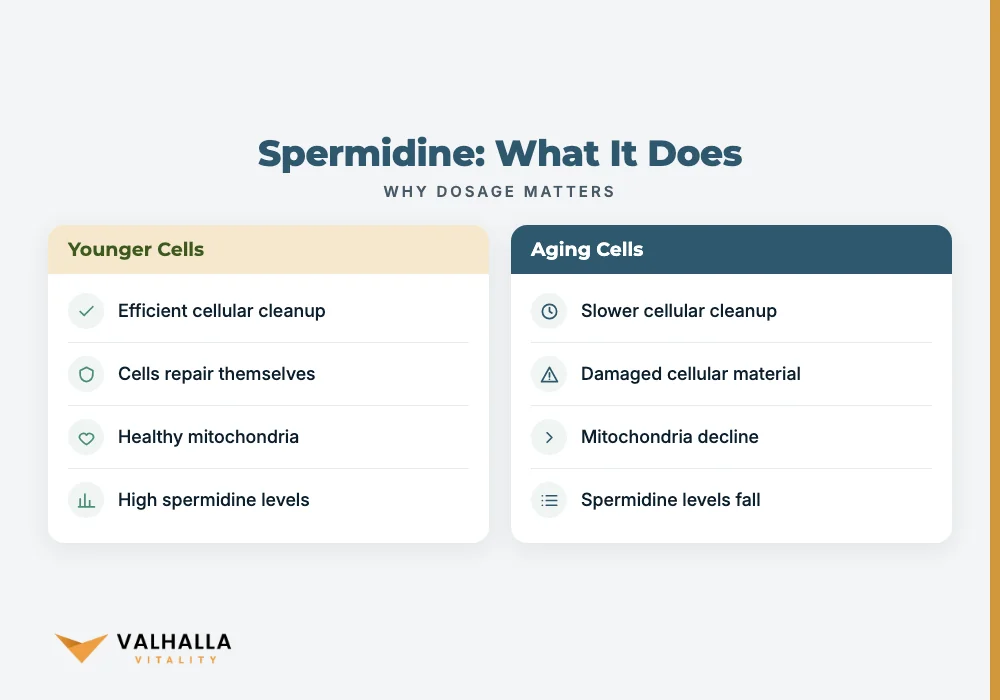
Spermidine belongs to the polyamine family. These small molecules carry two or more amino groups and regulate how cells survive, repair themselves, and replace damaged material over time. Spermidine resides in all living tissues and in ribosomes, the protein-building structures inside each cell. Researchers first isolated it from human semen. That is also how it got its name. Sperm still carry some of the highest concentrations found anywhere in the human body.
Its most important function is regulating autophagy. During autophagy, the body identifies damaged mitochondria and other dysfunctional cellular material, removes them, and creates space for functional replacements. Mitochondria are the energy-producing units of cells, and their gradual decline is tied directly to how aging progresses at the cellular level. Spermidine levels fall naturally as we get older. When they drop, autophagy becomes less efficient, and cellular cleanup slows.
That connection is what makes appropriate spermidine dosage worth discussing. For a closer look at how this pathway links to long-term health, see how autophagy and aging interact at the molecular level.
Getting spermidine from food first
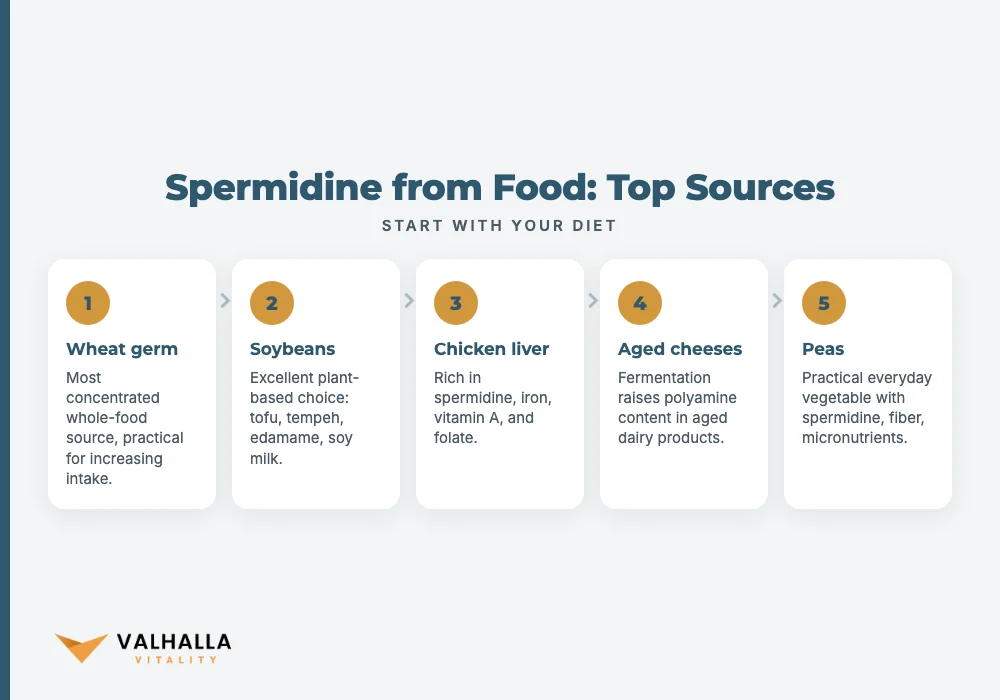
Before considering a supplement, diet is the starting point. Several common foods deliver meaningful amounts of spermidine, and for some people, dietary changes alone may shift the polyamine baseline.
Foods that naturally supply spermidine:
- Wheat germ: the most concentrated whole-food source and the most practical option for increasing dietary spermidine intake through food alone
- Soybeans: an excellent plant-based choice, available as tofu, tempeh, edamame, or soy milk
- Chicken liver: rich in spermidine and also high in iron, vitamin A, and folate, making it one of the more nutrient-dense options in this category
- Aged cheeses, including cheddar: fermentation raises the polyamine content in aged dairy products
- Peas: a practical everyday vegetable with measurable spermidine alongside fiber and other micronutrients
- Beef: a moderate source when part of a balanced diet; heavy red meat consumption is not generally recommended
- Hazelnuts: easy to incorporate as a daily snack
- Mangoes: a fruit source of spermidine that also supplies vitamin A
For a side-by-side look at dietary sources of spermidine and what a concentrated supplement adds to a food-based baseline, that comparison covers the key differences.
What is the recommended spermidine dosage per day?
There is no universal spermidine daily dose that applies to all adults. Age, existing dietary polyamine intake, gut microbiome function, and individual metabolism all influence how much circulating spermidine a person has and how much supplementation might add. Two people following the same diet can have noticeably different internal polyamine profiles.
A licensed provider determines the appropriate spermidine mg per day based on your specific situation. That typically means reviewing your current dietary habits, relevant lab markers, and any conditions that could affect polyamine metabolism. "How much spermidine should I take?" is a question that needs a professional baseline. Self-selecting a dose without that review leaves your spermidine dosage unmatched to your actual needs, and outcomes unclear.
Before your consultation, reviewing the available options for choosing a spermidine supplement format can help you ask better questions and arrive better prepared.
When is the best time to take spermidine?
Consistency matters more than the clock. Optimal timing is whichever time you can repeat without interruption every day. Most people attach it to a regular meal so it becomes part of an existing habit rather than a separate task.
Spermidine supplement timing has less to do with morning versus evening and more to do with building a stable daily rhythm. Missing doses regularly undermines any benefit a consistent intake might produce.
Should you take spermidine with food?
Yes. Taking spermidine with a full meal is the standard recommendation. Food slows digestion and may support absorption. Attaching your spermidine supplement timing to a meal you rarely skip is the most practical way to stay consistent over the long term.
How much spermidine is too much?
Spermidine is endogenous. Your body already produces it, and your diet delivers it every day. That combination gives it a broadly favorable safety profile compared to compounds that are entirely foreign to human physiology. The body already knows how to process it.
That said, taking more than a provider recommends is not advisable for any supplement. More does not automatically mean faster results. A licensed provider determines the appropriate spermidine daily dose for your situation and can adjust that assessment over time based on how you respond.
How long does spermidine take to work?
Realistic expectations matter here. Spermidine works through autophagy, a gradual cellular process. You are not switching on an immediate response. Changes at the cellular level accumulate over weeks to months, and any effects on subjective wellbeing or measurable markers often take longer still.
Short supplementation trials of a few weeks are unlikely to produce clear outcomes. Long-term, consistent use is the pattern the available evidence on autophagy-related supplementation points to as meaningful.
Youthavar: spermidine combined with cycloastragenol
Valhalla Vitality's Youthavar pairs spermidine with cycloastragenol, a compound studied for its potential role in cellular longevity. The two are combined because their proposed mechanisms are complementary: spermidine targets autophagy and cellular cleanup, while cycloastragenol has been studied in connection with telomere maintenance. Youthavar also carries antioxidant properties and may support immune function with consistent use.
For a closer look at how spermidine supplementation fits alongside food-based polyamine intake, the spermidine food supplement overview explains what natural sources deliver and what a concentrated product adds to that foundation.
Ready to discuss your spermidine dosage?
Book Your Consultation with a licensed provider to get a personalized review of whether spermidine supplementation aligns with your health goals.
FAQ
What is the recommended spermidine dosage per day?
There is no single spermidine dosage that applies to every adult. A licensed provider determines how much spermidine per day is appropriate based on your dietary baseline, age, and lab results. That individual review is what makes supplementation targeted rather than arbitrary.
When should you take spermidine?
The best time to take spermidine is with a full meal, at the same point in your day, every day. Spermidine supplement timing matters less than the consistency of the routine you build around it. Anchoring it to a regular meal makes staying on track much easier.
How much spermidine is too much?
Because the body produces and processes spermidine naturally, it has a well-established safety profile among supplements. Taking more than a provider recommends is still not advisable. A licensed provider determines the appropriate spermidine mg per day for your situation based on a full intake review.
Should you take spermidine with food?
Taking spermidine with a complete meal is standard practice. Food creates a stable digestive environment that may support absorption, and tying supplementation to a meal habit reduces the chance of skipping doses.
How long does spermidine take to work?
Spermidine works through autophagy, which unfolds gradually over weeks to months rather than days. Most people should not expect immediate changes. Consistent, long-term use is what the evidence on autophagy-related supplementation consistently points toward.
Sources
- Eisenberg T, Knauer H, Schauer A, et al. Induction of autophagy by spermidine promotes longevity. Nat Cell Biol. 2009;11(11):1305–1314.
- Madeo F, Eisenberg T, Pietrocola F, Kroemer G. Spermidine in health and disease. Science. 2018;359(6374):eaan2788.
- Nishimura K, Shiina R, Kashiwagi K, Igarashi K. Decrease in polyamines with aging and their ingestion from food and drink. J Biochem. 2006;139(1):81–90.
- Harley CB, Liu W, Blasco M, et al. A natural product telomerase activator as part of a health maintenance program. Rejuvenation Res. 2011;14(1):45–56.
You May Also Like
 Spermidine
 Supplement Forms: Pills, Tablets & Tincture
Spermidine supplement forms include pills, tablets, and tinctures. Compare bioavailability, side effects, and how a provider picks the right form for you.
October 30, 2026 ETRead more → Spermidine
 Benefits: Science, Safety, and How It Works
Spermidine benefits include autophagy, cardiovascular support, hair growth, and longevity support. Learn what the science shows and how to start.
October 29, 2026 ETRead more → Spermidine
Best Spermidine Supplement Guide: What the Research Shows
Best spermidine supplement selection starts with understanding autophagy, food sources, and key quality criteria. Here is what the research shows.
October 29, 2026 ETRead more →