
The following blog post is for entertainment and informational purposes only. It is not intended to provide medical advice or diagnosis. Please consult your doctor before making any health-related decisions.
A testosterone undecanoate cycle is a structured course of oral testosterone therapy in which the hormone is absorbed through the lymphatic system, making it functionally distinct from every other oral androgen in clinical use. This absorption route delivers meaningful hormone levels while largely bypassing the first-pass hepatic metabolism that makes traditional oral steroids hard on the liver. Eligibility requires confirmed laboratory results and a licensed provider's clinical judgment, not self-diagnosis. For what clinical studies show about oral testosterone replacement, that overview examines the research in practical terms.
What sets testosterone undecanoate apart from other oral androgens
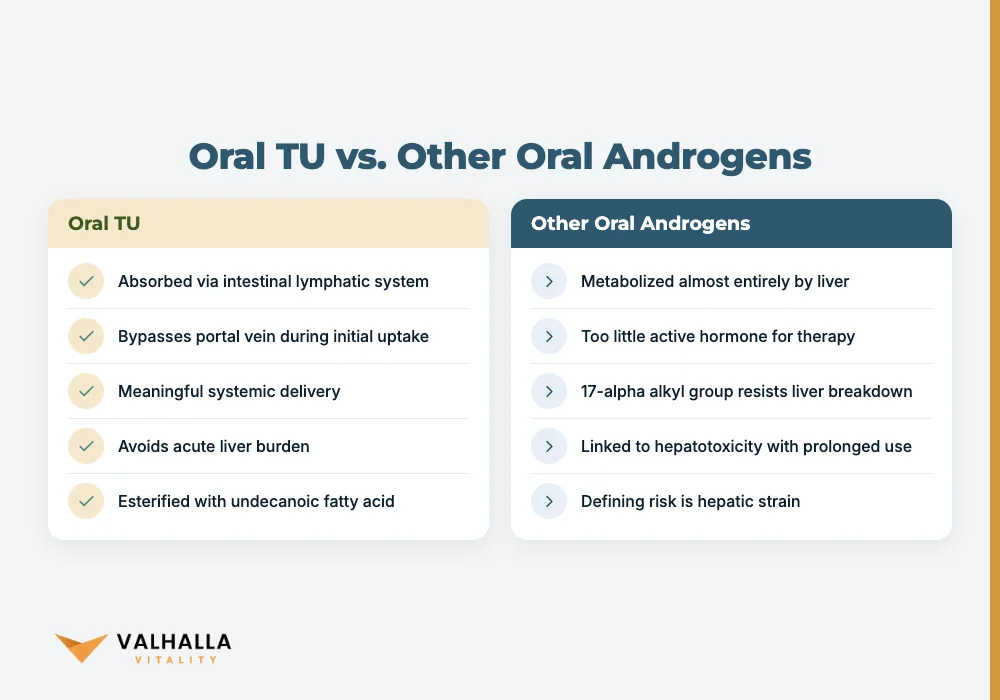
The history of oral testosterone is largely a story of failed attempts. Unmodified testosterone is metabolized almost entirely by the liver before reaching systemic circulation, leaving too little active hormone to be therapeutically useful. Early synthetic oral androgens solved this by adding a 17-alpha alkyl group to resist liver breakdown, but that modification is directly linked to hepatotoxicity with prolonged use. That tradeoff defined oral steroid pharmacology for decades. According to a 2022 analysis in Frontiers in Endocrinology (Bond et al., 2022), hepatic strain is one of the defining risks of 17-alpha alkylated oral steroids.
Testosterone undecanoate takes a structurally different route. It is esterified with an undecanoic fatty acid chain and formulated in a lipid-based vehicle. This combination enables absorption through the intestinal lymphatic system, bypassing the portal vein during initial uptake. The result is meaningful systemic delivery without the acute hepatic burden that disqualifies most oral androgens for TRT.
The bioavailability of oral testosterone in this formulation is still variable and substantially lower than injectable testosterone. Dietary fat at the time of administration is not optional. Without co-ingestion of dietary fat, oral testosterone absorption drops significantly because lymphatic uptake depends on chylomicron formation triggered by dietary lipids. Food timing is therefore clinically relevant throughout any oral TRT protocol using testosterone undecanoate.
How oral TRT delivery methods compare
| Feature | Oral TU | Injectable testosterone | Transdermal (gel or patch) |
|---|---|---|---|
| Absorption route | Lymphatic, bypasses portal vein | Direct to bloodstream via muscle | Through skin into bloodstream |
| First-pass hepatic effect | Largely bypassed at absorption | Not applicable | Not applicable |
| Hormone level profile | Requires consistent daily dosing with food | Peaks post-injection, gradual decline | Steady with daily application |
| Administration setting | Home use, with a fat-containing meal | Clinic or self-injection | Daily home application |
| Fertility impact | Suppresses HPT axis | Suppresses HPT axis | Suppresses HPT axis |
| Food requirement | Required for adequate absorption | Not applicable | Not applicable |
A licensed provider determines which route fits each individual after reviewing labs, health history, and the patient's practical circumstances.
For a closer look at how oral and injectable TRT routes compare clinically, that guide examines the clinical evidence across both delivery methods.
How does oral testosterone work in the body?
Oral testosterone absorption begins in the proximal small intestine. The lipid-formulated compound is incorporated into chylomicrons, transport particles the gut produces when processing dietary fat. These particles enter the intestinal lacteals and travel through the lymphatic system to the thoracic duct, then into venous circulation near the heart. The liver is largely bypassed during this initial absorption phase. That lymphatic pathway is the defining pharmacological feature of a testosterone undecanoate cycle.
Once circulating, testosterone undergoes several metabolic conversions. The enzyme 5-alpha reductase converts part of it to dihydrotestosterone (DHT) in peripheral tissues, including skin and the prostate. Aromatase converts another fraction to estradiol in adipose and other tissues. Both metabolites are biologically active and are monitored as standard parts of any oral TRT protocol.
Circulating testosterone binds to androgen receptors in target tissues throughout the body. Bond et al. (2022) in Frontiers in Endocrinology describe how androgen receptor activation drives downstream changes in gene expression: effects on protein synthesis in muscle, bone matrix deposition, red blood cell production through erythropoietin signaling, and multiple other hormonal feedback loops.
Unlike injectable testosterone, which enters systemic circulation rapidly and produces a pronounced hormone peak, the oral route via lymphatic absorption produces a more gradual rise tied to digestion timing. The pharmacokinetic profile of a testosterone undecanoate cycle is therefore heavily influenced by administration consistency. Inconsistent dosing times or missed meals during dosing create hormone fluctuations that complicate monitoring.
One downstream effect carries particular clinical importance: HPT axis suppression. The hypothalamus detects elevated circulating testosterone and reduces GnRH secretion. Pituitary LH and FSH output drops. The testes reduce their own testosterone synthesis. This is not a side effect specific to the oral route. It occurs with every testosterone delivery method because it reflects how the body's hormonal feedback system responds to exogenous testosterone.
What is testosterone undecanoate used for in TRT?
Testosterone undecanoate is used clinically to treat hypogonadism, a condition in which the body does not produce adequate testosterone to maintain normal physiological function. A 2022 review in Endocrinology and Metabolism Clinics of North America (Wang et al., 2022) identifies it as under-recognized, affecting a meaningful proportion of middle-aged and older men, with under-treatment remaining a persistent clinical problem.
Diagnosis requires more than a single low reading. A 2025 review in Sexual Medicine Reviews (Khera et al., 2025) states that true testosterone deficiency should be confirmed by at least two separate morning measurements combined with symptoms consistent with the hormonal deficit. Low labs without symptoms, or symptoms without confirmed low labs, are each insufficient on their own.
Clinical benefits associated with appropriately prescribed TRT include:
- Improvements in libido and sexual function, supported by a 2024 systematic review in Frontiers in Endocrinology (Xu et al., 2024)
- Support for bone mineral density during long-term therapy (Wang et al., 2022)
- Potential improvements in mood, energy, and cognitive clarity in men with confirmed hormonal deficiency (Wang et al., 2022)
- Reduction in fatigue symptoms attributable to low testosterone
Individual outcomes vary. They depend on whether low testosterone is the actual driver of the patient's symptoms, and a provider makes that determination.
The oral TRT protocol using testosterone undecanoate may suit men who find injections impractical or who prefer home oral administration. Men who travel frequently, cannot easily access a clinic for regular injections, or are uncomfortable with needles may find the oral route better aligned with their practical circumstances. Home oral administration may also support better long-term adherence for some patients.
For additional clinical context on pill-based testosterone options, a clinical overview of oral testosterone pills covers the relevant details.
How long does a testosterone undecanoate cycle last?
There is no single fixed duration for a testosterone undecanoate cycle in a clinical TRT context. Medical testosterone replacement is generally ongoing rather than strictly time-limited. The therapy continues as long as it remains clinically warranted and is supported by regular lab monitoring.
This differs from the "on-off cycle" concept common in non-medical anabolic steroid use. Stopping TRT abruptly without clinical guidance produces unpredictable hormone fluctuations. HPT axis suppression accumulated during therapy does not resolve instantly. Any discontinuation should be managed by a licensed provider.
Clinical TRT management moves through recognizable phases. The initiation phase establishes baseline hormone levels and monitors early response to the oral TRT protocol. Follow-up labs, typically at around three months, confirm whether the therapeutic target range has been reached and whether adjustments are needed. After hormone levels stabilize, monitoring intervals extend. They do not end.
Some patients change delivery methods over time. A provider may transition someone from an oral testosterone undecanoate cycle to an injectable form, or the reverse, based on clinical response, tolerability, or changes in circumstances. Understanding the pharmacological differences between oral and injectable testosterone is relevant to that decision, and how testosterone undecanoate and cypionate differ covers those distinctions in detail.
Post-cycle therapy (PCT), widely discussed in non-medical anabolic steroid contexts, is not a standard component of supervised TRT protocols. If a provider recommends discontinuing therapy, the approach to managing HPT axis recovery is determined by individual clinical factors at that time, not a generic supplement protocol.
What are the side effects of oral testosterone?
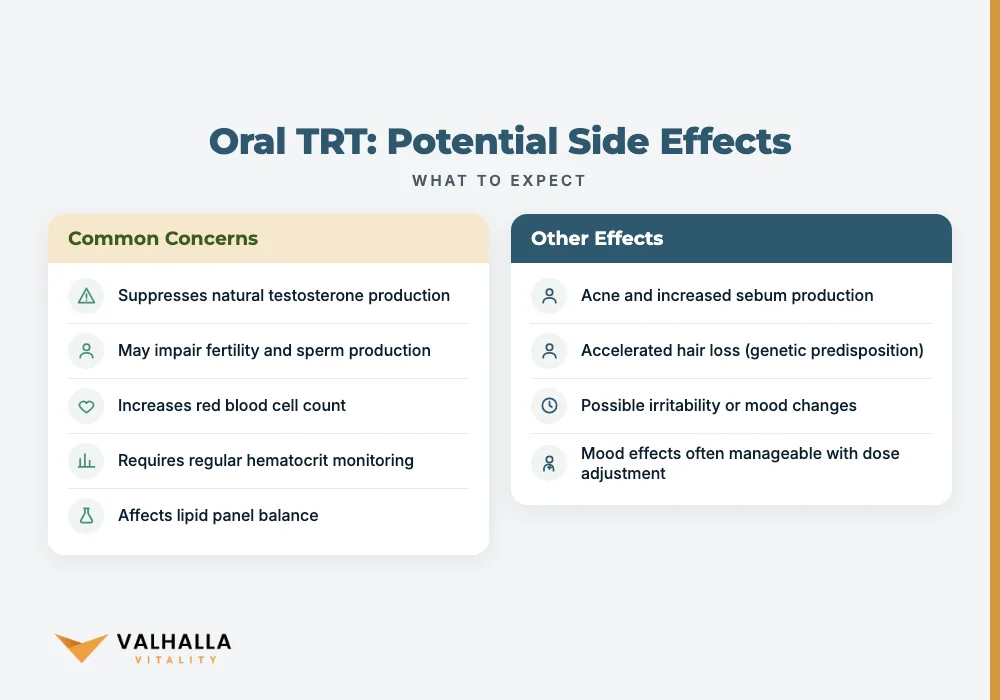
Side effects of a testosterone undecanoate cycle reflect the broader pharmacology of testosterone, with some considerations specific to the oral delivery route.
HPT axis suppression and fertility impact. All testosterone supplementation suppresses the body's natural production signal. Elevated circulating testosterone signals the hypothalamus to reduce GnRH, lowering LH and FSH output and ultimately suppressing testicular testosterone synthesis and sperm production. A 2025 review in Nature Reviews. Urology (Naelitz et al., 2025) confirms that TRT consistently impairs spermatogenesis in reproductive-age men, often significantly. This is one of the most clinically important considerations for men who have not yet completed their family.
Cardiovascular and hematological effects. Testosterone stimulates erythropoietin production, raising red blood cell count and hematocrit. Elevated hematocrit increases blood viscosity. Regular hematocrit monitoring allows providers to detect and manage this risk early. Lipid panel changes are also tracked throughout any oral TRT protocol, as testosterone therapy may affect the HDL-LDL balance depending on the individual.
Dermatological and androgenic effects. Acne, increased sebum production, and accelerated hair loss in men genetically predisposed to androgenic alopecia are recognized adverse effects. These are driven by DHT activity and occur across all testosterone delivery routes. They are not unique to the oral form.
Mood and behavioral effects. Some men report irritability or emotional variability, particularly during early dose-adjustment phases of a testosterone undecanoate cycle. These effects are typically manageable through provider-guided dose optimization and are not universal.
Estrogenic effects. Peripheral aromatization of testosterone to estradiol can produce elevated estrogen levels. Symptoms may include fluid retention, breast sensitivity, and mood variability. Estradiol is monitored alongside testosterone as a standard part of any responsible oral TRT protocol.
Liver considerations. The lymphatic absorption pathway significantly reduces first-pass hepatic exposure compared to 17-alpha alkylated oral steroids. Liver toxicity is therefore a far smaller clinical concern with testosterone undecanoate than with traditional oral androgens. Hepatic function markers are still included in standard follow-up labs as a routine precaution.
The specific risk profile for any individual depends on baseline health, genetics, the degree of testosterone elevation achieved, and consistency of monitoring.
Is oral testosterone safe for long-term use?
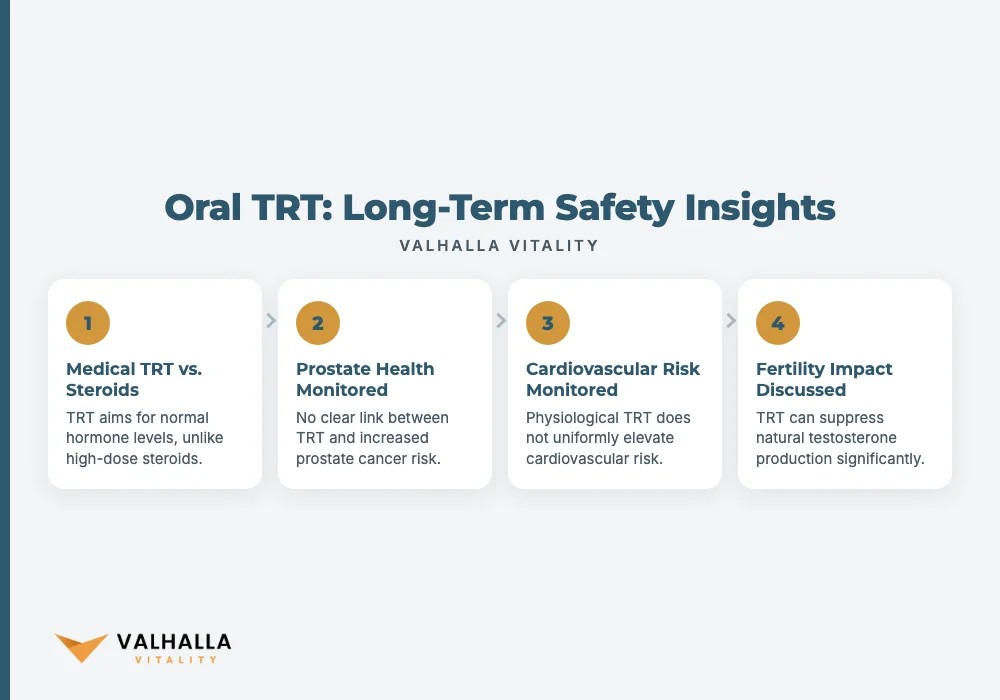
Long-term safety data on testosterone undecanoate has accumulated over decades of clinical use internationally. The overall picture from medical literature supports its manageability under proper supervision, though no therapy is without risk.
Khera et al. (2025) in Sexual Medicine Reviews address common safety misconceptions directly. Much concern about testosterone therapy stems from conflating medical TRT, which targets restoration to normal physiological hormone levels, with high-dose anabolic steroid use at supraphysiological concentrations. That distinction is central to interpreting risk data accurately.
Prostate health is a routinely monitored parameter. A 2024 meta-analysis in Frontiers in Endocrinology (Xu et al., 2024) found no clear association between TRT and increased prostate cancer risk in study populations. Current clinical practice supports regular PSA monitoring rather than withholding therapy on the basis of this concern alone.
Cardiovascular risk monitoring is standard in any responsible oral TRT protocol. Long-term therapy at physiological testosterone levels does not uniformly elevate cardiovascular risk, but individual responses vary. Baseline cardiovascular assessment and ongoing monitoring of hematocrit, lipids, and blood pressure are clinical requirements throughout therapy, not optional add-ons.
The fertility impact warrants specific attention for men of reproductive age. Natural testosterone production suppression from TRT may not recover quickly after stopping, particularly following longer treatment courses. According to Naelitz et al. (2025), this suppression can be significant and prolonged, making it essential to discuss fertility preservation before beginning a testosterone undecanoate cycle.
Standard long-term monitoring for an oral TRT protocol typically includes:
- Serum testosterone (total and free) at defined intervals
- Hematocrit and hemoglobin
- PSA and prostate evaluation
- Liver function markers
- Estradiol levels
- Lipid panel and cardiovascular risk parameters
- Blood pressure assessment
A licensed provider reviews these at scheduled intervals and adjusts the protocol based on measured results, not on symptom reports alone.
What to expect before and during a testosterone undecanoate cycle
Starting an oral TRT protocol begins well before the first dose. Clinical intake covers medical history, current symptoms, prior hormone testing, medications, and conditions that could affect prescribing decisions. This information, combined with laboratory results, forms the basis of any prescribing judgment.
A baseline laboratory panel typically includes total testosterone measured in the morning, free testosterone, LH, FSH, estradiol, hematocrit, PSA, and a comprehensive metabolic panel. Morning timing matters because testosterone levels are highest early in the day. Two separate low morning readings are generally required to confirm deficiency before a prescription is issued. Symptoms matter, but lab confirmation is required.
Once therapy begins, oral testosterone absorption depends on consistent food intake at each dose. Missing doses or taking them without a fat-containing meal produces unpredictable hormone fluctuations that complicate both monitoring and management. A licensed provider determines the dose after reviewing baseline labs, with adjustments based on follow-up results. Dose decisions follow the data, not assumptions.
The first monitoring checkpoint typically falls at approximately three months. Lab values at that point show whether the testosterone undecanoate cycle is reaching its therapeutic target and whether any adjustments are needed. After stabilization, monitoring continues at longer intervals. It does not stop. Each follow-up reassesses both measured hormone levels and symptom response, as the two do not always track together.
Over the course of therapy, lab monitoring becomes a routine part of the patient's healthcare. Most providers schedule blood draws at defined intervals, with results reviewed at a follow-up visit or through a secure online portal in telehealth settings. Changes in hematocrit, shifts in estradiol, or PSA movement all inform whether the current oral TRT protocol remains clinically optimal.
For context on the evidence behind oral testosterone outcomes and risk considerations for men, that resource covers the clinical factors that most influence individual results.
Valhalla Vitality connects patients with licensed providers for online medical intake, lab review, and prescription through a fully digital process. Availability varies by state.
Ready to find out if this is right for you?
If you are ready to find out whether a testosterone undecanoate cycle fits your clinical picture, Book Your Consultation to connect with a licensed provider who can review your labs and symptoms.
FAQ
What is the difference between oral testosterone undecanoate and injectable testosterone?
Oral testosterone undecanoate is absorbed through the lymphatic system after being taken with a fat-containing meal, while injectable testosterone enters the bloodstream directly through muscle tissue. Injections typically produce more pronounced hormone peaks and troughs, while consistently administered oral dosing may provide a more gradual daily profile when food timing is maintained.
Can testosterone undecanoate be used as an oral only steroid cycle for performance enhancement?
Clinical guidelines position testosterone undecanoate as a TRT option for men with confirmed hypogonadism, not as a performance-enhancement compound. Using any testosterone therapy outside a supervised medical protocol carries risks including HPT axis suppression and cardiovascular effects that go unmonitored.
How is testosterone undecanoate dosage determined?
A licensed provider determines testosterone undecanoate dosage after reviewing baseline labs, symptom history, and individual health data. The target in TRT is to restore testosterone to a normal physiological range, and adjustments are made based on follow-up lab values rather than assumed responses to any given amount.
Does a testosterone undecanoate cycle affect fertility?
Yes. Like all forms of testosterone replacement therapy, oral testosterone suppresses the hormonal signals that drive sperm production through HPT axis feedback. Naelitz et al. (2025) confirm this suppression can significantly reduce sperm output in reproductive-age men. Men who want to father children should discuss fertility preservation options with their provider before starting therapy.
Is a prescription required for testosterone undecanoate in the United States?
Yes. Testosterone undecanoate is a controlled substance in the United States, and a licensed provider must complete a clinical evaluation before any prescription is issued. Any platform offering it without lab review and health history assessment is not operating within legal and medical standards.
Sources
- Bond P et al. (2022). Anabolic-androgenic steroids: How do they work and what are the risks?. Frontiers in endocrinology. PubMed
- Wang C et al. (2022). Testosterone Replacement Therapy in Hypogonadal Men. Endocrinology and metabolism clinics of North America. PubMed
- Khera M et al. (2025). Testosterone deficiency and treatments: common misconceptions and practical guidance for patient care. Sexual medicine reviews. PubMed
- Xu Z et al. (2024). An updated systematic review and meta-analysis of the effects of testosterone replacement therapy on erectile function and prostate. Frontiers in endocrinology. PubMed
- Naelitz BD et al. (2025). Testosterone replacement therapy and spermatogenesis in reproductive age men. Nature reviews. Urology. PubMed
You May Also Like
 Oral testosterone
Oral Testosterone Therapy: Energy, Side Effects & Results
Oral testosterone therapy may improve energy and ease fatigue in men with low T. Learn how it works, what side effects to expect from treatment.
October 7, 2026 ETRead more → Oral testosterone
Oral Testosterone Fertility: How TRT Affects Sperm
Oral testosterone fertility: TRT typically reduces sperm production. Learn what the research shows and how to protect your reproductive options.
October 7, 2026 ETRead more → Oral testosterone
Oral Testosterone Therapy: Options, Benefits, and Risks
Oral testosterone therapy delivers TRT in pill form. Learn how testosterone undecanoate capsules work, who qualifies, and key side effects to watch.
October 6, 2026 ETRead more →