
The following blog post is for entertainment and informational purposes only. It is not intended to provide medical advice or diagnosis. Please consult your doctor before making any health-related decisions.
Oral testosterone side effects range from acne and fluid retention to more serious concerns involving the liver, cardiovascular system, and fertility. Most TRT side effects in men are manageable under clinical supervision, but the risk profile varies by individual, by formulation, and by how closely therapy is monitored. A licensed provider determines whether therapy is appropriate after reviewing labs and medical history. For context on both the risks and the potential benefits, the guide on oral testosterone benefits and risk tradeoffs covers the fuller picture.
What are the most common side effects of oral testosterone?
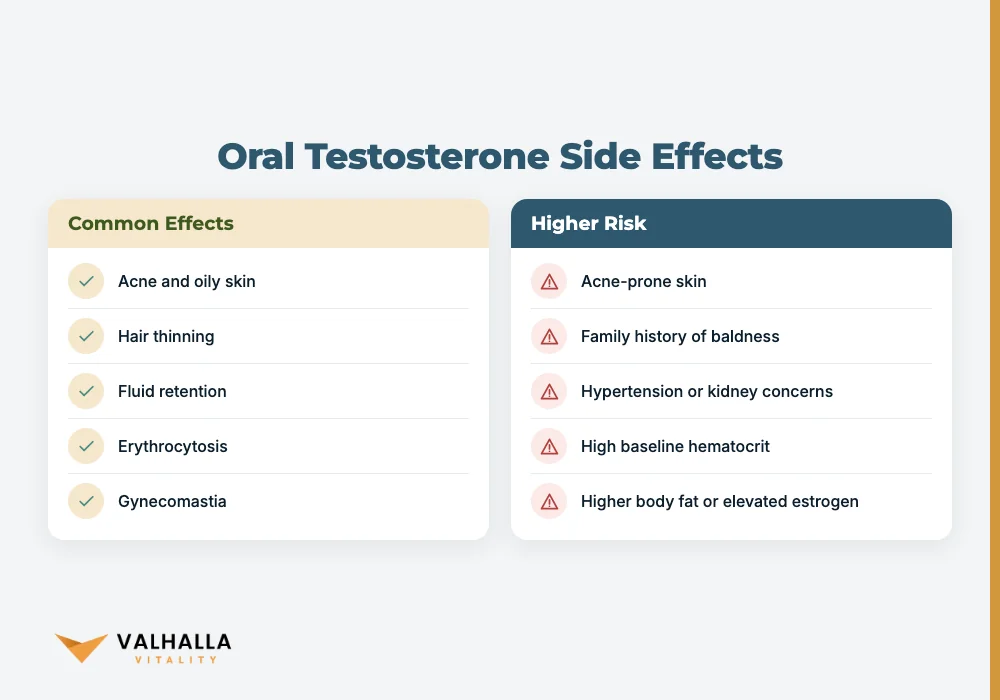
Oral testosterone side effects fall into several predictable categories. Knowing each one helps patients weigh tradeoffs honestly before starting.
| Side Effect | Why It Happens | Who Faces Higher Risk |
|---|---|---|
| Acne and oily skin | Androgen stimulation of sebaceous glands | Men with acne-prone skin |
| Hair thinning | DHT-driven follicle miniaturization | Men with a family history of baldness |
| Fluid retention | Sodium and water reabsorption in kidneys | Men with hypertension or kidney concerns |
| Erythrocytosis | Elevated red blood cell production | Men with high baseline hematocrit |
| Gynecomastia | Testosterone conversion to estradiol | Men with higher body fat or elevated estrogen |
| Testicular atrophy | Suppression of LH and FSH | All men on exogenous testosterone |
| Mood changes | Neuroactive steroid effects | Supraphysiologic dosing, baseline mood disorders |
Acne is consistently one of the most reported testosterone replacement side effects. Androgens activate sebaceous glands, increase oil production, and block pores, particularly on the face, chest, and back. For most men it responds well to targeted skincare; for some it requires adjunct treatment alongside TRT.
Hair thinning depends heavily on genetics. DHT conversion at susceptible follicles accelerates miniaturization in men predisposed to male-pattern baldness. This is worth discussing with a provider before starting, because it is not reliably reversible once underway.
Fluid retention is another commonly reported TRT side effect in men with blood pressure concerns. Testosterone influences sodium and water reabsorption in the kidneys, which can produce noticeable swelling in the lower extremities and incremental blood pressure elevation. Routine monitoring catches this early.
Erythrocytosis, a rise in red blood cell mass, develops gradually over months of therapy. Thicker blood raises clotting risk. Routine hematocrit checks are standard practice, and elevations are addressed through dose adjustment or therapeutic phlebotomy.
Does oral testosterone cause liver damage?
The testosterone liver damage risk associated with oral testosterone has changed substantially as formulations evolved. First-generation alkylated oral androgens caused documented hepatotoxicity and cholestasis, and that record drove their clinical abandonment. The question of liver risk for oral testosterone is now a question about which formulation.
Modern oral testosterone works through a different route. Testosterone undecanoate, the active compound in newer products, absorbs through the lymphatic system rather than the portal vein. That pathway reduces hepatic first-pass exposure substantially compared to earlier compounds. A 2025 review by Goldstein et al. in Sexual Medicine Reviews confirmed that newer oral testosterone undecanoate formulations show a meaningfully improved liver safety profile relative to older alkylated androgens. A 2023 review by Miller et al. in Sexual Medicine Reviews noted this lymphatic absorption pathway was specifically designed to minimize hepatic exposure and improve the safety of oral testosterone delivery.
The risk is lower. It is not gone. A 2022 analysis by Patel et al. in the International Journal of Impotence Research found that liver function testing is included in recommended monitoring protocols for oral testosterone undecanoate, even for the newer formulations. Liver enzymes can still shift, particularly under extended use or in men with underlying hepatic vulnerability.
Men with pre-existing liver conditions need explicit clinical evaluation before starting any form of oral testosterone therapy. A provider reviews that history and determines whether oral delivery is appropriate or whether another administration route better suits the clinical picture.
How does oral testosterone affect mood and behavior?
Testosterone mood swings are real, documented, and more nuanced than popular media suggests. Some men experience improved mood stability and reduced irritability when a clinically low testosterone level is corrected under supervision. Others, particularly when levels climb above the physiological range, report increased agitation, emotional dysregulation, or difficulty managing interpersonal conflict.
The "roid rage" framing in public discourse applies most accurately to supraphysiologic androgen use, not to properly monitored testosterone replacement side effects at clinical levels. Still, individual variation within the therapeutic range is substantial, and mood shifts are not fully predictable from lab values alone.
Anxiety and depressive symptoms can also emerge or change during therapy. A 2016 study by Giatti et al. in the Journal of Molecular Endocrinology examined how neuroactive steroids interact with brain receptor systems, providing biological context for why mood effects occur during hormonal therapies. These effects are physiological, not purely psychological, and should be tracked as seriously as any other clinical marker.
If irritability, low mood, or mood instability appears or worsens after starting therapy, communicating that to a provider promptly matters. Dose review often resolves it. Delayed reporting allows a pattern to develop that is harder to address.
Can oral testosterone cause gynecomastia?
Yes. Gynecomastia from TRT occurs when surplus testosterone converts to estradiol through peripheral aromatization, particularly in fat tissue. As estrogen rises relative to an individual's baseline, breast tissue in men can develop. It is gradual and, with early intervention, usually reversible.
Risk is not uniform. Men with higher body fat carry greater aromatase activity, which accelerates estrogen conversion and raises gynecomastia risk. Monitoring estradiol as part of a TRT panel is standard practice specifically because of this. When estrogen climbs above the comfortable range, a provider adjusts the protocol to reduce further aromatization.
Self-managed testosterone supplementation without clinical oversight makes this risk substantially harder to contain. Without estradiol monitoring, gynecomastia can progress undetected for months. Regular lab work and provider involvement catch most cases before they require pharmacological or surgical intervention. A comparison of how oral testosterone delivery stacks up against other options, including their respective gynecomastia risk profiles, appears in the oral testosterone therapy options guide.
Testosterone therapy cardiovascular risks
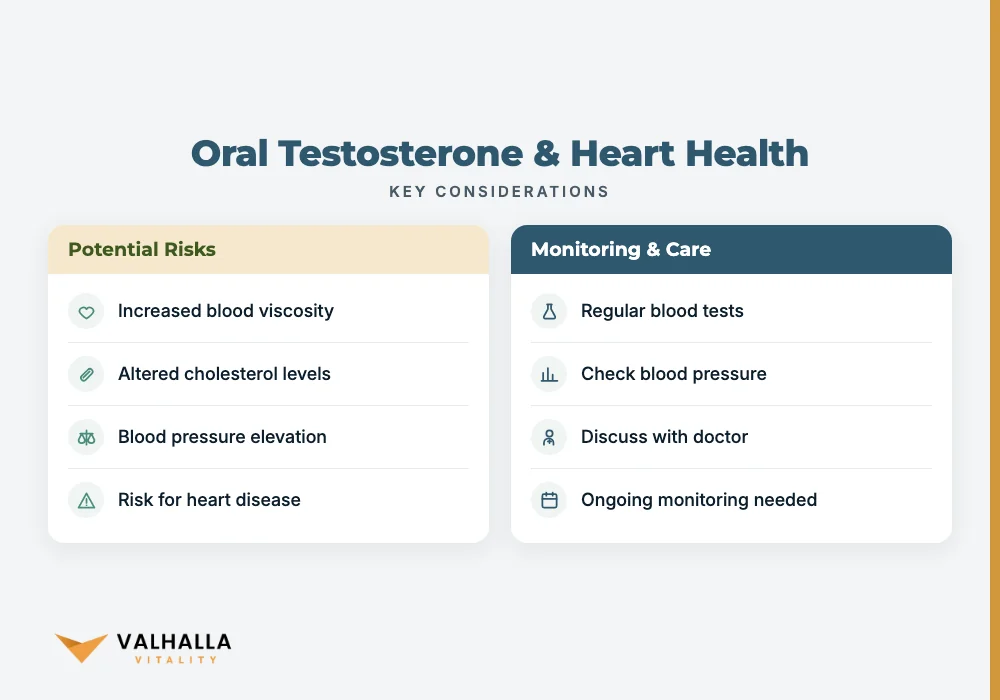
Testosterone therapy cardiovascular risks are one of the most studied concerns in TRT research, and the evidence base is genuinely complex. A 2017 review by Elsherbiny et al. in Current Cardiology Reports found that cardiovascular effects of TRT in adult males depend heavily on baseline health status, noting a bidirectional relationship: low testosterone correlates with cardiovascular risk factors, while supraphysiologic levels introduce additional cardiovascular strain. There is no single clean answer.
Specific oral testosterone side effects relevant to cardiovascular health include:
- Polycythemia: elevated hematocrit increases blood viscosity and the risk of clotting events
- Lipid changes: oral formulations tend to affect HDL and LDL cholesterol more than injectable or transdermal routes, due to absorption pathway differences
- Blood pressure elevation, partly through fluid retention
- Potential increased cardiac event risk for men with established coronary artery disease
Oral formulations produce somewhat different lipid effects than injections because of their distinct absorption profile. A 2017 review by Sansone et al. in Rejuvenation Research noted that long-term cardiovascular outcome data for oral testosterone specifically remains limited, making ongoing monitoring the practical safeguard rather than an established clean record.
Regular cardiovascular monitoring, covering hematocrit, blood pressure, and a lipid panel, is standard in well-managed testosterone replacement therapy. Men with existing heart conditions need explicit clinical evaluation before starting. That conversation belongs before any prescription is written, not after the first lab result comes back outside range.
Fertility, testicular atrophy, and reproductive function
Fertility-related oral testosterone side effects are frequently underdiscussed in introductory TRT guides. Exogenous testosterone suppresses the pituitary's release of LH and FSH, the hormones that signal the testes to produce both testosterone and sperm. The result is testicular atrophy and reduced sperm production, which together impair fertility.
Large doses of exogenous androgens, including Kyzatrex, may suppress spermatogenesis and affect semen parameters including sperm count. This is not a rare complication. It is the expected physiological response to sustained exogenous testosterone administration.
Men who have not completed their family, or who may want children in the future, need to raise this before starting therapy. There are clinical approaches that partially preserve fertility potential during testosterone therapy, but those require individual evaluation. Decisions about fertility preservation should be made before treatment begins, not revisited months into a suppressive protocol when options have narrowed.
Testicular atrophy typically resolves after stopping therapy. The timeline varies with duration of use and individual response. Extended use correlates with longer recovery windows.
Is oral testosterone safe for long-term use?
Long-term oral testosterone safety is a reasonable concern, and the evidence is still developing. Short and medium-term safety for testosterone undecanoate-based formulations is reasonably well established under active clinical monitoring, particularly for liver function, hematocrit, and cardiovascular markers. What remains less certain is the profile beyond a decade, because modern oral formulations have not been available long enough for that data to fully accumulate.
A 2023 review by Miller et al. in Sexual Medicine Reviews noted that oral testosterone undecanoate represents a meaningful improvement over alkylated predecessors, while emphasizing that long-term outcome data across all risk categories continues to be gathered. The practical implication: monitoring is the mechanism for detecting problems early, not a precaution against an established danger.
For most men under active clinical supervision, oral testosterone side effects from modern undecanoate-based formulations are manageable. Unmonitored use compounds risk over time. At Valhalla Vitality, a licensed provider reviews intake within 24 business hours and establishes a monitoring schedule before therapy begins.
Evaluating which TRT approach fits a specific health profile benefits from comparison. The guide on choosing the right testosterone replacement therapy walks through the key tradeoffs between oral, injectable, and transdermal options.
Managing oral testosterone side effects in practice
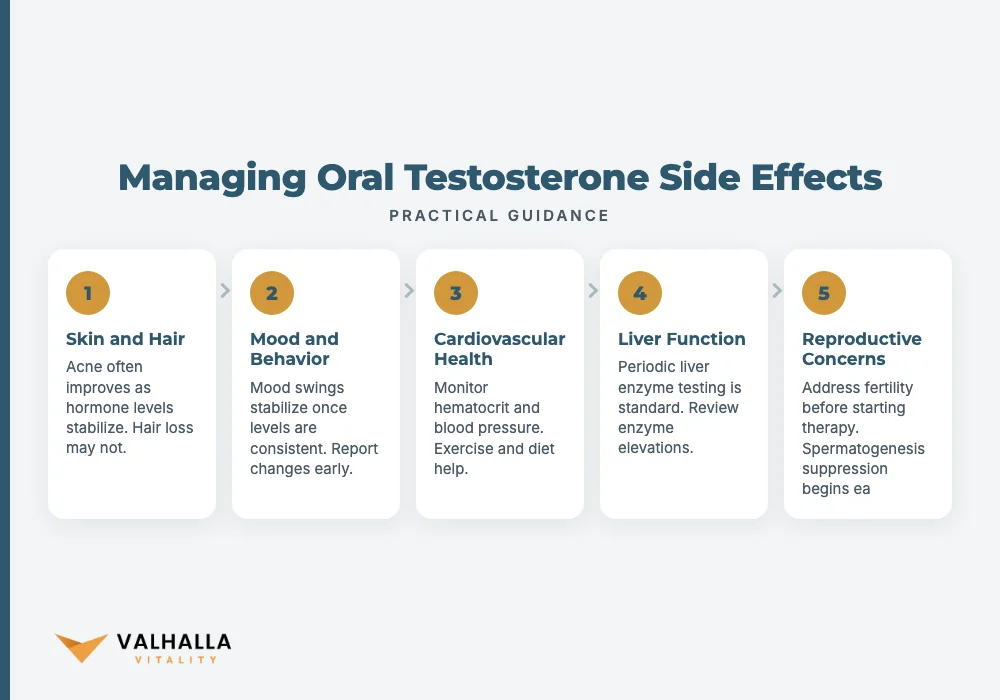
Practical side-effect management follows a consistent framework regardless of which oral testosterone formulation is prescribed, whether working through Kyzatrex side effects or those from other oral testosterone undecanoate products.
Skin and hair: Acne responds to topical or systemic treatment alongside TRT and often improves as hormone levels stabilize. Hair loss in men with genetic susceptibility is a different situation. It may not improve, and that tradeoff is worth discussing before therapy starts rather than after noticeable thinning has already progressed.
Mood and behavior: Testosterone mood swings typically stabilize once levels reach a consistent range, usually within the first few months. Tracking mood changes week over week during the stabilization period helps distinguish transient adjustment from a pattern that warrants clinical attention. Reporting early is consistently more effective than reporting late.
Cardiovascular and hematologic: Hematocrit and blood pressure monitoring at scheduled intervals are non-negotiable components of ongoing TRT management. Aerobic exercise and a low-sodium diet support cardiovascular health during therapy. Both complement clinical oversight; neither replaces it.
Liver function: Periodic liver enzyme testing remains part of the standard protocol for oral testosterone undecanoate. A 2025 review by Goldstein et al. confirms this remains appropriate even with the improved hepatic profile of newer formulations. Enzyme elevations warrant prompt clinical review.
Reproductive concerns: Men planning to conceive should address fertility explicitly before starting testosterone therapy. Spermatogenesis suppression begins early in treatment. Early planning preserves more options, and recovery after stopping therapy, while expected in most cases, does not follow a predictable timeline.
A licensed provider determines whether therapy is appropriate after reviewing labs and medical intake, adjusts the protocol when markers shift, and remains the accountability point for managing oral testosterone side effects across the full treatment course.
Talk with a licensed provider before starting
To understand which oral testosterone side effects apply to your health profile and whether therapy is appropriate for your situation, Book Your Consultation and have a licensed provider walk through the details with you.
FAQ
What are the most common side effects of oral testosterone?
The most frequently reported oral testosterone side effects include acne, fluid retention, changes in cholesterol, and erythrocytosis. Hair thinning and testosterone mood swings are also common, with genetic factors shaping much of the hair loss risk. Most are manageable under consistent clinical monitoring and routine lab checks.
Does oral testosterone damage the liver?
Modern oral testosterone undecanoate formulations carry significantly lower liver risk than older alkylated androgens because they absorb through the lymphatic system rather than the portal vein. Periodic liver enzyme testing remains part of standard monitoring for all oral testosterone therapies regardless of formulation. Men with pre-existing liver conditions need explicit clinical evaluation before starting.
Can oral testosterone cause gynecomastia?
Yes, gynecomastia from TRT can occur when excess testosterone converts to estradiol through peripheral aromatization. The risk is higher in men with greater body fat and lower when estradiol is monitored routinely as part of a TRT protocol. Early detection through regular labs allows a provider to intervene before significant tissue development occurs.
How does oral testosterone affect mood?
Testosterone mood swings during TRT can run in either direction: some men feel more stable when a genuine deficiency is addressed under supervision, while others experience irritability or agitation if levels move above the physiological range. Supraphysiologic dosing carries the highest mood-related risk. Tracking mood changes and communicating them early to a provider is the most effective management approach.
Is oral testosterone safe for long-term use?
Modern oral testosterone undecanoate formulations have a reasonable short and medium-term safety record under proper medical supervision. Long-term data beyond five to ten years remains limited because these formulations are relatively recent in clinical practice. Active monitoring for hematocrit, liver enzymes, blood pressure, and lipids is what makes long-term use manageable rather than uncertain.
Sources
- Goldstein I et al. (2025). Newer formulations of oral testosterone undecanoate: development and liver side effects. Sexual Medicine Reviews. PubMed
- Elsherbiny A et al. (2017). State-of-the-Art: a Review of Cardiovascular Effects of Testosterone Replacement Therapy in Adult Males. Current Cardiology Reports. PubMed
- Miller JA et al. (2023). Oral testosterone therapy: past, present, and future. Sexual Medicine Reviews. PubMed
- Giatti S et al. (2016). The other side of progestins: effects in the brain. Journal of Molecular Endocrinology. PubMed
- Sansone A et al. (2017). Testosterone Replacement Therapy: The Emperor's New Clothes. Rejuvenation Research. PubMed
- Patel M et al. (2022). JATENZO®: Challenges in the development of oral testosterone. International Journal of Impotence Research. PubMed
You May Also Like
 Oral testosterone
Oral Testosterone Therapy: Energy, Side Effects & Results
Oral testosterone therapy may improve energy and ease fatigue in men with low T. Learn how it works, what side effects to expect from treatment.
October 7, 2026 ETRead more → Oral testosterone
Oral Testosterone Fertility: How TRT Affects Sperm
Oral testosterone fertility: TRT typically reduces sperm production. Learn what the research shows and how to protect your reproductive options.
October 7, 2026 ETRead more → Oral testosterone
Oral Testosterone Therapy: Options, Benefits, and Risks
Oral testosterone therapy delivers TRT in pill form. Learn how testosterone undecanoate capsules work, who qualifies, and key side effects to watch.
October 6, 2026 ETRead more →