Oral Testosterone Pills: How They Work and Who They Help

The following blog post is for entertainment and informational purposes only. It is not intended to provide medical advice or diagnosis. Please consult your doctor before making any health-related decisions.
This oral treatment is a prescription option for men with clinically low testosterone. It works through the lymphatic system. This absorption route delivers stable testosterone levels without the liver toxicity associated with older oral formulations. A licensed provider reviews your labs and medical history before prescribing, with the goal of restoring testosterone to the normal physiological range. If you are weighing Kyzatrex oral testosterone replacement therapy against other low testosterone treatment options, understanding how these pills work is a useful first step.
What are oral testosterone pills?
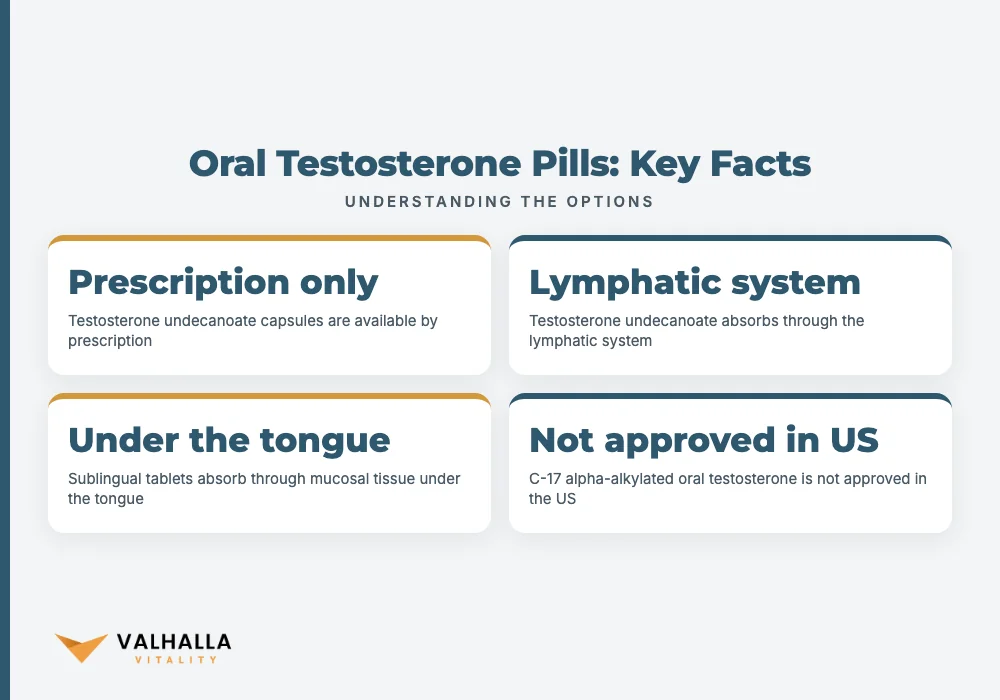
These are hormone medications taken by mouth to treat testosterone deficiency in men. The term covers more than one compound, and the differences between them are clinically important.
| Type | Absorption route | US status |
|---|---|---|
| Testosterone undecanoate capsules | Lymphatic system; fat co-ingestion required | Prescription only |
| Sublingual testosterone tablets | Mucosal tissue under the tongue | Available in some compounded protocols |
| C-17 alpha-alkylated oral testosterone | Hepatic first-pass (liver) | Not approved in the US; associated with liver toxicity |
Testosterone undecanoate capsules represent the clinically standard oral option in the US today. Their lymphatic absorption pathway bypasses the liver on the first pass, which is the core reason this formulation gained regulatory acceptance when earlier oral forms did not. A 2022 study in the International Journal of Impotence Research documented the formulation work required to achieve reliable lymphatic delivery for oral testosterone, including the critical role of dietary fat in ensuring consistent absorption (Patel et al., 2022).
Sublingual testosterone tablets dissolve under the tongue and absorb through mucosal tissue, also bypassing hepatic first-pass. They appear in compounded protocols rather than standardized branded products and are less widely available than the undecanoate alternative.
Neither type is sold over the counter. Both require a licensed provider to prescribe after reviewing labs and intake. Availability varies by state.
Are oral testosterone pills a prescription option?
Yes. Testosterone undecanoate capsules are indicated for adult men with confirmed hypogonadism. Kyzatrex is one currently available product in this category.
No comparable oral option exists without a prescription. Products marketed as testosterone "boosters" contain vitamins, herbs, or minerals. They do not contain testosterone. A licensed provider determines whether oral TRT is appropriate for a given individual after reviewing lab results, not supplement labels.
Are oral testosterone pills effective for low T?
They can be, for men with confirmed testosterone deficiency. Clinical use of oral testosterone targets the upper portion of the normal physiological range, not supraphysiological levels. Serum testosterone rises predictably when testosterone undecanoate capsules are taken consistently with food, because dietary fat is required for lymphatic uptake to occur.
Testosterone deficiency symptoms that commonly prompt men to seek evaluation include persistent fatigue, reduced libido, low mood, decreased muscle strength, and lower bone density. Restoring testosterone to a healthy range may support improvement across several of these areas. Response varies by individual, and a provider tracks labs over time to determine whether adjustments are needed.
For a closer look at this compound's clinical profile, the guide on the benefits and usage of testosterone undecanoate pills covers the pharmacology in practical terms.
What are the side effects of oral testosterone pills?
Side effects vary between individuals and are managed through regular clinical monitoring. Common ones include:
- Acne and increased skin oiliness
- Headache and mild nausea, typically most pronounced in the early weeks of treatment
- Elevated blood pressure
- Shifts in cholesterol and lipid levels
- Increased red blood cell count, which requires periodic lab monitoring
- Hair thinning in men with genetic predisposition to androgenic alopecia
Long-term unsupervised use raises cardiovascular risk. Routine blood pressure checks and lab work are standard parts of any testosterone therapy protocol. A licensed provider reviews results at each follow-up and adjusts the plan accordingly.
The liver toxicity concern historically linked to older oral formulations applies to C-17 alpha-alkylated compounds, not to this modern lymphatic-absorption form. Clinical monitoring remains necessary regardless of the formulation used.
Who should not take this treatment?
A provider reviews your full history and labs before prescribing. Clinical situations that typically disqualify a person from oral testosterone therapy include:
- Known or suspected prostate cancer or male breast cancer
- Recent heart attack, stroke, or active serious cardiovascular disease
- Significant liver or kidney disease that would impair clearance
- High red blood cell count (polycythemia)
- Untreated severe sleep apnea
- Pregnancy, or household contact with someone who is pregnant
A history of blood clotting disorders or significantly elevated cholesterol requires careful evaluation before starting any testosterone therapy. Older age is not an automatic disqualifier, but older adults need closer monitoring due to higher baseline cardiovascular risk. These are medical judgments, made by a licensed provider for each individual based on a complete clinical picture.
How does this treatment compare to testosterone injections?
Both methods deliver testosterone effectively. The pharmacological and practical differences, however, shape which approach fits a given person.
Injections create a serum peak shortly after administration, then taper until the next injection. That peak-and-trough pattern can produce noticeable fluctuations in energy or mood for some men between doses. This daily oral regimen tends toward steadier serum levels, with fewer pronounced swings.
Administration is the other key difference. Injections are intramuscular or subcutaneous, and most men self-inject at home after instruction from their provider. That requires comfort with needles. Oral pills require no injection technique. For men who strongly prefer to avoid injections, the TRT pill form may be the deciding factor.
Neither is universally better. The right choice depends on pharmacokinetics, tolerability, lifestyle, and what a licensed provider recommends after reviewing labs. The article on Kyzatrex oral TRT and how it compares to injectable alternatives covers those tradeoffs in more detail.
At Valhalla Vitality, the process begins with an online medical intake reviewed by a licensed provider within 24 business hours of order placement.
Ready to discuss your options?
If testosterone deficiency symptoms have led you here, a licensed provider can review your labs and determine whether this treatment is appropriate for your situation. Book Your Consultation to start the intake process.
FAQ
Are oral testosterone pills as effective as testosterone injections?
Both methods can restore testosterone to the normal physiological range when properly prescribed. The primary clinical difference is the serum-level pattern: oral testosterone taken daily tends toward steadier levels, while injections follow a peak-and-trough curve between doses.
What is Kyzatrex testosterone, and how does it differ from older oral forms?
Kyzatrex is a prescription testosterone undecanoate capsule that absorbs via the lymphatic system. Older oral testosterone compounds, specifically C-17 alpha-alkylated forms, were processed through the liver and carried significant hepatotoxicity risk; the lymphatic route addresses that concern.
Are sublingual testosterone tablets the same as oral testosterone pills?
No. Sublingual tablets dissolve under the tongue and absorb through mucosal membranes, while the standard oral undecanoate form passes through the digestive tract and absorbs via the lymphatics. Both bypass hepatic first-pass metabolism but through distinct routes with different protocols.
What testosterone deficiency symptoms typically lead a man to seek testing?
Persistent fatigue, reduced libido, low mood, decreased muscle mass, increased body fat, and lower bone density are common presenting concerns. A licensed provider orders lab work to confirm whether testosterone levels are the underlying cause before recommending any therapy.
Do oral testosterone pills require a prescription in the US?
Yes. Testosterone is a Schedule III controlled substance. No oral testosterone pill is available without a prescription for hypogonadism, and a licensed provider must review lab results before prescribing.
Sources
- Patel M et al. (2022). JATENZO®: Challenges in the development of oral testosterone. International journal of impotence research. PubMed
You May Also Like
 Oral testosterone
Oral Testosterone Therapy: Energy, Side Effects & Results
Oral testosterone therapy may improve energy and ease fatigue in men with low T. Learn how it works, what side effects to expect from treatment.
October 7, 2026 ETRead more → Oral testosterone
Oral Testosterone Fertility: How TRT Affects Sperm
Oral testosterone fertility: TRT typically reduces sperm production. Learn what the research shows and how to protect your reproductive options.
October 7, 2026 ETRead more → Oral testosterone
Oral Testosterone Therapy: Options, Benefits, and Risks
Oral testosterone therapy delivers TRT in pill form. Learn how testosterone undecanoate capsules work, who qualifies, and key side effects to watch.
October 6, 2026 ETRead more →