Oral Testosterone Dosage: Setting the Right TRT Protocol

The following blog post is for entertainment and informational purposes only. It is not intended to provide medical advice or diagnosis. Please consult your doctor before making any health-related decisions.
Oral testosterone dosage is not a one-size-fits-all number. A licensed provider determines the appropriate dose after reviewing your serum testosterone levels, medical history, and symptom pattern. For men with confirmed hypogonadism, Kyzatrex and other regulated oral formulations offer a needle-free path to restoring physiologically normal testosterone. The right oral TRT protocol depends entirely on your individual labs.
Who may benefit from low testosterone treatment
Testosterone affects muscle maintenance, bone density, libido, energy, and mood regulation. When levels fall below the normal range, persistent fatigue, reduced sex drive, and mood changes may follow. These symptoms overlap with many other conditions, which is exactly why blood work matters before any treatment decision.
A provider must measure serum testosterone on at least two separate mornings before confirming hypogonadism. Single measurements can miss normal day-to-day variation caused by illness, poor sleep, or acute stress. The full baseline panel typically includes total testosterone, free testosterone, estradiol, FSH, LH, hematocrit, and PSA. Each value informs whether therapy is appropriate and how the provider approaches the initial oral testosterone dosage.
Oral TRT delivery methods at a glance
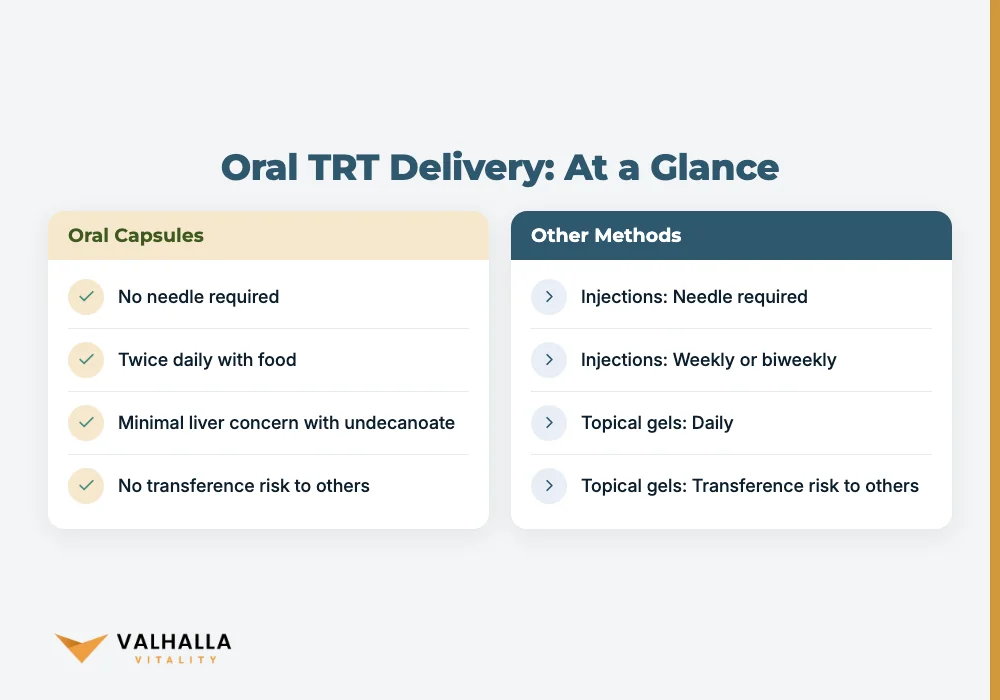
Modern oral testosterone undecanoate capsules absorb through the lymphatic system, largely avoiding the liver pathway that made older methyltestosterone tablets hepatotoxic. That design change is what makes contemporary oral forms viable for long-term hormone therapy.
| Feature | Oral capsules | Injections | Topical gels |
|---|---|---|---|
| Needle required | No | Yes | No |
| Typical schedule | Twice daily with food | Weekly or biweekly | Daily |
| Liver concern (historical) | Minimal with undecanoate | None | None |
| Peak variability | Moderate | Higher | Lower |
| Transference risk to others | None | None | Yes |
Understanding these differences helps patients have more productive conversations with their provider about which form fits their lifestyle and clinical needs.
What is the recommended oral testosterone dosage?
A licensed provider determines the oral testosterone dosage individually, based on where your baseline labs fall and how your body responds over the first weeks of treatment. No single starting number applies to every patient.
The process is iterative. After the initial prescription, serum testosterone is checked within one to two weeks, typically three to five hours after the morning dose. If levels fall outside the therapeutic target range, the dose is adjusted. This calibration step is expected, not a sign that the first prescription was wrong.
Several factors shape each dosing decision. Age matters. Kidney and liver function matter. Baseline testosterone concentration, severity of symptoms, cardiovascular history, hematocrit, and concurrent medications all factor in. Older men with age-related decline may need different calibration than younger men with primary hypogonadism. Two patients with similar baseline labs can reach different steady-state concentrations on an identical protocol. This variability is why regular lab monitoring matters far more than following any generic dosing chart.
How often should you take oral testosterone?
Most oral testosterone formulations are taken twice daily, once in the morning and once in the evening. Food is not optional. Absorption depends on dietary fat, and taking oral testosterone on an empty stomach can significantly reduce bioavailability.
Timing consistency matters more than patients often expect. Irregular spacing between doses makes follow-up lab interpretation unreliable. A provider drawing blood three to five hours after an inconsistently timed morning dose gets a misleading picture of steady-state levels. That leads to dosage decisions built on incomplete data.
Patients transitioning from injectable testosterone sometimes underestimate how much daily discipline this regimen requires. With injections, missing a scheduled time by a few hours matters less because the half-life spans days. Oral capsules require more routine precision to achieve stable serum levels. Once that routine is established, most patients report it becomes automatic.
How does oral TRT compare to injections?
Oral TRT and injectable testosterone are both effective for confirmed hypogonadism. Neither is universally superior. The better choice depends on patient preference, clinical factors, and lifestyle.
Injections produce sharper testosterone peaks. Some patients find this benefits mood and energy in the days immediately following the shot. The tradeoff: levels drop more sharply before the next injection, which can produce noticeable mood variability across the cycle. Testosterone capsules tend to produce a more consistent daily profile, though individual variation exists with both forms.
A 2024 systematic review in Frontiers in Endocrinology found consistent improvements in erectile function with TRT across delivery methods, provided dosing was adequately titrated. Adherence often predicts outcomes more reliably than form selection. A protocol the patient actually follows will outperform a technically superior one they find inconvenient.
Gels carry a documented transference risk to partners and children if skin contact occurs before the gel absorbs. Oral capsules address that concern entirely. For a practical side-by-side of how these forms compare in daily use, oral versus injectable TRT delivery covers the key tradeoffs.
What are the side effects of oral testosterone?
Oral TRT side effects are manageable with monitoring. Most complications arise when dosing runs high for an extended period without lab oversight.
Polycythemia. Testosterone stimulates red blood cell production. Excessive stimulation raises hematocrit, increasing blood viscosity and clot risk. Routine blood counts catch rising hematocrit early. Adjusting the oral testosterone dosage or briefly pausing therapy typically resolves it.
Cardiovascular effects. A 2025 systematic review in Hormones (Athens) examined TRT in men with pre-existing heart failure and found that outcomes varied considerably based on each patient's cardiovascular profile. Cardiovascular history is a standard part of the intake review. This is not a reason to avoid therapy by default. It is a reason to approach it carefully, with a provider who reviews your full history before prescribing.
Blood pressure and urinary tract. A 2016 meta-analysis in European Urology found that TRT did not significantly worsen lower urinary tract symptoms in most men, and modestly improved them in a subset. Blood pressure changes are possible and are monitored throughout the TRT dosing protocol.
Liver. Testosterone undecanoate absorbs through the lymphatic system, bypassing the first-pass liver metabolism that made older oral formulations hepatotoxic. Providers still monitor liver enzymes at dose adjustments as standard practice.
Mood and behavior. Testosterone deficiency is associated with depression and irritability. Restoring levels to the normal range typically improves mood. Excess levels can have the opposite effect. Calibrated testosterone dosing targets the physiological normal range, where most patients report mood improvement.
Prostate. A 2024 systematic review in Frontiers in Endocrinology found no significant PSA elevation in most patients receiving TRT at therapeutic doses. Men with pre-existing prostate conditions require closer monitoring, and PSA is a standard component of all follow-up labs.
Prompt reporting of new symptoms gives the provider what they need to adjust the oral testosterone dosage before a minor issue compounds.
Is oral testosterone replacement therapy effective?
For men with confirmed hypogonadism, yes. Oral hormone therapy reliably restores serum testosterone to the normal physiological range when dosing is properly calibrated. The 2024 meta-analysis in Frontiers in Endocrinology found consistent improvements in erectile function across treatment groups, with effect sizes growing over longer treatment durations.
Benefits documented in clinical data include improved energy, libido, mood, and body composition. These are effects of restoring physiological testosterone levels, not pharmacological enhancement beyond the normal range.
Some men with secondary hypogonadism, where the problem originates in pituitary signaling rather than in testosterone production itself, may be candidates for alternatives. A 2026 systematic review in European Journal of Clinical Pharmacology compared clomiphene citrate versus testosterone replacement therapy in male hypogonadism and found that TRT produced faster and more robust normalization of serum testosterone. Whether TRT or an alternative is appropriate depends on the underlying cause and whether fertility preservation matters. A provider determines the right path after a full workup.
For a broader look at who benefits from oral TRT and what the research realistically supports, what the clinical evidence shows about oral testosterone covers the topic in detail.
Kyzatrex and the current oral testosterone landscape
Kyzatrex is a prescription oral testosterone undecanoate capsule indicated for adult males with confirmed hypogonadism. It is not interchangeable with Jatenzo, another oral testosterone undecanoate product. Both share the same active compound, but their bioavailability profiles differ. Substituting one for the other without provider guidance is not clinically appropriate.
Before starting Kyzatrex, the provider must confirm the diagnosis through serum testosterone measurements on at least two separate mornings. Once diagnosis is confirmed, Kyzatrex dosage is individualized. Follow-up labs occur in the first one to two weeks, and the provider adjusts based on where serum levels land.
Kyzatrex is taken with food, twice daily. Cardiovascular precautions and ongoing lab monitoring requirements mirror those for other oral TRT forms. For more detail on how Kyzatrex fits into a broader treatment plan, Kyzatrex benefits and side effects explained covers the product-specific details.
How a provider determines your TRT dosing protocol
The oral testosterone dosage emerges from a structured clinical sequence. Understanding the steps helps patients engage actively with their own care.
Medical intake. A complete health history, medication list, and symptom review comes first. Fatigue, mood shifts, and libido changes can signal low testosterone, but they can also reflect thyroid dysfunction, sleep disorders, or metabolic conditions. A thorough intake distinguishes between these possibilities.
Baseline labs. Total testosterone, free testosterone, estradiol, FSH, LH, hematocrit, liver enzymes, and PSA establish the clinical starting point. These numbers determine whether therapy is appropriate and inform the initial dosing decision.
Prescription. If labs and intake support a diagnosis, the provider selects the delivery method and formulation. The initial oral testosterone dosage is a starting point, not a permanent prescription.
Early follow-up labs. Serum testosterone is checked within one to two weeks. If levels fall outside the target range, the dose is adjusted. This calibration round is normal and expected.
Ongoing monitoring. Hematocrit, PSA, blood pressure, and liver enzymes are reviewed at regular intervals throughout the TRT dosing protocol. TRT for most men is a long-term commitment. The protocol evolves with the patient's labs and health status.
At Valhalla Vitality, a licensed provider reviews your intake within 24 business hours. If therapy is appropriate, a prescription goes to a US partner compounding pharmacy, with delivery typically taking three to seven business days. Availability varies by state.
Start your evaluation
If you have symptoms of low testosterone and want a licensed provider to review your intake, Book Your Consultation to get started.
FAQ
What is the recommended oral testosterone dosage?
There is no universal recommended dose. A licensed provider determines the appropriate oral testosterone dosage individually after reviewing serum testosterone labs, medical history, and symptom pattern. The dose is then adjusted based on follow-up blood work taken one to two weeks after starting treatment.
How long does it take for oral TRT to work?
Most men notice changes within four to twelve weeks of starting a properly calibrated protocol, though this varies by symptom. Serum testosterone improvements are measurable in the first one to two weeks, which is why early follow-up labs are standard practice in every oral TRT protocol.
Is long-term oral TRT safe?
For men with confirmed hypogonadism who are monitored regularly, testosterone replacement is generally well-tolerated long-term. Ongoing lab monitoring, including blood counts, PSA, and liver enzymes, is essential for detecting changes that warrant a dosage adjustment.
Can oral testosterone cause liver damage?
Modern oral testosterone formulations based on testosterone undecanoate use a lymphatic absorption pathway that bypasses the first-pass liver metabolism associated with older methyltestosterone products. Providers still monitor liver enzymes as part of standard TRT lab panels, especially at dose adjustments.
Sources
- Xu Z et al. (2024). An updated systematic review and meta-analysis of the effects of testosterone replacement therapy on erectile function and prostate. Frontiers in endocrinology. PubMed
- Constantinou BT et al. (2026). Clomiphene citrate versus testosterone replacement therapy in male hypogonadism: a systematic review of literature and meta-analysis. European journal of clinical pharmacology. PubMed
- Kohn TP et al. (2016). Effects of Testosterone Replacement Therapy on Lower Urinary Tract Symptoms: A Systematic Review and Meta-analysis. European urology. PubMed
- Theodorakis N et al. (2025). Testosterone replacement therapy in heart failure: A systematic review of randomized controlled trials. Hormones (Athens, Greece). PubMed
You May Also Like
 Oral testosterone
Oral Testosterone Therapy: Energy, Side Effects & Results
Oral testosterone therapy may improve energy and ease fatigue in men with low T. Learn how it works, what side effects to expect from treatment.
October 7, 2026 ETRead more → Oral testosterone
Oral Testosterone Fertility: How TRT Affects Sperm
Oral testosterone fertility: TRT typically reduces sperm production. Learn what the research shows and how to protect your reproductive options.
October 7, 2026 ETRead more → Oral testosterone
Oral Testosterone Therapy: Options, Benefits, and Risks
Oral testosterone therapy delivers TRT in pill form. Learn how testosterone undecanoate capsules work, who qualifies, and key side effects to watch.
October 6, 2026 ETRead more →