Testosterone Undecanoate Half Life: TRT Dosing Guide

The following blog post is for entertainment and informational purposes only. It is not intended to provide medical advice or diagnosis. Please consult your doctor before making any health-related decisions.
Testosterone undecanoate half life distinguishes this long-acting testosterone ester from most other compounds used in TRT. In its injectable form, plasma concentration falls by half in roughly 20 days; the oral form clears far faster, with a half-life near 33 hours. That pharmacokinetic gap shapes injection scheduling and lab monitoring from the very first dose. A licensed provider determines the dose after labs and medical intake, not based on half-life figures alone.
Oral vs injectable testosterone undecanoate: at a glance
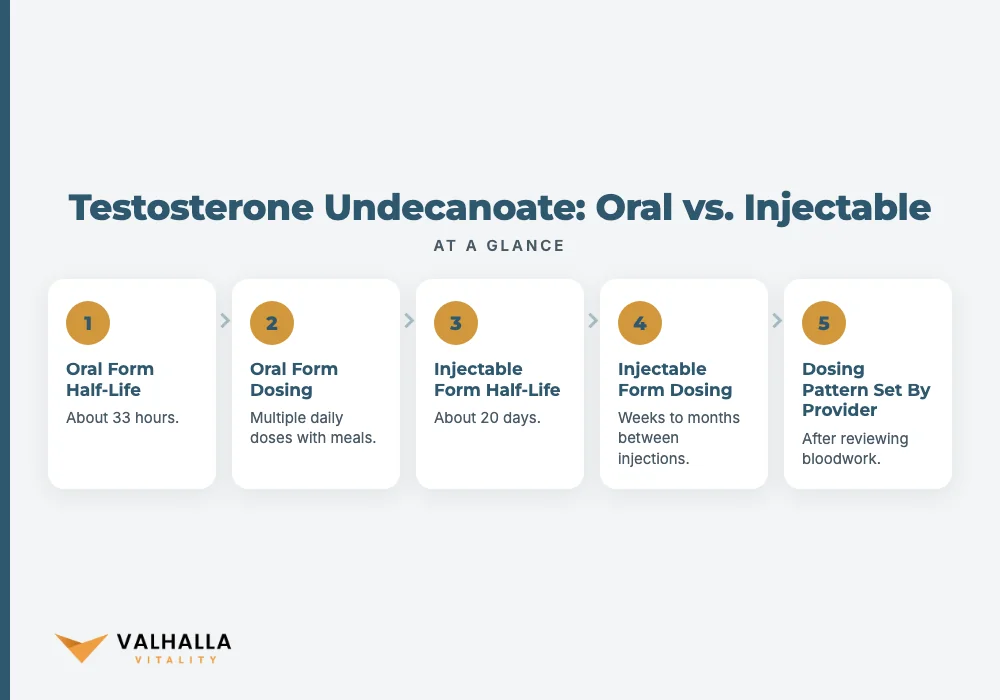
Testosterone undecanoate has been in clinical use since the 1970s. It is available in two forms with fundamentally different pharmacokinetic profiles, despite sharing the same core molecule.
| Form | Approximate half-life | Dosing pattern | Route |
|---|---|---|---|
| Oral testosterone undecanoate | ~33 hours | Multiple doses daily with meals | Capsule |
| Injectable testosterone undecanoate | ~20 days | Weeks to months between injections | Intramuscular |
| Testosterone cypionate (reference) | Shorter (days) | Weekly or bi-weekly | Intramuscular |
The table shows why injectable testosterone undecanoate qualifies as a long-acting testosterone ester: its half-life spans weeks while common short-acting esters measure days. Dosing pattern within each category is set by a licensed provider after reviewing bloodwork, not chosen by the patient.
How long does testosterone undecanoate stay in your system?
Injectable testosterone undecanoate remains active for weeks after a single injection. With a half-life of approximately 20 days, roughly half the compound is still circulating three weeks after the dose. Full clearance takes considerably longer. Each successive half-life removes only half of what remains, so detectable amounts persist well into the second month following administration.
The oral form follows a much shorter timeline. With a half-life near 33 hours, oral testosterone undecanoate largely exits the system within a few days of the last dose. That difference in testosterone undecanoate half life between forms has immediate practical consequences: a missed oral dose affects serum levels noticeably, while a delayed injectable dose carries far less pharmacokinetic consequence over the same short period.
The long half-life of injectable TU also matters for lab interpretation. A blood draw taken weeks after an injection still reflects meaningful drug exposure. Providers need that context when reviewing any testosterone measurement from a patient on this formulation, whether the draw is routine or comes from an unscheduled visit at another facility.
Individual metabolism shapes both timelines more than patients often expect. Age, body composition, liver function, and genetics all affect how quickly testosterone undecanoate is processed and eliminated. A 2023 review in Expert Review of Endocrinology & Metabolism noted that individual pharmacokinetic variability is a central reason TRT protocols require lab-guided adjustments rather than fixed population-average schedules (Fink et al., 2023). Two patients on the same prescribed interval can show meaningfully different trough levels at the same time point after injection.
Routine monitoring accounts for this variability. Providers draw labs at defined points in the dosing cycle to see where levels actually land, then refine the schedule based on real data rather than predicted averages.
What is the half life of oral versus injectable testosterone undecanoate?
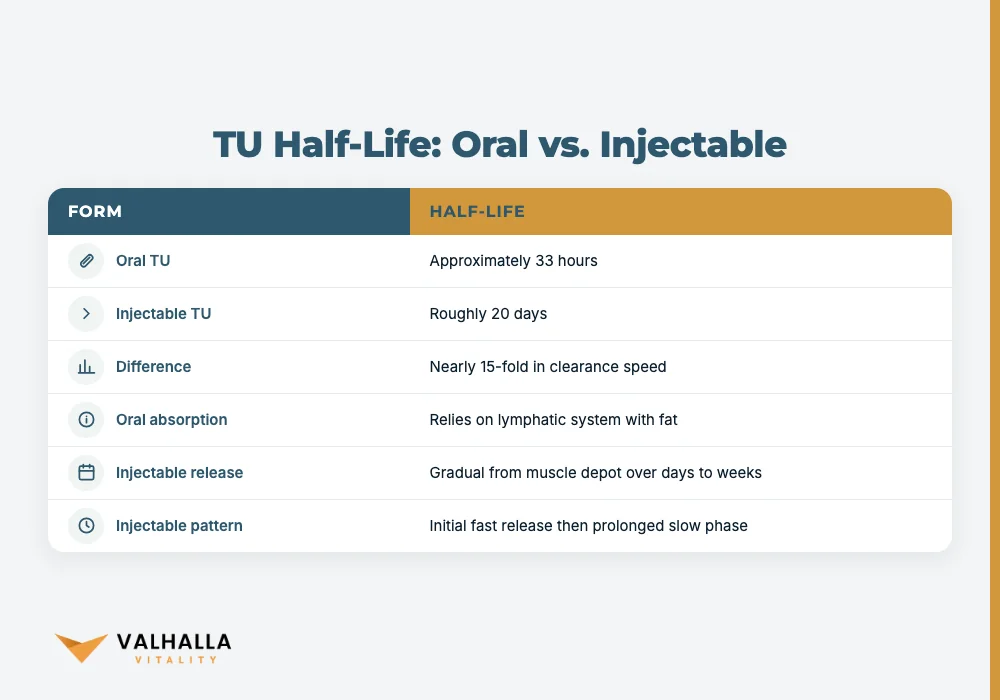
Oral testosterone undecanoate has a half-life of approximately 33 hours. Injectable testosterone undecanoate has a half-life of roughly 20 days. That is nearly a 15-fold difference in clearance speed, driven by how each form enters the bloodstream and how long it stays there.
The oral route relies on lymphatic absorption. After ingestion with a fat-containing meal, testosterone undecanoate bypasses first-pass hepatic metabolism by traveling through intestinal lymphatics rather than the portal vein. Oral testosterone bioavailability depends heavily on adequate dietary fat at the time of ingestion; without it, absorption drops substantially and serum concentrations become unpredictable (Fink et al., 2023).
This food dependency is one reason oral TU requires patient education beyond a simple prescription. The compound then clears at a pace set by hepatic and systemic metabolism, producing the roughly 33-hour half-life seen in pharmacokinetic studies.
The injectable form works through a different mechanism. Testosterone undecanoate is suspended in an oil vehicle and injected directly into muscle tissue. The compound releases gradually from the intramuscular depot into systemic circulation over days to weeks. That slow depot-driven release is the structural basis for the extended half-life and why infrequent injections are clinically feasible with this formulation.
The biphasic release pattern
After an intramuscular injection, plasma testosterone does not follow a single smooth arc. There is an initial phase of comparatively fast hormone release, producing an early peak in serum testosterone shortly after injection. This is followed by a prolonged, slower-release phase sustained by the remaining depot in muscle. Together, the two phases give injectable testosterone undecanoate its characteristic long-duration profile and represent a defining feature of testosterone ester pharmacokinetics at the long-acting end of the spectrum.
The early peak ensures levels rise promptly rather than requiring weeks to build. The sustained tail prevents the sharp trough that shorter esters produce toward the end of their dosing interval. This combination is why stable serum levels are achievable with infrequent injections on this formulation.
Clinically, the biphasic pattern also means that serum testosterone in the days immediately following injection is not representative of steady-state behavior. Providers interpret early-phase draws differently from mid-interval draws, which is why the timing of blood tests matters as much as the tests themselves.
How often should you inject testosterone undecanoate?
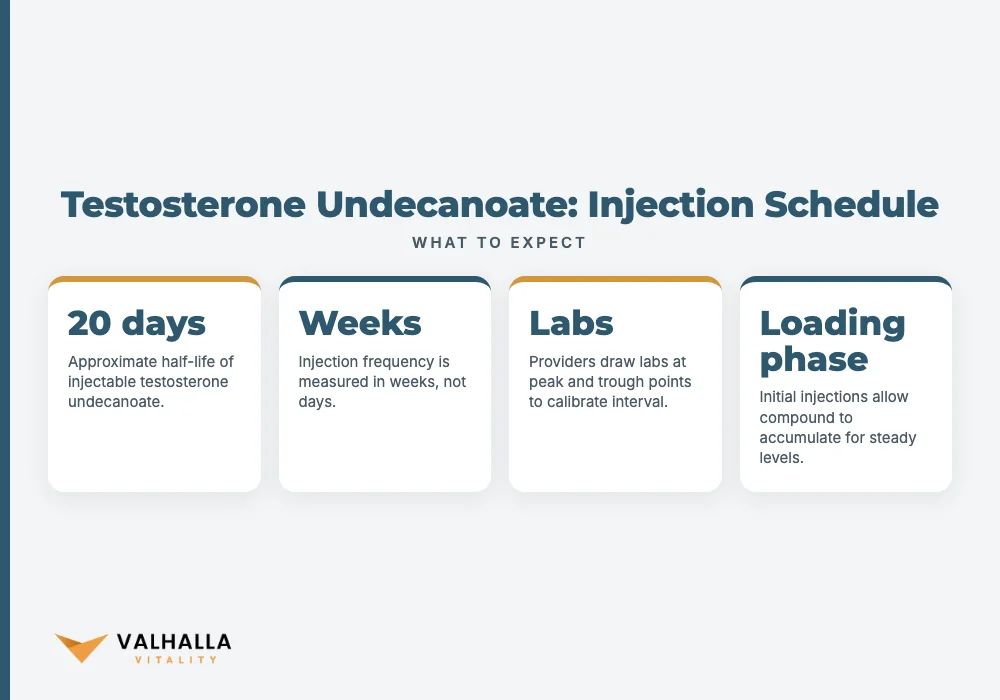
Because testosterone undecanoate half life in the injectable form spans roughly 20 days, TRT injection frequency with this compound, including the Aveed injection schedule, is measured in weeks rather than days. Providers can schedule injections well apart while keeping serum testosterone within the therapeutic range throughout the entire interval.
The exact schedule is not set by the half-life value alone. A licensed provider draws labs at peak and trough points in the dosing cycle, then calibrates the interval based on where values actually land.
Some patients maintain adequate levels across a wide interval; others need tighter scheduling. Neither pattern is predictable from the half-life alone, which is why early-phase monitoring is essential for individualizing the protocol.
The loading phase also requires attention. When initiating treatment or restarting after a break, the intramuscular depot needs time to accumulate sufficient compound for steady-state levels to develop. Providers schedule initial injections with the understanding that stable levels are not reached immediately, and early-phase labs reflect a transitional state rather than the patient's ongoing pharmacokinetic baseline.
Patients transitioning from weekly short-acting esters to injectable testosterone undecanoate often notice an immediate lifestyle difference. Fewer injection appointments and reduced injection anxiety are common observations. The longer interval makes travel and schedule disruption more manageable: a few days' deviation from the planned injection date carries far less pharmacokinetic consequence on a long-acting compound than on a short-acting ester.
The oral form demands a completely different approach. Because oral testosterone bioavailability depends on multiple daily doses to sustain levels across the day, consistency of timing and food pairing matters more than with an injectable protocol. Providers account for this when educating patients newly starting oral TU.
A 2024 systematic review in Frontiers in Endocrinology found that stable testosterone concentrations throughout the treatment interval are associated with improved outcomes across multiple measured TRT endpoints (Xu et al., 2024). That finding underscores why both dosing form and scheduling interval matter.
How does testosterone undecanoate half life affect TRT dosing intervals?
Testosterone undecanoate dosing intervals arise directly from testosterone ester pharmacokinetics. Long half-life means slow clearance. Slow clearance means the compound remains pharmacologically active for an extended period after each dose. That creates a wide dosing window.
Providers can schedule the next injection anywhere within a range that keeps serum testosterone inside the therapeutic band, rather than adhering to a narrow window as required with shorter esters. Testosterone undecanoate dosing therefore allows for real scheduling flexibility once individual pharmacokinetics are established through early monitoring.
The first weeks of treatment serve as the calibration phase. Initial labs drawn at strategic intervals show where peak and trough levels land relative to the prescribed schedule. Subsequent adjustments narrow in on a stable interval. Over time, provider and patient arrive at a schedule where testosterone remains in range across the full cycle without requiring frequent visits.
Once a stable interval is confirmed through monitoring, the dosing rhythm becomes more predictable. Fewer adjustments are needed and lab visits can be spaced further apart.
Dose changes require patience with long-acting compounds. Given testosterone undecanoate half life is approximately 20 days in injectable form, any dose change takes several full cycles before steady state reflects the new level. Drawing labs too soon after an adjustment produces conclusions from a transitional pharmacokinetic state. Providers account for this lag explicitly when planning post-adjustment monitoring.
The calibration process also captures individual testosterone metabolism, shaped by body composition, age, and hormonal feedback. A patient with different metabolic characteristics may clear the compound at a different rate than population averages predict, even at the same prescribed interval.
How does testosterone undecanoate compare to testosterone cypionate in duration?
Testosterone cypionate is one of the most widely prescribed injectable testosterone esters in the United States. Its duration of action is substantially shorter than injectable testosterone undecanoate. Cypionate clears in days, not weeks. That faster clearance requires weekly or bi-weekly injections to maintain stable serum levels, meaning more frequent self-administration compared to injectable TU.
Injectable testosterone undecanoate covers a much longer active window per dose. For patients who prefer fewer injections and can tolerate the longer loading period at treatment initiation, this difference matters. The compound sustains levels across an interval that would require multiple cypionate injections to cover.
The tradeoff is dose adjustment flexibility. Cypionate's shorter half-life lets providers observe the effect of a dose change within weeks. Injectable TU's extended half-life means each adjustment takes more cycles to appear in steady-state labs. If adverse effects emerge, cypionate also clears more quickly, which gives providers faster clinical response time.
No ester is universally superior. Patient lifestyle, monitoring tolerance, symptom history, and individual pharmacokinetics all factor into what a licensed provider recommends. For a detailed breakdown across multiple clinical parameters, the testosterone undecanoate vs cypionate comparison guide covers protocol differences and patient selection criteria in depth.
Why hormonal stability matters in long-acting TRT
Shorter-acting testosterone esters create a concentration cycle: levels peak shortly after injection, then fall gradually toward trough as the compound clears. Patients sensitive to this oscillation may notice symptom recurrence, lower energy, or mood changes in the days before the next scheduled dose.
Injectable testosterone undecanoate's extended half-life reduces the amplitude of that cycle. Levels rise after injection and decline slowly over weeks, producing a flatter profile compared to shorter esters.
The stable pattern that testosterone undecanoate half life enables is not incidental; it is built into the depot-release mechanism of the formulation. This stability may support more consistent energy, mood, and libido throughout the dosing interval, though individual response varies and outcomes are not uniform across patients.
The transition to a stable hormonal pattern takes several weeks with injectable TU, given the loading-phase dynamics of the long half-life. Providers typically defer assessment of therapeutic benefit until steady state is established, which means patience during initiation is part of the clinical protocol.
A 2023 review examining novel methods for treating low testosterone noted that erratic hormone levels may complicate interpretation of symptom response and make it harder to separate treatment effect from natural variation (Fink et al., 2023). A compound with predictable testosterone ester pharmacokinetics provides a cleaner clinical signal. The 2024 systematic review in Frontiers in Endocrinology also found that stable concentrations throughout the treatment interval correlate with improvements across multiple measured TRT endpoints (Xu et al., 2024).
For patients weighing the oral approach to achieving consistent daily levels, how the capsule form fits into hormone therapy protocols covers what providers monitor and how daily dosing with oral TU is structured in practice.
Monitoring and adjusting testosterone undecanoate therapy
Routine lab monitoring remains the cornerstone of safe testosterone undecanoate therapy regardless of formulation. Despite the predictable pharmacokinetics of injectable testosterone undecanoate, individual responses diverge from population averages. Body composition, injection site, technique, and metabolic changes all influence how the compound clears in any given patient.
A structured monitoring approach during initiation typically includes labs at both the peak and trough of the initial dosing cycles. These draws track testosterone levels and screen markers relevant to long-term TRT safety.
Hematocrit is routinely monitored because testosterone replacement can stimulate red blood cell production over time. Prostate-specific antigen is tracked as part of baseline safety screening. Estradiol is often included as well, since testosterone aromatizes to estrogen and elevated estradiol can produce symptoms that overlap with low testosterone deficiency signs.
A 2024 systematic review of TRT outcomes highlighted the importance of multimarker monitoring protocols for long-term safety in testosterone replacement therapy (Xu et al., 2024). Providers at Valhalla Vitality review each patient's individual lab trajectory and adjust protocols based on observed data rather than assumed averages.
For the oral form, the timing of the lab draw relative to the most recent dose matters more than with injectable TU. Oral testosterone bioavailability is influenced by food intake and daily dose timing, so a draw at an inconsistent time point can produce misleading concentration values. Providers typically specify a standardized draw window to maintain comparability across visits.
Dose changes with injectable TU require a waiting period before reassessment. Because testosterone undecanoate half life is roughly 20 days, a new steady state takes several dosing cycles to establish. Reviewing labs too soon after a change reflects a transitional pharmacokinetic state rather than the new baseline.
Switching to or from injectable testosterone undecanoate
Some patients transition to injectable testosterone undecanoate from shorter-acting esters because they prefer fewer injections or because the peaks and troughs of shorter compounds are producing symptom variability between doses. The reverse transition also occurs when tighter dose control is needed.
Both switches require pharmacokinetic planning. When moving from a short ester to injectable TU, residual levels from the previous compound are still declining when the new one begins building. Providers time the first TU injection to avoid either a coverage gap or a supraphysiologic overlap. Getting the timing wrong creates unnecessary hormonal disruption during the transition period.
Moving from injectable TU to a shorter ester requires patience. Given the approximately 20-day half-life, TU levels take weeks to fall meaningfully. The incoming compound cannot establish its own pharmacokinetic rhythm cleanly until TU contributes less to total circulating testosterone. Providers approach this as a slow, planned handover rather than a clean break.
The decision to switch formulations is rarely about pharmacokinetics alone. Lifestyle preferences, injection site tolerance, monitoring availability, and individual response all factor into which form makes most sense for a given patient. A licensed provider weighs these alongside lab results before recommending any formulation change.
For patients considering oral TU as an alternative to injectable therapy, the benefits and practical use of oral testosterone undecanoate covers what differs between formulations and what providers evaluate before recommending a switch.
Ready to discuss your testosterone options?
Book Your Consultation to speak with a licensed provider who can review your labs and evaluate whether testosterone undecanoate fits your clinical picture.
FAQ
How long does testosterone undecanoate stay in your system?
In injectable form, testosterone undecanoate has a half-life of approximately 20 days, so roughly half the dose remains in circulation three weeks after injection. Full clearance extends well into the second month, since each successive half-life removes only half of what remains. The oral form clears much faster, largely within a few days given its ~33-hour half-life.
What is the half life of oral versus injectable testosterone undecanoate?
Oral testosterone undecanoate has a half-life of approximately 33 hours, while injectable testosterone undecanoate has a half-life of roughly 20 days. The difference comes from route of absorption: oral TU travels through intestinal lymphatics and clears relatively quickly, while injectable TU releases slowly from an intramuscular oil depot over weeks.
How often should you inject testosterone undecanoate?
A licensed provider determines injection frequency based on lab results, not the half-life value alone. The approximately 20-day half-life of injectable testosterone undecanoate allows for intervals of weeks to months in many patients, but the exact schedule depends on individual pharmacokinetics and where peak and trough levels fall during monitoring.
How does testosterone undecanoate half life affect TRT dosing intervals?
The approximately 20-day half-life of injectable testosterone undecanoate means levels decline slowly and predictably after each dose, giving providers a wide window to schedule the next injection while keeping serum testosterone in range. Providers use peak and trough lab draws to calibrate the interval and adjust if values fall outside the therapeutic target.
How does testosterone undecanoate compare to testosterone cypionate in duration?
Injectable testosterone undecanoate has a substantially longer half-life than testosterone cypionate, which clears in days rather than weeks. Cypionate requires weekly or bi-weekly injections to maintain stable levels, while injectable TU allows much longer intervals between doses. The tradeoff is slower dose adjustment, since long-acting compounds take more cycles to reach a new steady state after a change.
Sources
- Fink J et al. (2023). Novel methods for the treatment of low testosterone. Expert Review of Endocrinology & Metabolism. PubMed
- Xu Z et al. (2024). An updated systematic review and meta-analysis of the effects of testosterone replacement therapy on erectile function and prostate. Frontiers in Endocrinology. PubMed
You May Also Like
 Oral Testosterone Undecanoate
Testosterone Decanoate vs Undecanoate: Key Differences
Testosterone decanoate vs undecanoate: compare half-life, injection frequency, and oral absorption to choose the right TRT ester for your needs.
October 7, 2026 ETRead more → Oral Testosterone Undecanoate
Testosterone Undecanoate Oral Dosage: Complete TRT Guide
Testosterone undecanoate oral dosage is set by a licensed provider after lab review. Understand oral TRT protocol, Kyzatrex dosage, and key dosing factors.
October 7, 2026 ETRead more → Oral Testosterone Undecanoate
Testosterone Undecanoate vs Cypionate: Full TRT Guide
Testosterone undecanoate vs cypionate: compare esters, injection frequency, side effects, and oral TRT options to discuss with your provider.
October 6, 2026 ETRead more →