Oral Testosterone Replacement: Pill vs Injection Guide

The following blog post is for entertainment and informational purposes only. It is not intended to provide medical advice or diagnosis. Please consult your doctor before making any health-related decisions.
Oral testosterone replacement is a clinically established approach to treating hypogonadism that uses capsules rather than injections or topical gels. No needle required. Modern testosterone undecanoate formulations absorb through the intestinal lymphatic system, bypassing the liver's first-pass metabolism and reaching systemic circulation at clinically useful hormone levels. A licensed provider can discuss oral testosterone undecanoate capsule options with you after reviewing your labs and health history.
How is oral testosterone absorbed in the body?
Understanding oral T bioavailability starts with a chemistry problem that made early versions of this therapy fail. When testosterone is swallowed and absorbed through the intestinal wall, it enters the portal vein, which routes blood directly to the liver. The liver degrades most of it. Older oral testosterone pills couldn't overcome this bottleneck without raising doses to levels that raised liver toxicity concerns, so early formulations failed clinically.
Modern testosterone undecanoate capsules solve this problem differently. The hormone is formulated with lipid excipients, and when taken with a fat-containing meal, it disperses into the gut's fatty contents and absorbs into the intestinal lymphatic system rather than the portal blood supply. Lymphatic drainage routes the hormone through the thoracic duct into venous blood, bypassing the liver entirely on the first pass. This pharmacological mechanism is what made FDA approval of oral testosterone undecanoate possible. Earlier oral testosterone products couldn't achieve it.
The clinical implication is significant. The current generation of testosterone undecanoate capsules passed the clinical bar for hormone delivery that earlier oral products failed to meet. That distinction matters when comparing oral testosterone replacement against older assumptions about what pills can and can't do.
What affects oral T bioavailability
Not all the testosterone in a capsule reaches the bloodstream. Several practical variables shape how much actually does.
Fat at each dose. This is the most critical factor. Testosterone undecanoate requires concurrent dietary fat for lymphatic uptake to function effectively. Skip the fat, and bioavailability drops enough to miss the therapeutic target. This is a concrete daily constraint that separates oral TRT from injections or gels, neither of which depends on what you ate at lunch.
Individual variation. Age, body composition, gut health, and metabolic status all influence how a person absorbs and clears testosterone undecanoate. Two men on identical regimens can show measurably different serum levels. This is exactly why regular bloodwork and provider-led adjustments are built into oral TRT protocols rather than being optional.
Consistency. Missed doses, irregular timing, or poor meal pairing produce hormonal fluctuations that oral TRT is specifically designed to avoid. Stability requires steady adherence.
Is oral TRT as effective as testosterone injections?
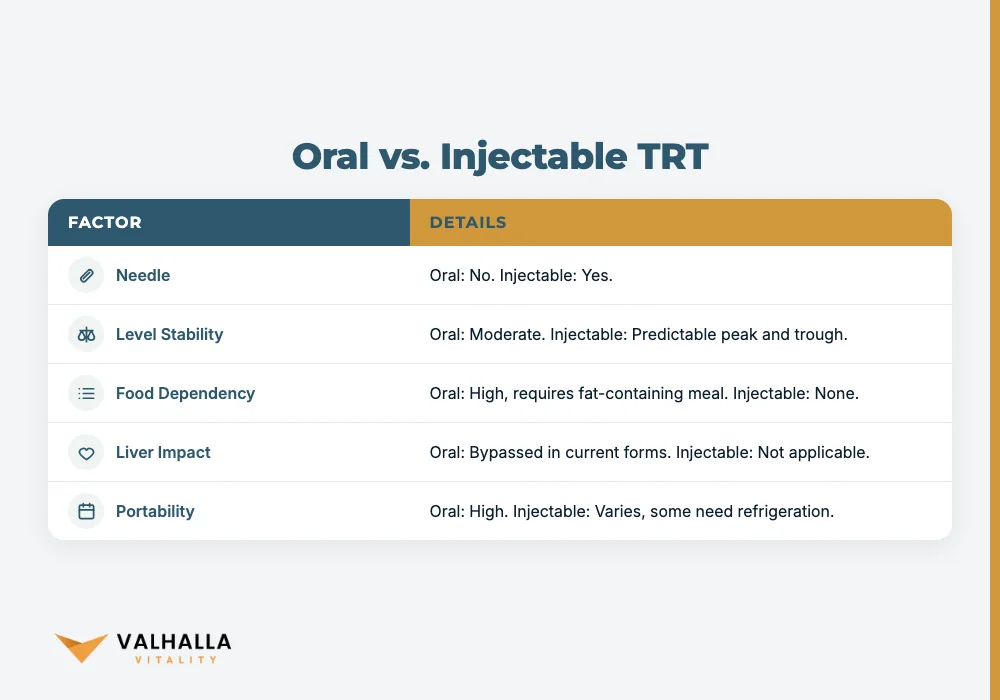
This is the central question behind every testosterone pill vs injection comparison, and behind searches like "jatenzo vs injections" specifically. Both delivery methods can raise serum testosterone into the normal physiological range. Where they differ is in how consistently they maintain levels, what the day-to-day administration looks like, and what factors outside the clinic affect them.
Both oral capsules and testosterone injections have been evaluated against defined hormone targets in clinical settings. The comparison below reflects how each method performs in real-world conditions, not just in an ideal protocol environment.
| Factor | Oral testosterone undecanoate | Injectable testosterone |
|---|---|---|
| Needle required | No | Yes |
| Absorption route | Intestinal lymphatic system; requires fat-containing meal | Intramuscular or subcutaneous injection |
| Level stability | Moderate; depends on dosing consistency and meal fat content | Predictable peak-and-trough pattern between injection intervals |
| Liver first-pass metabolism | Bypassed in current formulations | Not applicable |
| Food dependency | High; fat-containing meal required with each dose | None |
| Portability | High; stable at room temperature | Varies; oil-based formulations may require refrigeration |
| Blood pressure monitoring | Boxed warning on approved oral capsules | Standard TRT monitoring |
| Spermatogenesis impact | Suppresses sperm production | Suppresses sperm production |
Looking at that table practically: the absence of needles matters to some men far more than level stability. The absence of food dependency matters to others more than oral convenience. There is no universal winner. A licensed provider weighs the delivery method against the patient's clinical profile and daily reality, not a default preference for one route.
Injections carry a longer clinical track record. TRT without injections suits men who are needle-averse, travel frequently, or need to avoid the scheduling demands that injection administration adds. Both are legitimate clinical routes when prescribed appropriately.
For a practical side-by-side analysis of oral vs injectable TRT delivery methods, that resource covers how the two approaches compare across real patient scenarios.
Does oral testosterone replacement therapy actually work?
In a monitored clinical setting, yes, it can. A well-managed oral testosterone replacement regimen using testosterone undecanoate can raise serum testosterone into the normal range and support the effects associated with testosterone restoration: improved energy, better mood, increased libido, support for lean muscle mass, and stronger bones.
The broader TRT evidence base supports these effects. A 2024 systematic review and meta-analysis in Frontiers in Endocrinology found that testosterone replacement therapy was associated with meaningful improvements in erectile function (Xu Z et al., 2024). That review covered TRT across delivery methods. The underlying hormonal mechanism applies consistently to oral formulations as well.
What "working" means in practice is measurable. Testosterone levels rise into the normal physiological range, hold there across doses, and produce symptom improvement that shows up on clinical reassessment. Some patients stabilize quickly. Others need protocol adjustments before the regimen reaches its target. The monitoring structure is what allows those adjustments to happen.
Whether oral testosterone replacement works for a specific person depends on whether serum levels actually normalize on the regimen, how the individual metabolizes the formulation, and whether symptoms respond on follow-up testing. A licensed provider determines the dose after labs and schedules monitoring visits to track the response over time.
Oral TRT is a managed medical intervention. Not an assured outcome. That expectation matters.
Who is a good candidate for oral TRT?
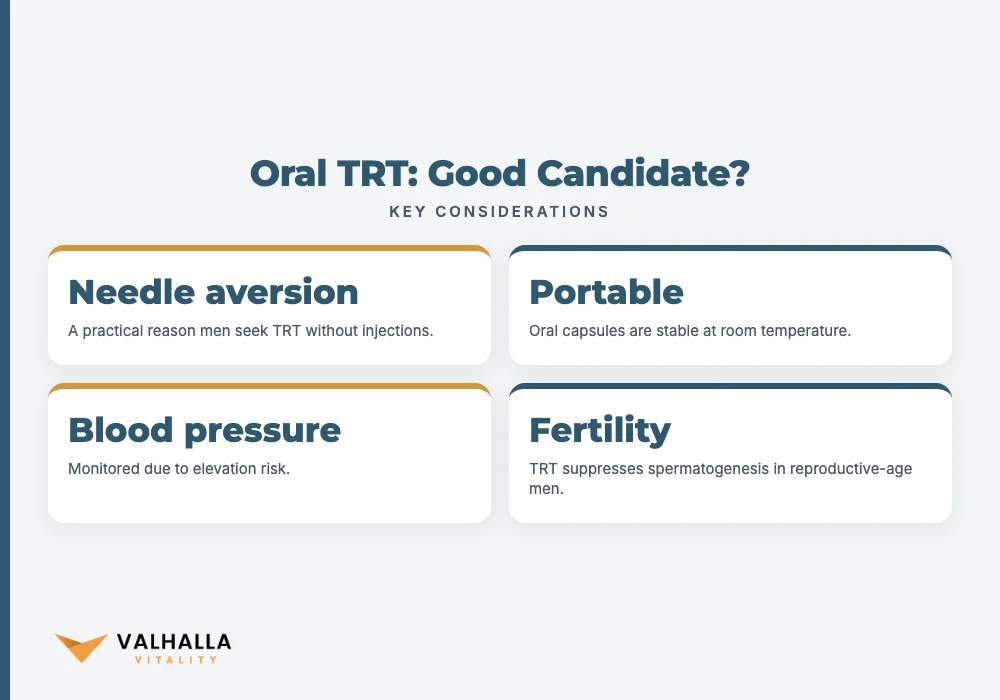
Not every man with documented low testosterone is the right fit for oral delivery specifically. A provider reviewing someone for oral testosterone replacement candidacy does more than confirm a low lab result. The assessment covers cardiovascular status, current medications, and health history for formulation-specific contraindications, and whether the patient's daily routine supports the adherence requirements that oral TRT needs to perform well.
Needle aversion or injection anxiety. The most practical reason men seek TRT without injections is that the prospect of weekly self-injection creates a genuine barrier to starting therapy. Remove that barrier, and compliance improves. A therapy someone consistently takes outperforms a theoretically superior one they find reasons to avoid.
Travel and daily schedule. Oral capsules are portable and stable at room temperature. No cold-chain storage, no sharps disposal, no clinic scheduling required. Men whose work or travel patterns are unpredictable often find consistent daily capsule dosing far easier to sustain than injection protocols.
Blood pressure baseline. This is a clinical screen, not a lifestyle preference. Testosterone undecanoate capsules carry a boxed warning for blood pressure elevation. A provider checks baseline blood pressure before prescribing and monitors it throughout treatment. Men with uncontrolled hypertension may not be appropriate candidates for this formulation.
Fertility intentions. This applies across all TRT delivery methods. A 2025 review in Nature Reviews Urology confirmed that testosterone replacement therapy consistently suppresses spermatogenesis in reproductive-age men (Naelitz BD et al., 2025). Men who plan to father children should discuss fertility preservation options with their provider before starting any form of TRT.
Broader clinical profile. Some lab findings, medical histories, or coexisting conditions make injections or topical delivery a better clinical fit. The provider review process makes that determination. No candidacy assessment can happen from reading an article alone.
What are the risks of taking testosterone orally?
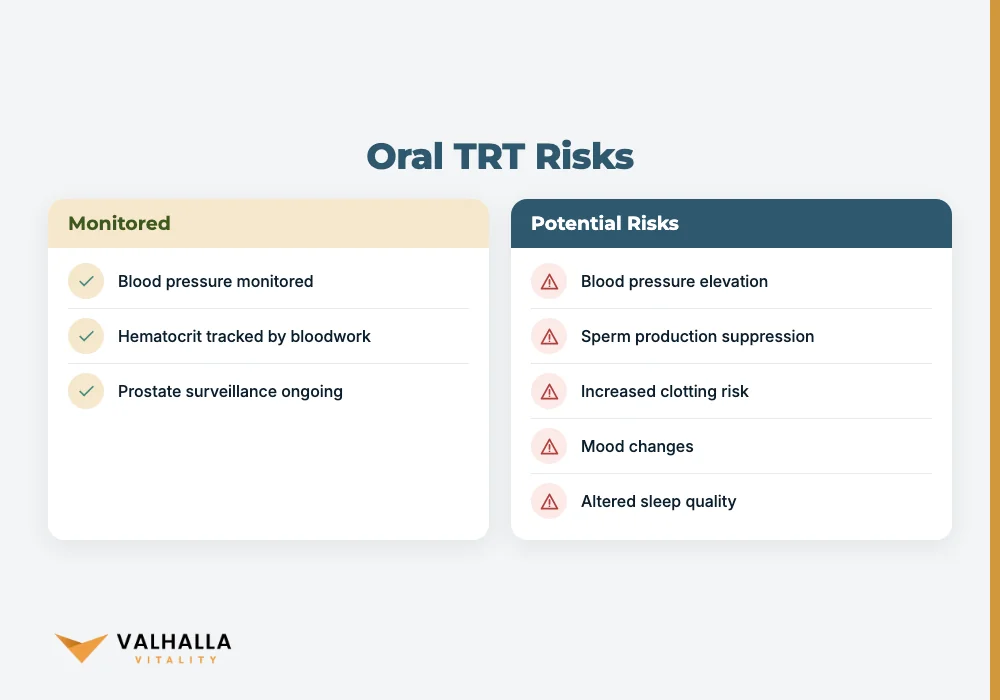
TRT pill side effects are real. Oral testosterone replacement carries one formulation-specific concern more prominent with capsules than with other TRT delivery methods, alongside the category-level risks that apply to TRT in general. Understanding the full risk profile before starting is part of making an informed decision alongside a provider.
Blood pressure elevation. This is the boxed warning on oral testosterone undecanoate capsules. Clinical data showed a statistically meaningful signal for blood pressure increases, sufficient for regulatory attention. Providers monitor blood pressure at baseline and at each follow-up visit. If levels rise and cannot be controlled, discontinuation is the standard response.
Spermatogenesis suppression. Testosterone replacement suppresses the hypothalamic-pituitary-gonadal axis, reducing the gonadotropin signals that drive sperm production. The effect can be significant and may not fully recover after stopping therapy. A 2025 review in Nature Reviews Urology confirmed this is a consistent finding in reproductive-age men on TRT (Naelitz BD et al., 2025).
Polycythemia. Testosterone stimulates red blood cell production. Elevated hematocrit raises clotting risk. Providers track hematocrit through regular bloodwork and adjust or pause therapy if levels climb too high.
Prostate surveillance. TRT's relationship with the prostate is closely studied in hormone medicine. A 2024 meta-analysis in Frontiers in Endocrinology found no significant increase in adverse prostate outcomes among monitored TRT patients (Xu Z et al., 2024). Ongoing surveillance remains standard practice regardless.
Mood and sleep changes. Some men report irritability or altered sleep quality during the early weeks of treatment while hormone levels are adjusting. These effects typically resolve or improve with provider-directed protocol changes.
The safety profile of oral TRT is manageable within a supervised clinical framework. A licensed provider determines the dose after labs and tracks the biomarkers that can catch developing problems early. That structure is the difference between managed therapy and unmonitored hormone use.
For a broader view of how testosterone therapy delivery types compare in terms of risk exposure and monitoring requirements, that resource breaks down each method in detail.
How oral testosterone replacement is prescribed
Oral testosterone requires a prescription in the United States. No over-the-counter product holds FDA approval for treating hypogonadism. A licensed provider must evaluate lab results, review health history, and make the prescribing decision before any capsule is dispensed.
Valhalla Vitality offers provider-reviewed testosterone therapy through a telehealth model. The process starts with completing an online medical intake form. A licensed provider reviews the submission within 24 business hours of order placement. If approved, the prescription goes to a partner US compounding pharmacy. Delivery typically takes 3 to 7 business days from the date the prescription is transmitted. Availability varies by state.
Monitoring continues after the first prescription. Follow-up testosterone levels, blood pressure checks, and hematocrit measurements are part of a proper oral TRT protocol. Providers use those results to confirm whether the regimen is producing target hormone levels and whether any early risk signals need attention. This is an ongoing clinical process, not a one-time transaction.
Ready to take the next step?
If oral testosterone replacement seems worth exploring for your situation, the place to start is a licensed provider review, not a self-assessment. Book Your Consultation to connect with a licensed provider who can evaluate your labs and symptoms.
FAQ
Is oral testosterone replacement safe?
Oral testosterone undecanoate capsules carry a boxed warning for elevated blood pressure. A licensed provider determines whether the therapy is appropriate after reviewing your health history and monitors blood pressure and key lab markers throughout treatment.
How long does it take for oral TRT to show results?
Individual timelines vary and no specific response window can be predicted with certainty. Providers typically reassess symptom response and recheck lab values after several weeks of consistent therapy, then adjust the protocol based on those results.
Can oral testosterone replacement affect fertility?
Yes. Testosterone replacement in any form suppresses the hormonal signals that drive sperm production, and a 2025 review confirmed this effect is consistent across reproductive-age men on TRT. Men who plan to father children should discuss fertility preservation options with their provider before starting any form of treatment.
Does oral TRT require a prescription?
Yes. All regulated oral testosterone products in the United States are prescription-only. A licensed provider must evaluate lab results and health history before any prescription can be written.
What is the difference between oral TRT and testosterone supplements?
Prescription oral TRT delivers actual testosterone hormone through a regulated formulation designed for clinical hormone replacement. Over-the-counter testosterone supplements contain no actual testosterone and are not approved for or capable of treating clinically diagnosed hypogonadism.
Sources
- Xu Z et al. (2024). An updated systematic review and meta-analysis of the effects of testosterone replacement therapy on erectile function and prostate. Frontiers in endocrinology. PubMed
- Naelitz BD et al. (2025). Testosterone replacement therapy and spermatogenesis in reproductive age men. Nature reviews. Urology. PubMed
You May Also Like
 Oral testosterone
Oral Testosterone Therapy: Energy, Side Effects & Results
Oral testosterone therapy may improve energy and ease fatigue in men with low T. Learn how it works, what side effects to expect from treatment.
October 7, 2026 ETRead more → Oral testosterone
Oral Testosterone Fertility: How TRT Affects Sperm
Oral testosterone fertility: TRT typically reduces sperm production. Learn what the research shows and how to protect your reproductive options.
October 7, 2026 ETRead more → Oral testosterone
Oral Testosterone Therapy: Options, Benefits, and Risks
Oral testosterone therapy delivers TRT in pill form. Learn how testosterone undecanoate capsules work, who qualifies, and key side effects to watch.
October 6, 2026 ETRead more →