Enclomiphene and TRT Together: Benefits and Evidence

The following blog post is for entertainment and informational purposes only. It is not intended to provide medical advice or diagnosis. Please consult your doctor before making any health-related decisions.
Using enclomiphene and TRT together lets providers raise testosterone while preserving the pituitary signals that standard TRT suppresses. TRT delivers exogenous hormone but shuts down LH and FSH output, which drives testicular atrophy and falling sperm counts over time. Enclomiphene, a selective estrogen receptor modulator (SERM), blocks the estrogen feedback that would otherwise keep those gonadotropins switched off. For men comparing these two approaches as standalone options, the combination occupies a distinct clinical middle ground.
Why TRT alone suppresses natural production
Testosterone replacement therapy introduces testosterone directly into the bloodstream. The hypothalamic-pituitary-gonadal (HPG) axis responds by scaling back its own output. LH drops. FSH follows.
That is efficient for symptom relief. But endogenous production slows significantly. Testosterone therapy side effects men commonly report, including testicular atrophy and declining sperm counts, trace back to this same HPG suppression. Knowing which TRT approach fits your situation can clarify whether adding enclomiphene makes clinical sense.
Here is what each component contributes:
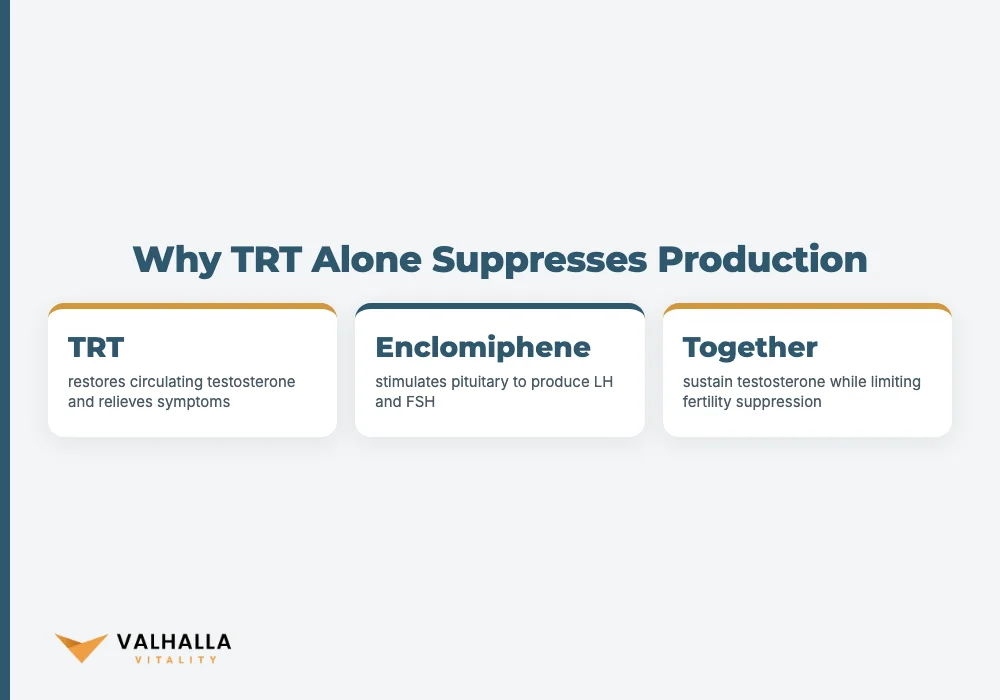
- TRT restores circulating testosterone and relieves symptoms such as low energy, reduced libido, and muscle loss.
- Enclomiphene stimulates the pituitary to keep producing LH and FSH, which signals the testes to generate testosterone naturally.
- Together, they may sustain testosterone levels while limiting the fertility suppression that TRT causes on its own.
What does enclomiphene do when combined with TRT?
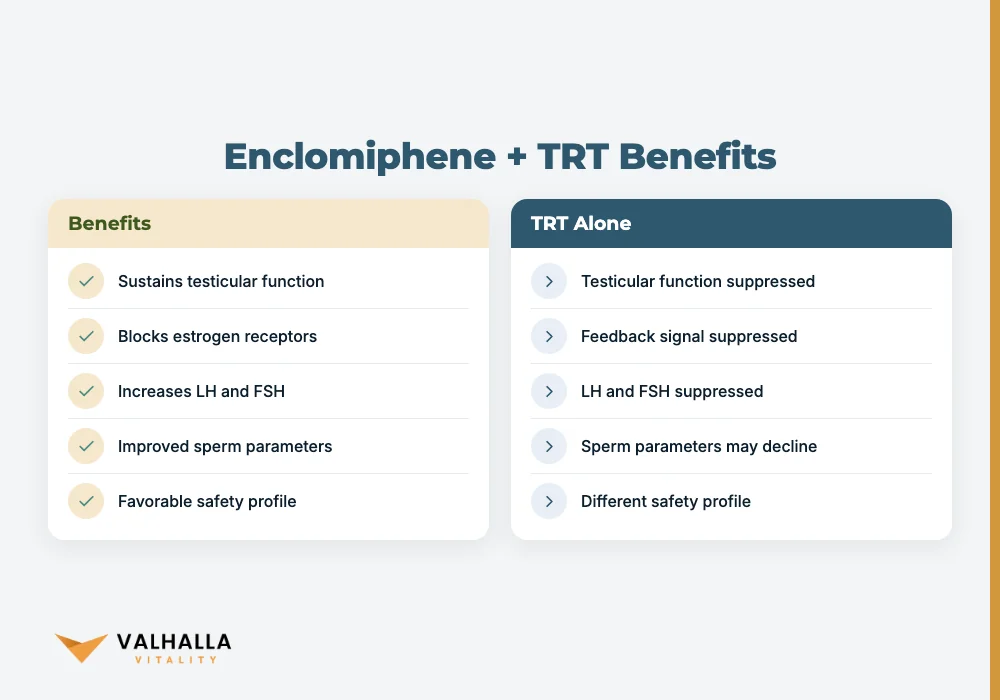
Enclomiphene acts at the pituitary level while TRT provides circulating hormone. It blocks estrogen receptors in the hypothalamus and pituitary, interrupting the feedback signal that would otherwise suppress LH and FSH release. The testes keep receiving stimulation. They continue producing testosterone even while exogenous hormone is already circulating.
A 2016 review in Expert Opinion on Pharmacotherapy by Rodriguez et al. found enclomiphene citrate effective at increasing LH, FSH, and serum testosterone in men with secondary hypogonadism, with improved sperm parameters compared to placebo. Those findings have since been replicated. A 2025 systematic review and meta-analysis in Archives of Endocrinology and Metabolism by Hohl et al. confirmed consistent enclomiphene testosterone levels improvements and gonadotropin increases across randomized controlled trials, with a favorable safety profile versus testosterone monotherapy.
The practical implication: using enclomiphene and TRT together may sustain testicular function that TRT alone suppresses.
Can you take enclomiphene while on TRT?
Yes, though the decision depends on the clinical picture. Providers typically consider the combination when a man on TRT wants to preserve fertility or avoid full testicular atrophy. It is not a default add-on for every TRT patient. A licensed provider determines whether enclomiphene and TRT together is appropriate after reviewing lab values, symptoms, and fertility goals.
Secondary hypogonadism, where the problem originates in the hypothalamus or pituitary rather than the testes, is the condition with the strongest clinical evidence for this approach. For primary hypogonadism, where the testes themselves are the issue, adding enclomiphene has less established rationale because the stimulation pathway the drug relies on is already compromised.
How does enclomiphene affect LH and FSH levels on TRT?
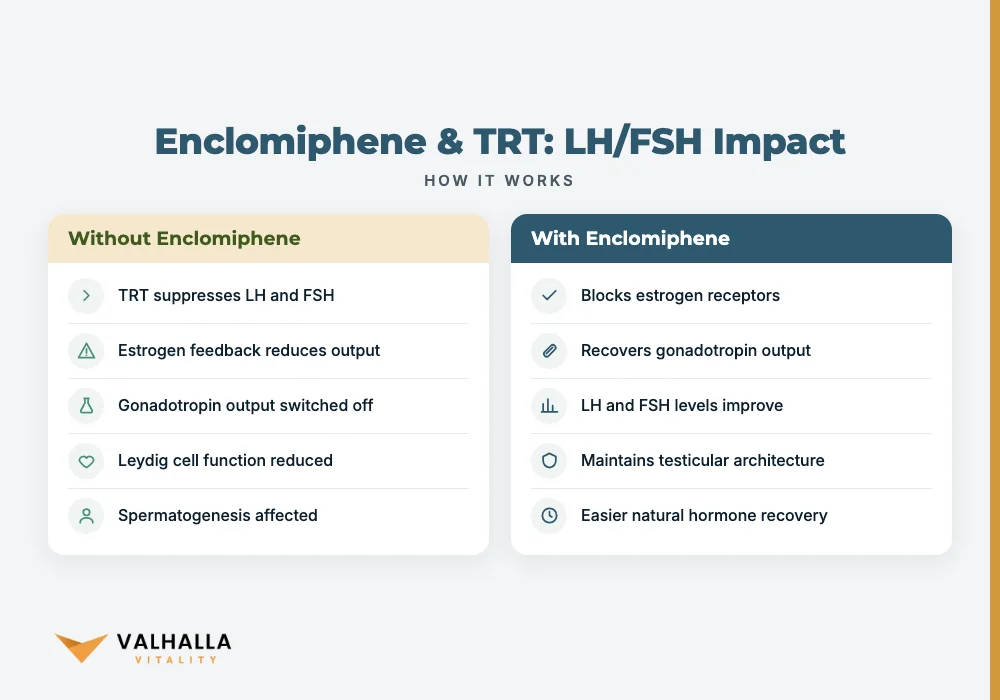
TRT nearly suppresses both LH and FSH to negligible levels, which is the core problem this combination addresses. The enclomiphene LH FSH boost mechanism works by blocking estrogen feedback that would otherwise keep gonadotropin output switched off.
Enclomiphene selectively blocks estrogen receptors at the pituitary and hypothalamus. Estrogen normally signals the brain to reduce LH and FSH release. Block that signal, and gonadotropin output recovers even under the suppressive influence of exogenous testosterone. This mechanism produces the LH and FSH boost that makes enclomiphene clinically useful in men on TRT.
In the 2016 Rodriguez et al. review, enclomiphene testosterone levels improved significantly alongside LH and FSH restoration in men with secondary hypogonadism. The 2025 Hohl et al. meta-analysis confirmed similar gonadotropin improvements across multiple randomized trials.
LH drives Leydig cell function and FSH drives spermatogenesis. Maintaining both signals preserves testicular architecture, which makes it easier to recover natural hormone production if TRT is ever discontinued.
Does enclomiphene restore fertility during testosterone therapy?
Enclomiphene may help preserve fertility during testosterone therapy, though full restoration is not assured. Standard TRT suppresses sperm production significantly, often rendering men functionally infertile during treatment, because without LH and FSH the testes stop producing sperm.
Adding enclomiphene while on testosterone provides TRT sperm production support by maintaining FSH levels above the threshold needed for spermatogenesis. The 2025 Hohl et al. meta-analysis reported improvements in sperm count, motility, and morphology in men combining enclomiphene with testosterone therapy compared with TRT alone.
Enclomiphene fertility on testosterone therapy outcomes depend on baseline testicular function, how long TRT has been used, and the protocol a provider designs. For a fuller picture of how testosterone therapy affects sperm counts, the interaction between exogenous hormones and male fertility is covered in detail.
Is it safe to stack enclomiphene with testosterone injections?
The safety profile for enclomiphene in clinical trials is generally favorable. Common side effects include headache, nausea, fatigue, and changes in libido. More serious events such as elevated liver enzymes are rare (Hohl et al., 2025).
A 2024 evidence synthesis in Health Technology Assessment by Cruickshank et al. identified cardiovascular and hematologic monitoring as key safety requirements for men on testosterone therapy. Adding enclomiphene introduces additional variables, particularly around estrogen signaling, so lab monitoring becomes more important, not less.
A licensed provider determines the appropriate approach after reviewing baseline health, labs, and specific goals. Regular monitoring of testosterone during long-term treatment is a standard component of safe management.
Who benefits from enclomiphene and TRT together?
Not every man on TRT needs enclomiphene. The combination is most commonly considered for three groups: men who want to maintain sperm production while on testosterone therapy; men who may want to discontinue TRT at some point and want to preserve recovery potential; and men with confirmed secondary hypogonadism where the HPG axis is intact but underactive.
Providers typically look at FSH, LH, and often a semen analysis before making this decision. If you are still working out whether your symptoms reflect a primary or secondary issue, the team at Valhalla Vitality can guide that evaluation before any protocol is recommended.
Ready to find out if this protocol fits you?
Book Your Consultation to speak with a licensed provider who reviews your labs and discusses whether combining enclomiphene and TRT is the right approach for your situation.
FAQ
Can you take enclomiphene while on TRT?
Yes, and providers typically consider it for men who want to preserve fertility or testicular function during testosterone therapy. The combination is not automatic; a licensed provider evaluates lab values, hypogonadism type, and fertility goals before prescribing enclomiphene alongside TRT. It is not appropriate for all patients.
Does enclomiphene restore fertility during testosterone therapy?
Enclomiphene may help maintain spermatogenesis by keeping FSH elevated, which TRT alone suppresses. The 2025 Hohl et al. meta-analysis reported improvements in sperm count, motility, and morphology when enclomiphene was added to testosterone therapy. Full fertility restoration is not assured and depends on baseline testicular function and protocol duration.
What does enclomiphene do when combined with TRT?
Enclomiphene blocks estrogen feedback at the pituitary and hypothalamus, preventing TRT from fully shutting down LH and FSH. This keeps the testes stimulated to produce testosterone and sperm even while exogenous hormone is present. The result is higher endogenous testicular activity alongside the testosterone TRT delivers.
How does enclomiphene affect LH and FSH levels on TRT?
TRT substantially reduces both LH and FSH by satisfying the HPG axis with exogenous hormone. Enclomiphene blocks the estrogen signal driving that suppression, which partially restores gonadotropin output. The 2016 Rodriguez et al. review documented significant LH and FSH recovery in men with secondary hypogonadism on enclomiphene therapy.
Is it safe to stack enclomiphene with testosterone injections?
Clinical trials show a generally favorable safety profile for enclomiphene, with common side effects including headaches, nausea, and fatigue. Rare events include elevated liver enzymes and cardiovascular changes, which is why regular lab monitoring is essential. A licensed provider determines dosing and monitors safety throughout any combined protocol.
Sources
- Rodriguez KM et al. (2016). Enclomiphene citrate for the treatment of secondary male hypogonadism. Expert Opinion on Pharmacotherapy. PubMed
- Hohl A et al. (2025). Clomiphene or enclomiphene citrate for the treatment of male hypogonadism: a systematic review and meta-analysis of randomized controlled trials. Archives of Endocrinology and Metabolism. PubMed
- Cruickshank M et al. (2024). The effects and safety of testosterone replacement therapy for men with hypogonadism: the TestES evidence synthesis and economic evaluation. Health Technology Assessment. PubMed
You May Also Like
 Enclomiphene, Testosterone
Enclomiphene vs TRT: side effects, fertility, and fit
Enclomiphene vs TRT: how each works, what side effects to expect, and which fits your clinical picture. A licensed provider decides after labs.
October 20, 2026 ETRead more → Liraglutide, Semaglutide
Liraglutide Side Effects: What Patients Need to Know
Liraglutide side effects range from nausea to rare but serious risks. Learn what to expect, how long they last, and when to call your provider.
November 1, 2026 ETRead more → Liraglutide, Semaglutide
Liraglutide for Weight Loss: How It Works and Results
Liraglutide for weight loss is a GLP-1 weight loss injection that curbs appetite. Learn how it works, expected results, and common side effects.
November 1, 2026 ETRead more →