
The following blog post is for entertainment and informational purposes only. It is not intended to provide medical advice or diagnosis. Please consult your doctor before making any health-related decisions.
Enclomiphene dosage is set by a licensed provider based on your labs, not by a general guideline. A provider reviews your hormone panel, symptoms, and medical history before deciding whether enclomiphene is appropriate and what starting protocol makes sense. Regular lab monitoring then determines whether any adjustments are needed over time. To start the evaluation, a structured provider consultation is the first step.
How enclomiphene works: the HPG axis
Understanding the mechanism behind enclomiphene explains why dosage decisions are always lab-driven.
Enclomiphene is the trans-isomer of clomiphene. Non-steroidal. It blocks estrogen receptors at the hypothalamus, which prompts the hypothalamus to increase gonadotropin-releasing hormone (GnRH) output. The pituitary responds by releasing more luteinizing hormone (LH) and follicle-stimulating hormone (FSH).
LH signals the testes to produce testosterone. FSH supports sperm development. Both outcomes happen through the body's existing signaling pathway rather than by introducing synthetic testosterone from outside. That distinction defines the therapy's clinical profile.
Testosterone replacement therapy (TRT) takes a different path. It adds testosterone directly to the bloodstream. When the hypothalamus detects adequate circulating testosterone, it reduces GnRH output. LH and FSH fall. Sperm production typically declines. Enclomiphene does the opposite: it raises LH and FSH, which drives the testes to produce more testosterone on their own.
For men with secondary hypogonadism, a condition where the testes retain the capacity to produce testosterone but the upstream signal from the pituitary or hypothalamus is insufficient, enclomiphene restores that signal without bypassing the system entirely.
Enclomiphene for low testosterone: who gets evaluated
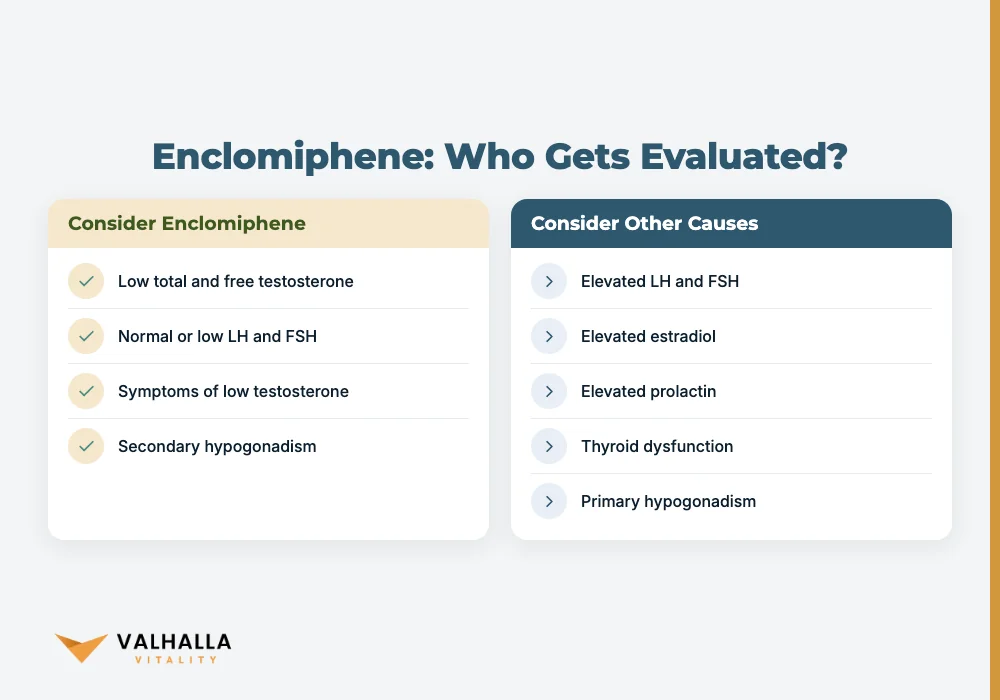
Not every man who feels fatigued will test low for testosterone. Not every man with low testosterone qualifies for enclomiphene. The provider's evaluation separates these scenarios before any protocol begins.
Men presenting with fatigue, reduced libido, mood changes, or difficulty concentrating often suspect a testosterone issue. Labs may confirm that, or they may point elsewhere. A thorough evaluation considers the full hormonal picture before any enclomiphene dosage decision is made.
Here is what the assessment typically includes:
- Total and free testosterone to establish actual baseline levels
- LH and FSH to distinguish primary from secondary hypogonadism
- Estradiol since elevated estrogen can suppress testosterone independently
- Prolactin to rule out a pituitary cause
- Thyroid panel because thyroid dysfunction produces symptoms that closely resemble low testosterone
- Complete metabolic panel and CBC to assess liver and blood health
- Symptom history, including duration and effect on daily function
This evaluation matters for one specific reason: enclomiphene addresses secondary hypogonadism, not primary. If LH is normal or elevated while testosterone is low, the testes are the problem, not the signal. Enclomiphene amplifies the signal. It cannot compensate for a non-responsive testicular response.
Men researching enclomiphene for low testosterone and what an evaluation involves usually want to understand their options before committing to any path. That order, evaluation first and protocol second, is exactly how providers approach it.
What is the recommended enclomiphene dosage for men?
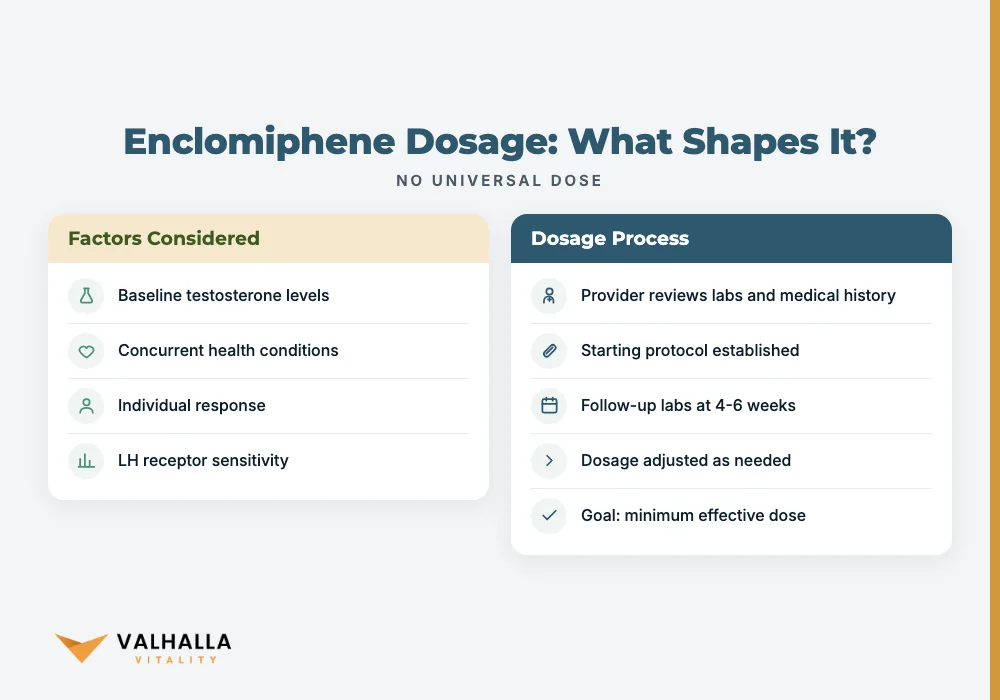
A licensed provider determines the appropriate enclomiphene dosage after reviewing labs, not before. There is no universal recommended dose because LH receptor sensitivity, baseline testosterone levels, concurrent health conditions, and individual response all differ between patients.
Reference amounts vary across clinical literature and patient searches; a provider determines the protocol/dose after labs, not from a general guide. These are data points from research on secondary hypogonadism, not universal starting recommendations. Whether any specific amount applies to a patient depends on their labs and provider judgment.
The process that leads to a confirmed enclomiphene dosage follows a consistent structure. First, a provider reviews baseline labs and medical intake. If the profile supports moving forward, a starting protocol is established. Follow-up labs at four to six weeks show whether LH, FSH, and testosterone are responding. The provider then decides whether the enclomiphene dosage stays the same, increases, or decreases.
Not every patient reaches a stable protocol on the first round. Some require two or three adjustment cycles before the right level is confirmed. The goal is the minimum effective enclomiphene dosage that produces a durable hormonal response, not the fastest possible testosterone rise.
Enclomiphene starting dose: what shapes the first protocol
The enclomiphene starting dose is set conservatively by design. Providers typically begin at a lower level and adjust upward based on lab response rather than starting high and managing side effects after the fact.
Several factors shape where the starting point lands:
- How suppressed LH and FSH are at baseline
- The gap between current testosterone and a healthy target range
- Whether fertility preservation is a goal
- Current medications and relevant health conditions
- Prior hormone therapy history, including any previous TRT use
This is why searches for "enclomiphene starting dose" return a range rather than a single answer. Individual variation is clinically significant. The consistent pattern across protocols is: start conservative, confirm with labs, adjust as needed.
Enclomiphene cycle length: what to expect over time
Enclomiphene cycle length is not fixed. It depends on the clinical goal and how quickly labs respond.
Short initial cycles, typically four to eight weeks, confirm whether the protocol is working before extending treatment. If LH, FSH, and testosterone are trending correctly, the cycle continues. If not, the protocol adjusts before more time passes.
Longer treatment periods extend to three to six months or beyond for men whose testosterone stabilizes in a healthy range. Some patients transition to long-term maintenance monitored quarterly. Others complete a defined course, taper the medication, and recheck labs several weeks later to see whether levels hold independently.
Enclomiphene's hormonal effects normalize when the medication is stopped. That is a feature of the mechanism, not a limitation. The HPG axis is not permanently altered, which keeps the option of changing the therapeutic approach open throughout treatment. This is one reason some providers prefer trying enclomiphene before committing to TRT.
What the provider evaluation process looks like
Starting an enclomiphene protocol through a telehealth provider does not require an in-person visit.
At Valhalla Vitality, the process begins with a medical intake form covering symptom history, current medications, and health background. A licensed provider reviews the intake within 24 business hours. Based on what the intake shows, the provider determines whether existing labs are sufficient or whether a fresh draw is needed before any enclomiphene dosage can be established.
If labs are ordered, at-home testing kits are available. Results return to the provider, who reviews them in the context of the intake. If the picture supports proceeding, the provider sets the initial protocol and transmits the prescription to a partner compounding pharmacy. From prescription transfer to delivery, shipment typically takes three to seven business days.
Monitoring continues through the same telehealth format: labs at regular intervals, provider review of results, and any enclomiphene dosage adjustments communicated through the platform. Availability varies by state.
How to take enclomiphene
How to take enclomiphene follows a simple structure once the protocol is set. Take the oral dose at the same time each day for the duration your provider specifies.
Consistent timing is not a minor detail. Irregular dosing creates variability in drug concentration, which complicates lab interpretation and can produce uneven hormonal patterns. Food does not significantly affect absorption, so most patients tie the dose to a fixed part of their daily routine to make it automatic.
If a dose is missed, take it as soon as you remember on the same day. If the next dose is approaching, skip the missed one entirely. Do not double up. Doubling temporarily elevates drug levels, which can push estradiol higher and produce side effects without improving the protocol.
Any consistent pattern of missed doses should be flagged to your provider before the next lab draw. A testosterone reading taken on an irregular dosing schedule is not directly comparable to one from a stable routine, and the provider needs to know that when interpreting your results.
What is the best time of day to take enclomiphene?
The best time to take enclomiphene is the time you can maintain every single day.
Testosterone follows a circadian rhythm, typically peaking in the early morning and declining through the afternoon. Some providers prefer morning dosing to align with this natural pattern. Others find that evening dosing fits better when a patient already has a supplement or medication routine at that time.
There is no strong clinical evidence that morning outperforms evening for enclomiphene specifically. The practical driver is habit and adherence, not pharmacological timing precision. For a detailed look at the timing evidence and provider perspectives, the guide on the best time to take enclomiphene each day covers this question directly.
Choose a time. Stick to it. Tell your provider so the schedule is documented.
Can you take enclomiphene every day?
Yes. Most protocols involve daily dosing because the mechanism requires consistent estrogen receptor blockade to maintain elevated LH and FSH output. Gaps in dosing allow the feedback loop to partially reset, which can cause testosterone to fall before the next dose re-establishes the signal.
Some providers shift to alternate-day dosing for patients who show a strong hormonal response, particularly if testosterone is running too high or if side effects emerge at daily use. These adjustments are always lab-informed.
Enclomiphene cycle length and daily dosing frequency are adjusted together. Daily use through a defined cycle, with labs at the midpoint and endpoint, is the standard starting structure because it provides the clearest data on how the HPG axis is responding.
How long does enclomiphene take to work?
Enclomiphene affects LH and FSH within the first weeks of consistent use. Most providers schedule a follow-up lab draw at four to six weeks to capture the initial hormonal response. By that point, total testosterone typically reflects whether the enclomiphene dosage is on track.
Subjective improvements in energy, libido, mood, and concentration often follow the lab changes but not at the same pace. Some men notice a shift within the first few weeks. Others describe a more gradual improvement that becomes clear at two to three months, once hormone levels have stabilized rather than just risen from a low baseline.
What matters is not how quickly you notice something. It is whether labs confirm the protocol is producing the intended response. Symptom improvement without lab confirmation, or lab confirmation without symptom change, both prompt a provider conversation. They may point to the right enclomiphene dosage while a separate contributing factor is still affecting how you feel.
Can you drink alcohol while taking enclomiphene?
Moderate alcohol consumption is not a documented direct contraindication for enclomiphene. The concern is practical.
Alcohol, particularly in excess, can suppress testosterone acutely and disrupt sleep quality. Both effects work against the goals of a hormone protocol. Regular heavy drinking can also raise estradiol through peripheral aromatization, potentially blunting the testosterone response that an adequate enclomiphene dosage would otherwise produce.
From a monitoring standpoint, frequent alcohol use complicates lab interpretation. A testosterone reading during or shortly after a period of heavier drinking may be artificially suppressed, which can lead a provider to adjust an enclomiphene dosage that was actually working correctly on a cleaner baseline.
Most providers recommend keeping alcohol minimal during the initial evaluation phase, particularly in the days before a lab draw. If alcohol is a regular part of your routine, disclose it during the intake so your provider can account for it when reviewing your results.
Lab monitoring during enclomiphene therapy
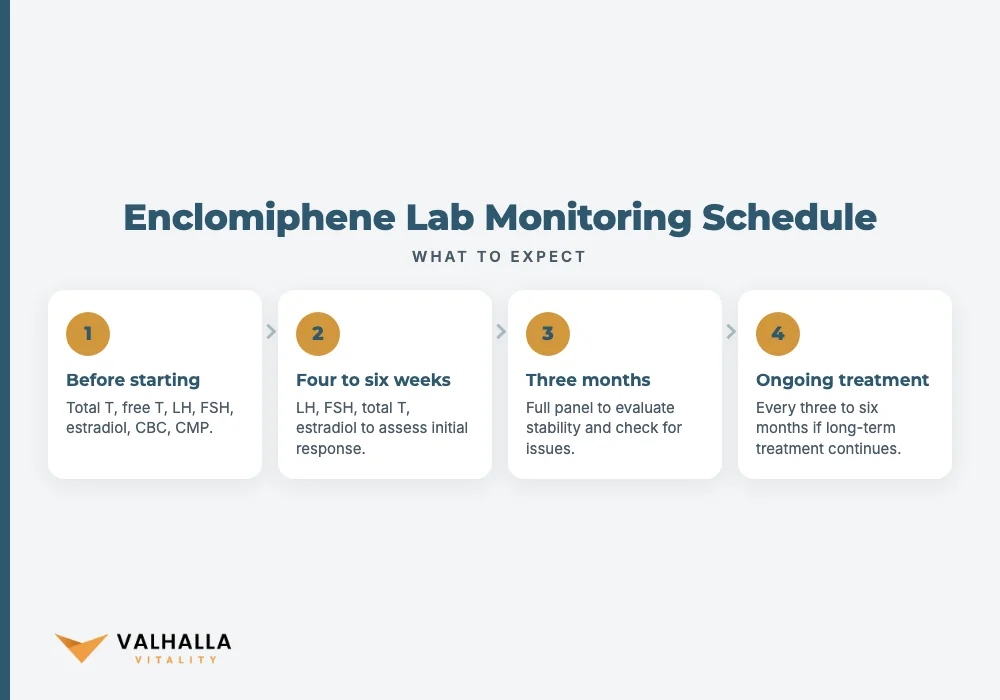
Lab monitoring is not optional. It is how your provider confirms whether the current enclomiphene dosage is working and whether anything needs to change.
A standard monitoring schedule typically looks like this:
- Before starting: total testosterone, free testosterone, LH, FSH, estradiol, CBC, comprehensive metabolic panel
- Four to six weeks in: LH, FSH, total testosterone, estradiol to assess initial response
- Three months: full panel to evaluate stability and check for emerging issues
- Ongoing: every three to six months if long-term treatment continues
Providers are looking for specific patterns at each check. Did testosterone rise into a healthy range? Did LH and FSH respond, confirming HPG axis activation? Is estradiol within a range that supports testosterone rather than suppressing it? Are red blood cell counts stable?
If the numbers are trending correctly and symptoms are improving, the protocol continues. If testosterone is moving too slowly, the enclomiphene dosage may be adjusted upward. If it is running too high or estradiol is climbing, the dose may be reduced or the protocol modified.
Knowing what providers watch during enclomiphene treatment and how labs drive those decisions can help you approach monitoring appointments with clearer expectations and better questions.
Enclomiphene vs. TRT: two different approaches
Both enclomiphene and TRT address low testosterone symptoms. The mechanism is different, and that difference shapes who is a better candidate for each.
Here is how the two therapies compare on key factors:
- Testosterone source: TRT introduces it externally; enclomiphene drives the body to produce it through stimulated LH and FSH
- LH and FSH levels: TRT suppresses them over time; enclomiphene raises them
- Sperm production: typically declines on TRT; typically maintained or improved with enclomiphene
- Reversibility after stopping: TRT requires a recovery period before natural production resumes; enclomiphene's effects normalize more directly once the medication is discontinued
For men concerned about fertility, or who want to preserve natural production, enclomiphene is often explored first. For men with primary hypogonadism, where the testes cannot respond to LH regardless of the signal, TRT is the more direct path because enclomiphene's signal amplification has no downstream target to work with.
The choice depends on the patient's hormone profile, health goals, and lab picture. This is another reason why the evaluation precedes any enclomiphene dosage decision.
Ready for a provider review?
If questions about enclomiphene dosage are prompting you to look for answers, a licensed provider can review your hormone picture and determine whether this path fits your situation. Book Your Consultation to start the intake process.
FAQ
What is the recommended enclomiphene dosage for men?
There is no universal recommended dose. A licensed provider determines the appropriate enclomiphene dosage after reviewing your hormone panel, symptoms, and medical history. A provider determines the protocol/dose after labs; whether any specific amount from clinical research applies to your situation is a medical decision.
What is the best time of day to take enclomiphene?
The best time to take enclomiphene is whatever time you can maintain consistently every day. Most providers suggest morning dosing to align with the body's natural testosterone rhythm, while others recommend evening dosing to fit existing medication routines. Consistent daily timing matters more than the specific hour.
How long does enclomiphene take to work?
Most men see measurable changes in LH, FSH, and total testosterone within four to six weeks of consistent daily use. Subjective improvements in energy, libido, and mood may take two to three months as hormone levels stabilize. Lab results, not symptom timing alone, guide whether the protocol is producing the expected response.
Can you take enclomiphene every day?
Most enclomiphene protocols involve daily dosing to maintain consistent estrogen receptor blockade and a sustained LH and FSH signal. Some providers adjust to less frequent dosing based on individual lab response, but daily use through a defined enclomiphene cycle length is the standard starting structure.
Can you drink alcohol while taking enclomiphene?
Moderate alcohol is not a direct contraindication, but heavy or frequent drinking can suppress testosterone and make lab results harder to interpret accurately. Most providers recommend keeping alcohol minimal during the initial evaluation period, especially in the days before a scheduled lab draw.
Sources
- Valhalla Vitality. Enclomiphene Citrate for Low Testosterone.
- Valhalla Vitality. The Best Time to Take Enclomiphene Each Day.
- Valhalla Vitality. Enclomiphene Citrate Tablets: Use, Doses, and Side Effects.
You May Also Like
 Enclomiphene
Enclomiphene Blood Clots: Risks, Signs, and Prevention
Enclomiphene blood clots risk: how this SERM affects coagulation, who faces higher risk, warning signs to watch for, and what monitoring looks like.
October 8, 2026 ETRead more → Enclomiphene
Enclomiphene Appetite: Does It Increase Your Hunger?
Enclomiphene appetite effects can include increased hunger as testosterone rises. Learn how these metabolic changes work and how to manage them.
October 8, 2026 ETRead more → Enclomiphene
Enclomiphene sperm count: what clinical research shows
Enclomiphene sperm count research shows this oral SERM raises FSH levels, stimulates spermatogenesis, and may support male fertility outcomes in men.
October 8, 2026 ETRead more →