
The following blog post is for entertainment and informational purposes only. It is not intended to provide medical advice or diagnosis. Please consult your doctor before making any health-related decisions.
When men explore options for low testosterone or fertility concerns, enclomiphene vs hcg is often the first practical question that comes up. Enclomiphene citrate is an oral nonsteroidal estrogen antagonist that stimulates the body's own LH and FSH production. HCG is an injectable. It mimics LH directly at the testes, bypassing the hypothalamic-pituitary signaling loop. Both can raise testosterone, but they reach that outcome through fundamentally different mechanisms, and those mechanisms matter for fertility, testicular health, and long-term tolerability. Our guide to enclomiphene for low testosterone walks through how providers evaluate each patient's labs and goals before recommending a path.
Quick comparison: enclomiphene vs HCG
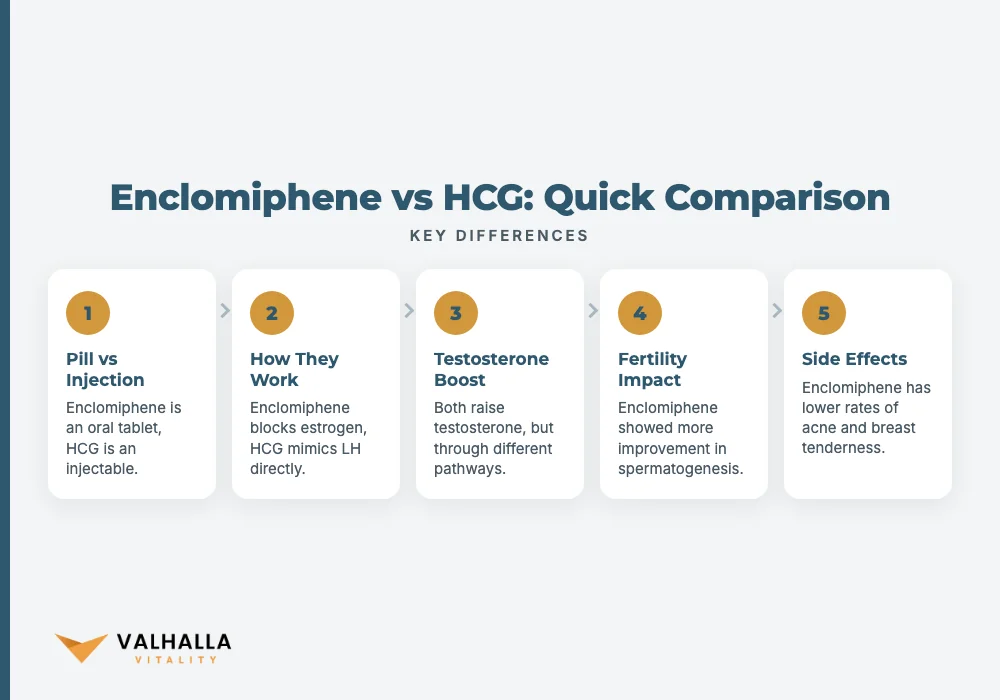
The table below covers what most men want answered before talking to a provider.
| Factor | Enclomiphene | HCG |
|---|---|---|
| Form | Oral tablet | Injectable |
| Mechanism | Blocks estrogen receptors at hypothalamus; triggers LH and FSH release | Mimics LH directly at Leydig cells in the testes |
| Testosterone effect | Raises endogenous testosterone via HPG axis | Raises testosterone directly at testicular level |
| FSH stimulation | Yes | No direct FSH effect |
| Spermatogenesis (3-month study) | 96% of patients improved | 20% of patients improved |
| Side effects (comparative) | Lower rates of acne and breast tenderness | Higher rates; possible estradiol elevation |
| Administration | Oral | Subcutaneous injection |
Both agents work through the HPG axis, but they enter it at very different points. That entry point determines how each performs on fertility, testicular maintenance, side effect risk, and compatibility with existing testosterone therapy. Most practical differences between the two trace back to this single mechanistic distinction.
How each option works
Enclomiphene blocks estrogen receptors at the hypothalamus and pituitary. With that negative feedback removed, the pituitary increases output of LH and FSH. Higher LH signals the Leydig cells to produce more testosterone. Higher FSH drives spermatogenesis. The process uses the body's intact hormonal axis throughout.
HCG is a shorter route. As an LH analog, it binds to Leydig cell receptors directly and stimulates testosterone production at the testes. It bypasses the pituitary. This limits its direct impact on FSH-dependent sperm production. For men on exogenous testosterone, HCG is commonly added because TRT suppresses the natural LH signal and leaves the testes without stimulation.
Every practical difference in the enclomiphene vs hcg comparison, whether fertility outcomes, TRT compatibility, or side effect profiles, traces back to where each drug acts first.
Is enclomiphene a good alternative to HCG?
Yes. Clinical data support enclomiphene as a viable hcg alternative for men with secondary hypogonadism. A 2019 study in over 100 patients with secondary hypogonadism found enclomiphene citrate raised testosterone to a comparable level as HCG. The same study found enclomiphene produced fewer side effects, including lower rates of acne and breast tenderness.
The administration difference matters in practice. Enclomiphene is oral. HCG requires subcutaneous injections. For men managing a months-long protocol, that gap in complexity affects adherence, and adherence affects outcomes.
Enclomiphene also keeps the HPG axis engaged rather than bypassing it. Working upstream, it restores the LH and FSH signal that low testosterone had diminished. That preserved axis function supports both testosterone and sperm production simultaneously, which HCG alone does not match.
The enclomiphene vs hcg decision ultimately depends on the individual's current medications, lab values, and fertility goals. A licensed provider determines whether enclomiphene testosterone therapy is appropriate after reviewing the full hormone panel.
Can enclomiphene replace HCG on TRT?
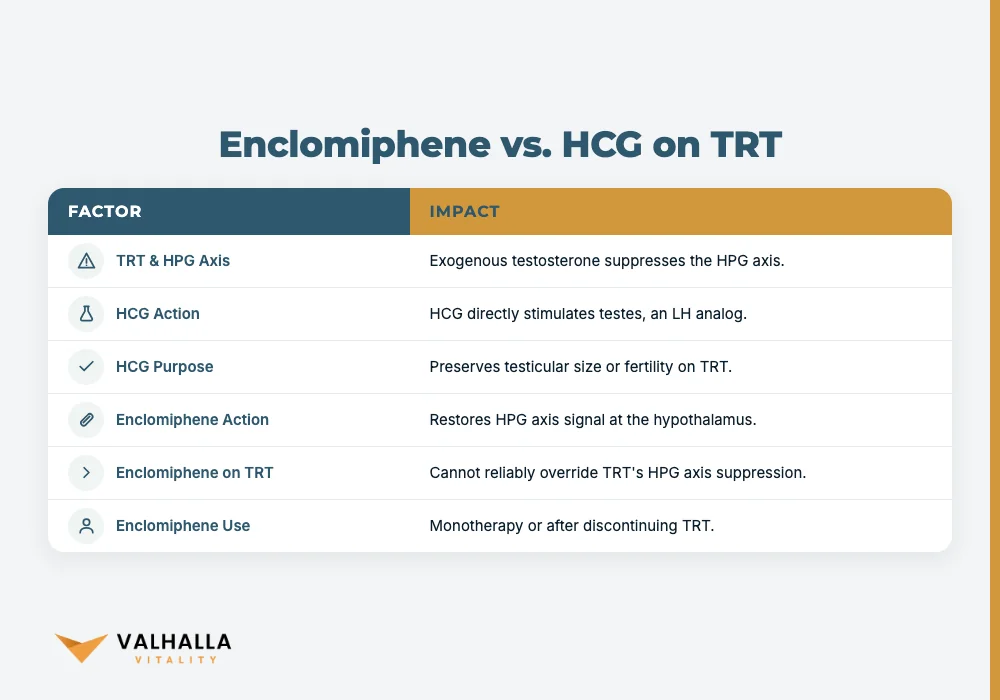
Not directly. Men on exogenous testosterone have a suppressed HPG axis. The brain reads circulating testosterone and stops producing GnRH, which shuts down pituitary LH and FSH output. Without LH, the testes shrink. Without FSH, sperm production falls. Testosterone therapy without hcg or another gonadal support leaves the testes essentially unactivated.
HCG sidesteps this problem. As a direct LH analog, it stimulates the testes regardless of what the hypothalamus is doing. That is the standard add-on for men on TRT who want to preserve testicular size or fertility potential.
Enclomiphene works by restoring the HPG axis signal at the hypothalamus. On TRT, exogenous testosterone actively suppresses that axis. Enclomiphene cannot reliably override that suppression while TRT is ongoing.
Enclomiphene monotherapy is a distinct strategy for men not on TRT, or for those who discontinue it under provider supervision to restore their natural axis. For a full look at how these two treatment philosophies differ from the start, the guide on enclomiphene as an alternative to TRT covers the decision framework in detail.
Does enclomiphene prevent testicular atrophy like HCG?
Enclomiphene and HCG both support testicular function, but which works better depends on whether TRT is already in the picture.
For men not on TRT, enclomiphene keeps LH and FSH elevated by removing negative feedback at the hypothalamus. This sustained stimulation maintains testicular activity and prevents the atrophy that develops with untreated secondary hypogonadism. The mechanism is the body's own hormonal signaling, restored by enclomiphene's upstream action.
For men already on TRT, HCG is the more reliable option. TRT suppresses the pituitary, so enclomiphene's attempt to restore the natural signal runs into that suppression. HCG bypasses it entirely. Direct testicular stimulation works even when the HPG axis is shut down by exogenous testosterone.
The hcg alternative testicular atrophy question has no single universal answer. A provider assessing testicular health checks LH, FSH, testicular volume, and testosterone response over time. One patient's profile may favor enclomiphene entirely; another's may require HCG. The right support depends on what the body can currently respond to, and that requires lab data.
Which is better for fertility: HCG or enclomiphene?
For men focused on sperm production, the enclomiphene vs hcg fertility data are clear. A three-month clinical study found that 96% of patients on enclomiphene citrate showed improved spermatogenesis. The HCG group in the same study showed improvement in only 20% of patients over the same period.
The mechanism explains the gap. Enclomiphene raises both LH and FSH. FSH is the primary driver of sperm production in the testes. HCG raises LH only and does not directly stimulate FSH-dependent spermatogenesis. That dual-hormone action is why enclomiphene sperm count outcomes outperform HCG in fertility-focused comparisons.
For men weighing hcg alternatives fertility options, this figure often drives the decision. One important context: the study included men with secondary hypogonadism specifically. Results vary with other causes of impaired sperm production. A provider reviews a full semen analysis alongside the hormone panel before recommending either option for fertility.
What are the side effects of HCG vs enclomiphene?
Both treatments carry side effect risk. The 2019 comparative study found enclomiphene associated with fewer side effects than HCG, with lower rates of acne and breast tenderness specifically.
HCG directly stimulates testosterone production at the testes. As testosterone rises, some converts to estradiol through aromatization. HCG can drive this more strongly, and elevated estradiol sometimes causes breast tissue sensitivity, mood changes, or water retention. Managing estradiol becomes an additional step in some HCG protocols.
Enclomiphene does not introduce hormone directly into the system. It removes a feedback brake at the hypothalamus, letting endogenous production rise. Estradiol can still increase as testosterone climbs, but the elevation tends to be more gradual. Individual lab response determines whether estrogen management is needed.
Side effect profiles are often a key factor in the enclomiphene vs hcg conversation. The available evidence does not show permanent adverse effects with either treatment when labs are monitored appropriately. For a detailed review, the guide on side effect profiles and clinical monitoring for enclomiphene covers what providers track at each follow-up.
What a provider weighs when choosing between the two
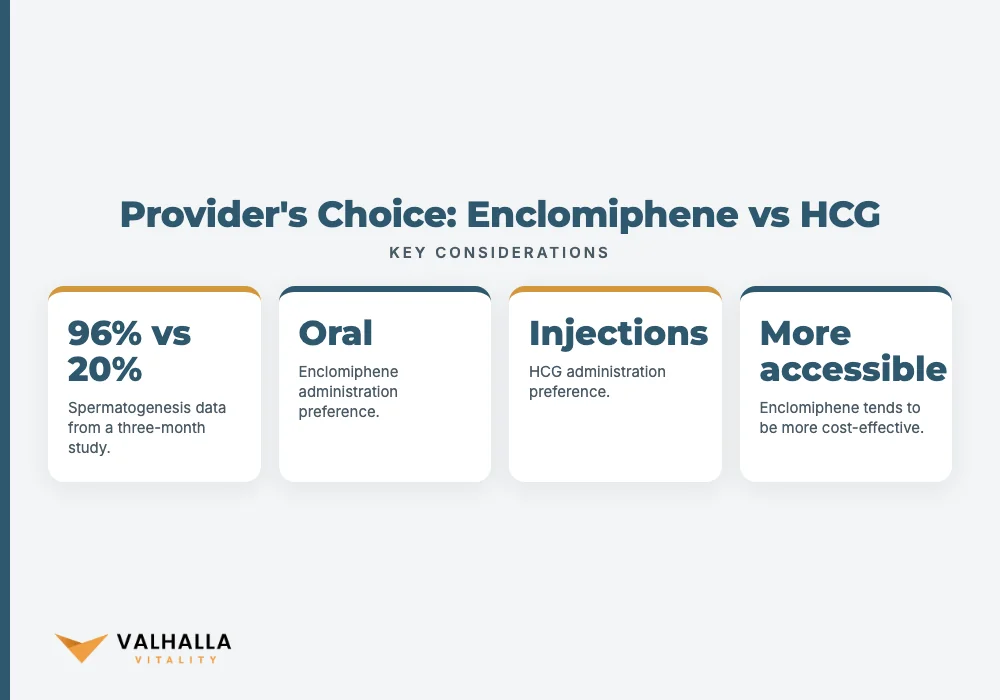
Most enclomiphene vs hcg comparisons stop at mechanism. What patients need to understand is the clinical decision: what does a provider evaluate before recommending one over the other?
Current TRT status. If a patient is already on exogenous testosterone, enclomiphene alone will not override HPG suppression. HCG is the appropriate add-on. If the patient wants to switch to enclomiphene instead, discontinuing TRT first, under provider supervision, is typically required.
Fertility urgency. For men actively trying to conceive, the 96% vs 20% spermatogenesis data from the three-month study is a significant factor. Providers weigh this alongside the current semen analysis and baseline FSH level.
Baseline hormone panel. LH, FSH, total testosterone, free testosterone, and estradiol together define the picture. Low LH and FSH with low testosterone suggests secondary hypogonadism, the core indication for enclomiphene. Normal or elevated LH with low testosterone points to primary testicular failure, where neither option performs as expected.
Administration preference. Enclomiphene is oral. HCG requires regular injections. Some patients will not maintain an injection protocol consistently over months, and that is a legitimate clinical consideration, not just a convenience one.
Access and cost. Enclomiphene testosterone therapy tends to be more accessible and cost-effective than ongoing HCG protocols, which vary considerably depending on the protocol design. Availability varies by state through telehealth providers for both options.
Monitoring frequency. Both therapies require periodic labs. A licensed provider determines how often based on baseline values and the patient's early response. More suppressed HPG function at baseline typically means closer early monitoring.
These criteria do not replace clinical evaluation. Understanding them makes the appointment more productive and the questions sharper.
Talk to a provider about enclomiphene vs HCG
If you want a provider's assessment of which option fits your labs and goals, Book Your Consultation to have your hormone panel reviewed and your options discussed with a licensed provider.
FAQ
Is enclomiphene a good alternative to HCG?
Yes, for men with secondary hypogonadism, clinical data support enclomiphene as an effective alternative. A 2019 study in over 100 patients found enclomiphene raised testosterone comparably to HCG while producing fewer side effects, including lower rates of acne and breast tenderness. A licensed provider determines appropriateness after reviewing individual labs.
Can enclomiphene replace HCG on TRT?
Not directly. HCG bypasses HPG axis suppression by acting directly at the testes, making it effective alongside TRT. Enclomiphene works through the HPG axis, which exogenous testosterone suppresses. Men who want to move away from HCG while on TRT should ask a provider whether discontinuing TRT is the right first step.
Does enclomiphene prevent testicular atrophy like HCG?
Enclomiphene prevents atrophy associated with low LH by restoring the natural LH and FSH signal through the HPG axis. This is effective for men not on TRT. For men on TRT, HCG's direct testicular stimulation is more reliable because it bypasses the suppressed pituitary signal.
Which is better for fertility: HCG or enclomiphene?
Clinical data favor enclomiphene. A three-month comparative study found 96% of patients on enclomiphene showed improved spermatogenesis versus 20% on HCG. Enclomiphene raises both LH and FSH, giving it an advantage in supporting sperm production over HCG's LH-only mechanism.
What are the side effects of HCG vs enclomiphene?
Both can cause acne and breast tenderness, but the 2019 comparative study found lower rates with enclomiphene. HCG may more readily elevate estradiol, sometimes requiring additional management. A licensed provider monitors labs throughout treatment to identify and address any side effects.
Sources
- Clinical study (2019). Enclomiphene citrate versus HCG in over 100 patients with secondary hypogonadism: comparable testosterone outcomes with fewer adverse effects in the enclomiphene group.
- Three-month clinical study. Spermatogenesis comparison in secondary hypogonadism: enclomiphene citrate (96% improvement) versus HCG (20% improvement).
- Twelve-week clinical trial. Total and free testosterone outcomes with enclomiphene citrate from baseline.
You May Also Like
 Enclomiphene
Enclomiphene vs Clomiphene: Key Differences for Men
Enclomiphene vs clomiphene for men: how they differ in structure, side effects, and testosterone outcomes, plus what current research shows for each.
October 7, 2026 ETRead more → Enclomiphene
Enclomiphene Benefits for Men: Testosterone & Wellness
Enclomiphene benefits include higher testosterone, better energy, and preserved fertility. See how SERM therapy compares to TRT and who qualifies.
October 6, 2026 ETRead more → Enclomiphene
Clomid vs Enclomiphene: Men's Guide to Low Testosterone
Clomid vs enclomiphene for low testosterone: how each compound works, side effect differences, and how a licensed provider decides which to recommend.
October 5, 2026 ETRead more →