
The following blog post is for entertainment and informational purposes only. It is not intended to provide medical advice or diagnosis. Please consult your doctor before making any health-related decisions.
Enclomiphene weight loss is an off-label application of a medication originally developed to treat secondary male hypogonadism. Low testosterone promotes fat accumulation and lean muscle loss, so raising it through the body's own hormonal pathways may support better body composition over time. A licensed provider reviews labs and intake to determine whether this approach fits your clinical picture. The guide to enclomiphene for low testosterone covers the full evaluation process in detail.
Does low testosterone cause weight gain?
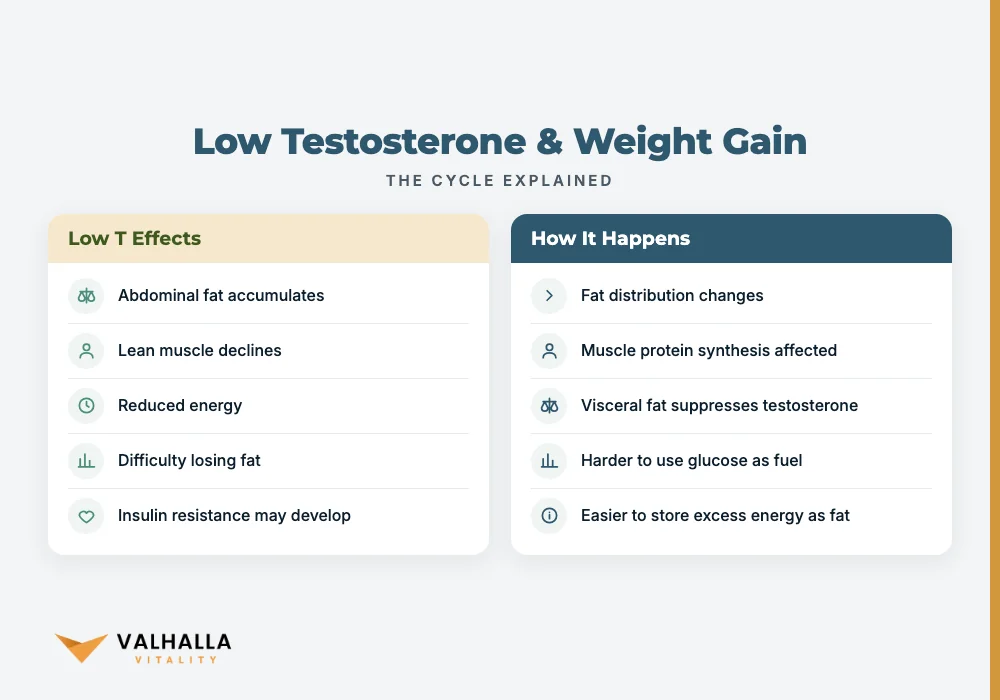
Yes. The relationship runs in both directions.
Testosterone helps regulate fat distribution and muscle protein synthesis in men. When levels drop, abdominal fat accumulates while lean mass declines. These are not independent symptoms. Visceral abdominal fat is metabolically active in ways that can further suppress testosterone production, reinforcing the hormonal pattern that caused it to accumulate in the first place. Low testosterone weight gain is as much a metabolic problem as a hormonal one.
Signs that low testosterone may be contributing to body composition changes include:
- Accumulation of abdominal fat despite consistent dietary habits
- Loss of lean muscle that gradually makes physical activity harder
- Reduced energy that limits how much activity can be sustained
- Persistent difficulty losing fat even when maintaining a caloric deficit
Insulin sensitivity is another piece of the picture. Testosterone influences how efficiently tissues use glucose. When testosterone is low, insulin resistance can develop in skeletal muscle and fat tissue, making it harder to use glucose as fuel and easier to store excess energy as fat. This is one mechanism through which hypogonadism and excess body fat reinforce each other over time.
A 2024 meta-analysis in Andrology (Ken-Dror et al.) built prediction tools to estimate how much testosterone obese men can gain from weight loss alone. The data confirm that testosterone and body weight are intertwined at a physiological level. Addressing only one side without considering the other leaves the underlying cycle intact.
Men with unexplained fatigue, reduced physical performance, or persistent difficulty with body composition may benefit from having their hormone levels evaluated by a provider. That assessment typically begins with a blood panel.
How does enclomiphene affect body composition in men?
Enclomiphene is a selective estrogen receptor modulator. It blocks estrogen receptors at the hypothalamus and pituitary gland. That signal prompts those structures to release more luteinizing hormone (LH) and follicle-stimulating hormone (FSH). Both travel to the testes and stimulate natural testosterone production.
This is the critical distinction from testosterone replacement therapy. TRT delivers testosterone from outside, which suppresses the HPG axis. Enclomiphene keeps that axis active. For men who want testosterone support without compromising natural production or fertility, that difference matters significantly.
A 2025 systematic review and meta-analysis in Archives of Endocrinology and Metabolism (Hohl et al.) analyzed data from randomized controlled trials and confirmed that enclomiphene raises LH, FSH, and total testosterone more consistently than placebo in men with secondary hypogonadism. As testosterone rises through this pathway, the hormonal environment may shift in ways that support fat reduction and lean mass retention. The testosterone body composition effects that follow are gradual. They build over months of sustained treatment, not over days.
A note on related compounds: enclomiphene is the purified trans-isomer of clomiphene citrate. Earlier clomiphene citrate fat loss research helped establish that selective estrogen receptor modulators can influence male body composition through the HPG axis. Enclomiphene's lower estrogenic activity makes it the preferred compound in current clinical practice. For a detailed look at how enclomiphene interacts with hormones and metabolism, including how it compares to clomiphene, see that full overview.
Does enclomiphene help with weight loss?
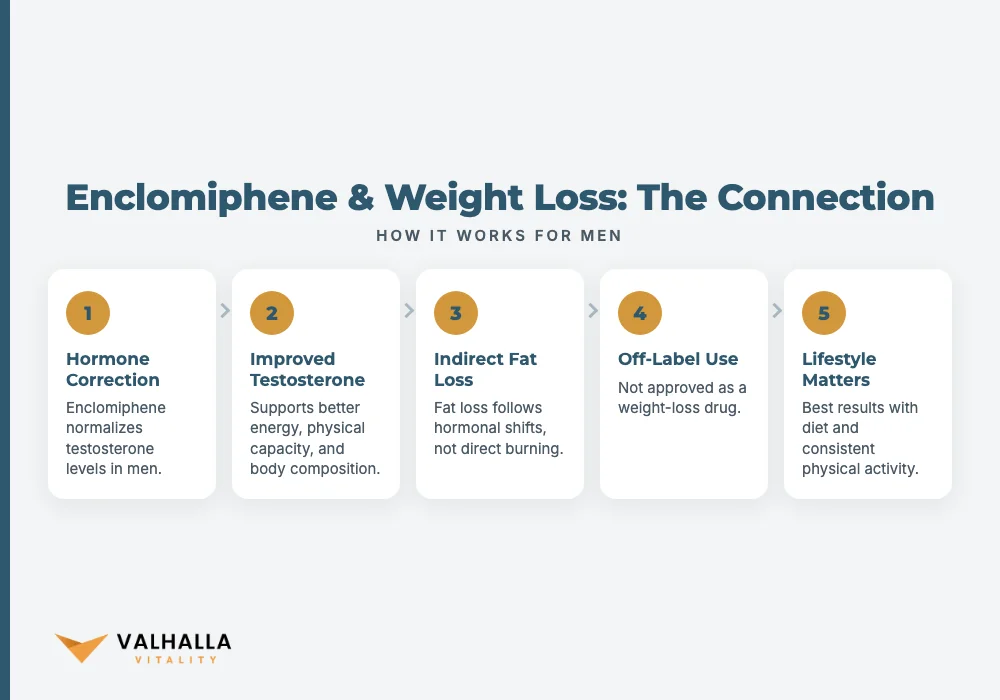
Enclomiphene does not directly burn fat. It corrects a hormonal environment that may be working against weight management.
A 2016 expert review in Expert Opinion on Pharmacotherapy (Rodriguez et al.) described enclomiphene as capable of normalizing testosterone in men with secondary hypogonadism while preserving natural production. When testosterone normalizes, men often report improved energy, better physical capacity, and a gradual shift in body composition toward more muscle and less stored fat. Those downstream effects are what connect enclomiphene weight loss to the broader goal of reducing body fat.
Here is what the evidence does and does not support for enclomiphene fat loss:
- Enclomiphene raises LH and FSH, prompting the testes to produce more testosterone.
- Improved testosterone may support lean mass retention and reduce fat accumulation over time.
- Fat loss is not direct; it follows hormonal and metabolic shifts, not a single pharmaceutical mechanism.
- This use is off-label. Enclomiphene is not approved as a weight-loss drug.
- A licensed provider determines whether therapy is appropriate after reviewing labs and intake.
The indirect nature of the mechanism means that men using enclomiphene for body composition typically see better results when they pair it with appropriate diet and consistent physical activity. The medication adjusts the hormonal environment. What a person does within that environment determines the outcome.
How quickly does enclomiphene work for fat loss?
Not quickly. Realistically, enclomiphene weight loss timelines are measured in months, not weeks. That framing matters because men who expect rapid body changes often stop treatment before the hormonal environment has had time to produce results.
LH and FSH may rise within weeks of starting treatment. Testosterone levels may begin to increase in that same window. But body composition changes, enclomiphene fat loss in practice, lag behind those hormonal shifts considerably. Clinical data from the Hohl 2025 meta-analysis showed measurable testosterone improvements in short-term trials, but body composition outcomes require sustained treatment alongside lifestyle support.
There is a complication worth noting. A 2019 study in Clinical Endocrinology (Wong et al.) documented reversible hypogonadism caused by energy deficit. Men who significantly restrict calories can suppress the HPG axis and produce lab values that look like secondary hypogonadism. In those cases, the correct intervention is nutritional, not pharmaceutical. A provider identifies this pattern through labs and intake before prescribing enclomiphene.
Enclomiphene may create conditions that favor better body composition. It does not accelerate fat loss on its own. Months of consistent treatment, paired with appropriate nutrition and physical activity, define when meaningful change becomes possible.
Can enclomiphene cause weight gain?
Men researching enclomiphene weight loss often ask this question because they want to know whether the therapy could backfire. Weight gain is not a well-documented effect. Enclomiphene raises testosterone, and higher testosterone generally supports lean mass over stored fat. The pharmacological direction runs counter to fat accumulation.
Some individuals notice early changes in fluid balance or appetite when hormones shift. These are generally mild and temporary. Enclomiphene side effects men most frequently encounter include visual disturbances, headache, and gastrointestinal discomfort, based on clinical trial data reviewed in the Hohl 2025 meta-analysis. Significant weight gain is not among the primary adverse effects documented in that evidence base.
Enclomiphene carries less estrogenic activity than clomiphene citrate. Elevated estrogen in men is associated with fat accumulation and mood changes, so the reduced estrogenic burden is a recognized clinical advantage. For a closer look at what side effects to watch for and how providers track labs during treatment, the safety overview covers that ground in full.
Any unexpected or persistent weight changes while on enclomiphene warrant a conversation with the prescribing provider.
Enclomiphene weight loss evaluation: what providers check first
The right starting point is labs, not symptoms alone.
A provider evaluating enclomiphene weight loss support looks at total testosterone, free testosterone, LH, FSH, and estradiol. The pattern of those values determines whether secondary hypogonadism is likely. In secondary hypogonadism, LH and FSH are low or inappropriately normal relative to testosterone, pointing to a signaling problem at the hypothalamus or pituitary rather than at the testes themselves. That specific profile is what enclomiphene is designed to address.
If LH and FSH are already elevated, the testes are the source of the deficiency. Stimulating them further with enclomiphene will not produce an effect. A lab-guided evaluation prevents an ineffective prescription.
Thyroid function is sometimes added to the initial panel. Thyroid disorders can produce fatigue and body composition changes that overlap with low testosterone symptoms, and identifying a co-occurring condition early shapes treatment decisions.
Energy status matters separately. As Wong et al. (2019) documented, caloric restriction severe enough to suppress the HPG axis can produce a pattern that mimics secondary hypogonadism. Treating that pattern with enclomiphene is unlikely to help. A thorough intake process includes questions about diet, exercise volume, and overall energy balance precisely because this distinction matters for outcomes.
The full evaluation takes place through an online intake process, reviewed by a licensed provider within 24 business hours. At-home lab testing is available when labs are needed. When a prescription is appropriate, it goes to a partner compounding pharmacy, with delivery typically within three to seven business days from the time the prescription is transmitted. Availability of this therapy varies by state.
Talk to a licensed provider
Speak with a licensed provider to find out whether enclomiphene makes sense for your hormone health and body composition goals. Book Your Consultation
FAQ
Does enclomiphene directly cause fat loss?
No. Enclomiphene raises LH and FSH to stimulate the body's own testosterone production, and improved testosterone may support a gradual shift toward lean mass over stored fat. Fat loss remains dependent on appropriate diet and physical activity.
How does enclomiphene differ from testosterone replacement therapy?
Enclomiphene stimulates natural testosterone production by keeping the HPG axis active, which preserves testicular function and fertility. Testosterone replacement delivers the hormone externally and typically suppresses natural production. A provider selects between these approaches based on labs and the underlying cause of low testosterone.
Is enclomiphene approved for weight loss?
No. Enclomiphene citrate has been studied for secondary male hypogonadism. Its use for body composition or weight management is off-label, and a licensed provider must evaluate whether it is appropriate for an individual's complete clinical picture.
Can enclomiphene be used alongside other weight-loss therapies?
That depends on the individual's labs and overall clinical profile. Some men have both hormonal and metabolic contributors to excess body fat. A provider reviews the full picture before determining whether combining treatments is appropriate.
What are the most common side effects of enclomiphene in men?
Clinical trials most commonly report visual disturbances, headache, and gastrointestinal discomfort. These effects are generally mild and tend to resolve during treatment. Any persistent or worsening symptoms should be reported to the prescribing provider promptly.
Sources
- Ken-Dror G et al. (2024). Meta-analysis and construction of simple-to-use nomograms for approximating testosterone levels gained from weight loss in obese men. Andrology. PubMed
- Hohl A et al. (2025). Clomiphene or enclomiphene citrate for the treatment of male hypogonadism: a systematic review and meta-analysis of randomized controlled trials. Archives of Endocrinology and Metabolism. PubMed
- Rodriguez KM et al. (2016). Enclomiphene citrate for the treatment of secondary male hypogonadism. Expert Opinion on Pharmacotherapy. PubMed
- Wong HK et al. (2019). Reversible male hypogonadotropic hypogonadism due to energy deficit. Clinical Endocrinology. PubMed