
The following blog post is for entertainment and informational purposes only. It is not intended to provide medical advice or diagnosis. Please consult your doctor before making any health-related decisions.
Enclomiphene dosage bodybuilding is a topic that has grown as more physically active men connect suboptimal testosterone to stalled progress despite consistent training. Enclomiphene citrate is a prescription SERM that stimulates the body's own testosterone production by resetting the hormonal signaling chain between the brain and the testes. A licensed provider determines the dose after reviewing bloodwork and symptoms. For an in-depth look at enclomiphene's mechanism and clinical profile, that resource covers how it works at each step.
What is enclomiphene and why are bodybuilders and athletes asking about it?
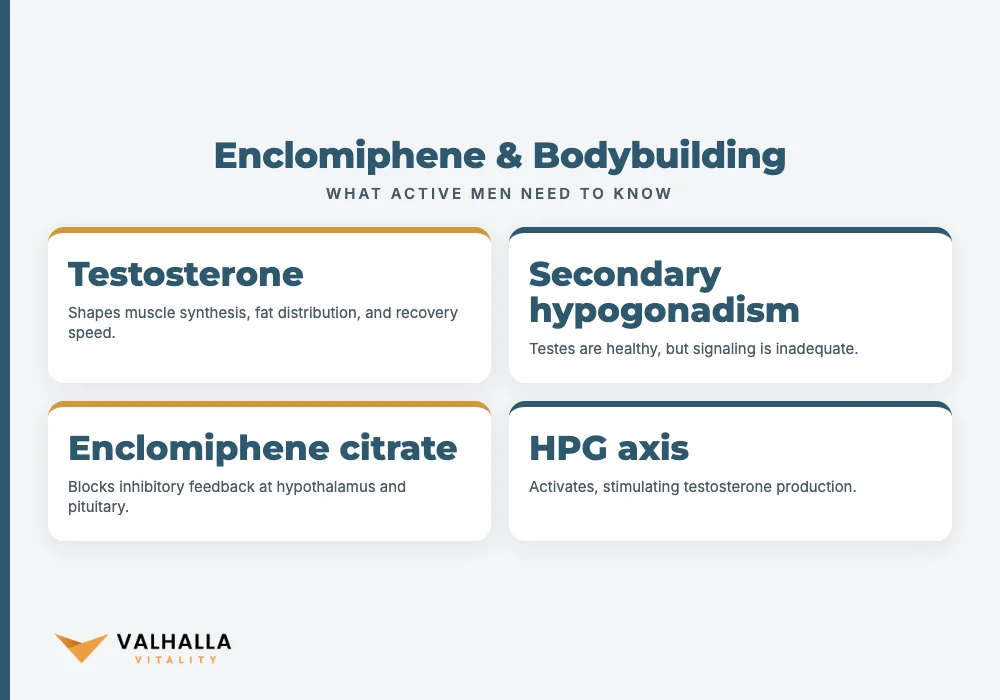
Testosterone shapes everything that matters in a training context: muscle protein synthesis rate, fat distribution, recovery speed, red blood cell production, and the sustained focus that keeps training consistent. When levels fall below a healthy range, those processes slow. A man can be training hard, sleeping enough, and eating well, yet body composition stops moving. That gap between effort and result often prompts a blood panel.
Men who train consistently tend to notice hormonal symptoms earlier than sedentary men, because they have a clear reference point for how their body responds to effort. When recovery slows without explanation, strength stalls despite good programming, or body fat accumulates despite caloric discipline, the pattern becomes recognizable. This is one reason why enclomiphene dosage bodybuilding has become a significant area of inquiry: active men are often the first to recognize when their hormonal environment is limiting their progress.
Enclomiphene dosage bodybuilding: why the hormonal cause determines the treatment
Many men in that situation discover secondary hypogonadism. The testes are structurally healthy. The problem is upstream: the hypothalamus or pituitary is not sending adequate signals to trigger full testosterone production. The solution is not to add testosterone from an external source. It is to restore the signaling that should already be there.
Enclomiphene citrate is the trans-isomer of clomiphene. It targets estrogen receptors at the hypothalamus and pituitary, blocking the inhibitory feedback that suppresses GnRH, LH, and FSH. With that brake removed, the HPG axis activates. LH rises. FSH rises. The testes receive stronger stimulation and produce more testosterone. The axis stays intact and fully functional throughout.
This structural feature is what separates enclomiphene from exogenous testosterone. Injected or topical testosterone suppresses the HPG axis and typically reduces sperm production. Enclomiphene does the opposite. Research on enclomiphene's impact on the male reproductive axis consistently shows maintained or improved spermatogenesis alongside rising testosterone, making it the option of choice for men who want hormonal support without compromising fertility.
Enclomiphene vs. exogenous testosterone: key differences
| Feature | Enclomiphene | Exogenous testosterone |
|---|---|---|
| Testosterone source | Your own testes (endogenous) | External (injection, gel, or pellet) |
| Effect on HPG axis | Stimulated | Suppressed |
| Sperm production | Maintained or improved | Often reduced |
| Administration | Oral tablet | Injection, topical, or pellet |
| Primary indication | Secondary hypogonadism | Hypogonadism (primary or secondary) |
| Lipid monitoring | Recommended | Recommended |
| Fertility outcome | Favorable | Unfavorable without adjuncts |
No therapy fits every man. A licensed provider reviews lab values, symptoms, and individual goals before recommending either path.
What is the correct enclomiphene dosage for bodybuilding?
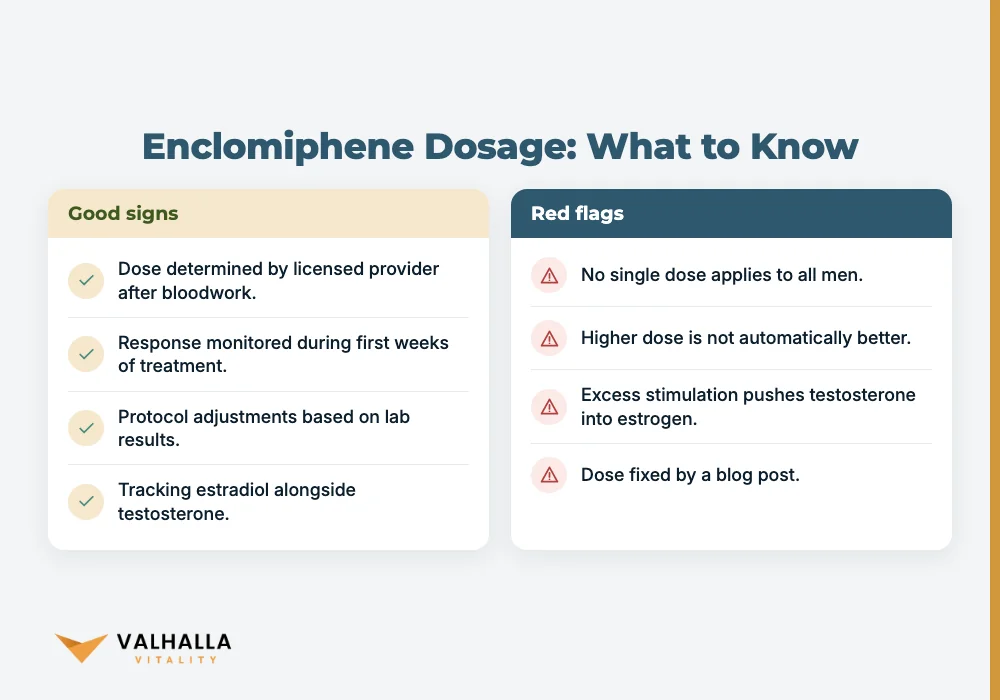
The central question in any enclomiphene dosage bodybuilding discussion is also the one most online sources handle poorly. There is no single dose that applies to all men. A licensed provider determines the appropriate amount after reviewing your bloodwork. The right level depends on your baseline testosterone, LH, FSH, and estradiol, along with how your body responds during the first weeks of monitored treatment.
Clinical practice confirms that dose-response is real and individual. Some men respond fully on lower amounts. Others need more to bring testosterone into a healthy range. But higher is not automatically better. Excess stimulation pushes testosterone through aromatase into estrogen, which can reduce the effectiveness of the treatment and create its own side effects. This is precisely why protocol adjustments depend on lab results, not a starting number fixed by a blog post.
One factor often overlooked in enclomiphene dosage bodybuilding discussions is estrogen management. Testosterone and estrogen are not opposites on a dial. They operate in dynamic balance. As enclomiphene raises testosterone, a portion of that testosterone converts to estradiol through aromatase. In most men at therapeutic doses, this conversion stays within a healthy range. In men with higher baseline aromatase activity, often those carrying more body fat, tracking estradiol alongside testosterone becomes particularly important. A provider who follows both markers can tell apart a man who needs a dose adjustment from one who needs a different intervention entirely.
The process at a telehealth provider typically involves:
- A detailed medical intake covering symptoms, health history, and current medications.
- Baseline labs: total testosterone, free testosterone, LH, FSH, estradiol, lipid panel, CBC, and metabolic panel.
- Provider review of the intake and labs within 24 business hours of order placement.
- A prescription to a US partner compounding pharmacy, if appropriate, with availability varying by state.
- Follow-up labs at scheduled intervals to confirm hormonal response and guide any adjustments needed.
Men who source enclomiphene outside this framework remove the monitoring that makes the therapy clinically useful rather than simply convenient.
How much does enclomiphene raise testosterone levels?
Clinical research has found that enclomiphene can raise serum testosterone substantially in men with secondary hypogonadism, often bringing levels into or above the normal physiological range. That result depends on one key condition: the testes must be capable of responding to stimulation. In secondary hypogonadism, they are. The enclomiphene testosterone boost documented in clinical research is driven by stronger LH and FSH signaling, not by adding testosterone from an external source, which is precisely what makes it a different category of treatment from exogenous TRT. The problem was the signal, not the hardware.
A distinctive feature of enclomiphene's response is that LH and FSH rise alongside testosterone. That pattern confirms the therapy is working through the HPG axis as intended. A provider who tracks LH and FSH at follow-up appointments sees whether the mechanism is behaving correctly, not just whether the testosterone number improved.
Early research, including studies in animal models, found that enclomiphene raised testosterone alongside increases in cholesterol. Subsequent human clinical research confirmed the same link. This is clinically significant: a lipid panel is a standard part of any responsible enclomiphene protocol. Some men see LDL shift upward even as testosterone improves, and catching that early requires consistent monitoring rather than one-time baseline testing.
One hard boundary: enclomiphene will not raise testosterone in men with primary hypogonadism, where the testes themselves are damaged or absent. Pituitary tumors and congenital GnRH deficiency also fall outside what enclomiphene can address. The initial provider evaluation, distinguishing primary from secondary hypogonadism through labs and clinical history, determines whether the therapy can produce results before any prescription is written.
Does enclomiphene build muscle?
Enclomiphene does not build muscle directly. It raises testosterone. Testosterone then acts on muscle tissue.
The chain is specific. LH rises, stimulating Leydig cells in the testes to produce testosterone. Testosterone enters circulation and binds to androgen receptors in skeletal muscle. At those receptors, it increases nitrogen retention and the rate of protein synthesis. It also blunts the catabolic effect of cortisol on muscle, which means recovery from training sessions improves alongside the rate of adaptation to training stimulus.
Enclomiphene muscle building effects are a downstream result of hormonal normalization, not a direct pharmacological action on muscle fibers. This is why any meaningful discussion of enclomiphene dosage bodybuilding should start with a blood panel: the therapy only moves the needle when low testosterone is the documented limiting factor. The men who see the most meaningful change in body composition are typically those with documentably low testosterone before treatment began. Their hormonal environment was limiting the return on their training effort. Enclomiphene removes that limit.
Testosterone also influences motivation, sleep architecture, and training consistency, factors that contribute to muscle development indirectly but meaningfully over months. Men who restore hormonal levels often find that training quality improves before the scale or the mirror shows any change, because better hormonal status supports better recovery between sessions.
Men with testosterone already in a healthy range should not expect enclomiphene to push their physique beyond their physiological baseline. The therapy addresses a deficit. It does not create a surplus above the normal range. Enclomiphene for athletes in the clinical literature consistently refers to men with a documented hormonal gap, not men seeking performance above their natural ceiling.
A blood panel before starting answers the essential question of whether that gap actually exists for you.
Does enclomiphene help burn fat?
Enclomiphene may support fat loss in men with secondary hypogonadism by restoring testosterone and shifting the hormonal environment that promotes visceral fat accumulation. The mechanism is indirect, and the effect builds over months.
Testosterone and adipose tissue share a two-way relationship that can become self-reinforcing when hormone levels fall. Low testosterone promotes visceral fat accumulation, particularly around the abdomen. That visceral fat increases aromatase activity, converting more testosterone to estrogen. Higher estrogen suppresses testosterone further. Left unaddressed, the cycle feeds itself.
Enclomiphene fat loss effects operate by interrupting that root cause. When enclomiphene raises testosterone through HPG axis stimulation, the estrogenic environment that encourages fat storage begins to shift. Clinical research on testosterone normalization in hypogonadal men has found modest but measurable improvements in body composition, including reductions in fat mass alongside increases in lean tissue, when levels return to a physiological range.
Framing enclomiphene weight loss accurately matters here. The therapy is not approved or prescribed as a fat loss drug. Men who seek it for weight management without a hormonal diagnosis are unlikely to meet the clinical criteria for a prescription. Men who have documented low testosterone alongside excess body fat may find that addressing the hormonal issue supports better body composition outcomes alongside consistent training and sound nutrition.
For more on how enclomiphene relates to body weight and fat reduction, that article examines the clinical evidence in full.
Can enclomiphene cause weight gain?
Enclomiphene does not cause weight gain the way anabolic steroids do. There is no supraphysiological androgen load, no aggressive aromatization, and no pronounced water retention typical of exogenous testosterone esters.
Some men notice minor fluid shifts in the first few weeks of treatment as hormone levels adjust. These typically resolve on their own as levels stabilize. Significant or sustained weight gain is not a documented effect of enclomiphene at therapeutic doses in the published clinical data.
Enclomiphene SERM results in terms of tolerability are generally favorable. The most commonly reported side effects include headache, mood changes, and visual disturbances in a small fraction of men. These are class effects shared with other SERMs and worth discussing with a provider before starting. Knowing what to watch for, and when to follow up, is part of responsible treatment from day one.
For a full review of enclomiphene's documented side effects and monitoring protocols, that resource covers the published clinical data.
What a provider evaluates before prescribing enclomiphene
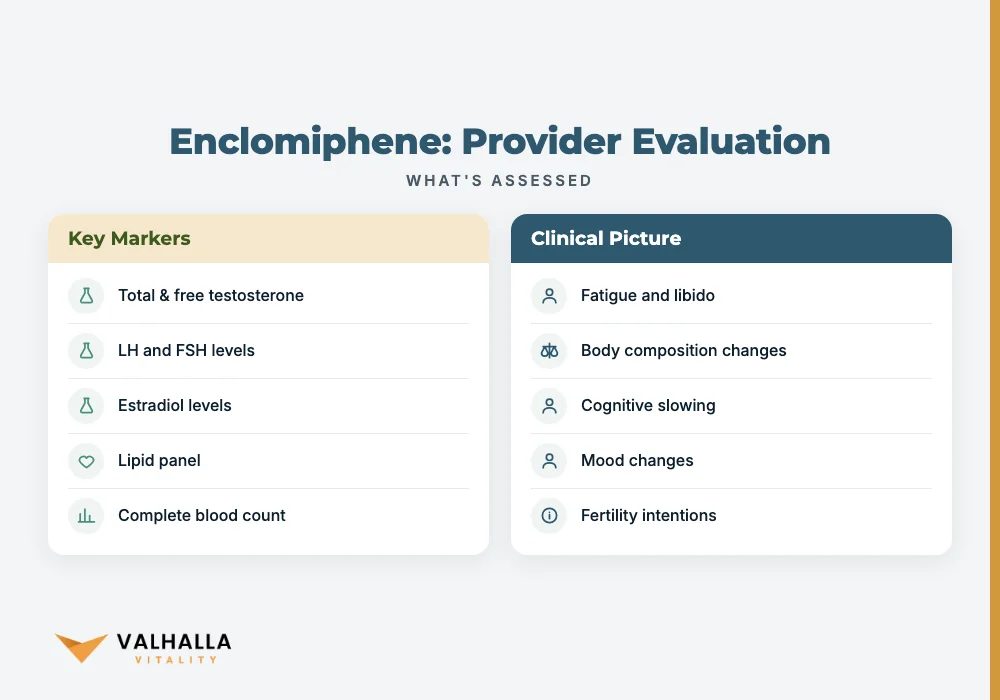
Most men researching enclomiphene dosage bodybuilding want to understand what the prescription process actually looks like. Each evaluation step serves a clinical purpose.
Hormonal markers. Total testosterone, free testosterone, LH, FSH, and estradiol establish whether secondary hypogonadism is present and whether enclomiphene's mechanism fits the cause. The pattern of low testosterone alongside low or inappropriately normal LH and FSH is the signal the therapy is designed to address.
Metabolic and cardiovascular baseline. A lipid panel, complete blood count, and metabolic panel identify contraindications and provide a baseline for tracking changes during treatment. Given the research linking enclomiphene to cholesterol shifts, this panel is not optional.
Symptom profile. Fatigue, reduced libido, stalled body composition despite consistent training, cognitive slowing, and mood changes all contribute to the clinical picture. Symptoms and lab values together determine whether treatment is warranted. Labs alone rarely answer the question.
Fertility intentions. Enclomiphene actively supports the HPG axis and preserves spermatogenesis. For men who want hormonal improvement without compromising fertility, that is the relevant differentiator. A provider who asks about this is matching therapy to individual goals.
Contraindications. Pituitary tumors, primary testicular failure, and congenital GnRH deficiency mean enclomiphene will not produce results and another approach is needed. Identifying these upfront prevents weeks of ineffective treatment.
At Valhalla Vitality, licensed providers review intakes and bloodwork within 24 business hours of order placement, and prescriptions go to US partner compounding pharmacies upon approval.
Men who want to understand how enclomiphene structurally and clinically differs from clomiphene, the older SERM it has largely replaced in male hormone medicine, will find a side-by-side comparison of the two compounds useful context before their consultation.
Tracking enclomiphene SERM results: what the timeline looks like
Enclomiphene works through the body's own biology. Patience is part of the protocol.
LH and FSH typically rise within the first week of treatment, confirming the HPG axis has responded. Testosterone levels follow over the subsequent two to four weeks. Felt improvements in energy, libido, and mood come after that. Body composition changes, which depend on consistent training and nutrition alongside hormonal normalization, take several months to become apparent.
A useful clinical checkpoint: if follow-up labs at four to six weeks show testosterone rising toward the normal range with LH and FSH elevated above baseline, the therapy is working as intended. If testosterone remains low despite adequate LH and FSH stimulation, the provider reassesses whether the problem is primary rather than secondary and adjusts accordingly. This is why characterizing the cause of low testosterone before prescribing matters as much as monitoring during treatment.
Men who purchase enclomiphene without a prescription lose this feedback loop entirely. They also step outside the legal framework of a provider-patient relationship, which carries real risk if complications arise.
Men approaching enclomiphene dosage bodybuilding decisions with a clear understanding of this timeline tend to get the most from treatment: they know what to look for at each lab checkpoint, and they can distinguish a normal adjustment period from a signal that the protocol needs review. Enclomiphene for athletes and active men who take body composition seriously should understand it as addressing one specific layer in a broader picture. Training quality, sleep, protein intake, and stress management all influence testosterone independently. Enclomiphene addresses the hormonal signaling layer when bloodwork identifies that layer as the documented limiting factor.
For a thorough look at the clinical picture of secondary hypogonadism and how provider-supervised treatment progresses, that article covers the full diagnostic and therapeutic context.
Ready to speak with a licensed provider?
If you want to know whether enclomiphene is appropriate for your situation, a licensed provider review is the next step. Book Your Consultation to get started.
FAQ
Does enclomiphene build muscle directly?
Enclomiphene does not directly stimulate muscle growth. It raises testosterone by activating the HPG axis, and that testosterone then supports protein synthesis and recovery in skeletal muscle. Men with documented low testosterone tend to see the most meaningful body composition changes once levels normalize.
What is the correct enclomiphene dosage for bodybuilding?
No universal dose applies to all men. A licensed provider determines the appropriate amount after reviewing baseline labs including testosterone, LH, FSH, and estradiol, then adjusts over time based on follow-up bloodwork and how the individual responds.
Does enclomiphene help burn fat?
Enclomiphene may support body composition improvements, including fat reduction, in men with secondary hypogonadism by restoring testosterone and reducing the hormonal conditions that favor visceral fat accumulation. It is not prescribed as a stand-alone fat loss therapy.
Can enclomiphene cause weight gain?
Significant weight gain is not a documented feature of enclomiphene at therapeutic doses. Minor fluid shifts in the early weeks of treatment are possible and typically resolve as hormone levels stabilize.
How long does it take to see results from enclomiphene?
LH and FSH typically rise within the first week, with testosterone following over subsequent weeks. Improvements in energy and libido develop over weeks to months, while body composition changes generally require several months of consistent training alongside hormonal normalization.
You May Also Like
 Enclomiphene
 Before and After: Physical Changes Explained
Enclomiphene before and after: what physical changes to expect, how the results timeline unfolds, and why provider monitoring matters for outcomes.
October 21, 2026 ETRead more → Enclomiphene
 Vision Side Effects: Eye Floaters & More
Enclomiphene vision side effects include eye floaters, blurry vision, and light sensitivity. Know the warning signs and when to contact your provider.
October 21, 2026 ETRead more → Enclomiphene
 Drug Test: Detection, WADA, and Disclosure
Enclomiphene drug test detection depends on the test type. Learn how workplace panels, military screening, and WADA rules treat this SERM.
October 21, 2026 ETRead more →