
The following blog post is for entertainment and informational purposes only. It is not intended to provide medical advice or diagnosis. Please consult your doctor before making any health-related decisions.
Enclomiphene dosage for bodybuilding is set by a licensed provider based on individual lab results, not drawn from a standard chart. The key markers are serum testosterone, LH, and FSH levels, which determine whether enclomiphene is the appropriate approach and at what level to begin. If you want a provider to review your hormone panel and set a protocol, book a consultation as the first step. The timing, dose, and any adjustments all follow the same lab-driven process at every check-in. Men researching enclomiphene dosage bodybuilding protocols often start with online forums, but the lab values are what a licensed provider actually uses to build the protocol.
How enclomiphene works as a testosterone-stimulating SERM
Enclomiphene is a selective estrogen receptor modulator, known as a SERM. It blocks estrogen receptors in the hypothalamus and pituitary gland specifically, not in muscle or peripheral tissue. That selectivity is what gives it clinical utility.
When estrogen cannot bind to hypothalamic receptors, the brain's negative feedback loop for LH secretion is interrupted. More luteinizing hormone (LH) is released from the pituitary. LH travels to the testes and signals Leydig cells to produce testosterone. Follicle-stimulating hormone (FSH) increases in parallel, supporting both testicular function and sperm production.
The sequence runs through the body's own hormonal axis. This distinguishes enclomiphene from TRT in a meaningful way. Testosterone replacement therapy delivers testosterone externally, which causes the hypothalamus to suppress its own LH output because circulating testosterone reads as sufficient. Enclomiphene activates the axis rather than bypassing it.
For men who train, this has practical implications. Endogenous testosterone production stays active throughout therapy. Testicular function is preserved. Fertility is not disrupted. These outcomes are not available with standard TRT during the treatment period.
Enclomiphene has no direct androgenic activity. It is not an anabolic steroid. Its value in a bodybuilding context comes entirely from stimulating the body's own testosterone output, not from any external addition. Any enclomiphene dosage bodybuilding protocol is built on that mechanism, improving the signal, not substituting the hormone.
Enclomiphene citrate has been studied in the context of secondary hypogonadism, where low testosterone stems from inadequate LH and FSH signaling rather than primary testicular failure. That clinical context confirms the mechanism is well-characterized.
Men who want a broader clinical picture of enclomiphene's application in bodybuilding contexts, including the specific situations in which providers typically recommend it, will find that resource covers the prescribing context in depth.
When should you take enclomiphene during a cycle?
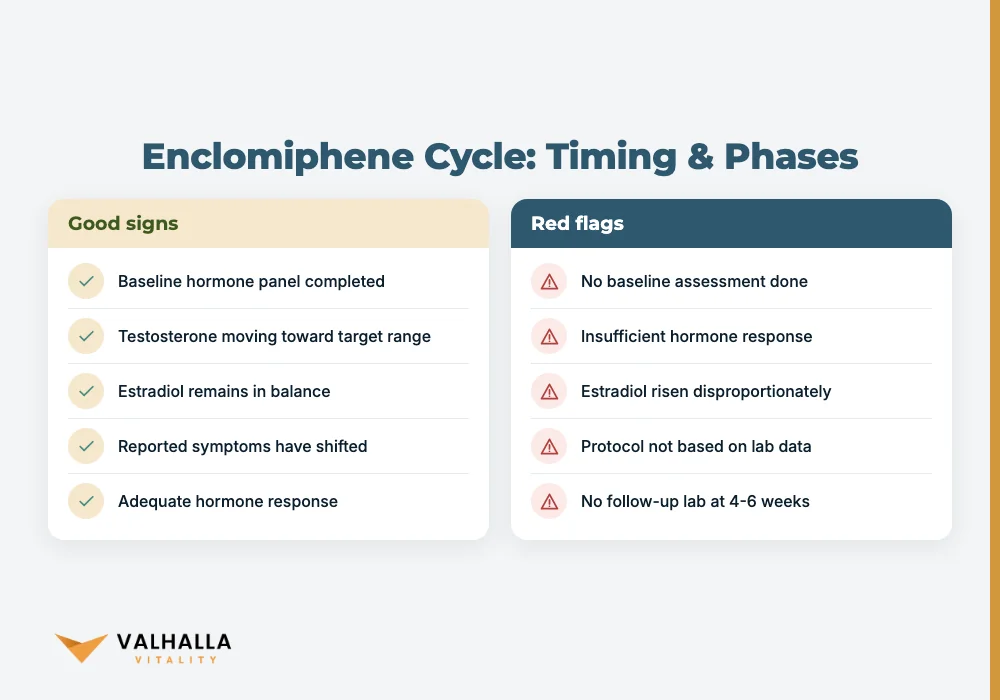
Timing depends on why you are using it. That is the direct answer. Whether enclomiphene is started before, during, or after another compound depends entirely on the clinical goal and what your labs show at each phase.
An enclomiphene cycle for men is structured around data, not a calendar. Three phases define it:
Baseline assessment: A provider orders a full hormone panel before therapy begins. This establishes starting testosterone, LH, FSH, and estradiol levels, along with liver function and metabolic markers. Without a baseline, no protocol decision is grounded in reality.
Active therapy: The provider sets the initial protocol from the baseline data. A follow-up lab is scheduled at four to six weeks. At that check, the provider reviews whether testosterone has moved toward the target range, whether estradiol remains in balance, and whether reported symptoms have shifted.
Adjustment or conclusion: If the hormone response is adequate and symptoms have resolved, the protocol may hold or begin tapering. If the response is insufficient, the protocol is revised. If estradiol has risen disproportionately, an aromatase management strategy may be added.
That three-phase structure is consistent regardless of the goal, an enclomiphene dosage bodybuilding protocol follows the same lab-first logic whether the application is post-cycle recovery or secondary hypogonadism management.
The specific window for when to take enclomiphene varies by context:
- Post-cycle recovery: the protocol typically starts after the suppressive compound has cleared, which allows the HPG axis to resume signaling before enclomiphene applies its LH-stimulating effect.
- Secondary hypogonadism management: the provider sets the schedule based on lab findings at intake, with specific timing relative to meals determined individually.
- Hormone optimization in men with borderline-low testosterone: the provider determines start timing based on symptom severity and lab values at intake.
Clinical data from the drug's development program indicates that measurable changes in LH, FSH, and testosterone can appear within two to four weeks of beginning therapy. Individual response varies considerably. Some men notice early shifts in energy and libido within the first two weeks. Lab-confirmed testosterone changes generally require the full four-to-six-week period.
What is the recommended enclomiphene dosage for bodybuilding?
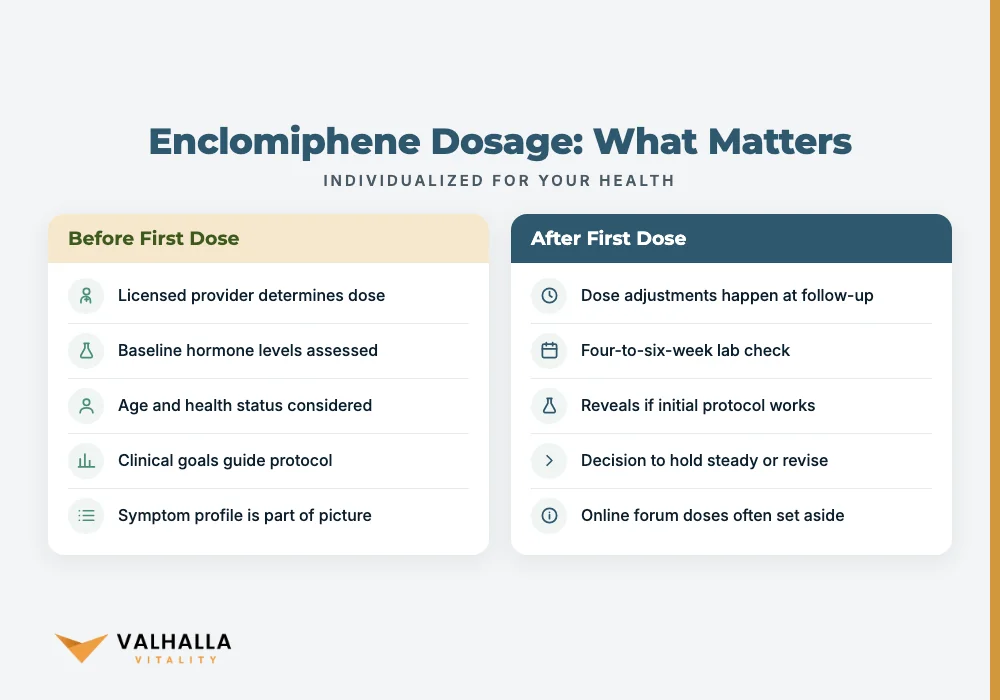
A licensed provider determines the dose after labs. This is not a legal disclaimer but a reflection of how the clinical decision actually works.
The appropriate starting amount depends on your baseline hormone levels, age, prior cycle history, current health status, and clinical goals. There is no formula that applies across all men. Enclomiphene dosage for bodybuilding is individualized by design.
What shapes an enclomiphene dosage bodybuilding protocol before the first dose
What a provider assesses before setting any protocol:
- Serum total and free testosterone: current levels show how far below physiological range the deficit falls and what it suggests about the underlying cause.
- LH and FSH: these reveal whether low testosterone is driven by a signaling problem (secondary hypogonadism) or primary testicular failure. Enclomiphene addresses the former and has no effect on the latter.
- Estradiol: the baseline level determines how much margin exists before estrogenic side effects become a clinical concern.
- Liver enzymes and metabolic markers: these establish contraindications and the baseline against which follow-up values are compared.
- Symptom profile: fatigue, reduced libido, lengthened recovery times, mood changes, and shifts in body composition are all part of the clinical picture, not merely subjective complaints.
Dose adjustments happen at the follow-up, not at the start. The four-to-six-week lab check is the first real decision point. It reveals whether the initial protocol is working, whether to hold steady, or whether revision is needed.
Men who arrive with a specific dose from online forums generally find that providers set that aside and start from the actual lab data. That is standard clinical practice. The gap between what circulates online and what providers actually prescribe is a consistent feature of enclomiphene dosage bodybuilding discussions.
Can enclomiphene help build muscle?
Enclomiphene may support muscle development indirectly by restoring testosterone to a healthy physiological range. It does not deliver testosterone from an outside source, and it is not an anabolic steroid.
Testosterone drives muscle protein synthesis, recovery efficiency, and lean mass accumulation over time. When testosterone falls below an optimal range, training adaptations slow down. Recovery windows lengthen. Body composition tends to drift unfavorably, even with consistent resistance training.
Enclomiphene for bodybuilding addresses this by targeting the signal chain behind testosterone production. Restoring testosterone to a healthy level may support:
- Muscle protein synthesis responds more effectively after resistance training sessions.
- Recovery windows between training days tend to shorten.
- Energy and drive during training may improve.
- Symptoms that interfere with consistent performance, including fatigue, reduced motivation, and prolonged soreness, may decrease.
The practical ceiling matters. Enclomiphene does not produce supraphysiological testosterone levels. It may restore hormone function to where it naturally belongs. When the hormonal environment normalizes, training adaptations respond at the level they would without the deficiency, not above it.
A clinical trial in the drug's development program enrolled 38 men in a double-blind, placebo-controlled crossover study. Participants received treatment for 60 days, with serum testosterone monitored throughout. The trial found measurable increases in testosterone levels compared to placebo.
Adequate dietary protein and a consistent resistance training program remain necessary for the hormonal restoration to translate into muscle development. Enclomiphene restores a condition. Training produces the result. Men who approach enclomiphene dosage bodybuilding with that understanding tend to set more realistic expectations about what restored testosterone will and will not do.
How does enclomiphene compare to clomiphene for bodybuilders?
Enclomiphene is the isolated testosterone-stimulating isomer of clomiphene citrate, without the estrogenic companion isomer that accounts for most of clomiphene's side effects in men. This is the core difference in the enclomiphene vs clomiphene bodybuilding comparison.
Standard clomiphene citrate contains both enclomiphene and zuclomiphene. Enclomiphene drives LH and FSH stimulation. Zuclomiphene has longer-lasting estrogenic activity and is associated with mood disturbances, visual side effects, and the estrogenic complaints that men who have used standard clomiphene often describe.
Isolating enclomiphene changes the tolerability profile. Men using enclomiphene get the testosterone-stimulating mechanism with reduced exposure to zuclomiphene-related effects. Visual disturbances, a consistent clomiphene complaint, are less frequently reported with enclomiphene. Mood disruption is generally less pronounced.
For a full breakdown of the isomeric differences between enclomiphene and clomid, including clinical tolerability comparisons, that resource covers the pharmacological and practical distinctions in depth.
One practical note: enclomiphene is only available through licensed prescribers. It is not an over-the-counter supplement. Providers who prescribe it do so for documented secondary hypogonadism, with lab confirmation required before any protocol begins.
Men who have previously used clomiphene citrate outside the medical system and are transitioning to a provider-supervised enclomiphene protocol often report a meaningful difference during use. The removal of the zuclomiphene component accounts for most of that difference. That tolerability shift is one reason enclomiphene dosage bodybuilding protocols have largely replaced clomiphene-based approaches in clinical practice.
What are the side effects of enclomiphene in men?
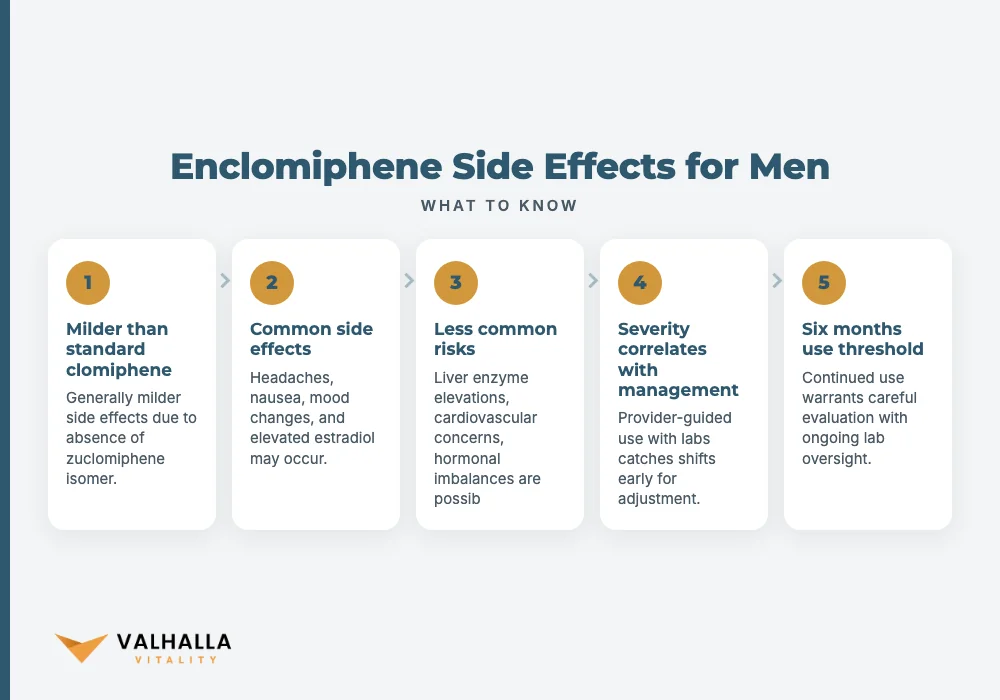
Enclomiphene side effects men experience are generally milder than those seen with standard clomiphene because the zuclomiphene isomer is absent. No therapy is risk-free, and a properly managed protocol monitors for side effects at every lab check.
Commonly reported side effects include:
- Headaches appear, particularly in the first weeks of therapy.
- Nausea occurs but is typically transient, resolving within the first month.
- Mood changes, including mild irritability, affect some users.
- Estradiol may elevate when the testosterone response outpaces the body's estrogenic self-regulation capacity.
Less common but more serious risks:
- Liver enzyme elevations can occur, which is why baseline and follow-up liver panels are part of any standard monitoring protocol.
- Cardiovascular concerns, including effects on blood viscosity, may arise in men with pre-existing cardiovascular risk factors.
- Hormonal imbalances sometimes require protocol revision or, in some cases, discontinuation.
Side effect severity correlates with how the protocol is managed. Self-directed use without regular lab monitoring means imbalances can go undetected for weeks before becoming symptomatic. Provider-guided use means labs catch shifts early, allowing adjustment before problems compound.
For a detailed review of the clinical risk profile of enclomiphene, including what a monitoring timeline looks like in practice, that resource covers the safety picture in full.
Clinical guidance from the drug's development program identifies six months as a threshold after which continued use warrants careful evaluation with ongoing lab oversight.
Enclomiphene dosage bodybuilding: what monitoring actually looks like
Most discussions about enclomiphene dosage bodybuilding stop at the initial dose. The monitoring phase is where actual protocol management happens, and it is where self-directed cycles most often go wrong.
A properly run enclomiphene cycle for men includes lab reviews at three checkpoints: before starting, at four to six weeks into therapy, and at the end of the intended cycle. At each check, the provider reviews:
- Total and free testosterone: is it moving toward the target range?
- LH and FSH: is the HPG axis responding to SERM stimulation as expected?
- Estradiol: is it staying within an acceptable range, or rising faster than testosterone?
- Liver function: are there any signals requiring attention?
- Symptom report: the provider tracks energy, libido, recovery quality, mood, and training response.
If the enclomiphene testosterone boost is insufficient at the four-week mark, the provider adjusts. If testosterone has normalized and symptoms resolved, the provider may hold steady or start a taper. If estradiol has risen significantly, an aromatase management approach may be added.
The structural difference between clinical use and forum-guided self-medication is exactly this. Forum protocols set a dose for a fixed period and move on. Provider-guided protocols track what your body is doing at each interval and respond to it.
Men with confirmed testosterone deficiency who also train may find that managing low testosterone in active men covers the monitoring framework in additional depth, including what labs are typically ordered and how results shape protocol decisions.
Enclomiphene for bodybuilding versus TRT: the practical difference
When men who train compare enclomiphene for bodybuilding against TRT, three factors consistently shape the decision: reliability of testosterone increase, preservation of fertility and testicular function, and reversibility after stopping therapy.
Reliability of testosterone increase: TRT delivers testosterone directly and is generally more predictable for reaching a specific serum target. Enclomiphene depends on the HPG axis responding, which introduces individual variability. Men with primary hypogonadism, where the testes themselves have limited function, may not respond adequately to enclomiphene because it stimulates signaling rather than compensating for end-organ failure.
Fertility and testicular function: Enclomiphene preserves both throughout therapy. TRT suppresses both. Recovery after TRT discontinuation is possible but may not be complete, and the timeline is unpredictable. Some men recover fully within months; others take considerably longer, and a subset does not return to pre-treatment production levels.
Reversibility: Because enclomiphene stimulates the HPG axis rather than bypassing it, the axis tends to return to its pre-treatment state relatively quickly after discontinuation. TRT recovery is less predictable and often takes longer.
For younger men, for those who have not yet started a family, or for those uncertain about long-term exogenous therapy, enclomiphene offers a path to hormone optimization that does not foreclose future options.
For a broader look at TRT dosage considerations for men who train, including the clinical trade-offs between replacement and stimulation strategies, that resource walks through the decision framework in detail.
The right choice depends on your labs, your symptom profile, your goals, and the judgment of a licensed provider who has reviewed your case. No article or forum can make that determination. When evaluating enclomiphene dosage bodybuilding approaches against exogenous testosterone, the provider's assessment of your HPG axis function is the most important input.
Availability of enclomiphene therapy varies by state.
Ready to have a provider review your hormone levels?
If your training and recovery are not responding the way they should, and testosterone levels may be a contributing factor, a licensed provider can review your labs and determine whether an enclomiphene protocol fits your situation. Book Your Consultation to get started.
FAQ
What is the recommended enclomiphene dosage for bodybuilding?
A licensed provider determines the dose after reviewing your lab results, including testosterone, LH, FSH, and estradiol. No universal protocol applies across all men because individual hormone baselines, health history, and clinical context all shape the decision. The protocol is then adjusted at follow-up based on how labs and symptoms respond.
When should you take enclomiphene during a cycle?
Timing depends on the clinical goal. For post-cycle recovery, enclomiphene is typically started after the suppressive compound has cleared the system. For secondary hypogonadism management, the provider sets timing based on lab results and intake information at each phase of the protocol.
Can enclomiphene help build muscle?
Enclomiphene may support muscle development indirectly by restoring testosterone to a healthy physiological range. Adequate testosterone drives muscle protein synthesis and recovery, so correcting a deficiency may allow training adaptations to proceed more effectively. It is not an anabolic steroid and does not produce supraphysiological effects.
How does enclomiphene compare to clomiphene for bodybuilders?
Enclomiphene isolates the testosterone-stimulating isomer from clomiphene citrate, removing the zuclomiphene isomer associated with estrogenic side effects and visual disturbances. Men generally find enclomiphene better tolerated than standard clomiphene while achieving comparable LH and FSH stimulation.
What are the side effects of enclomiphene in men?
Common side effects include headaches, nausea, and mood changes in the early weeks of therapy. Less common but more serious risks include liver enzyme elevations and cardiovascular concerns in men with pre-existing risk factors. Provider-supervised lab monitoring catches most issues early and allows protocol adjustment before side effects progress.
Sources
- Enclomiphene citrate development program: double-blind, placebo-controlled crossover clinical trial in 38 men with secondary hypogonadism, monitoring serum testosterone, LH, FSH, and estradiol over 60 days of treatment. Referenced for data on testosterone response magnitude and timeline.
- Enclomiphene citrate development program: clinical data on gonadotropin (LH, FSH) and testosterone response timelines (two to four weeks from treatment initiation) and prescribing guidance on duration thresholds (six months). Referenced for protocol structure and monitoring framework.
- Comparative pharmacological analysis of enclomiphene (trans-clomiphene) and zuclomiphene (cis-clomiphene): estrogenic receptor binding activity, LH-stimulating effects, and tolerability profiles in men. Referenced for the enclomiphene versus clomiphene comparison section.
You May Also Like
 Enclomiphene
 Before and After: Physical Changes Explained
Enclomiphene before and after: what physical changes to expect, how the results timeline unfolds, and why provider monitoring matters for outcomes.
October 21, 2026 ETRead more → Enclomiphene
 Vision Side Effects: Eye Floaters & More
Enclomiphene vision side effects include eye floaters, blurry vision, and light sensitivity. Know the warning signs and when to contact your provider.
October 21, 2026 ETRead more → Enclomiphene
 Drug Test: Detection, WADA, and Disclosure
Enclomiphene drug test detection depends on the test type. Learn how workplace panels, military screening, and WADA rules treat this SERM.
October 21, 2026 ETRead more →