Enclomiphene Citrate: Benefits, Side Effects & How It Works

The following blog post is for entertainment and informational purposes only. It is not intended to provide medical advice or diagnosis. Please consult your doctor before making any health-related decisions.
Enclomiphene citrate is a SERM that may support testosterone in men with secondary hypogonadism by stimulating the pituitary to release LH and FSH, which then signal the testes to produce testosterone naturally. Unlike testosterone replacement, it works through the body's own hormonal axis. Men reviewing their treatment options for secondary hypogonadism often consider it because it may preserve fertility while addressing low testosterone.
What is enclomiphene citrate used for?
Enclomiphene citrate is used primarily to treat secondary hypogonadism in men. This is a condition where low testosterone originates from insufficient pituitary signaling rather than primary testicular failure. The hypothalamic-pituitary-gonadal axis remains functional but underactive.
A 2016 review in Expert Opinion on Pharmacotherapy by Rodriguez et al. described it as a promising SERM for low testosterone because it restores upstream hormonal signaling rather than replacing testosterone directly. Beyond hypogonadism, enclomiphene is also studied for its potential to support male fertility. Higher LH and FSH stimulate both testosterone and sperm development simultaneously, which makes it relevant for men who want to maintain reproductive function while addressing hormone levels.
Key enclomiphene benefits
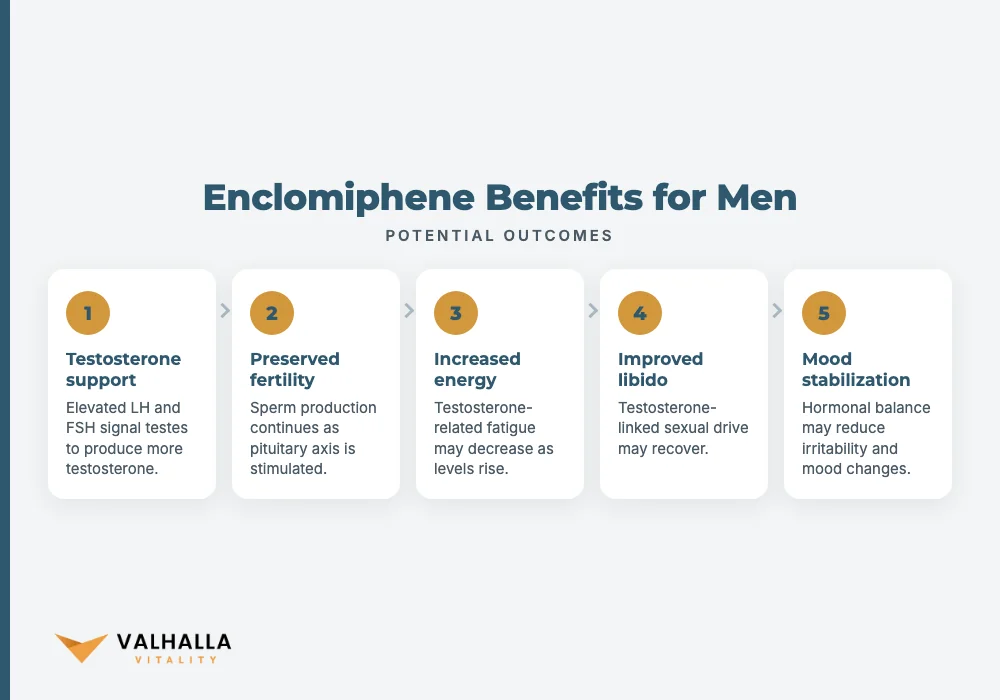
The reported enclomiphene benefits span hormonal, physical, and cognitive areas that men with secondary hypogonadism commonly flag as concerns.
| Reported benefit | How it may occur |
|---|---|
| Testosterone support | Elevated LH and FSH signal the testes to produce more testosterone |
| Preserved fertility | Sperm production continues because the pituitary axis is stimulated, not bypassed |
| Increased energy | Testosterone-related fatigue may decrease as levels rise |
| Improved libido | Testosterone-linked sexual drive may recover |
| Mood stabilization | Hormonal balance may reduce irritability and mood changes |
| Bone and muscle support | Testosterone contributes to skeletal and muscle tissue maintenance |
These potential outcomes are tied to an enclomiphene testosterone boost that must be confirmed through lab work. A licensed provider reviews labs and medical history before recommending any enclomiphene hypogonadism protocol or other intervention.
How enclomiphene citrate works
The compound is the trans-isomer of clomiphene. It binds to estrogen receptors in the hypothalamus, blocking the normal negative feedback signal that estrogen sends. With that signal reduced, the hypothalamus increases GnRH output. The pituitary then releases more LH and FSH.
Elevated LH drives the Leydig cells in the testes to produce testosterone. Higher FSH supports sperm production at the same time. The mechanism is upstream. The body's own biology does the work.
That differs meaningfully from testosterone replacement therapy, which delivers exogenous hormone directly into circulation. TRT raises serum testosterone but suppresses LH and FSH production, often reducing testicular size and sperm output over time. By working upstream, it tends to preserve those parameters. Men who want to address low testosterone without suppressing their reproductive axis often find this distinction clinically significant.
Enclomiphene vs clomiphene
Clomiphene contains two isomers: the trans-isomer (enclomiphene) and the cis-isomer (zuclomiphene). Zuclomiphene has a long half-life and weak estrogenic activity, contributing to the hot flashes, mood changes, and vision disturbances historically associated with clomiphene therapy.
Enclomiphene citrate isolates the active trans-isomer. The estrogenic interference from zuclomiphene is removed. The 2025 systematic review and meta-analysis by Hohl et al. in Archives of Endocrinology and Metabolism compared both compounds across randomized controlled trials and found enclomiphene produced consistent improvements in testosterone, LH, and FSH with a favorable tolerability profile.
Men researching the enclomiphene citrate vs clomiphene comparison typically find the isomer distinction is the central clinical reason the compound has attracted renewed interest among providers.
How long does enclomiphene take to work?
Measurable testosterone changes appear quickly. Data reviewed by Rodriguez et al. (2016) showed levels may increase by approximately 11% after a single dose, rising to around 15% by day seven in men with hypogonadism. A small study of 15 men cited in that review recorded a notable surge in testosterone within one week of treatment, with associated improvements in sperm density and libido.
Results emerge within a week. Individual timelines vary.
Starting testosterone level, age, body composition, and overall health all influence the speed and degree of response. A provider monitors labs at follow-up visits to confirm whether levels are responding and to adjust treatment as needed.
What are the side effects of enclomiphene?
Enclomiphene side effects are generally mild compared to older SERM regimens. Commonly reported adverse effects include:
- Nausea and stomach discomfort or bloating
- Headache
- Mild swelling in the feet
- Skin changes such as acne
- Breast tenderness
- Visual disturbances or blurred vision
Breast tenderness and visual changes are the two effects requiring prompt provider contact. Blurred vision warrants stopping the medication immediately. Most other effects are dose-related and manageable with ongoing monitoring.
For a full picture of what providers track during treatment, the enclomiphene safety profile and lab guide covers the process in detail.
Does enclomiphene cause water retention?
Generalized water retention is not a commonly documented effect of this SERM. Some men report mild, localized swelling in the feet, which appears in clinical safety data. This is distinct from the broader fluid retention sometimes associated with anabolic steroids or direct testosterone therapy.
Persistent or worsening swelling should be reported to the prescribing provider.
What is the correct dosage of enclomiphene for men?
There is no standard number to look up. A licensed provider determines the appropriate enclomiphene dosage for men after reviewing intake forms, baseline labs including total testosterone, LH, and FSH, and the individual's symptom history.
Calibration matters more than any single figure. Too low a dose may produce no meaningful hormonal shift. Too high may provoke estrogen-related side effects or disrupt the feedback loop the therapy is designed to activate. The dose is adjusted as labs are rechecked and the response is evaluated over time.
Men interested in how telehealth providers approach this process can explore the hormone health services at Valhalla Vitality before making any decisions.
Talk to a licensed provider
When you are ready to determine whether enclomiphene citrate is appropriate for your situation, Book Your Consultation with a licensed provider who will review your intake and labs before making any recommendation.
FAQ
What is enclomiphene citrate used for?
Enclomiphene citrate is used primarily to treat secondary hypogonadism in men, where low testosterone results from insufficient pituitary signaling rather than direct testicular damage. It may also support sperm production, making it relevant for men who want to address testosterone levels without suppressing fertility.
How long does enclomiphene take to work?
Early clinical data reviewed by Rodriguez et al. (2016) indicate testosterone levels may rise by approximately 11% after a single dose and around 15% by day seven. Individual responses vary based on starting hormone levels, age, and overall health.
What are the side effects of enclomiphene?
Commonly reported enclomiphene side effects include headache, nausea, bloating, breast tenderness, mild foot swelling, acne, and in rare cases visual disturbances. Blurred vision warrants stopping the medication and contacting a provider promptly. Most side effects are dose-related and manageable under provider oversight.
Does enclomiphene cause water retention?
Significant water retention is not a commonly documented effect of this compound. Some men report mild, localized foot swelling, but generalized fluid retention is not well-established in clinical trial data. Persistent swelling should be discussed with a provider.
What is the correct dosage of enclomiphene for men?
A licensed provider determines enclomiphene dosage for men after reviewing lab results and symptom history. There is no one-size-fits-all dose, and self-selecting without provider oversight risks either insufficient hormonal effect or estrogen-related side effects.
Sources
- Rodriguez KM, Pastuszak AW, Lipshultz LI (2016). Enclomiphene citrate for the treatment of secondary male hypogonadism. Expert Opinion on Pharmacotherapy. PubMed
- Hohl A et al. (2025). Clomiphene or enclomiphene citrate for the treatment of male hypogonadism: a systematic review and meta-analysis of randomized controlled trials. Archives of Endocrinology and Metabolism. PubMed
You May Also Like
 Enclomiphene
 Before and After: Physical Changes Explained
Enclomiphene before and after: what physical changes to expect, how the results timeline unfolds, and why provider monitoring matters for outcomes.
October 21, 2026 ETRead more → Enclomiphene
 Vision Side Effects: Eye Floaters & More
Enclomiphene vision side effects include eye floaters, blurry vision, and light sensitivity. Know the warning signs and when to contact your provider.
October 21, 2026 ETRead more → Enclomiphene
 Drug Test: Detection, WADA, and Disclosure
Enclomiphene drug test detection depends on the test type. Learn how workplace panels, military screening, and WADA rules treat this SERM.
October 21, 2026 ETRead more →