Oral Testosterone Tablets: Benefits, Risks, and Safety

The following blog post is for entertainment and informational purposes only. It is not intended to provide medical advice or diagnosis. Please consult your doctor before making any health-related decisions.
Oral testosterone tablets are clinically validated medications that may raise testosterone to clinically adequate levels in men with confirmed hypogonadism. They absorb through the digestive tract into the lymphatic system before entering general circulation, bypassing the first-pass liver metabolism that made early oral androgens unsafe for long-term use. Modern testosterone replacement pills pair testosterone with fatty acid carriers to achieve therapeutic blood levels without requiring the liver to process the full absorbed dose. A licensed provider reviews labs and medical history to determine whether FDA-cleared oral testosterone capsules or a different delivery format fits your clinical picture.
How oral testosterone tablets work
After swallowing a testosterone pill, the active compound absorbs through intestinal walls into the lymphatic system rather than the portal circulation that feeds directly into the liver. From there, the hormone enters the bloodstream and travels to androgen receptors in muscle tissue, bone, the brain, and reproductive organs. It supports maintenance of lean mass, bone mineral density, mood regulation, and sexual function through these receptor interactions.
The formulation detail that makes this work is the fatty acid carrier. It dramatically improves lymphatic uptake and allows the hormone to reach therapeutic concentrations. Taking these tablets with a fat-containing meal is not optional; it is required for absorption to occur reliably. A 2021 review in Expert Opinion on Pharmacotherapy by Kresch et al. confirmed that current lymphatically absorbed oral testosterone formulations represent a meaningful addition to the treatment options available in the US, alongside injections, gels, and pellets.
Delivery formats for testosterone replacement: a comparison
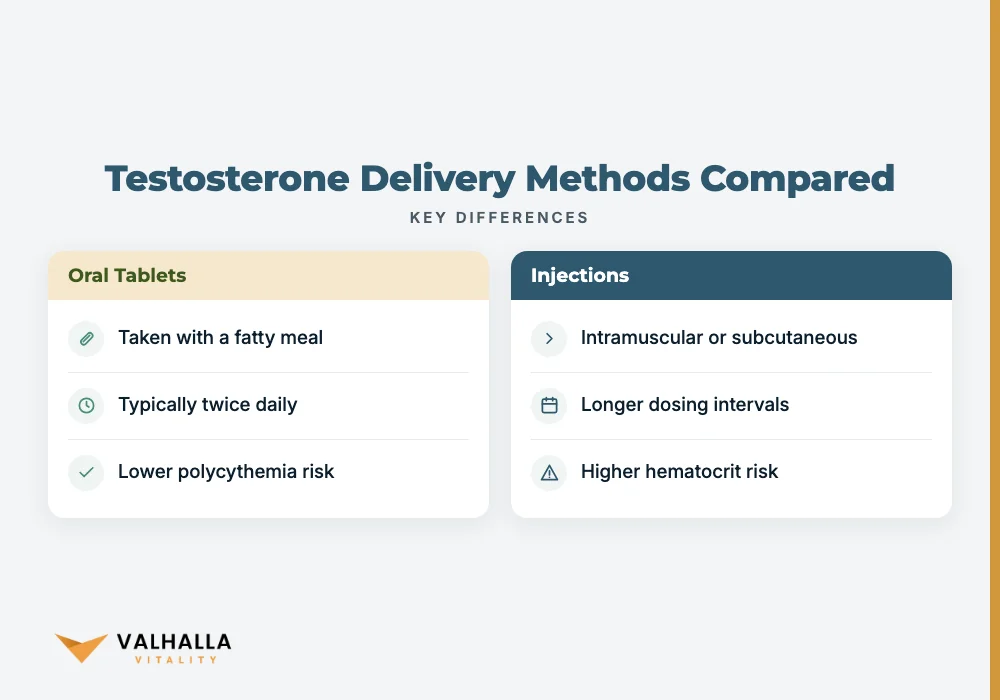
| Delivery method | Mechanism | Key clinical point |
|---|---|---|
| Oral tablets | Lymphatic absorption from the gut | Take with a fatty meal; twice-daily dosing typical |
| Injections | Intramuscular or subcutaneous depot | Longer dosing intervals; higher hematocrit risk than oral |
| Topical gels or patches | Transdermal absorption | Daily application; risk of skin transfer to household members |
| Subcutaneous pellets | Slow-release implant | Long duration; requires an in-office insertion procedure |
A 2022 Bayesian network meta-analysis by Nackeeran et al. in The Journal of Urology found that route of administration significantly affects hematocrit elevation. Injectable testosterone was associated with higher polycythemia rates compared to oral routes. That distinction has direct clinical consequences for patients whose baseline hematocrit sits near the upper limit of normal.
What are the benefits of testosterone pills for men?
Testosterone pills for men with clinically confirmed low testosterone may support muscle mass, bone density, mood, libido, and metabolic function. These benefits are most meaningful when testosterone levels are genuinely deficient, not simply at the low end of a reference range. A provider assesses symptoms, labs, and the full clinical picture before concluding that replacement is warranted.
Muscle mass and physical strength. Testosterone supports muscle protein synthesis and lean mass maintenance. Men with hypogonadism who restore levels to the physiological range may see improvements in physical capacity and lean muscle over the course of months. These are restorative changes, not performance-enhancement effects, and they develop gradually. Providers distinguish medically indicated replacement from fitness-driven use of androgens.
Bone mineral density. Low testosterone correlates with reduced bone density and higher fracture risk, particularly in older men. Replacement therapy may slow bone loss and support mineral density over time. Providers often track bone health through periodic imaging in patients with relevant risk factors, such as age or prior fractures.
Mood and cognitive function. Clinical evidence links testosterone deficiency to depressive symptoms, irritability, and impaired concentration. Restoring levels to physiological range may support emotional stability and cognitive clarity. Response varies substantially between individuals. A provider will also assess whether mood symptoms stem from low testosterone or from other concurrent conditions before attributing them to hormone deficiency.
Libido and sexual function. Testosterone plays a direct role in sexual drive and contributes to erectile function. Men with documented low T frequently report reduced interest in sex and decreased satisfaction with sexual activity. Appropriate replacement may help restore libido and improve function. Testosterone is one factor among several that influence sexual health, and a provider considers the full picture.
Fat distribution and metabolic health. Testosterone influences fat storage, particularly in the abdominal region. Deficiency is associated with increased central adiposity. Replacement may shift body composition toward more lean mass and less abdominal fat in men with documented deficiency. These metabolic effects interact with diet and physical activity, so lifestyle factors remain relevant even during replacement therapy.
No single benefit is certain. All are conditional on confirmed deficiency, a supervised protocol, consistent medication use, and regular follow-up monitoring. Individual variation is substantial.
Are oral testosterone tablets safe to take?
Yes, when prescribed and monitored by a licensed provider. Specific oral testosterone formulations have been reviewed and cleared based on clinical trial data addressing both efficacy and safety. The monitoring requirement is not procedural overhead. It is the mechanism that keeps therapy safe.
Modern oral testosterone tablets differ substantially from the 17-alpha-alkylated oral androgens that caused liver damage in earlier decades. Current formulations use lymphatic absorption pathways that reduce hepatic burden significantly. That said, liver function testing remains part of standard monitoring because some hepatic exposure still occurs during metabolism.
Blood pressure warrants regular tracking throughout therapy, since testosterone replacement may raise it in certain patients. Hematocrit, the fraction of whole blood occupied by red blood cells, rises with testosterone therapy across all delivery routes. Research by Nackeeran et al. (2022) found that injectable testosterone elevates hematocrit more than oral routes. For patients near the upper acceptable threshold, that difference is clinically meaningful and may tip the route decision toward oral administration.
Testosterone pills side effects that providers watch for include acne, fluid retention, mood changes, and lipid panel shifts. Regular follow-up labs catch these early enough to adjust before harm accumulates. A provider will modify or pause the protocol if any marker moves outside the acceptable range. Managing testosterone replacement without licensed supervision is unsafe. A single dose rarely causes acute harm, but blood thickening, liver stress, and cardiovascular changes can develop silently over months when no one is checking.
Can testosterone be taken orally instead of injections?
Yes. Oral testosterone tablets are a clinically validated option alongside injections, and neither route is universally superior. The right choice reflects the individual's lab values, baseline health markers, lifestyle, and preference.
When weighing testosterone pills vs injections, several practical differences matter. Injections allow longer intervals between doses, which some patients prefer over a twice-daily schedule. However, the hematocrit data from Nackeeran et al. (2022) shows that injectable testosterone carries statistically higher polycythemia risk compared to oral formulations. For patients with elevated baseline hematocrit or prior cardiovascular events, a provider may favor oral administration on safety grounds rather than convenience.
Oral tablets require a twice-daily schedule with a fat-containing meal. Injections require either a self-injection technique or clinic visits on a fixed schedule. Neither constraint suits every patient. A provider evaluates both options against the clinical picture and recommends accordingly. The patient's preference is a factor in that decision, but it is not the only one.
For a detailed look at how these two delivery routes compare across clinical parameters, including absorption differences, monitoring requirements, and typical patient profiles, the linked article covers the trade-offs that shape provider recommendations.
Who should consider oral testosterone tablets?
Oral testosterone tablets are for adult men with clinically confirmed hypogonadism. Confirmed means documented through lab testing, not inferred from symptoms alone. Symptoms of low testosterone overlap with hypothyroidism, sleep apnea, depression, and other treatable conditions. Prescribing testosterone before ruling these out does not help and carries unnecessary risk.
A provider typically considers oral tablets when:
- Symptoms including fatigue, reduced libido, decreased lean mass, or mood changes accompany lab-confirmed testosterone deficiency
- Injectable testosterone is not preferred due to needle aversion, lifestyle factors, or elevated baseline hematocrit
- The patient can reliably maintain a twice-daily oral schedule with meals
- Baseline liver function and cardiovascular markers fall within acceptable limits at the time of evaluation
Oral testosterone is contraindicated in men with certain cardiovascular conditions, active liver disease, or hormone-sensitive cancers. Providers review these contraindications against a complete medical history and current labs before any prescription is written.
The structured provider-led process is not a bureaucratic formality. It is the safety framework. There is no appropriate clinical scenario in which a patient selects their own dose, adjusts frequency based on perceived effect, or skips lab monitoring. That structure is what distinguishes medically supervised testosterone replacement from unsupervised use.
Availability varies by state.
How long does it take for testosterone pills to work?
Timelines vary between individuals. Some men report early shifts in energy and mood within the first several weeks of therapy. Physical changes, including improvements in lean mass or fat distribution, take longer and require testosterone levels to remain consistently in the therapeutic range throughout treatment.
What matters more than timelines is whether blood levels have actually reached the target window. A provider confirms this at a follow-up lab panel scheduled after starting, then at regular intervals once the protocol stabilizes. If levels are outside the target range, the provider adjusts before expecting clinical changes to appear.
Stopping therapy abruptly tends to produce a return of the original symptoms. Any decision to discontinue should happen in conversation with the prescribing provider. Age, baseline testosterone level, body composition, and overall health status all influence the pace at which therapeutic changes become apparent. Managing expectations realistically is part of a well-run protocol.
Low testosterone oral treatment: what a provider checks before prescribing
Providers do not prescribe testosterone replacement based on symptoms alone. The diagnostic process typically includes:
- Morning serum total testosterone, measured on at least two separate occasions
- Luteinizing hormone and follicle-stimulating hormone levels, to distinguish primary from secondary hypogonadism
- Hematocrit and complete blood count
- Liver function panel
- Prostate-specific antigen for men over 40
- Lipid panel and resting blood pressure
A licensed provider determines the dose after reviewing these results alongside the full intake. The symptom picture and the lab picture must both support the diagnosis before prescribing is appropriate. When one element is missing or ambiguous, the provider investigates further rather than proceeding.
For context on how different oral testosterone compounds compare at a clinical level, this review of testosterone undecanoate and related oral formulations covers the compound-level distinctions that influence prescribing decisions.
Monitoring testosterone replacement: what happens after you start
Once therapy starts, monitoring is not optional. It is how responsible testosterone replacement remains safe over time. A first follow-up lab panel is typically scheduled within the first several weeks, then at regular intervals once levels stabilize.
Markers tracked during active therapy include:
- Serum testosterone, to confirm levels remain in the therapeutic range
- Hematocrit, to monitor for polycythemia
- Liver enzymes, to track hepatic impact over time
- Blood pressure
- Prostate-specific antigen annually in older patients
If hematocrit climbs too high, a provider may reduce the dose, switch delivery routes, or temporarily pause therapy. Blood that is too thick raises clotting risk, and this is a predictable consequence of testosterone therapy when no one is watching. The same logic applies to liver enzymes and blood pressure. Each marker has a threshold; crossing it triggers a protocol adjustment, not an immediate emergency.
Patients who stop attending follow-up labs are not in a supervised protocol, regardless of how the original prescription was issued. That is where risk accumulates without anyone noticing.
Valhalla Vitality connects patients with licensed providers who manage the full testosterone replacement process, from intake review to lab monitoring. Provider approval occurs within 24 business hours of order placement, with the prescription delivered to a US partner compounding pharmacy after review. Availability varies by state.
For a clinical overview of how oral testosterone replacement has evolved and what research currently supports, this examination of oral TRT efficacy covers the evidence behind current prescribing practices.
Ready to find out if oral testosterone tablets are right for you?
If low testosterone symptoms are affecting your daily life and you want a provider-led clinical assessment, Book Your Consultation to have a licensed clinician review your intake and labs before any recommendation is made.
FAQ
Are testosterone replacement pills the same as anabolic steroids?
No. Prescription testosterone replacement pills support physiologically normal testosterone levels in men with confirmed deficiency. Anabolic steroids are synthetic compounds used at supraphysiological doses for performance purposes and are a distinct category from medically prescribed testosterone replacement.
Do oral testosterone tablets require a prescription?
Yes. Oral testosterone formulations require a prescription from a licensed provider. Over-the-counter products marketed as testosterone boosters contain herbal compounds, not pharmaceutical testosterone, and the FDA has not evaluated them for the treatment of hypogonadism.
Are testosterone pills safe for long-term use?
Long-term safety depends on regular monitoring. With hematocrit, liver function, blood pressure, and prostate-specific antigen tracked at scheduled intervals and kept within acceptable ranges, continued therapy is generally considered appropriate under ongoing clinical supervision.
What makes modern oral testosterone tablets different from older liver-toxic forms?
Current prescription tablets use lymphatic absorption that bypasses the liver on the first pass. Older oral androgens were 17-alpha-alkylated to survive liver metabolism directly, which caused hepatotoxicity. Modern formulations do not use that structural modification, which is why the hepatic risk profile is substantially lower.
Is low testosterone oral treatment available in my state?
Availability varies by state. A licensed provider reviews your location and clinical profile during the intake process to confirm whether oral testosterone therapy can be prescribed where you live.
Sources
- Kresch E et al. (2021). An update on the available and emerging pharmacotherapy for adults with testosterone deficiency available in the USA. Expert Opinion on Pharmacotherapy. PubMed
- Nackeeran S et al. (2022). The Effect of Route of Testosterone on Changes in Hematocrit: A Systematic Review and Bayesian Network Meta-Analysis of Randomized Trials. The Journal of Urology. PubMed
You May Also Like
 Oral testosterone
Oral Testosterone Therapy: Energy, Side Effects & Results
Oral testosterone therapy may improve energy and ease fatigue in men with low T. Learn how it works, what side effects to expect from treatment.
October 7, 2026 ETRead more → Oral testosterone
Oral Testosterone Fertility: How TRT Affects Sperm
Oral testosterone fertility: TRT typically reduces sperm production. Learn what the research shows and how to protect your reproductive options.
October 7, 2026 ETRead more → Oral testosterone
Oral Testosterone Therapy: Options, Benefits, and Risks
Oral testosterone therapy delivers TRT in pill form. Learn how testosterone undecanoate capsules work, who qualifies, and key side effects to watch.
October 6, 2026 ETRead more →