
The following blog post is for entertainment and informational purposes only. It is not intended to provide medical advice or diagnosis. Please consult your doctor before making any health-related decisions.
The best oral testosterone pills are prescription capsules, specifically testosterone undecanoate formulations like Kyzatrex, not herbal supplements sold over the counter. These medications require a prescription and a licensed provider's review of lab results before they can be dispensed. If oral testosterone therapy is worth exploring, Kyzatrex prescription testosterone capsules represent the leading clinical option available through licensed telehealth providers. Understanding how they work, how they compare to OTC supplements, and what the evaluation process involves can clarify which approach fits a given clinical picture.
Prescription pills vs. OTC boosters: understanding the difference
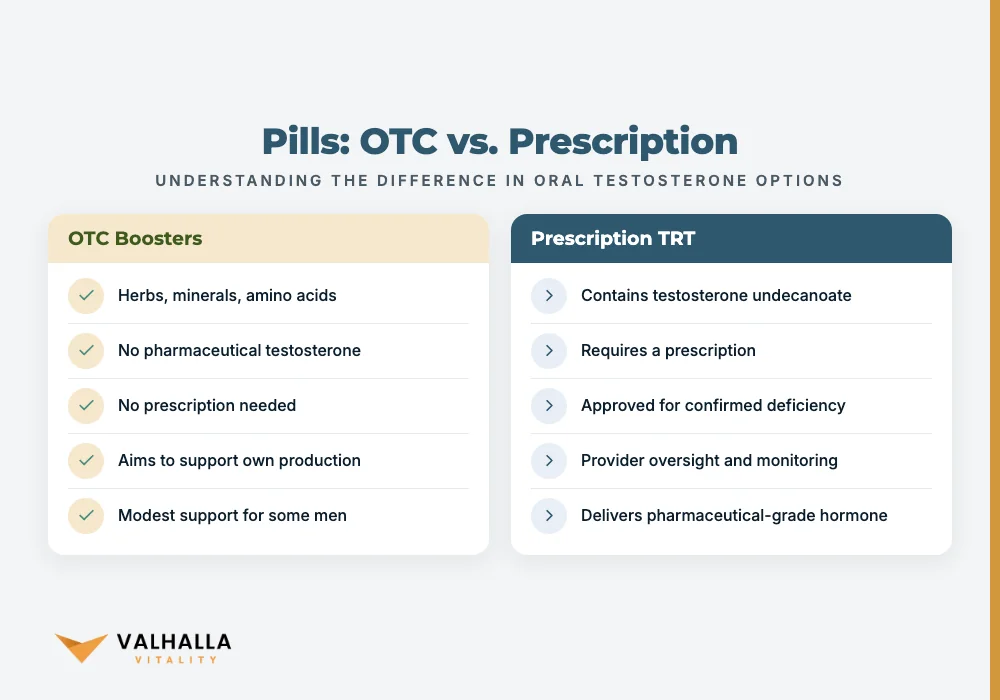
Men researching oral testosterone options often encounter two product categories that share similar marketing language. The distinction matters. What you can expect from each is completely different.
Over-the-counter testosterone boosters contain herbs, minerals, and amino acids. Common ingredients include tribulus terrestris, ashwagandha, zinc, magnesium, and D-aspartic acid. These compounds aim to support the body's own hormone production indirectly by influencing the enzymatic pathways involved in testosterone synthesis. They do not contain testosterone itself. No prescription is required.
Prescription testosterone capsules are a different category entirely. They contain pharmaceutical-grade testosterone undecanoate. A licensed provider prescribes them after reviewing bloodwork, medical history, and symptom evaluation. They are classified as testosterone replacement therapy. Provider oversight and follow-up monitoring are built into the process from the start.
| Feature | OTC testosterone boosters | Prescription testosterone capsules |
|---|---|---|
| Contains pharmaceutical testosterone | No | Yes |
| Requires a prescription | No | Yes |
| Approved for confirmed testosterone deficiency | No | Yes |
| Provider oversight and monitoring included | No | Yes |
OTC products may offer modest support for some men. Prescription testosterone replacement pills deliver pharmaceutical-grade hormone under clinical supervision, with bloodwork before and after to confirm that levels reach the target range.
Do oral testosterone boosters actually work?
OTC testosterone boosters may produce limited results for some men. That is the accurate, sourced answer. The evidence behind herbal compounds like ashwagandha, tribulus terrestris, or zinc in supporting hormone production is inconsistent. Some trials report modest effects on specific markers. Others find no meaningful difference from placebo. No study shows OTC supplements achieving the level of hormone correction that confirmed testosterone replacement therapy provides.
Prescription testosterone replacement is a different question with a different evidence base. A 2023 review in Sexual Medicine Reviews traced oral testosterone therapy from its earliest failed formulations through today's clinical options, finding that modern testosterone undecanoate capsules address the absorption and liver-toxicity challenges that made earlier oral products impractical for sustained clinical use (Miller et al., 2023). The evidence behind prescription capsules is substantially more rigorous than what supports any OTC blend.
The practical conclusion: if a licensed provider has confirmed testosterone deficiency through blood testing, OTC products are unlikely to restore levels to a clinically meaningful range. That is where the best oral testosterone pills, meaning prescription testosterone undecanoate capsules, become the relevant clinical option.
What is the best oral testosterone for men?
The best oral testosterone for men is the prescription capsule a licensed provider recommends after reviewing labs, health history, and symptoms. There is no single answer that applies universally. Among the options currently available in the US, Kyzatrex oral testosterone is one of the most recently approved formulations and reflects the improvements in oral TRT for men that resulted from decades of formulation research.
A 2025 review in Sexual Medicine Reviews examined newer oral testosterone undecanoate formulations and noted that modern products have substantially reduced the hepatotoxicity risks associated with older oral androgens (Goldstein et al., 2025). Earlier compounds, particularly 17-alpha-alkylated testosterone derivatives, carried real and documented liver risks. The newer testosterone undecanoate formulations do not share that mechanism, owing to a different absorption pathway.
Provider judgment shapes this decision. Identifying the best oral testosterone pills for a given individual means weighing formulation, absorption profile, and lifestyle compatibility alongside laboratory data. Some men will do better with injectable testosterone based on individual cardiovascular status, lifestyle, or preference. Others find that clinical oral testosterone fits more naturally into a daily routine. The right delivery method is a clinical decision made after reviewing the full picture, not a consumer choice.
What is Kyzatrex and how does it work?
Kyzatrex is a prescription oral testosterone undecanoate capsule indicated for use in men with testosterone deficiency caused by a medical condition. Its safety profile is better than older oral testosterone products. The mechanism explains why.
When taken with a fatty meal, testosterone undecanoate is absorbed through the intestinal lymphatic system. This route bypasses hepatic first-pass metabolism entirely. The fat content of the meal triggers the lymphatic absorption pathway. That bypass is what distinguishes Kyzatrex from older oral androgens: the liver is not the primary processing site, which removes the source of liver damage that characterized earlier oral testosterone compounds.
The development and clinical path of Kyzatrex oral testosterone reflects decades of formulation work aimed at solving exactly that safety problem. A 2025 review confirmed that newer oral TU products have a substantially improved liver safety profile compared with historical oral androgens (Goldstein et al., 2025).
A licensed provider determines the dose after reviewing lab results. Consistent administration with meals is essential, because skipping food significantly reduces lymphatic absorption and leads to unstable serum testosterone levels. Follow-up bloodwork at six to eight weeks confirms whether the target range has been achieved.
Is oral testosterone safer than injections?
Neither delivery method is universally safer. They carry different risk profiles, and the better fit depends on individual health factors rather than a universal recommendation.
Injectable testosterone avoids daily dosing and meal-timing requirements. Many men maintain stable serum levels on a weekly or biweekly injection cycle. Tradeoffs include injection-site reactions, hematocrit fluctuations in the days after each dose, and the practical burden of self-injection.
Clinical oral testosterone avoids needles entirely and integrates into a daily medication routine. A 2023 review confirmed that the lymphatic absorption mechanism of testosterone undecanoate largely bypasses the hepatic first-pass effect that caused liver damage with earlier oral androgens, placing the liver safety profile of modern oral TU significantly ahead of historical products (Miller et al., 2023). That said, cardiovascular and hematocrit monitoring remains necessary with oral delivery, as it does with injections.
Both delivery paths carry the same core TRT considerations: potential hematocrit elevation, estradiol changes, effects on lipids, and suppression of endogenous testosterone production. These are monitored with follow-up labs regardless of how testosterone enters the body.
For a detailed comparison of the two approaches, how oral testosterone compares to injectable delivery covers the clinical and practical tradeoffs side by side.
How long does oral testosterone take to work?
Treatment begins affecting serum hormone levels within days of starting. Energy and sleep quality changes are often the first things men notice, typically within a few weeks. Mood and libido tend to follow. Physical changes, including shifts in muscle mass or body composition, take longer.
Providers generally describe meaningful physical changes on a three-to-six-month timeline. A 2024 systematic review and network meta-analysis examining testosterone replacement therapy's effects on lower urinary tract function found that statistically significant improvements emerged over months of consistent treatment, not within the first few weeks (Yuan et al., 2024). This aligns with how TRT works across physiological systems: it restores hormone levels, and the downstream effects accumulate with time.
Consistent dosing is essential throughout. Missing doses or taking prescription testosterone capsules without adequate food reduces absorption, delays measurable results, and introduces variability that complicates follow-up monitoring.
What oral TRT for men may affect over time
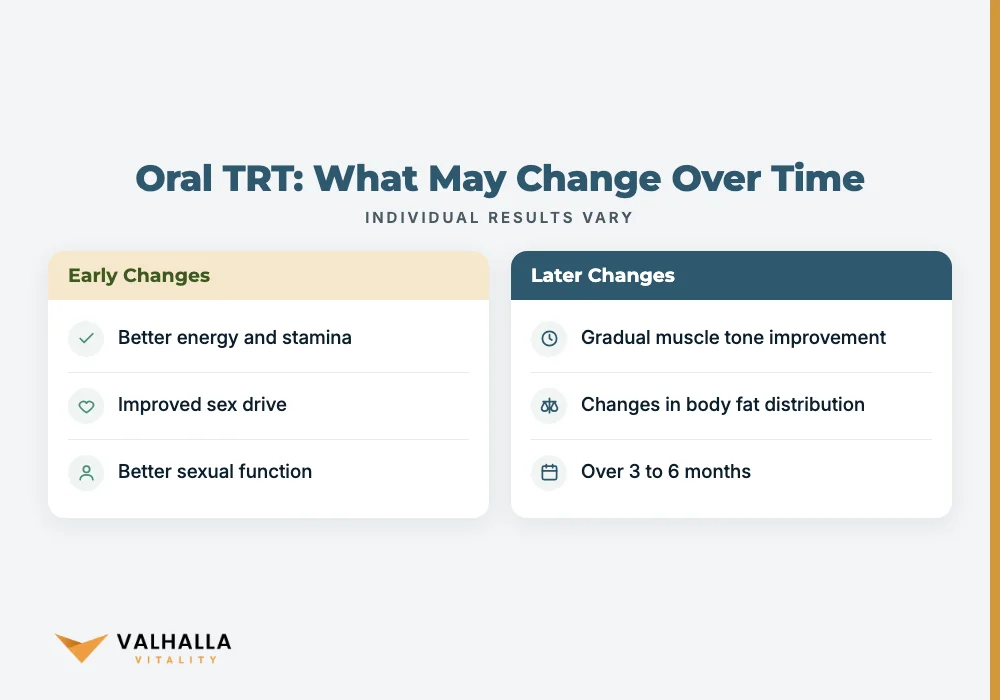
Oral TRT is associated with a range of effects that reflect the roles testosterone plays across multiple systems. These vary from person to person and differ by individual.
Energy and stamina are among the first changes men with confirmed testosterone deficiency report after starting oral testosterone therapy. Testosterone influences metabolic rate and cellular energy processes. Restoring levels to the normal range may support better stamina during physical activity and more stable energy throughout the day.
Libido and sexual health are closely linked to testosterone in men. Low testosterone is a recognized contributor to reduced sex drive. Clinical oral testosterone, when prescribed and monitored appropriately, may support improved libido and sexual function as hormone levels normalize. Effects on libido are typically among the earlier changes, often noticeable within the first weeks of therapy.
Muscle mass and body composition respond to testosterone on a longer timeline. Testosterone supports protein synthesis and lean mass maintenance. Men with confirmed deficiency who begin oral TRT may notice gradual improvements in muscle tone and body fat distribution over three to six months of consistent therapy, particularly when combined with regular physical activity.
A licensed provider sets realistic expectations based on individual baseline labs, age, and health status. No therapy ensures specific results.
Practical criteria for evaluating the best oral testosterone pills
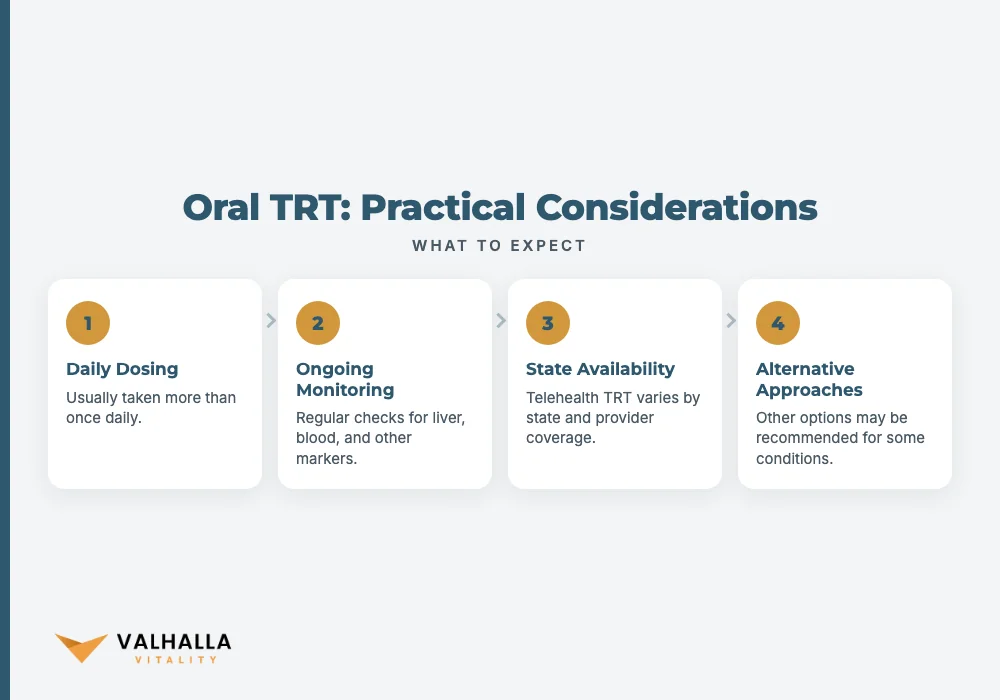
Not every candidate for testosterone replacement will be a good fit for oral delivery, and knowing the practical requirements before the evaluation helps set accurate expectations.
Meal adherence. Testosterone undecanoate capsules must be taken with a meal containing fat. This triggers the lymphatic absorption pathway and is non-negotiable. Men who frequently skip meals or cannot maintain consistent food intake may experience less stable serum testosterone with oral delivery compared with a weekly injection.
Daily dosing schedule. Prescription testosterone capsules are typically taken more than once daily, based on the specific product and provider guidance. For men who prefer a daily pill routine, this can be convenient. For others, less frequent injections fit better.
Ongoing monitoring. Although modern oral TU has an improved liver safety profile, liver function monitoring remains part of the clinical protocol for oral testosterone therapy. Hematocrit, estradiol, PSA, and cholesterol monitoring continues throughout treatment. That is part of what clinical oral testosterone means, not an optional extra.
State availability. Oral TRT for men through telehealth is not available everywhere. Availability varies by state, depending on licensed provider coverage and which partner pharmacies serve each region.
Alternative approaches. For men whose testosterone deficiency stems from a hypothalamic-pituitary signaling issue rather than primary testicular failure, or for men prioritizing fertility preservation, a provider may recommend an alternative rather than direct testosterone replacement. What men considering oral TRT should know outlines when each approach tends to apply clinically.
What the evaluation and prescription process involves
At a telehealth provider like Valhalla Vitality that offers oral TRT for men, the evaluation follows structured steps. First, a patient completes an online medical intake covering symptoms, health history, current medications, and relevant risk factors. Second, a licensed provider reviews the intake and lab results, typically within 24 business hours of the order being placed. Third, if the provider determines that testosterone replacement is appropriate, the prescription goes to an FDA-inspected U.S. pharmacy and arrives approximately 3 to 7 business days from the time the prescription is transferred.
Labs anchor every step of this process. Before prescribing any testosterone replacement pills, a provider will assess total and free testosterone, LH, FSH, estradiol, hematocrit, PSA, and a metabolic panel. Two separate morning measurements are standard for confirming testosterone deficiency, because testosterone levels fluctuate and a single low reading is not sufficient for diagnosis on its own.
Follow-up bloodwork at six to eight weeks confirms that therapeutic testosterone levels have been reached. Ongoing monitoring continues from there, with dose adjustments based on lab results rather than symptoms alone.
This structured, provider-led process is what separates the best oral testosterone pills from any supplement purchased without a prescription. The clinical infrastructure around the medication is what makes it both safe and medically appropriate.
Start your evaluation
To find out whether oral testosterone therapy fits your clinical picture, Book Your Consultation with a licensed provider.
FAQ
Can I get prescription testosterone capsules without a provider evaluation?
No. Prescription testosterone capsules require a licensed provider to confirm testosterone deficiency through bloodwork and write a prescription. Products sold without a prescription contain herbs and minerals, not pharmaceutical-grade testosterone.
Who qualifies for prescription testosterone replacement pills?
Qualification requires confirmed testosterone deficiency on at least two separate morning lab draws, along with a provider review of medical history and any contraindications. A licensed provider makes that determination after reviewing the full clinical picture.
How do oral testosterone capsules differ from injections in practice?
Oral capsules are taken daily with a meal and absorbed through the lymphatic system. Injections are administered weekly or biweekly and do not require meal timing. Both require ongoing monitoring; the better fit depends on labs, health history, and provider recommendation.
Is oral TRT available in every state?
Availability varies by state. Whether a licensed provider can prescribe oral testosterone through telehealth depends on state licensing and which partner pharmacies serve each area.
Does oral testosterone therapy require ongoing monitoring?
Yes. Follow-up labs to track serum testosterone, hematocrit, estradiol, PSA, and cholesterol are part of any well-managed oral TRT program, scheduled by the licensed provider as a standard part of the treatment plan.
Sources
- Miller JA et al. (2023). Oral testosterone therapy: past, present, and future. Sexual medicine reviews. PubMed
- Goldstein I et al. (2025). Newer formulations of oral testosterone undecanoate: development and liver side effects. Sexual medicine reviews. PubMed
- Yuan X et al. (2024). Effect of testosterone replacement therapy on lower urinary tract symptoms: A systematic review and network meta-analysis. Journal of evidence-based medicine. PubMed
You May Also Like
 Oral testosterone
Oral Testosterone Therapy: Energy, Side Effects & Results
Oral testosterone therapy may improve energy and ease fatigue in men with low T. Learn how it works, what side effects to expect from treatment.
October 7, 2026 ETRead more → Oral testosterone
Oral Testosterone Fertility: How TRT Affects Sperm
Oral testosterone fertility: TRT typically reduces sperm production. Learn what the research shows and how to protect your reproductive options.
October 7, 2026 ETRead more → Oral testosterone
Oral Testosterone Therapy: Options, Benefits, and Risks
Oral testosterone therapy delivers TRT in pill form. Learn how testosterone undecanoate capsules work, who qualifies, and key side effects to watch.
October 6, 2026 ETRead more →