
The following blog post is for entertainment and informational purposes only. It is not intended to provide medical advice or diagnosis. Please consult your doctor before making any health-related decisions.
Enclomiphene vs clomiphene is the core comparison for men exploring oral options for secondary hypogonadism. Both are selective estrogen receptor modulators that stimulate the hypothalamic-pituitary-gonadal (HPG) axis to increase the body's own testosterone output. Clomiphene is a mixture of two isomers; enclomiphene is the purified active isomer from that pair, delivering the same HPG stimulation with a cleaner hormonal signal. A licensed provider reviews labs and symptoms before recommending either. Men evaluating testosterone support often encounter both compounds at the same time, which makes understanding the distinction practically useful.
What is the difference between enclomiphene and clomiphene?
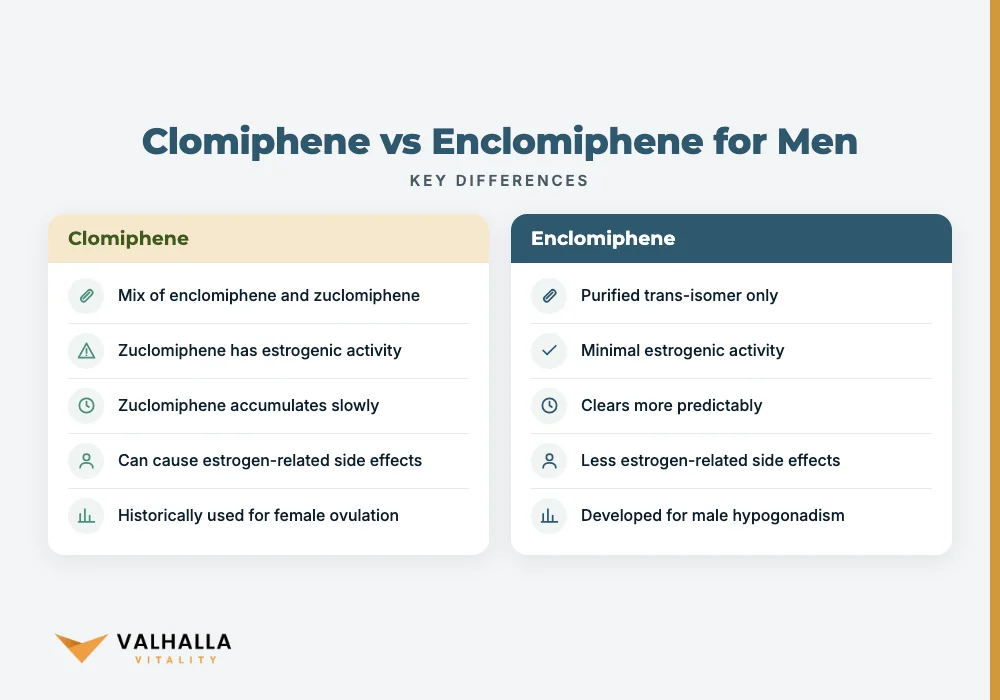
Clomiphene citrate is a racemic compound, meaning it contains two mirror-image isomers in roughly equal proportions: enclomiphene (the trans-isomer) and zuclomiphene (the cis-isomer). Enclomiphene citrate is the trans-isomer extracted and purified on its own.
Both isomers block estrogen receptors in the hypothalamus. That blockade signals the pituitary to release more LH and FSH. LH tells the testes to produce testosterone; FSH supports sperm production. The mechanism is shared.
The difference lies in zuclomiphene. That isomer has measurable estrogenic activity. It also clears the body slowly. In men taking clomiphene long-term, zuclomiphene accumulates and contributes to estrogen-related side effects that the pure isomer does not produce.
Historically, the racemic composition of clomiphene was not a concern in women. For male patients, where elevated estrogen can blunt the testosterone benefit, that distinction became clinically relevant. The development of enclomiphene as a standalone compound addressed this directly.
| Feature | Clomiphene citrate | Enclomiphene citrate |
|---|---|---|
| Composition | Racemic mix (enclomiphene + zuclomiphene) | Purified trans-isomer only |
| Estrogenic activity | Present (from zuclomiphene) | Minimal |
| Clearance | Zuclomiphene accumulates over weeks | Clears more predictably |
| Regulatory status in men | Off-label | Off-label or compounded |
| Fertility effects | Preserved | Preserved |
| Primary historical use | Female ovulation induction | Secondary male hypogonadism |
Enclomiphene vs clomiphene: clinical use in men
Both compounds entered clinical practice the same way: off-label, for men whose HPG axis was underperforming. Clomiphene came first, initially as a female ovulation-induction agent, with its application to clomiphene male infertility and secondary hypogonadism following once providers recognized the mechanism applied to male patients as well. Clomid, the best-known brand name for clomiphene, is where many men first encounter the idea of a "Clomid testosterone boost" before learning that the compound works by stimulating the HPG axis rather than supplying external hormone.
The right candidate for either drug is specific. Secondary hypogonadism means the testes are functional, but the pituitary is not sending adequate LH and FSH signals. A provider confirms this with baseline labs: total testosterone, LH, and FSH. Low testosterone combined with low or inappropriately normal LH and FSH points to HPG axis underfunction. Primary hypogonadism, where LH and FSH are already elevated because the testes cannot respond, does not respond to either compound. This distinction is why lab evaluation precedes any prescription.
A 2022 systematic review and meta-analysis by Huijben et al. in Andrology confirmed that clomiphene citrate raises testosterone in men with hypogonadism while preserving LH, FSH, and sperm production. That separates both SERMs from testosterone replacement therapy (TRT). TRT delivers exogenous testosterone, which suppresses the HPG axis and typically reduces sperm counts. Clomiphene works from the top of the axis down, leaving natural production intact. A 2026 meta-analysis by Constantinou et al. in the European Journal of Clinical Pharmacology made the same distinction: clomiphene and TRT both raise testosterone, but only clomiphene maintains fertility potential. For men who are not finished with family planning, that difference matters considerably.
Neither compound holds regulatory approval for use in men. Both are used off-label or through compounding pharmacies when a licensed provider prescribes them.
Is enclomiphene better than clomiphene for men?
The enclomiphene vs clomiphene comparison, when applied to men, centers on the presence or absence of zuclomiphene's estrogenic activity. For many men, enclomiphene produces a more selective hormonal response. That is the direct answer.
A 2025 systematic review and meta-analysis by Hohl et al. in Archives of Endocrinology and Metabolism compared both compounds across randomized controlled trials in male hypogonadism. The review found enclomiphene effective at raising enclomiphene testosterone levels while generating fewer estrogenic adverse effects than the racemic mixture. A 2016 review by Rodriguez et al. in Expert Opinion on Pharmacotherapy described enclomiphene citrate as a selective estrogen modulator male-targeted formulation, developed specifically to remove zuclomiphene's estrogenic interference. The enclomiphene for men advantage, in both analyses, comes from what the compound does not contain rather than a fundamentally different mode of action.
"Better" is contextual. A man who tolerates clomiphene well and responds adequately may have no clinical reason to change. A man who develops significant estrogen-related effects on the racemic compound may benefit from the cleaner profile. Individual responses vary. A provider assesses the complete picture before any recommendation is made.
Both drugs preserve fertility. Both work through the same receptor pathway. The practical question is not which compound is superior in theory but which fits the individual's response and tolerance after lab-confirmed assessment.
What are the side effects of clomiphene compared to enclomiphene?
The side effect profiles overlap because the mechanism is the same. They diverge where zuclomiphene's estrogenic activity takes over.
Clomiphene side effects in men may include:
- Hot flashes, driven by hypothalamic estrogen receptor disruption
- Mood changes and emotional sensitivity
- Visual disturbances such as blurred vision or light sensitivity; rare but documented, and worth reporting to a provider immediately
- Nausea or abdominal discomfort
Enclomiphene side effects follow a similar but generally milder pattern. Reported effects include hot flashes, headaches, and mild digestive discomfort. The estrogenic effects linked to zuclomiphene accumulation are absent. Over a longer treatment course, this difference grows more significant as zuclomiphene continues to build in men taking the racemic compound.
Individual responses vary considerably. Some men tolerate clomiphene well for months; others notice effects early in treatment. A provider monitors labs throughout regardless of which compound is prescribed. For a detailed look at how providers track labs during enclomiphene treatment, the monitoring framework matters alongside the compound choice itself.
Which is safer for men: enclomiphene or clomiphene?
Both have acceptable safety profiles when managed by a provider. Neither is inherently dangerous. Both require lab monitoring throughout treatment.
Clomiphene's long clinical history gives it a robust safety record. The 2026 meta-analysis by Constantinou et al. found it generally well tolerated in men with hypogonadism. The 2022 review by Huijben et al. reached similar conclusions. The primary concern is not acute toxicity but the gradual estrogenic effect from zuclomiphene accumulation, which matters more in long-term use than in a short course.
Enclomiphene's safety data in men comes from a smaller but growing body of randomized trials. Hohl et al. (2025) drew exclusively on RCT data, which lends stronger weight to the safety signals observed compared to retrospective chart reviews. The absence of zuclomiphene reduces the estrogenic concern. The compound is newer, and its long-term follow-up record in men is less extensive than clomiphene's decades of clinical use.
Short-term and long-term profiles may differ. Providers prescribing either compound for extended courses typically schedule periodic lab reviews, tracking testosterone, estradiol, and semen parameters where fertility is a consideration.
Can enclomiphene replace clomiphene for testosterone support?
Yes. A licensed provider can prescribe enclomiphene in most situations where clomiphene would have been considered, provided the indication is secondary hypogonadism and the compound is available. Enclomiphene is typically obtained through compounding pharmacies. Availability varies by state. Clomiphene has an established generic supply, making it more accessible in some clinical settings.
The enclomiphene vs clomiphene decision is often downstream of a more fundamental question. For men weighing HPG stimulation against hormone replacement altogether, how enclomiphene compares to testosterone injections involves a separate trade-off. Both oral SERMs preserve natural production and sperm counts; testosterone injections raise levels more rapidly but suppress the axis. A licensed provider determines the dose after reviewing labs and discussing individual goals.
Through the Valhalla Vitality telehealth model, a licensed provider reviews intake within 24 business hours of order placement, and prescriptions reach the patient through partner compounding pharmacies in approximately 3-7 business days from when the pharmacy receives the prescription.
The bottom line on enclomiphene vs clomiphene for men: the mechanisms are nearly identical, the side effect profiles diverge where zuclomiphene is involved, and the clinical choice depends on individual response, provider judgment, and compound availability.
Talk with a licensed provider
If the enclomiphene vs clomiphene comparison has raised questions about your hormone health, a licensed provider can review your intake and lab results to determine whether either option is appropriate for you. Book Your Consultation
FAQ
What is the main difference between enclomiphene and clomiphene?
Clomiphene is a racemic mixture of two isomers: enclomiphene and zuclomiphene. Enclomiphene is the purified active isomer only. Zuclomiphene, absent in enclomiphene, has estrogenic activity and accumulates in the body over time, which explains most of the side effect differences between the two compounds.
Does enclomiphene have regulatory approval for use in men?
No. Enclomiphene does not have regulatory approval for male hypogonadism and is typically prescribed off-label or obtained through a compounding pharmacy under a licensed provider's direction. Clomiphene has no male-specific approval either; both are used off-label in men for this indication.
Do enclomiphene and clomiphene preserve fertility?
Yes. Both stimulate the HPG axis rather than supplying external testosterone, so LH, FSH, and sperm production remain active. A 2022 systematic review by Huijben et al. confirmed that clomiphene raises testosterone in men with hypogonadism while preserving these reproductive hormones.
What side effects should men expect from these drugs?
Both may cause hot flashes, mood changes, and gastrointestinal discomfort. Clomiphene's zuclomiphene component adds estrogenic activity that can contribute to additional side effects over extended use; enclomiphene generally produces a milder profile because that isomer is absent.
How does a provider decide which compound to prescribe?
A licensed provider reviews lab results including total testosterone, LH, FSH, and estradiol, along with symptoms, fertility goals, and compound availability. Neither drug is appropriate without that evaluation; a provider determines whether a therapy is appropriate after reviewing your intake.
Sources
- Hohl A et al. (2025). Clomiphene or enclomiphene citrate for the treatment of male hypogonadism: a systematic review and meta-analysis of randomized controlled trials. Archives of Endocrinology and Metabolism. PubMed
- Constantinou BT et al. (2026). Clomiphene citrate versus testosterone replacement therapy in male hypogonadism: a systematic review of literature and meta-analysis. European Journal of Clinical Pharmacology. PubMed
- Rodriguez KM et al. (2016). Enclomiphene citrate for the treatment of secondary male hypogonadism. Expert Opinion on Pharmacotherapy. PubMed
- Huijben M et al. (2022). Clomiphene citrate for men with hypogonadism: a systematic review and meta-analysis. Andrology. PubMed
You May Also Like
 Enclomiphene
 Hair Loss: DHT, Follicles, and the Evidence
Enclomiphene hair loss is not a listed side effect, but testosterone raises DHT, which can affect follicles. Here is what clinical research shows.
October 12, 2026 ETRead more → Enclomiphene
 for Gyno: Causes, Prevention & Treatment
Enclomiphene for gyno: how this SERM may help reduce gynecomastia by rebalancing estrogen and testosterone levels. Talk to a licensed provider today.
October 11, 2026 ETRead more → Enclomiphene
 vs Tamoxifen for PCT and Testosterone
Enclomiphene vs tamoxifen: compare how each SERM supports testosterone recovery, PCT protocols, and side effect profiles before talking to a provider.
October 11, 2026 ETRead more →