
The following blog post is for entertainment and informational purposes only. It is not intended to provide medical advice or diagnosis. Please consult your doctor before making any health-related decisions.
Enclomiphene vs zuclomiphene compares two isomers of clomiphene citrate, each binding to estrogen receptors differently and staying active for different durations. Men researching enclomiphene for low testosterone will encounter both names, and the distinction between them is clinically meaningful. A licensed provider reviews labs and medical history before recommending either compound.
Enclomiphene vs zuclomiphene: quick comparison
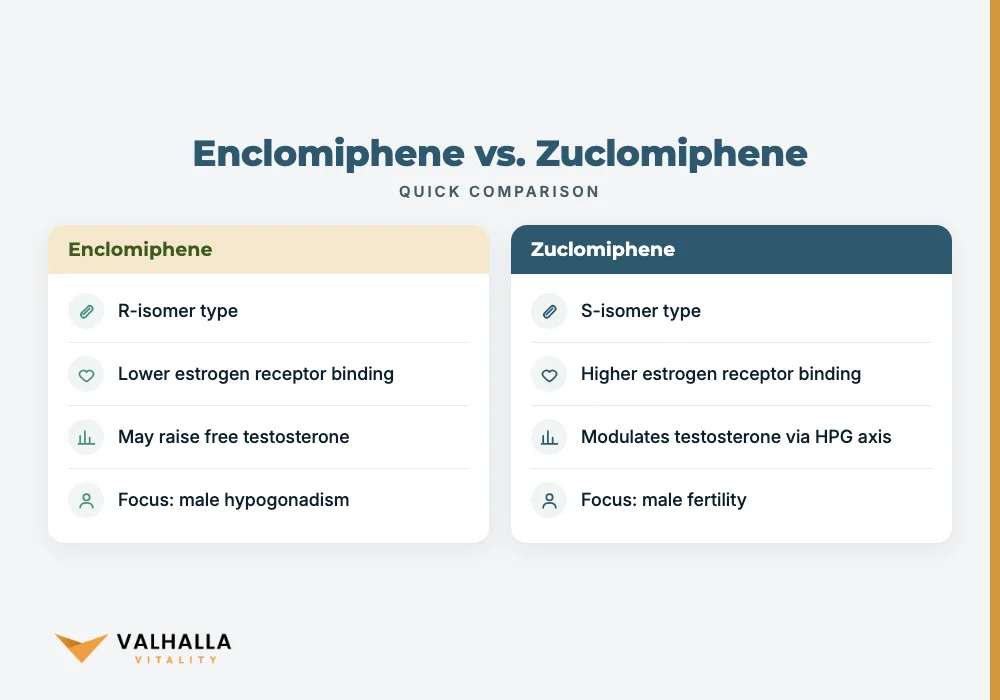
| Property | Enclomiphene | Zuclomiphene |
|---|---|---|
| Isomer type | (R)-isomer, also called (+)-clomiphene | (S)-isomer |
| Estrogen receptor binding | Lower affinity | Higher affinity, longer tissue retention |
| Effect on testosterone | May reduce SHBG binding, raising free testosterone | Modulates testosterone via HPG axis |
| Main research focus | Secondary male hypogonadism | Male fertility; some female reproductive research |
Clomiphene citrate isomers: the basics
Clomiphene citrate is a selective estrogen receptor modulator (SERM) with two structural forms called isomers. Enclomiphene is the (R)-form, also called (+)-clomiphene. Zuclomiphene is the (S)-form. They are chemically related but not pharmacologically identical.
Zuclomiphene binds more strongly to estrogen receptors and persists longer in the body. This difference in receptor engagement is why researchers began studying each isomer separately. The question was whether enclomiphene alone offered a more targeted clinical option for men with hormonal deficiencies.
What is the difference between enclomiphene and zuclomiphene?
The core enclomiphene vs zuclomiphene distinction is receptor affinity. Zuclomiphene binds more strongly and stays active longer. That extended receptor activity shapes a different side effect profile compared to enclomiphene.
On the mechanism side, enclomiphene may increase free testosterone by reducing the binding of testosterone to sex hormone-binding globulin (SHBG). SHBG renders testosterone biologically inactive in circulation. Less binding means more testosterone available for use. Zuclomiphene influences testosterone primarily through direct estrogen receptor modulation.
A 2016 review by Rodriguez et al. in Expert Opinion on Pharmacotherapy examined enclomiphene as a standalone option for secondary male hypogonadism. The paper's focus on enclomiphene separately reflected these mechanistic differences from the full clomiphene compound.
How does enclomiphene increase testosterone levels?
Enclomiphene effects on testosterone run through two mechanisms. First, by reducing SHBG binding, enclomiphene may raise the fraction of testosterone that stays free and biologically active.
Second, enclomiphene acts on the hypothalamic-pituitary-gonadal (HPG) axis. This signaling chain links the brain to the testes. By interacting with estrogen receptors at the hypothalamic and pituitary level, enclomiphene may reduce the negative feedback that suppresses testosterone release. The testes then receive a stronger signal to produce testosterone naturally.
This mechanism works with the body's own regulatory system rather than bypassing it. For a pharmacological comparison of enclomiphene with a closely related compound, how enclomiphene differs from clomid covers the relevant distinctions.
Enclomiphene for hypogonadism: what the research shows
The evidence base for enclomiphene for hypogonadism has grown considerably. A 2025 systematic review and meta-analysis by Hohl et al., published in Archives of Endocrinology and Metabolism, analyzed randomized controlled trial data on clomiphene and enclomiphene for male hypogonadism. RCT-level evidence in men's hormonal health is still relatively limited, which makes that kind of review particularly relevant for clinical decisions.
Secondary hypogonadism is the specific condition enclomiphene research has centered on. The testes remain functional; the brain's hormonal signaling to the testes is suppressed. The Rodriguez et al. (2016) paper described enclomiphene citrate benefits men with this condition may experience when the goal is restoring the body's own signaling rather than replacing testosterone from outside.
At Valhalla Vitality, licensed providers assess whether this profile fits a patient's individual labs and clinical picture before any prescription is written.
Is enclomiphene safe for men?
Is enclomiphene safe? Based on current data, it appears well-tolerated under medical supervision. The 2025 meta-analysis by Hohl et al. drew on RCT-level evidence, and the outcomes across those trials inform how providers approach monitoring today.
Enclomiphene's lower estrogen receptor affinity compared to zuclomiphene may reduce estrogenic side effects. Individual responses still vary. A licensed provider determines whether a therapy is appropriate after reviewing your intake. Availability varies by state.
What are the side effects of enclomiphene citrate?
Reported side effects of enclomiphene citrate include acne and headaches. Gynecomastia, which is abnormal breast tissue growth, is a known risk with compounds that interact with estrogen receptors.
The zuclomiphene side effects men experience from the full clomiphene compound tend to be more pronounced in the estrogenic category. Zuclomiphene's stronger receptor binding is the likely reason. Long-term use of clomiphene isomers has also been linked to potential liver effects, which is why ongoing lab work is standard clinical practice.
Monitoring and safety during enclomiphene treatment covers what providers typically track during a course of therapy and why regular testing is built into responsible protocols.
Can enclomiphene replace testosterone replacement therapy?
Not for all men. Whether enclomiphene can replace TRT is a clinical question that depends on lab results, not general preference. The mechanisms are fundamentally different.
TRT supplies testosterone from an external source. Enclomiphene stimulates the body's own production through the HPG axis. For men with secondary hypogonadism whose testes remain functional, enclomiphene may restore hormone levels while preserving the natural signaling loop.
Men on TRT commonly experience testicular suppression as a consequence of exogenous testosterone. Enclomiphene avoids that by keeping the HPG axis engaged. A licensed provider determines which approach fits the clinical picture after a full workup. For context on another natural-pathway option, enclomiphene vs HCG for men covers how those two approaches compare.
Speak with a licensed provider
Book Your Consultation to have a licensed provider review your labs and walk through your enclomiphene options.
FAQ
What is the difference between enclomiphene and zuclomiphene?
Enclomiphene is the (R)-isomer of clomiphene citrate; zuclomiphene is the (S)-isomer. Zuclomiphene binds more strongly to estrogen receptors and persists longer in the body, while enclomiphene binds with lower affinity and may increase free testosterone by reducing SHBG binding.
Is enclomiphene safe for men?
Current clinical data, including a 2025 systematic review by Hohl et al. in Archives of Endocrinology and Metabolism, suggests enclomiphene appears well-tolerated under clinical supervision. A licensed provider monitors labs regularly and determines whether the therapy remains appropriate for the individual.
What are the side effects of enclomiphene citrate?
Reported side effects include acne, headaches, and potential gynecomastia due to estrogen receptor interaction. Long-term use of clomiphene isomers has also been linked to potential liver effects, making regular lab monitoring a standard part of clinical practice.
Can enclomiphene be used for male hypogonadism?
Yes, enclomiphene for hypogonadism has been studied in randomized controlled trials reviewed by Hohl et al. (2025). It targets secondary hypogonadism specifically, where the testes remain functional but the brain's hormonal signaling to the testes is suppressed.
How does enclomiphene differ from testosterone replacement therapy?
Enclomiphene stimulates the body's own testosterone production through the HPG axis, while TRT supplies testosterone from an external source. A provider determines which approach fits the clinical picture based on individual labs and symptoms, not general preference.
Sources
- Hohl A et al. (2025). Clomiphene or enclomiphene citrate for the treatment of male hypogonadism: a systematic review and meta-analysis of randomized controlled trials. Archives of Endocrinology and Metabolism. PubMed
- Rodriguez KM et al. (2016). Enclomiphene citrate for the treatment of secondary male hypogonadism. Expert Opinion on Pharmacotherapy. PubMed
You May Also Like
 Enclomiphene
Enclomiphene for Gyno: Causes, Prevention & Treatment
Enclomiphene for gyno: how this SERM may help reduce gynecomastia by rebalancing estrogen and testosterone levels. Talk to a licensed provider today.
October 11, 2026 ETRead more → Enclomiphene
Enclomiphene vs Tamoxifen for PCT and Testosterone
Enclomiphene vs tamoxifen: compare how each SERM supports testosterone recovery, PCT protocols, and side effect profiles before talking to a provider.
October 11, 2026 ETRead more → Enclomiphene
Enclomiphene Heart Palpitations: What Men Need to Know
Enclomiphene heart palpitations occur in some men on therapy. Learn how the drug affects blood pressure, cholesterol levels, and cardiovascular risk.
October 11, 2026 ETRead more →