
The following blog post is for entertainment and informational purposes only. It is not intended to provide medical advice or diagnosis. Please consult your doctor before making any health-related decisions.
Clomid vs enclomiphene is one of the most common questions men raise when exploring testosterone support that works with the body's own hormone axis rather than replacing it. Both compounds stimulate LH and FSH production by blocking estrogen receptors at the hypothalamus and pituitary. The difference is molecular composition. Enclomiphene is the isolated active isomer; Clomid is a mixture of two isomers with distinct receptor behaviors. A licensed provider reviews your intake and lab work before recommending either, and this overview of low testosterone treatment options explains what that evaluation involves.
How is enclomiphene different from clomiphene citrate?
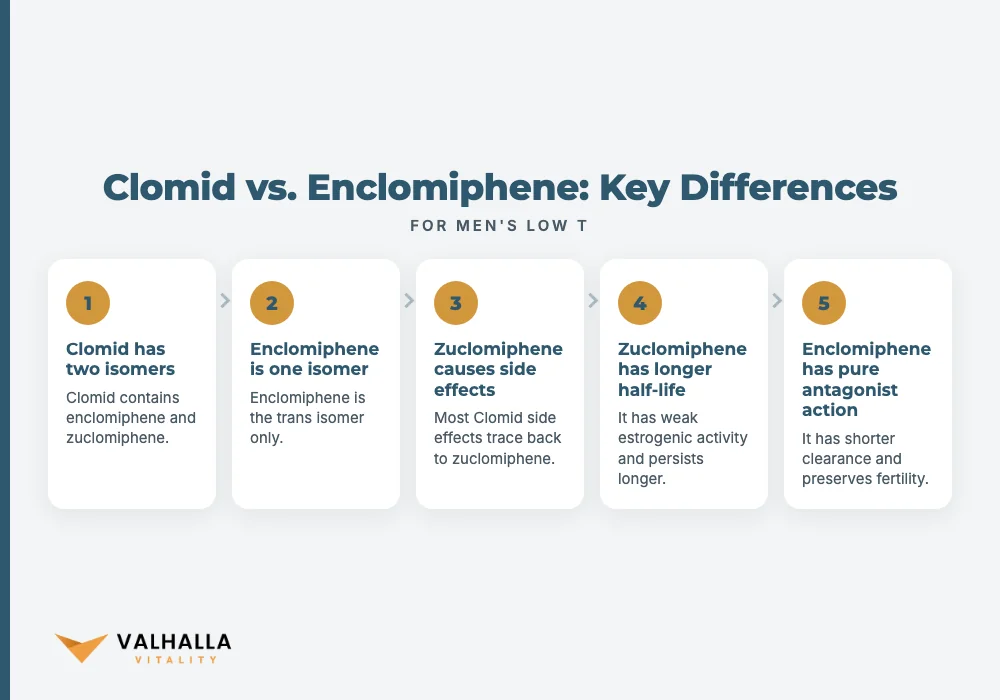
Enclomiphene is the trans isomer of clomiphene, separated from its companion isomer, zuclomiphene. Clomid (clomiphene citrate) contains roughly 38% enclomiphene and 62% zuclomiphene. That split matters because zuclomiphene behaves differently at the receptor level. It has a longer half-life and weak estrogenic agonist activity at some tissues, not purely antagonist activity. Most Clomid side effects in men trace back to zuclomiphene. Removing it changes the pharmacological profile entirely.
| Feature | Enclomiphene citrate | Clomid (clomiphene citrate) |
|---|---|---|
| Molecular form | Single active isomer (trans) | Two isomers (trans + cis) |
| Estrogenic action | Pure antagonist | Mixed: antagonist + weak agonist |
| Half-life / clearance | Shorter, faster clearance | Zuclomiphene persists significantly longer |
| Primary studied indication | Secondary male hypogonadism | Female infertility; off-label for men |
| Effect on sperm production | Preserves fertility | Preserves fertility |
| Regulatory status | Compounded medication | Indicated for female infertility; used off-label for men |
A 2016 review in Expert Opinion on Pharmacotherapy by Rodriguez et al. found that isolating the enclomiphene fraction produced reliable testosterone, LH, and FSH increases without the prolonged estrogenic exposure carried by zuclomiphene. That finding shaped how providers now think about the two options for men.
For a deeper look at the receptor-level mechanics, how enclomiphene citrate works at the molecular level covers the HPG axis interactions in detail.
Is enclomiphene better than Clomid for men?
For most men with secondary hypogonadism, enclomiphene shows a more favorable profile than Clomid based on available RCT evidence. A 2025 systematic review and meta-analysis by Hohl et al. in Archives of Endocrinology and Metabolism analyzed randomized controlled trials comparing both compounds directly. Enclomiphene produced clinically meaningful improvements in testosterone, LH, and FSH. Its tolerability profile was more favorable than clomiphene across the trials reviewed. That gap matters. The full clomid vs enclomiphene picture shows this tolerability advantage holds across multiple measured endpoints, not just a single metric.
That said, clomiphene citrate for men is a legitimate off-label option with decades of clinical use. Men evaluating enclomiphene for low testosterone will find the most relevant evidence in trials designed specifically for secondary hypogonadism. Men who respond well to Clomid and experience no significant side effects may not need to switch. The case for enclomiphene is specific. What enclomiphene citrate benefits most clearly offer are a cleaner single-isomer mechanism, faster clearance, and reduced estrogenic off-target activity. Those differences matter most for men sensitive to estrogen-related effects or needing faster hormonal adjustment.
Clomid was designed for female ovulation induction. Its use in men is entirely off-label. Enclomiphene has been specifically studied in male secondary hypogonadism, and a growing RCT evidence base now supports that focused application.
Can men take Clomid to boost testosterone?
Yes. Clomid for men testosterone is a documented off-label application supported by clinical guidelines. Clomiphene blocks estrogen receptors at the pituitary, signaling the brain to release more LH and FSH. That drives natural testosterone production without external hormone administration. The clomid vs enclomiphene distinction matters here: while both stimulate the same HPG axis, enclomiphene clears faster and avoids the prolonged estrogenic activity that zuclomiphene introduces. The mechanism is otherwise identical; the difference lies in how long each compound stays active and how each interacts with tissues outside the HPG axis.
The 2018 Endocrine Society Clinical Practice Guideline (Bhasin et al.) recognizes stimulation therapy, including clomiphene, as an option for men with secondary hypogonadism, particularly when fertility preservation is a clinical priority. Both Clomid and enclomiphene maintain sperm production by preserving LH and FSH signaling, unlike exogenous testosterone, which suppresses both.
Extended Clomid use carries the risk of mood changes and visual disturbances from zuclomiphene's estrogenic activity. For shorter courses where tolerability is less of a concern, Clomid can be a workable option. For longer treatment periods, enclomiphene's cleaner profile is a practical advantage.
Clomid vs enclomiphene: side effect comparison
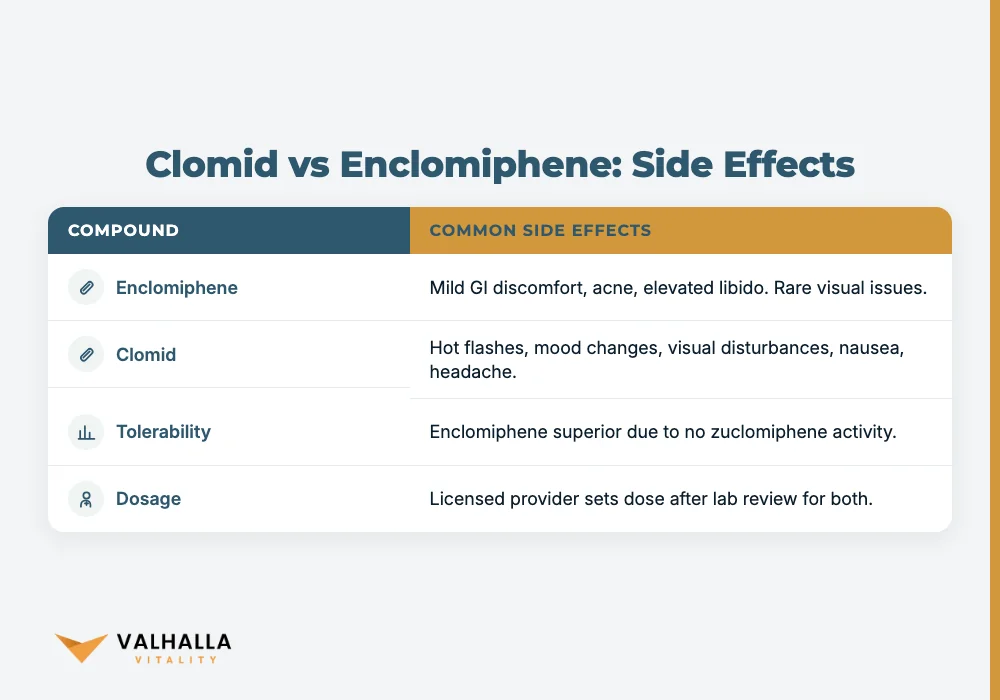
Enclomiphene side effects men most commonly report are mild. Gastrointestinal discomfort, acne, and occasionally elevated libido top the list. Visual disturbances are rare and significantly less frequent than with Clomid.
Clomid's more common side effects in men include:
- Hot flashes, from anti-estrogenic activity at the hypothalamus
- Mood changes and irritability, linked to zuclomiphene's mixed agonist-antagonist action
- Visual disturbances, including blurred vision or floaters
- Nausea and headache
The 2025 meta-analysis by Hohl et al. found enclomiphene's tolerability profile to be superior, attributing the advantage specifically to the absence of zuclomiphene's estrogenic off-target activity.
Enclomiphene dosage for men is set by a licensed provider after reviewing baseline labs. A licensed provider determines the dose after labs for Clomid as well. No self-selected regimen is appropriate for either compound.
Which is safer for PCT: enclomiphene or Clomid?
Both compounds have been used as a Clomid PCT alternative following anabolic steroid cycles, though enclomiphene's faster clearance may offer a cleaner recovery. The goal in post-cycle therapy is to restart suppressed LH and FSH signaling and restore natural testosterone. For a focused look at how enclomiphene fits into that role, the post-cycle therapy guide for enclomiphene walks through what providers evaluate before recommending it.
Mechanically, enclomiphene may allow a more straightforward HPG axis restart. Zuclomiphene's longer persistence can extend low-grade estrogenic signaling through the recovery window, potentially complicating the restart process. Neither compound is appropriate for self-directed post-cycle use without clinical oversight.
A licensed provider determines whether PCT is appropriate, which compound fits, and determines the dose after labs. That evaluation is the starting point, not an optional step.
How providers weigh clomid vs enclomiphene
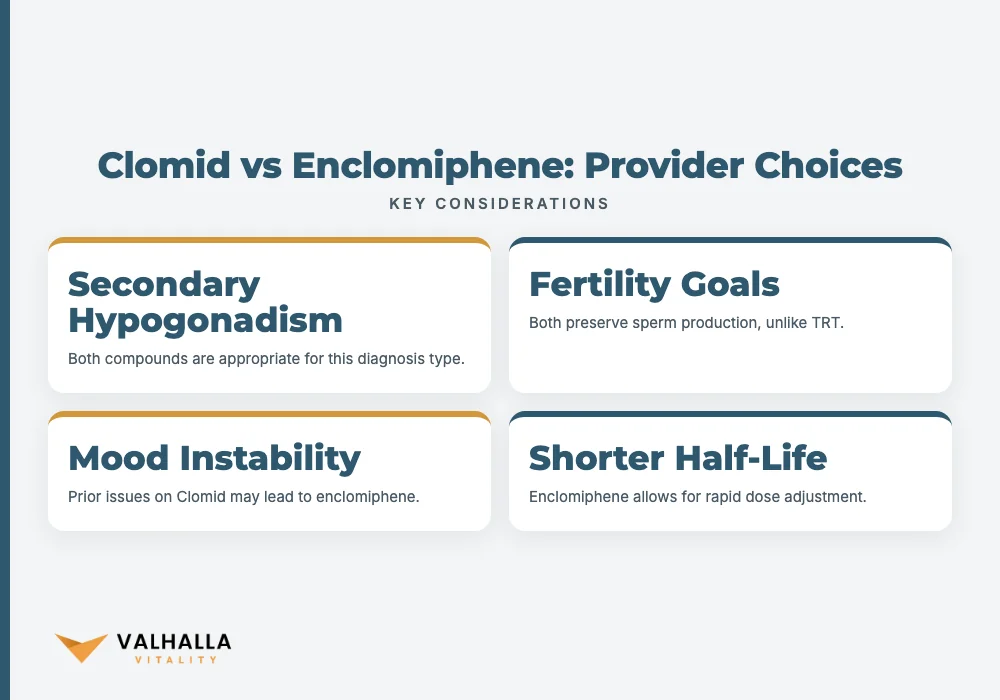
A provider's choice between these compounds is not based on trend. It comes from evaluation. The 2018 AUA Guideline (Mulhall et al.) recommends thorough workup, including lab testing, before initiating any testosterone optimization therapy. That workup shapes the decision.
Key factors providers consider:
- Diagnosis type: Both compounds are appropriate for secondary hypogonadism, where the brain-to-testes signaling is impaired. Neither is indicated for primary gonadal failure.
- Fertility goals: Both preserve LH and FSH signaling and maintain sperm production in a way exogenous TRT does not. Fertility preservation often tips the choice toward one of these options over TRT.
- Side effect history: Men with prior mood instability or visual symptoms on Clomid typically transition to enclomiphene.
- Clearance needs: Enclomiphene's shorter half-life matters when rapid dose adjustment or treatment transitions are anticipated.
- Treatment duration: For longer protocols, enclomiphene's single-isomer profile generally produces fewer cumulative estrogenic side effects.
Providers at Valhalla Vitality review labs and a complete medical intake before recommending any option. Availability varies by state.
Ready to speak with a licensed provider?
When you're ready, Book Your Consultation with a licensed clinician who reviews your labs and intake before recommending any therapy.
FAQ
Is enclomiphene better than Clomid for men?
Enclomiphene is the isolated active isomer and avoids the prolonged estrogenic activity linked to zuclomiphene in Clomid. A 2025 systematic review by Hohl et al. found enclomiphene showed superior tolerability in men with hypogonadism. A provider determines which compound fits based on labs and individual history.
Can men take Clomid to boost testosterone?
Yes. Clomid for men testosterone is a well-documented off-label application. Clomiphene blocks estrogen receptors at the pituitary, triggering natural LH and FSH release that raises testosterone. The 2018 Endocrine Society guideline recognizes stimulation therapy as an option for men with secondary hypogonadism.
What are the main side effects of enclomiphene vs Clomid?
Enclomiphene side effects men report most often are mild: stomach discomfort, acne, and occasionally elevated libido. Clomid more frequently causes hot flashes, mood changes, and visual disturbances, which the evidence attributes to zuclomiphene's estrogenic activity at certain receptor sites.
How is enclomiphene different from clomiphene citrate?
Enclomiphene is the trans isomer of clomiphene, separated from zuclomiphene. It acts as a pure estrogen receptor antagonist with a shorter half-life. Zuclomiphene persists longer and has mild estrogenic agonist activity at some tissues, which is the source of most Clomid side effects in men.
Which is safer for PCT: enclomiphene or Clomid?
Both are used as post-cycle options, but enclomiphene's faster clearance may let the HPG axis normalize more quickly after stopping. A licensed provider evaluates the degree of suppression and lab results before recommending any post-cycle protocol.
Sources
- Hohl A et al. (2025). Clomiphene or enclomiphene citrate for the treatment of male hypogonadism: a systematic review and meta-analysis of randomized controlled trials. Archives of Endocrinology and Metabolism. PubMed
- Rodriguez KM et al. (2016). Enclomiphene citrate for the treatment of secondary male hypogonadism. Expert Opinion on Pharmacotherapy. PubMed
- Bhasin S et al. (2018). Testosterone Therapy in Men With Hypogonadism: An Endocrine Society Clinical Practice Guideline. The Journal of Clinical Endocrinology and Metabolism. PubMed
- Mulhall JP et al. (2018). Evaluation and Management of Testosterone Deficiency: AUA Guideline. The Journal of Urology. PubMed
You May Also Like
 Enclomiphene
Enclomiphene Before and After: Physical Changes Explained
Enclomiphene before and after: what physical changes to expect, how the results timeline unfolds, and why provider monitoring matters for outcomes.
October 21, 2026 ETRead more → Enclomiphene
Enclomiphene Vision Side Effects: Eye Floaters & More
Enclomiphene vision side effects include eye floaters, blurry vision, and light sensitivity. Know the warning signs and when to contact your provider.
October 21, 2026 ETRead more → Enclomiphene
Enclomiphene Drug Test: Detection, WADA, and Disclosure
Enclomiphene drug test detection depends on the test type. Learn how workplace panels, military screening, and WADA rules treat this SERM.
October 21, 2026 ETRead more →