
The following blog post is for entertainment and informational purposes only. It is not intended to provide medical advice or diagnosis. Please consult your doctor before making any health-related decisions.
Enclomiphene PCT describes using enclomiphene citrate within a post cycle therapy protocol to restart natural testosterone production after a steroid cycle. As a selective estrogen receptor modulator, it blocks estrogen receptors in the hypothalamus and removes the brake that exogenous androgens place on the body's own hormonal signaling. That lets the HPG axis fire again. A licensed provider reviews bloodwork and cycle history before prescribing; for how enclomiphene works across its clinical applications, see our enclomiphene citrate benefits and clinical profile.
What PCT does and why steroid cycles require it
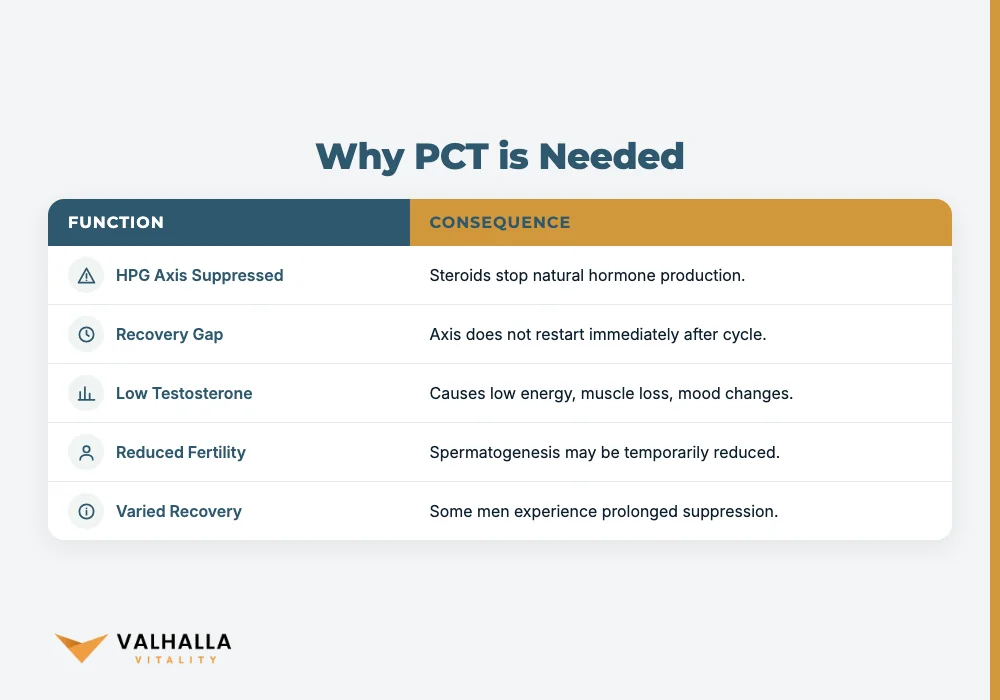
Anabolic-androgenic steroids suppress the HPG axis. High exogenous androgen levels signal the hypothalamus to cut GnRH production. The pituitary follows by reducing LH and FSH output. Without LH, the Leydig cells stop producing testosterone.
The suppression is functional, not structural. When the cycle ends and exogenous androgens clear, the axis can recover. But it does not restart immediately. A 2016 review by McBride et al. in the Asian Journal of Andrology found that recovery of spermatogenesis following anabolic-androgenic steroid use varies widely, with some men experiencing prolonged suppression depending on the compounds and duration involved. A 2024 systematic review by Rajmil et al. in Actas Urológicas Españolas confirmed this variability, noting that after heavier AAS use, hormonal and spermatogenic recovery can extend considerably beyond initial estimates.
During that gap, testosterone stays low.
| Suppressed function | Consequence during the recovery gap |
|---|---|
| GnRH secretion | No signal reaches the pituitary |
| LH and FSH output | Testes lack the trigger to produce testosterone |
| Testicular testosterone | Low energy, muscle loss, reduced libido, mood changes |
| Spermatogenesis | Fertility may be temporarily reduced; timeline varies individually |
The practical experience of that gap differs by person. Some men notice declining energy within days of ending a cycle. Others feel the full effect two to three weeks out, once longer-clearing compounds have dropped. What stays consistent is that the HPG axis benefits from an external prompt to restart efficiently. Waiting without intervention can extend the recovery window significantly, as the McBride et al. 2016 review indicates.
PCT protocols aim to shorten that gap, because effective steroid cycle recovery depends on how quickly the HPG axis can be restarted independently. Common approaches include SERMs, aromatase inhibitors, hCG, or combinations of these, depending on suppression depth and individual clinical factors. The goal is to restore the HPG axis to self-sustaining function, so that levels remain stable when the intervention ends.
How enclomiphene works as a SERM for post cycle
Enclomiphene is the trans-isomer of clomiphene. It binds estrogen receptors at the hypothalamus without activating them. That blocks the negative feedback that normally suppresses GnRH release.
With that pathway reopened, the hypothalamus resumes pulsatile GnRH secretion. The pituitary responds with LH and FSH. The testes, receiving that LH signal, begin producing testosterone. This is how enclomiphene functions as a SERM for post cycle recovery: it reactivates the signaling chain from the top rather than delivering hormones from outside.
A 2016 study by Rodriguez et al. in Expert Opinion on Pharmacotherapy found that enclomiphene citrate raised serum testosterone in men with secondary hypogonadism while maintaining LH, FSH, and sperm parameters. That fertility preservation distinguishes it from testosterone replacement therapy, which suppresses gonadotropins directly and cannot restart the axis on its own. For men who want testosterone recovery after steroids without compromising reproductive function, that difference is clinically significant.
That finding also clarifies why enclomiphene occupies a different category from TRT in clinical practice. TRT suppresses the HPG axis while delivering the hormone exogenously, creating dependence on the external source. Enclomiphene restores the axis's own output, which is why it is considered a fertility-preserving intervention where TRT is not.
Can enclomiphene be used as a PCT?
Yes. Enclomiphene can be used as part of a post cycle therapy protocol. Secondary hypogonadism is defined by insufficient gonadotropin signaling to otherwise functional testes, which is exactly what post-cycle suppression creates. The axis is functional; it just is not signaling. Enclomiphene addresses that gap directly.
The Rodriguez et al. 2016 study documented effective testosterone restoration through HPG axis stimulation in secondary hypogonadism, which is the same physiological pattern that PCT aims to resolve. The mechanism translates directly to the post-cycle context.
Whether enclomiphene is the right tool for a specific case involves additional factors: the depth of suppression, the specific steroids used, tolerability, and whether fertility preservation is a priority. A provider makes that determination after reviewing post-cycle labs, not before them.
What is the correct enclomiphene PCT protocol?
No universal enclomiphene PCT protocol exists. A licensed provider determines the appropriate approach after reviewing post-cycle bloodwork and full cycle history. Suppression depth varies significantly between a short mild cycle and a prolonged high-dose stack.
The suppression picture also differs considerably between individuals. One patient finishing a short cycle may have mildly reduced gonadotropins with testosterone trending toward recovery. Another finishing a prolonged compound stack may have fully suppressed LH and FSH with profoundly low testosterone. A single dosage and duration would not serve both appropriately, which is why post-cycle labs are the entry point for any protocol, not a self-reported cycle history.
Before prescribing, a provider typically evaluates:
- Post-cycle bloodwork establishes the baseline: total testosterone, LH, FSH, estradiol, hematocrit, lipid panel, and liver enzymes.
- The anabolic compounds used, their ester types, and cycle duration determine the appropriate start timing for PCT.
- Time elapsed since the last anabolic dose confirms whether residual androgens have cleared sufficiently for a SERM to work effectively.
- Any prior PCT history and SERM response informs how the current course should be structured.
- Fertility goals change the protocol significantly, since sperm preservation requires a different emphasis than testosterone restoration alone.
Timing is not a formality. Anabolic compounds vary widely in half-life, and starting enclomiphene before residual androgens have cleared means working against ongoing axis suppression. A provider calculates the start point from the specific compounds involved rather than a default waiting period.
For how dosing decisions are made in practice, the enclomiphene dosage and protocol overview walks through the clinical reasoning behind those choices.
Availability of enclomiphene for PCT varies by state.
How long should you take enclomiphene for PCT?
Duration depends on lab results, not a calendar. A provider typically reassesses at four to six weeks with repeat testosterone, LH, and FSH panels. If testosterone has returned to a stable, clinically appropriate range and gonadotropins are tracking correctly, the course may be tapered or ended.
Not everyone recovers on the same schedule. The 2024 Rajmil et al. systematic review found that after heavy AAS use, hormonal and spermatogenic recovery can extend well beyond initial months. Recovery speed is also shaped by pre-cycle baseline testosterone levels, age, total accumulated suppression across prior cycles, and individual HPG axis function. These factors reinforce why follow-up labs rather than a fixed schedule determine how long to take enclomiphene for PCT.
Two risks bound that decision. Stopping too early, before the HPG axis can sustain itself, risks a secondary hormone crash when the SERM clears. Stopping too late adds drug exposure with no additional benefit once the axis has stabilized. Neither risk is identifiable by symptoms alone. Bloodwork at scheduled intervals is the only reliable reference point.
Is enclomiphene better than Clomid for PCT?
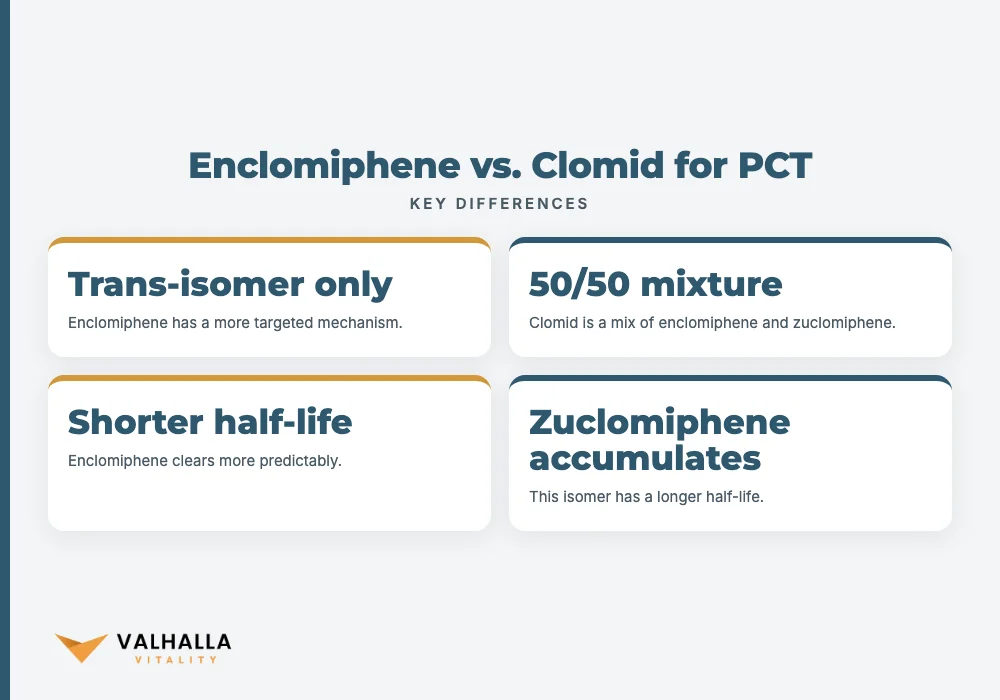
Enclomiphene has a more targeted mechanism for PCT than Clomid because it lacks the zuclomiphene isomer responsible for many of Clomid's side effects in men. The enclomiphene vs Clomid distinction ultimately comes down to that single isomer difference. Clomid (clomiphene citrate) is a 50/50 mixture of enclomiphene and zuclomiphene. The testosterone-raising activity comes from enclomiphene. Zuclomiphene carries estrogenic agonist properties, has a significantly longer half-life, and accumulates over a course of treatment. Visual disturbances and mood changes attributed to Clomid in men largely reflect that zuclomiphene activity.
For a detailed clinical comparison, see the Clomid vs enclomiphene comparison for men's hormone health.
| Feature | Enclomiphene | Clomid (clomiphene citrate) |
|---|---|---|
| Isomer composition | Trans-isomer only | 50% trans + 50% cis (zuclomiphene) |
| Hypothalamic activity | Pure estrogen receptor antagonist | Mixed antagonist and agonist |
| Visual side effects | Less commonly reported | More commonly reported (zuclomiphene) |
| Half-life profile | Shorter; clears more predictably | Zuclomiphene accumulates with repeated dosing |
| FSH and sperm parameters | Preserved per Rodriguez et al. 2016 | Less predictable due to zuclomiphene |
The Rodriguez et al. 2016 study found that enclomiphene raised testosterone while maintaining sperm concentration and motility, comparing favorably to mixed-isomer clomiphene on reproductive parameters. For men who want testosterone recovery after steroids without affecting fertility, that distinction is clinically meaningful.
Whether enclomiphene is the right choice for a specific patient depends on tolerability, availability, and what a provider determines after reviewing the clinical history. Neither compound ensures recovery.
Does enclomiphene restore natural testosterone after a steroid cycle?
Enclomiphene may restore natural testosterone after a steroid cycle by reactivating the HPG axis from the hypothalamic level. The Rodriguez et al. 2016 study documented rising testosterone alongside maintained LH and FSH during enclomiphene treatment, which is the expected pattern when the axis is working through its own signaling chain rather than being bypassed.
Full return to pre-cycle baseline is not assured. The McBride et al. 2016 review in the Asian Journal of Andrology found that recovery timelines after AAS use vary considerably, shaped by the type and duration of compounds, age, and individual biology. Most men do recover to functional testosterone levels, but the timeline is not predictable from cycle history alone. A provider typically explains that enclomiphene PCT may shorten the recovery window compared to no intervention, but cannot commit to a specific endpoint on any timeline.
Factors that affect how well enclomiphene PCT restores natural testosterone include cycle duration and the androgenic compounds used, age at the time of the cycle, pre-cycle baseline testosterone levels, how promptly PCT started after the last anabolic dose, and individual SERM response. When testosterone does not recover adequately after a completed course, a provider reassesses whether persistent secondary hypogonadism has developed. That condition requires a different long-term management strategy, since a time-limited PCT course would no longer be the right approach.
Enclomiphene PCT: Side Effects and Monitoring
Enclomiphene is generally considered better tolerated than mixed-isomer clomiphene, but adverse effects are possible. Common effects reported in clinical studies include hot flashes, nausea, and elevated estradiol. Serious reactions, though uncommon, can include hypersensitivity responses such as rash or facial swelling, chest discomfort, and visual disturbances. Any of these warrant prompt contact with the prescribing provider.
For a detailed review of safety data, the article on enclomiphene side effects and risk considerations covers clinical trial findings in depth.
Monitoring during an enclomiphene PCT protocol typically includes repeat testosterone, estradiol, LH, and FSH at scheduled intervals, along with liver function markers given the compound's hepatic metabolism. Lab monitoring at regular intervals also tracks estradiol levels, which can rise during PCT as testosterone recovers and aromatization increases. If estradiol climbs to symptomatic levels, a provider may adjust the protocol accordingly. A provider sets the monitoring schedule based on the individual's response and the course length.
What a provider checks before prescribing enclomiphene for PCT
This is the step most enclomiphene PCT guides omit, and it directly shapes outcomes. Before prescribing, a licensed provider at Valhalla Vitality conducts a structured intake that covers:
- The intake requires post-cycle bloodwork: total testosterone, free testosterone, LH, FSH, estradiol, hematocrit, lipid panel, and liver enzymes.
- A full history of the anabolic compounds used, including ester type and cycle duration, determines timing and dose structure.
- The current symptom review covers energy, libido, mood, sleep quality, and any changes in strength or body composition since cycle end.
- Previous PCT attempts and the patient's SERM response are documented if a prior cycle history exists.
- Fertility goals determine whether the protocol prioritizes sperm preservation alongside testosterone recovery.
Those labs distinguish a suppressed but recoverable HPG axis from a more persistent hypogonadal pattern. Simple post-cycle suppression typically shows low testosterone alongside low LH and FSH: the brain has stopped signaling. If LH and FSH are already elevated while testosterone remains low, that points toward primary hypogonadism where the testes are not responding, and enclomiphene would not be the appropriate tool. Identifying that difference before prescribing is what structured intake accomplishes.
The intake also screens for conditions affecting SERM metabolism, including liver function. Provider-guided enclomiphene PCT produces better-calibrated outcomes because the protocol is matched to where the individual's axis actually stands, not to a generic template assembled from a forum post.
Ready to discuss your post cycle therapy protocol?
A licensed provider reviews your labs and history to determine whether enclomiphene PCT is appropriate for your situation. Book Your Consultation to get started.
FAQ
Can enclomiphene be used as a PCT?
Enclomiphene can be used as part of a post cycle therapy protocol because it targets the hypothalamic-pituitary axis directly, stimulating the body's own LH and FSH production to restart testosterone synthesis. A licensed provider evaluates post-cycle bloodwork and cycle history before recommending it. Availability varies by state.
What is the correct enclomiphene PCT protocol?
No single enclomiphene PCT protocol applies to every case. A licensed provider determines dose and duration based on post-cycle lab values, including testosterone, LH, FSH, and estradiol, along with the specific compounds used and the individual's fertility goals. Start timing also depends on half-life clearance of the anabolic compounds.
How long should you take enclomiphene for PCT?
Duration is determined by repeat bloodwork rather than a fixed schedule, with reassessment typically at four to six weeks. A provider tapers or ends the course when testosterone and gonadotropins have stabilized at appropriate levels. Stopping before the HPG axis can sustain itself independently risks a secondary hormone crash.
Is enclomiphene better than Clomid for PCT?
Enclomiphene is the active testosterone-restoring isomer in Clomid, used without the zuclomiphene component that contributes to visual disturbances and mood effects in some men. A 2016 study found enclomiphene raised testosterone while better preserving sperm parameters than mixed-isomer clomiphene. Whether it is the right choice depends on tolerability, availability, and a provider's clinical assessment.
Does enclomiphene restore natural testosterone after a steroid cycle?
Enclomiphene may restore natural testosterone by reactivating the HPG axis at the hypothalamic level, allowing the body's own signaling chain to drive testosterone production. Research shows testosterone and gonadotropin levels rise during enclomiphene treatment, but full recovery to pre-cycle baseline varies by individual and cycle history. Repeat labs are the only reliable way to confirm whether the axis has recovered sufficiently.
Sources
- Rajmil O et al. (2024). Recovery of spermatogenesis after androgenic anabolic steroids abuse in men. A systematic review of the literature. Actas urologicas espanolas. PubMed
- Rodriguez KM et al. (2016). Enclomiphene citrate for the treatment of secondary male hypogonadism. Expert opinion on pharmacotherapy. PubMed
- McBride JA et al. (2016). Recovery of spermatogenesis following testosterone replacement therapy or anabolic-androgenic steroid use. Asian journal of andrology. PubMed
You May Also Like
 Enclomiphene
Enclomiphene for Gyno: Causes, Prevention & Treatment
Enclomiphene for gyno: how this SERM may help reduce gynecomastia by rebalancing estrogen and testosterone levels. Talk to a licensed provider today.
October 11, 2026 ETRead more → Enclomiphene
Enclomiphene vs Tamoxifen for PCT and Testosterone
Enclomiphene vs tamoxifen: compare how each SERM supports testosterone recovery, PCT protocols, and side effect profiles before talking to a provider.
October 11, 2026 ETRead more → Enclomiphene
Enclomiphene Heart Palpitations: What Men Need to Know
Enclomiphene heart palpitations occur in some men on therapy. Learn how the drug affects blood pressure, cholesterol levels, and cardiovascular risk.
October 11, 2026 ETRead more →