Oral Testosterone for Men: Brands, Benefits, and Risks

The following blog post is for entertainment and informational purposes only. It is not intended to provide medical advice or diagnosis. Please consult your doctor before making any health-related decisions.
Oral testosterone for men is a prescription capsule form of testosterone replacement therapy (TRT) that avoids injections entirely. Prescription options now exist in the United States, giving men with clinically confirmed testosterone deficiency a direct path toward men's testosterone replacement therapy without needles or patches. A licensed provider reviews lab results and medical history before deciding whether oral TRT is appropriate.
What are the available oral testosterone brands?
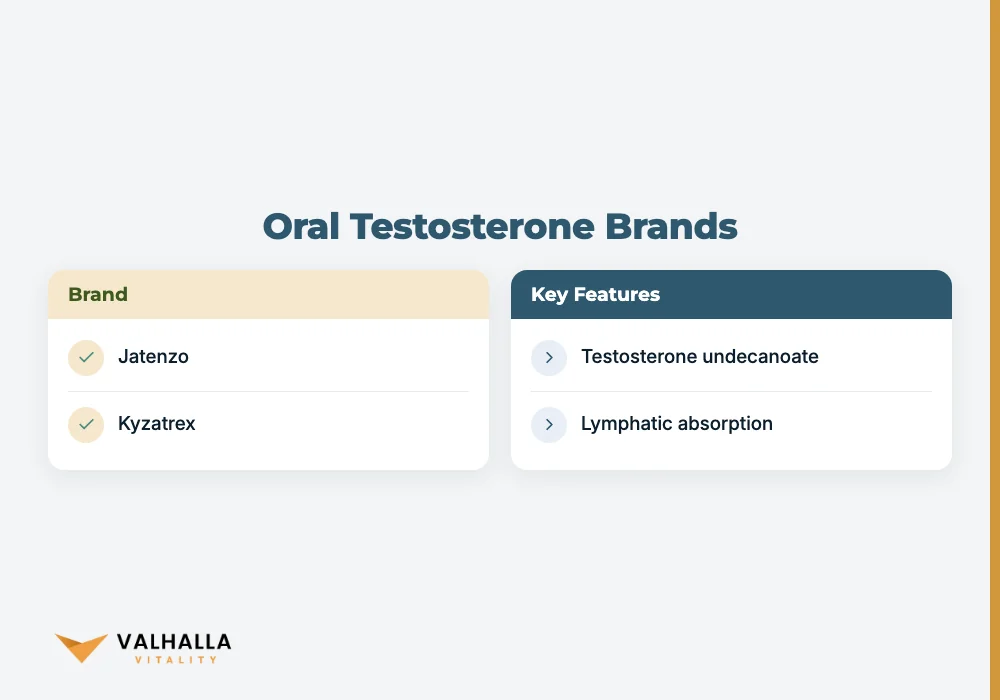
Two testosterone pill brands are available by prescription in the United States: Jatenzo and Kyzatrex. Both use oral testosterone undecanoate as the active molecule. Both rely on lymphatic absorption, which reduces the hepatic burden compared with older oral testosterone compounds. A 2023 review by Miller et al. in Sexual Medicine Reviews traced this shift from hepatotoxic legacy formulations to modern lymphatic-route products.
| Brand | Active molecule | Absorption route | Requires food? |
|---|---|---|---|
| Jatenzo | Testosterone undecanoate | Lymphatic | Yes |
| Kyzatrex | Testosterone undecanoate | Lymphatic | Yes |
Jatenzo capsules benefits include a well-studied pharmacokinetic profile developed through its clinical program. Kyzatrex is a newer Kyzatrex TRT option that works through the same lymphatic mechanism. A 2021 update by Kresch et al. in Expert Opinion on Pharmacotherapy identified both among the key oral pharmacotherapy options available to US patients with testosterone deficiency. A licensed provider determines the dose after labs.
For clinical detail on how Kyzatrex performs across outcomes, the article covering Kyzatrex benefits and side effects is a useful reference.
Is oral testosterone for men as effective as injections for TRT?
Oral testosterone for men can reach therapeutic hormone levels in most patients with confirmed hypogonadism. It is one of several viable TRT delivery routes. A 2022 review by Wang et al. in Endocrinology and Metabolism Clinics of North America found that oral, injectable, topical, and subcutaneous delivery methods each achieve hormonal targets through distinct pharmacokinetic profiles, and the best fit depends on individual patient factors evaluated during a clinical review.
Injectable TRT produces defined concentration peaks between administrations. A 2022 paper by Figueiredo et al. in JCEM confirmed subcutaneous injection as a safe and practical option with a predictable absorption pattern. Oral capsules taken with a meal absorb through the lymphatic system and follow a different daily curve. Neither route is universally better.
When deciding between oral TRT vs injections, real-world adherence matters as much as pharmacokinetics. For a detailed clinical comparison of oral and injectable TRT routes, the evidence suggests route selection should match patient factors, not a theoretical ranking. TRT without injections may work better for men who find needles difficult to maintain consistently over months.
What are the side effects of oral testosterone for men?
Testosterone capsules side effects include elevated blood pressure, increased red blood cell count (erythrocytosis), acne, and mood changes. These are not unique to the oral route; they occur across most TRT delivery methods.
What sets oral testosterone apart is a recognized change in lipid levels, specifically a reduction in HDL cholesterol. A 2025 review by Goldstein et al. in Sexual Medicine Reviews addressed this in the context of newer oral testosterone undecanoate formulations and confirmed it as a clinically relevant monitoring target.
Liver safety has improved with current formulations. Older oral testosterone compounds used a chemical modification that caused direct hepatic stress. Modern oral testosterone undecanoate products absorb through the lymphatic system instead, bypassing that pathway. Goldstein et al. noted that this distinction meaningfully changes the liver risk profile, though periodic liver enzyme monitoring remains appropriate.
Monitoring during oral TRT typically includes:
- Serum testosterone levels
- Hematocrit and red blood cell count
- Blood pressure
- Liver enzyme panel
- Lipid panel, including HDL cholesterol
The schedule and thresholds are set by the prescribing provider. No universal interval applies to all patients. For a fuller picture of individual risk factors, see the guide on risks associated with oral testosterone capsules.
How does oral testosterone affect cardiovascular health?
Cardiovascular monitoring is standard TRT management regardless of delivery route. Blood pressure elevation is a consistent finding across oral, injectable, and topical testosterone. A 2022 review by Wang et al. in Endocrinology and Metabolism Clinics of North America emphasized that regular blood pressure and hematocrit tracking is part of routine care for all TRT patients.
Erythrocytosis is a particularly relevant risk. When red blood cell count climbs too high, blood viscosity increases, which may raise the risk of clotting events. Routine hematocrit monitoring detects this early. Providers adjust or pause treatment based on results.
Current guidelines do not categorically exclude oral TRT for patients with cardiovascular risk factors. They require careful clinical evaluation before any prescription. No regimen begins without a baseline cardiovascular assessment.
Can you self-administer oral testosterone at home?
Yes. Oral testosterone capsules are taken at home without clinical assistance, which is a primary practical advantage of testosterone pills TRT over injection protocols. At Valhalla Vitality, the full process from medical intake and provider review to prescription and ongoing lab monitoring runs online, with no in-clinic administration required.
Both prescription oral testosterone capsule brands must be taken with a meal. Fat in the meal supports lymphatic absorption. Taking the capsule on an empty stomach significantly reduces how much testosterone enters circulation. The pharmacy and prescribing provider supply brand-specific instructions.
Simplified home administration does not reduce medical oversight. Oral TRT without injections lowers the logistical burden. It does not lower the requirement for follow-up labs, blood pressure checks, and periodic provider reviews throughout treatment.
Ready to explore your TRT options?
A licensed provider can evaluate your labs and history to determine whether oral TRT fits your clinical profile. Book Your Consultation to begin the process.
FAQ
Is oral testosterone as effective as injections?
Oral testosterone can achieve the same therapeutic hormone targets as injectable TRT in most patients with confirmed hypogonadism. Delivery routes differ in their pharmacokinetic profiles, and a provider determines which option best fits an individual patient's health history and lifestyle.
What oral testosterone brands are available by prescription in the US?
Jatenzo and Kyzatrex are the two prescription oral testosterone undecanoate options currently available in the United States. Both require a prescription and must be taken with a meal to support absorption through the lymphatic system.
Do oral testosterone capsules damage the liver?
Modern prescription oral testosterone undecanoate formulations absorb through the lymphatic system rather than through direct hepatic processing, significantly reducing liver stress compared with older oral testosterone compounds. Periodic liver enzyme monitoring remains part of standard care during treatment.
Can oral testosterone raise blood pressure?
Blood pressure elevation is a recognized effect of TRT across all delivery routes, including oral capsules. Providers monitor blood pressure before and throughout treatment as part of routine TRT management.
How does prescription oral testosterone differ from over-the-counter testosterone boosters?
Prescription oral testosterone is a pharmaceutical hormone replacement that requires a diagnosis, a licensed provider's prescription, and ongoing lab monitoring. Over-the-counter testosterone boosters are dietary supplements with no established clinical effect on serum testosterone levels.
Sources
- Miller JA et al. (2023). Oral testosterone therapy: past, present, and future. Sexual medicine reviews. PubMed
- Kresch E et al. (2021). An update on the available and emerging pharmacotherapy for adults with testosterone deficiency available in the USA. Expert opinion on pharmacotherapy. PubMed
- Wang C et al. (2022). Testosterone Replacement Therapy in Hypogonadal Men. Endocrinology and metabolism clinics of North America. PubMed
- Figueiredo MG et al. (2022). Testosterone Therapy With Subcutaneous Injections: A Safe, Practical, and Reasonable Option. The Journal of clinical endocrinology and metabolism. PubMed
- Goldstein I et al. (2025). Newer formulations of oral testosterone undecanoate: development and liver side effects. Sexual medicine reviews. PubMed
You May Also Like
 Oral testosterone
Oral Testosterone Therapy: Energy, Side Effects & Results
Oral testosterone therapy may improve energy and ease fatigue in men with low T. Learn how it works, what side effects to expect from treatment.
October 7, 2026 ETRead more → Oral testosterone
Oral Testosterone Fertility: How TRT Affects Sperm
Oral testosterone fertility: TRT typically reduces sperm production. Learn what the research shows and how to protect your reproductive options.
October 7, 2026 ETRead more → Oral testosterone
Oral Testosterone Therapy: Options, Benefits, and Risks
Oral testosterone therapy delivers TRT in pill form. Learn how testosterone undecanoate capsules work, who qualifies, and key side effects to watch.
October 6, 2026 ETRead more →