
The following blog post is for entertainment and informational purposes only. It is not intended to provide medical advice or diagnosis. Please consult your doctor before making any health-related decisions.
Turkesterone is an ecdysteroid extracted from Ajuga turkestanica, a plant used in traditional central Asian herbal practice. Understanding how turkesterone works begins with one fact: it does not bind to androgen receptors as synthetic anabolic steroids do. That changes everything. Research links its anabolic effects to the phosphatidylinositol-3-kinase (PI3K) pathway, which increases protein synthesis and drives amino acid uptake at the cellular level. That non-hormonal mechanism is what makes turkesterone supplements distinct from hormone-based compounds.
What is ajuga turkestanica extract?
Turkesterone belongs to the ecdysteroid class, a group of steroid hormones found naturally in arthropods and certain plants. It occurs in small quantities in foods like spinach, yams, and quinoa. Ajuga turkestanica and Maral root contain it in much higher concentrations and are the primary botanical sources for commercial supplements.
Industrial production starts by soaking the plant root in ethanol or a comparable solvent to release the crude ecdysteroid content. That extract is then purified through techniques including chromatography and crystallization, removing impurities and concentrating the active compound. The finished product typically takes the form of a capsule or tablet. Concentration levels vary widely.
Structurally, turkesterone shares some surface-level similarity with testosterone. Its metabolites resemble testosterone-related compounds, but the receptor interaction is fundamentally different. That distinction is central to why it attracts interest from turkesterone for athletes seeking anabolic support without hormonal interference.
How does turkesterone work in the body?
Turkesterone activates the PI3K signaling pathway to increase muscle protein synthesis. It does not engage androgen receptors. Those two facts together explain most of its appeal. The mechanism is verified.
The evidence for this mechanism comes from ecdysteroid research on the closely related compound 20-hydroxyecdysone (20E). Blocking the PI3K pathway with a specific inhibitor suppresses 20E's anabolic effect entirely. That points to PI3K as the operative route, not androgen signaling. Turkesterone is structurally similar to 20E and is understood to act through the same channel.
Understanding how turkesterone works also requires looking at leucine uptake. The compound appears to enhance the absorption of leucine from dietary protein. Leucine is the primary amino acid signal for muscle tissue repair, so more of it reaching muscle cells shortens the rebuild window after training. Add an apparent increase in ATP synthesis, and the compound addresses both the repair and the energy sides of recovery. This pathway is key.
Because androgen receptors are not involved, turkesterone does not suppress natural testosterone production. Post-cycle therapy is not typically required after a turkesterone protocol.
What are the benefits of taking turkesterone?
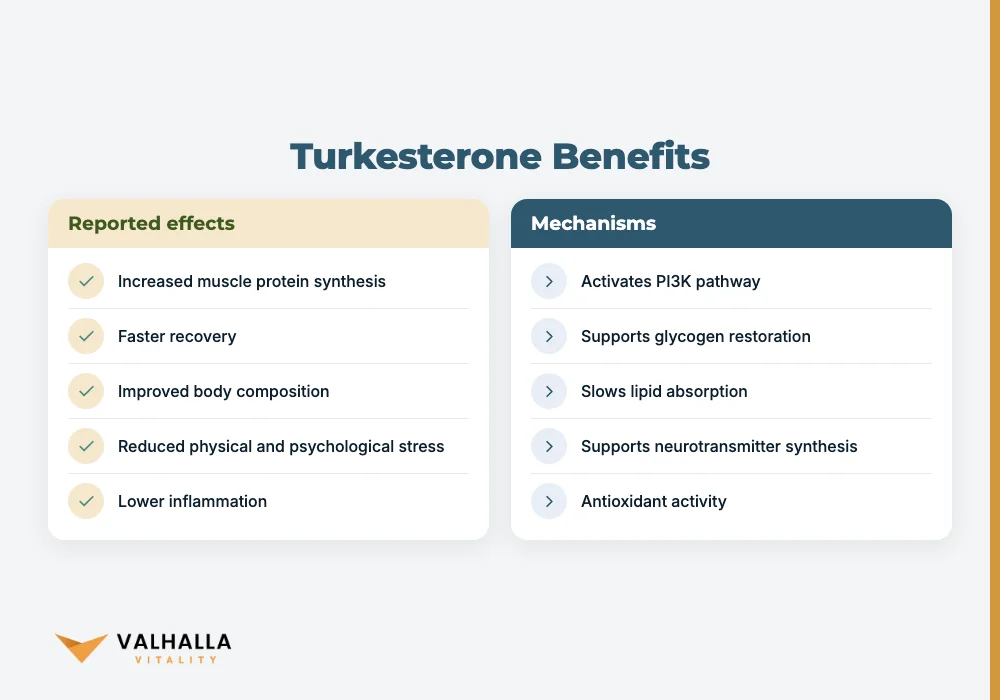
Turkesterone benefits span muscle, metabolic, and systemic categories. The list runs deep. Here is what the research describes:
| Category | Reported effect |
|---|---|
| Muscle protein synthesis | May increase via PI3K pathway activation |
| Recovery | Faster; supported by leucine uptake and glycogen restoration |
| Endurance | Higher ATP output may reduce perceived fatigue |
| Body composition | May improve muscle-to-fat ratio; affects lipid absorption |
| Stress response | Adaptogenic properties may buffer physical and psychological stress |
| Inflammation | Antioxidant activity with some immunomodulatory function |
Muscle growth. Turkesterone muscle growth outcomes are driven by protein synthesis stimulation, not hormonal manipulation. Faster recovery follows because the compound also supports glycogen replenishment and reduces lactic acid buildup between sessions. Most athletes notice this. The broader evidence on ecdysteroid health effects includes metabolic and anti-inflammatory findings that extend well beyond muscle tissue alone.
Metabolic effects. This ecdysteroid supplement appears to slow lipid absorption and help regulate insulin resistance. Both effects may contribute to improved body composition over time. Research also points to benefits on glucose and cholesterol regulation, suggesting a systemic metabolic influence rather than a purely muscle-focused mechanism.
Adaptogenic and cognitive effects. Turkesterone has been described as an adaptogenic agent in the research literature. Most teams skip this. It may help the body cope with physical and psychological stress, in part through support of neurotransmitter synthesis. This area is far less studied than the muscular benefits.
How long does it take for turkesterone to work?
Results do not appear immediately. Consistency builds the result. Reduced post-training soreness and improved recovery are usually the first changes users notice, sometimes within the first few weeks of consistent use. Visible changes in lean mass take longer and depend on training quality, protein intake, and individual physiology.
How turkesterone works in practice is inseparable from the training and nutrition context around it. For a detailed look at how ecdysteroid supplementation aligns with structured resistance programs, that topic is reviewed separately.
A licensed provider determines the appropriate intake level and duration based on your individual health profile and goals. No specific timeline can be promised for any individual.
Turkesterone side effects: what the research shows
How turkesterone works through non-androgenic pathways is one reason its safety profile looks relatively favorable. No serious adverse effects have been identified in the available literature at typical supplementation levels. That profile stands out.
Mild gastrointestinal discomfort and lightheadedness are the most commonly reported issues among users. Taking the supplement with food generally reduces stomach sensitivity.
Does turkesterone cause acne?
Acne does not appear in the confirmed side effect data for turkesterone. No androgenic trigger exists. The hormonal pathway that drives steroid-induced acne requires androgen receptor activation, which turkesterone does not trigger. Without that activation, the skin-based androgenic chain is not engaged. For a closer look at skin and hair side effect concerns in the ecdysteroid literature, that evidence is reviewed separately.
Is turkesterone safe for daily use?
Current research describes a low toxicity profile at typical supplement levels. The related ecdysteroid class has not shown lethal effects at amounts well above standard supplementation ranges. Ecdysteroids also occur naturally in common foods at low concentrations, which supports a cautiously favorable baseline.
Long-term human trial data remains limited. Liver health has been noted as one area worth monitoring with extended use. A licensed provider should assess your health history before you begin a daily turkesterone protocol.
Book your consultation
If turkesterone is part of your current research into evidence-based supplement options, a provider review can help clarify whether it fits your individual profile. Book Your Consultation to connect with a licensed provider.
FAQ
How does turkesterone work in the body?
Turkesterone activates the PI3K signaling pathway, increasing muscle protein synthesis and enhancing leucine uptake from dietary protein. It does not bind to androgen receptors, so natural testosterone production is not suppressed. This non-hormonal mechanism is what separates it from synthetic anabolic compounds.
What are the benefits of taking turkesterone?
The main reported benefits include increased muscle protein synthesis, faster post-training recovery, higher ATP output for endurance, and improved body composition through effects on lipid absorption. Some research also describes adaptogenic and anti-inflammatory effects, though much of the supporting data comes from preclinical studies.
Does turkesterone cause acne?
No confirmed clinical link exists between turkesterone and acne. Because it does not activate androgen receptors, it does not trigger the hormonal pathway that typically drives steroid-related acne. Reported cases remain anecdotal and are not supported by controlled research.
How long does it take for turkesterone to work?
Improved recovery and reduced post-training soreness may appear within the first few weeks of consistent use. Visible changes in lean mass take longer and depend on training load, nutrition, and individual physiology. No universal timeline applies.
Is turkesterone safe for daily use?
Current research points to a low toxicity profile at typical supplementation levels, and ecdysteroids naturally occur in common foods in trace amounts. Long-term human data is limited. A licensed provider should review your health history before you commit to a daily protocol.
Sources
- Research on the PI3K/Akt signaling pathway and 20-hydroxyecdysone (20E) anabolic activity in skeletal muscle tissue, cited in the mechanism of action section.
- Ecdysteroid class safety studies and no-observed-adverse-effect levels in preclinical models, cited in the side effects and daily use sections.
- Botanical and phytochemical analysis literature on Ajuga turkestanica ecdysteroid concentrations and commercial extraction methods.
- Studies on leucine uptake and amino acid transport in muscle tissue with ecdysteroid exposure, cited in the mechanism section.
- Research on ecdysteroid influence on lipid absorption, glucose regulation, and insulin sensitivity, cited in the metabolic effects section.
- Literature on adaptogenic properties and neurotransmitter support of plant-derived ecdysteroids, cited in the adaptogenic effects section.
You May Also Like
 Turkesterone
 Muscle Growth: What the Research Shows
Turkesterone muscle growth research reviewed: how this ecdysteroid may support protein synthesis, timelines, safety, and what to ask before starting.
October 30, 2026 ETRead more → Turkesterone
 Bodybuilding: What Athletes Need to Know
Turkesterone bodybuilding explained: how ecdysteroids work, what studies show, results timeline, and why provider review matters before you start.
October 30, 2026 ETRead more → Turkesterone
Natural Turkesterone for Muscle Growth: What to Know
Natural turkesterone from Ajuga turkestanica may support muscle growth and recovery without androgenic side effects. Here's what the evidence shows.
October 27, 2026 ETRead more →