
The following blog post is for entertainment and informational purposes only. It is not intended to provide medical advice or diagnosis. Please consult your doctor before making any health-related decisions.
Turkesterone muscle growth is one of the more studied topics in natural supplementation right now. This plant-derived ecdysteroid may support muscle protein synthesis through pathways that differ from conventional anabolic agents, making it a standout candidate among natural muscle building supplements. A 2024 review in Nutrients (Todorova et al.) confirmed both ecdysterone and turkesterone as compounds with meaningful potential in sport and healthy nutrition. For a grounded starting point, this turkesterone supplement research and safety data overview covers what the evidence actually shows.
What is turkesterone?
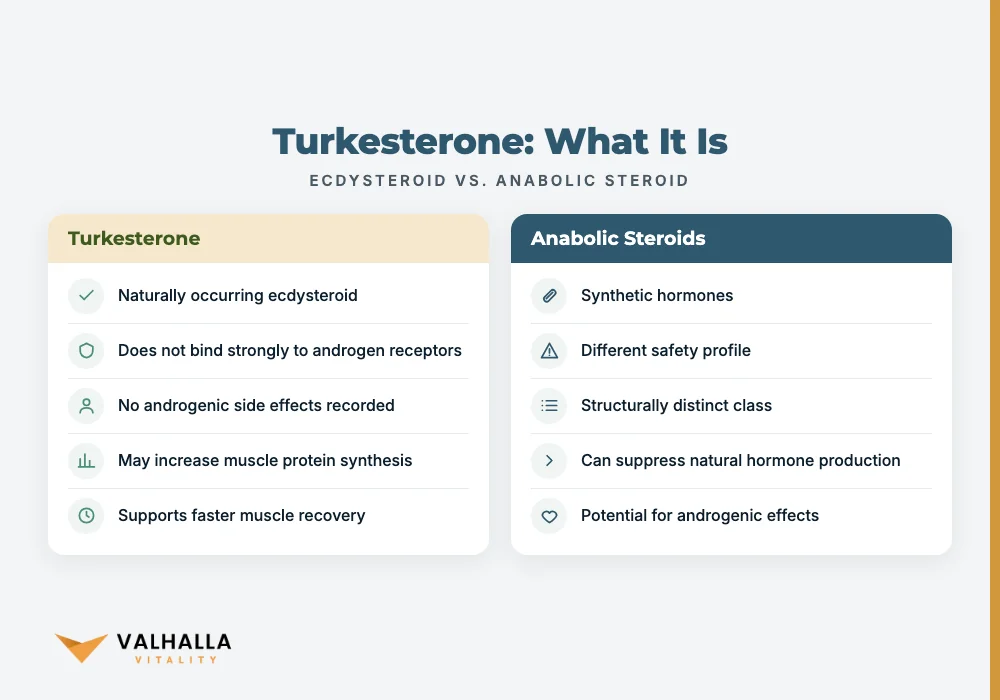
Turkesterone is a naturally occurring ecdysteroid. Ecdysteroids are steroid-like compounds found in certain plants, including spinach, yams, and various Central Asian herbs. Their concentration in food sources is too low to affect physiology. That is why the active compound is extracted and concentrated for supplement production.
Unlike anabolic steroids, turkesterone does not appear to bind strongly to androgen receptors. It belongs to a structurally distinct class, which is why its safety profile differs from synthetic hormones. A closer look at what current research shows about how turkesterone functions at the biochemical level is worth the time before evaluating any supplementation decision.
Key effects studied in ecdysteroid research (Todorova et al., 2024):
- May increase muscle protein synthesis, supporting lean mass development over time
- May enhance glycogen retention in muscle tissue, contributing to endurance during training sessions
- Appears to support faster muscle recovery between workouts
- Does not appear to elevate testosterone or suppress the body's natural hormone production
- No androgenic side effects have been recorded in available human research
These combined effects explain why athletes and fitness-focused individuals have concentrated their interest in turkesterone protein synthesis as the central mechanism worth examining.
Does turkesterone actually build muscle?
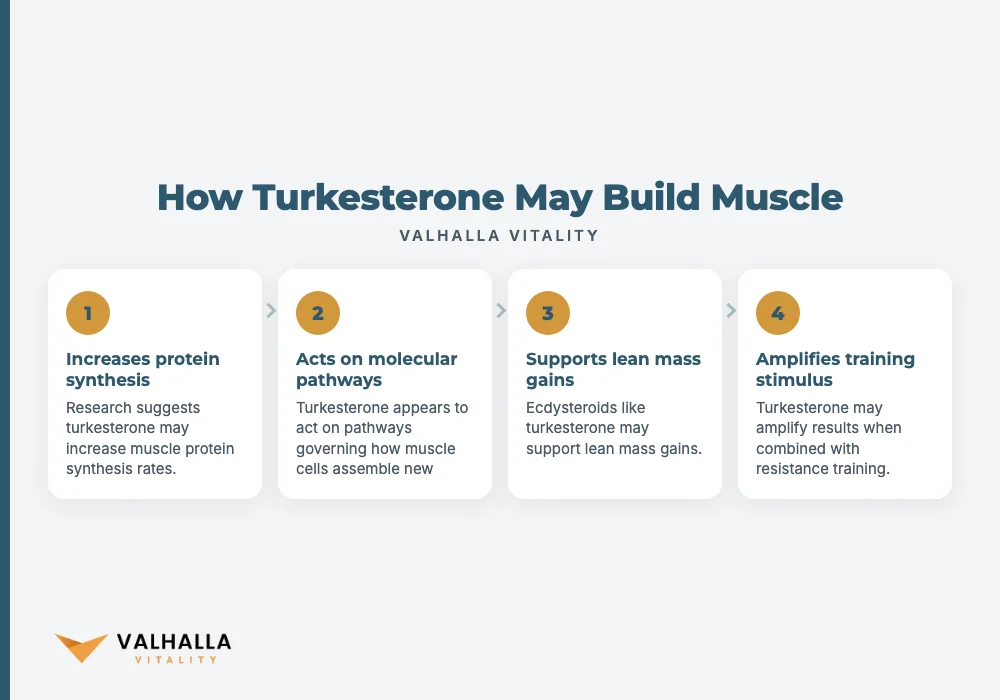
Research suggests it may, particularly through increased muscle protein synthesis. Most studies to date used animal models and in vitro methods, with a smaller number of human trials available. Todorova et al. (2024) reviewed the available literature and found consistent signals that ecdysteroids, including turkesterone, may support lean mass gains by increasing protein synthesis rates in muscle cells.
The case for turkesterone muscle growth rests primarily on this specificity. Rather than broadly stimulating hormone production, turkesterone appears to act on molecular pathways governing how efficiently muscle cells assemble new proteins. The ecdysteroid anabolic effects documented in research point to a targeted mechanism. That precision is a key reason researchers continue to study it.
No supplement replaces progressive resistance training or adequate protein intake. Todorova et al. consistently observed that ecdysteroid supplementation performs alongside a solid training and nutrition foundation. The training stimulus still drives adaptation. Turkesterone may amplify it.
Turkesterone muscle growth and protein synthesis
Muscle protein synthesis, or MPS, is the biological process by which muscle cells build new structural proteins after exercise-induced stress. Higher MPS rates over time translate to more lean tissue. This is the primary pathway through which turkesterone is thought to drive turkesterone muscle growth.
Ecdysteroids appear to upregulate PI3K/Akt signaling, a molecular cascade central to protein synthesis regulation. This is the same pathway activated by resistance training itself, which may explain the additive effects observed when turkesterone is combined with exercise load in studies. Practically, turkesterone may amplify the body's natural anabolic response to training rather than bypassing or replacing it.
Recovery is the other dimension. Elevated MPS rates mean damaged muscle fibers repair more quickly between sessions. Faster repair allows for greater training frequency and accumulated volume over time. Both the synthesis boost and the recovery effect contribute to the sustained interest in turkesterone for bodybuilding applications.
Does turkesterone raise testosterone levels?
No. This distinction matters more than it might appear at first. Turkesterone does not raise serum testosterone. Ecdysteroids carry a steroidal molecular structure, but they occupy a different class from androgens entirely. The structural similarity to testosterone is a surface-level biochemical observation. It is not functional equivalence.
Available evidence does not show turkesterone supplementation significantly changing testosterone levels in humans (Todorova et al., 2024). It does not bind to androgen receptors the way testosterone does. It does not suppress the hypothalamic-pituitary-gonadal axis. These are separate mechanisms, operating on separate systems.
This is also why turkesterone sits in a different category from hormone optimization protocols. If you're looking beyond muscle growth specifically, turkesterone's effects across athletic and wellness contexts are worth reading to understand the fuller picture.
Turkesterone vs steroids: what makes them different
The turkesterone vs steroids comparison deserves a direct answer. Anabolic steroids bind to androgen receptors, driving protein synthesis and muscle growth while simultaneously triggering androgenic effects: hormonal suppression, potential organ stress, and other well-documented risks that accumulate with sustained use.
Turkesterone operates differently. It does not bind to androgen receptors at meaningful levels. It does not suppress endogenous hormone production. No androgenic side effects have been reported in human studies of ecdysteroids (Todorova et al., 2024). This is the core appeal as a natural muscle building supplement. Potential anabolic effects, without the androgenic risk profile attached to synthetic hormones. That is a meaningful distinction.
It is not a wholesale substitute for everything anabolic steroids do. But the risk calculus differs in ways that matter. People integrating turkesterone into a structured training program should treat it as a complement to progressive programming, not a replacement for it.
How long does it take for turkesterone to work?
Several weeks, not days. The turkesterone results timeline varies by individual and training baseline. Studies reviewed by Todorova et al. (2024) show measurable changes in body composition and performance markers emerging over multi-week periods. Most people who report noticeable effects describe them appearing after several consistent weeks of supplementation paired with regular resistance training.
Rapid lean mass changes in the first week or two are not supported by current evidence. Turkesterone fits sustained supplementation cycles where cumulative effects in protein synthesis and recovery build gradually. Abandoning the supplement after two or three weeks, because visible changes have not yet appeared, is a common and avoidable mistake.
Before starting, discussing the realistic timeline with a provider who can contextualize expectations based on your training history, diet, and health profile is the more informed approach.
What is the correct turkesterone dosage for muscle growth?
There is no universally established dose for humans. Research reviewed by Todorova et al. (2024) examined a range of quantities in animal models and small human trials, but no regulatory body has defined a standard protocol for turkesterone dosage for bodybuilding or general muscle growth purposes.
The reason is straightforward: the human research base is still developing, and individual factors, including body composition, training volume, and concurrent supplement use, all affect how any given amount performs. A licensed provider determines the appropriate amount and duration after reviewing your health history and goals. Self-directed dosing from supplement labels or online guides carries inherent risk, especially when stacking with other compounds.
Is turkesterone safe for long-term use?
Current evidence points to a favorable short-term safety profile. Todorova et al. (2024) noted no significant adverse effects in reviewed studies, and no androgenic side effects have been recorded in human research. Long-term human data, however, remains limited.
No documented harm is not the same as confirmed long-term safety. That gap in the evidence is worth acknowledging before committing to extended use. Responsible use means monitoring your individual response, cycling the supplement where appropriate, and consulting a provider if you have any underlying health conditions or are taking other compounds. Valhalla Vitality approaches supplement guidance from that same position: informed, provider-reviewed decisions rather than guesswork.
Speak with a provider
If turkesterone muscle growth support is something you are evaluating as part of a training plan, a licensed provider can review whether it fits your health profile before you start. Book Your Consultation.
FAQ
Does turkesterone build muscle without exercise?
No supplement creates lean mass in the absence of training. Research on turkesterone protein synthesis consistently shows effects that depend on adequate resistance training load and protein intake. Turkesterone may enhance how efficiently muscles respond to exercise, not replace the training stimulus itself.
Does turkesterone affect hormone levels?
Available evidence does not show turkesterone significantly altering testosterone or other hormones. Ecdysteroids do not bind to androgen receptors at meaningful levels, and no androgenic side effects have been recorded in human studies (Todorova et al., 2024). This is a fundamental difference from anabolic steroids.
How is the turkesterone results timeline different from creatine?
The mechanisms and timelines differ substantially. Creatine typically produces measurable performance changes within days by increasing phosphocreatine availability. Turkesterone's effects on protein synthesis and recovery build gradually over weeks of consistent use. Some people use both within a training stack, but individual responses vary.
Is turkesterone legal in competitive sports?
Turkesterone is not currently listed as a prohibited substance by the World Anti-Doping Agency. Regulations change, and competitive athletes governed by specific organizations should verify current status with their governing body before supplementing.
Sources
- Todorova V et al. (2024). Ecdysterone and Turkesterone-Compounds with Prominent Potential in Sport and Healthy Nutrition. Nutrients. PubMed
You May Also Like
 Turkesterone
 Bodybuilding: What Athletes Need to Know
Turkesterone bodybuilding explained: how ecdysteroids work, what studies show, results timeline, and why provider review matters before you start.
October 30, 2026 ETRead more → Turkesterone
How Turkesterone Works: Mechanism, Benefits, Safety
How turkesterone works: it triggers PI3K-driven protein synthesis without activating androgen receptors. Mechanism, benefits, and safety covered.
October 30, 2026 ETRead more → Turkesterone
Natural Turkesterone for Muscle Growth: What to Know
Natural turkesterone from Ajuga turkestanica may support muscle growth and recovery without androgenic side effects. Here's what the evidence shows.
October 27, 2026 ETRead more →