
The following blog post is for entertainment and informational purposes only. It is not intended to provide medical advice or diagnosis. Please consult your doctor before making any health-related decisions.
Turkesterone hair loss concerns are common among supplement users, and they deserve a direct answer. Turkesterone is a plant-derived ecdysteroid with no documented androgenic activity, meaning it does not operate on the hormonal pathways responsible for male pattern baldness. No human studies have linked turkesterone supplementation to elevated DHT or testosterone levels. For a grounding in how ecdysteroids function at the biochemical level, that context helps frame the evidence covered throughout this article.
What is turkesterone?
Turkesterone is an ecdysteroid extracted from Ajuga turkestanica, a flowering plant native to Central Asia. Ecdysteroids are compounds found in arthropods and various plant species, where they regulate developmental processes such as molting and growth. In human research, they are studied for potential effects on muscle protein synthesis and metabolic function.
The classification matters for the hair question. Anabolic steroids bind tightly to androgen receptors in human tissue, activating pathways that produce both muscle growth and androgenic side effects, including hair follicle miniaturization in susceptible individuals. Ecdysteroids, including turkesterone, interact primarily with estrogen receptor beta. That receptor pathway has different downstream consequences and does not appear to trigger the androgenic cascade responsible for androgenetic alopecia.
Turkesterone sits alongside 20-hydroxyecdysone (ecdysterone) as one of the most studied ecdysteroids for performance applications. Both have been investigated for potential effects on strength and body composition. Animal studies have shown turkesterone administration was associated with increased muscle mass and strength in rodent models. Human clinical data remain limited. Across the available research, the absence of androgenic activity is a consistent finding, and that consistency is the foundation of the turkesterone hair loss discussion.
Turkesterone is not classified under anabolic steroid legislation in the United States. That legal and pharmacological distinction reflects the fundamental receptor biology: ecdysteroids and anabolic steroids are different compound classes with different mechanisms and different risk profiles. The category confusion, partly driven by marketing language in the supplement industry, is what generates most of the turkesterone hair loss concern in the first place.
Reported potential effects of turkesterone
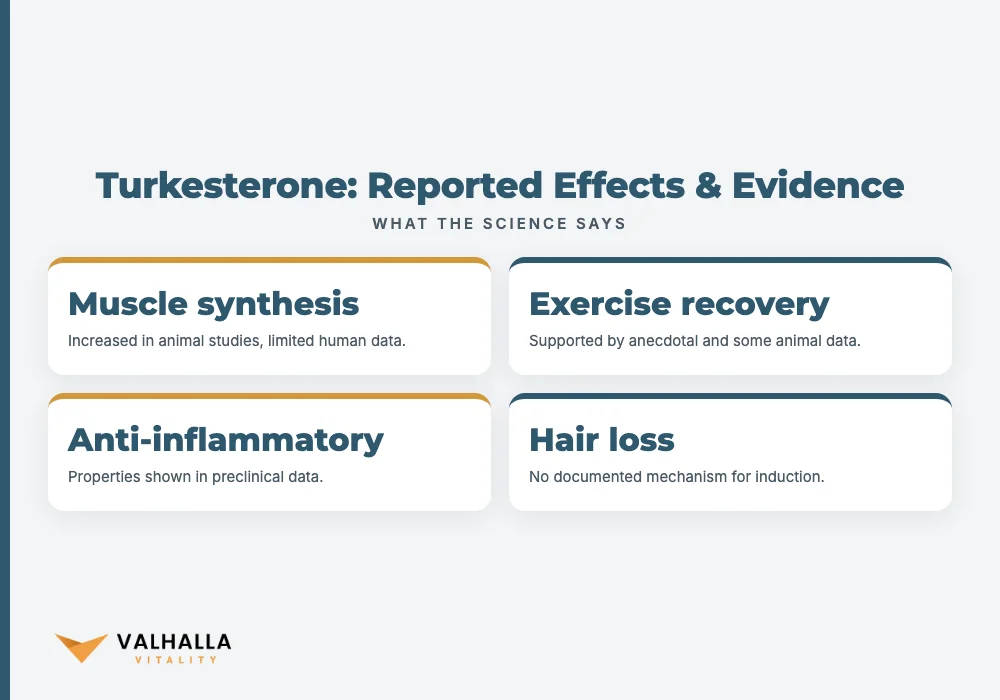
Mapping the proposed effects of turkesterone alongside the evidence base helps clarify what the compound does and does not influence:
| Reported effect | Evidence base | Androgenic activity? |
|---|---|---|
| Muscle protein synthesis increase | Animal studies; limited human data | None documented |
| Exercise recovery support | Anecdotal; some animal data | None documented |
| Anti-inflammatory properties | Preclinical data | None documented |
| Cognitive function support | Animal studies | None documented |
| Joint and bone support | Preliminary animal data | None documented |
| Testosterone elevation | Not documented in humans | N/A |
| DHT elevation | Not documented | N/A |
| Hair loss induction | No documented mechanism | N/A |
None of the proposed effects involve androgen receptor activation of the type linked to hair follicle miniaturization. This is consistent with the receptor biology that separates ecdysteroids from anabolic compounds.
Does turkesterone cause hair loss?
No current evidence shows that turkesterone causes hair loss. That is the direct answer.
Hair loss linked to supplements almost always follows a specific hormonal mechanism. Dihydrotestosterone (DHT) is the primary driver of androgenetic alopecia, also called male pattern baldness. It forms when the enzyme 5-alpha reductase converts testosterone into this more potent androgen. In people with genetic sensitivity, DHT attaches to receptors in scalp follicles and progressively miniaturizes them, eventually halting hair growth. Compounds that raise testosterone, raise DHT, or bind androgen receptors with high affinity can accelerate this process in susceptible individuals.
Turkesterone does not raise DHT in humans. It has not been shown to raise testosterone. It does not bind androgen receptors through the pathway that triggers follicle miniaturization. The turkesterone hair loss concern, while understandable given the compound's association with performance supplement stacks, has no documented biological mechanism in current literature.
Anecdotal reports exist, and they deserve acknowledgment. Online supplement communities include users who reported hair thinning while taking turkesterone. But hair loss has many potential causes: physical and psychological stress, nutritional deficiencies, thyroid disruption, androgenetic alopecia already in progress before supplementation began, and concurrent medications or supplements. Without controlled studies tracking hair outcomes in turkesterone users against matched controls, attributing changes to this specific compound is speculative.
Interest in turkesterone hair loss as a safety question has grown alongside the supplement's rising popularity in fitness communities. Users are right to ask. The answer, based on available evidence, is that turkesterone does not share the mechanistic profile of compounds associated with androgenic alopecia. That makes the turkesterone hair loss concern largely theoretical at present, while still worth monitoring in individuals with a known hair loss history.
The pattern of turkesterone side effects in consistent user reports leans toward gastrointestinal symptoms: nausea, stomach discomfort, and occasional headaches. Androgenic effects such as increased acne, oily skin, or hair thinning are not recurring findings. This pattern aligns with what the receptor biology predicts for a non-androgenic compound.
Turkesterone hair loss vs anabolic steroid hair loss
The turkesterone hair loss risk profile is fundamentally different from that of anabolic-androgenic steroids (AAS). AAS activate androgen receptors. That is the same molecular pathway that drives follicle miniaturization in androgenetic alopecia. Hair loss is a recognized, well-documented consequence of AAS use, particularly for individuals carrying the genetic variant that makes follicles sensitive to DHT.
Turkesterone does not activate androgen receptors through this mechanism. That biochemical divergence explains why the adverse effect profiles of these two compound classes differ so substantially, even when both are used toward similar performance goals. Understanding this distinction is foundational to evaluating the turkesterone hair loss question accurately.
Does turkesterone increase DHT levels?
No human studies have documented turkesterone increasing DHT. This is consistent with the compound's receptor profile.
DHT drives androgenetic alopecia by miniaturizing genetically susceptible follicles. For any supplement to raise DHT, it must either elevate free testosterone (giving 5-alpha reductase more substrate to convert) or directly stimulate androgen biosynthesis. Turkesterone has not been shown to do either.
Several supplement categories do genuinely shift the androgen balance. Prohormones, androstenedione-based compounds, and some herbal "testosterone boosters" containing androgenic precursors feed directly into the DHT pathway. Turkesterone's proposed mechanism, operating through estrogen receptor beta, does not intersect with that biosynthetic route.
Does turkesterone affect DHT through an indirect pathway? No such pathway has been identified in ecdysteroid research. The muscle protein synthesis effects observed in animal models appear distinct from androgen-mediated growth, consistent with receptor activity that bypasses androgen production entirely.
One nuance worth preserving: "no documented DHT elevation" accurately reflects current evidence. It does not prove zero effect under all conditions in every individual. Long-term, large-scale human trials measuring comprehensive androgen panels, including DHT, free testosterone, and androgen metabolites, have not been conducted for turkesterone at clinical scale. The evidence is mechanistically and empirically reassuring. The research base is still developing.
Turkesterone vs anabolic steroids: the key difference for hair
The turkesterone vs anabolic steroids comparison provides the clearest context for why hair loss fears arise with this supplement at all.
Classic anabolic-androgenic steroids work by binding androgen receptors, directly mimicking or amplifying testosterone's effects. Muscle growth is one result. Androgenic stimulation of hair follicles is another. In genetically susceptible users, even short steroid cycles can accelerate follicle miniaturization. Several synthetic androgens convert directly to DHT or bind the androgen receptor more potently than testosterone itself. HPG (hypothalamic-pituitary-gonadal) axis suppression from AAS also disrupts the hormonal environment in ways that affect hair cycles long after a cycle ends.
None of this applies to turkesterone. It is not a synthetic androgen. It does not bind androgen receptors in the same way. It does not suppress the HPG axis. The physiological footprint is genuinely distinct, and it explains why turkesterone side effects in existing research do not resemble a classic steroid side effect profile.
Does turkesterone raise testosterone? Current evidence says no. Anabolic steroids shift the testosterone environment dramatically, driving both intended effects and side effects. Turkesterone has not been shown to raise testosterone in humans, which means the downstream androgen cascade, including DHT elevation and its impact on follicles, is not initiated.
Animal research documented that turkesterone administration was associated with increased muscle mass and strength in rodent models. These effects appear to occur through protein synthesis pathways that do not require testosterone elevation. That is why the turkesterone hair loss risk profile diverges from anabolic steroids even when both compounds are used for body composition purposes.
The potential health effects attributed to turkesterone covers the broader research picture, including where the evidence is strongest and where it remains preliminary.
Does turkesterone affect testosterone levels?
Does turkesterone raise testosterone? No significant testosterone elevation has been found in human research. No testosterone suppression has been documented either, which separates it from prohormones and anabolic steroids on both ends.
Ecdysteroids are not testosterone precursors. They are not secretagogues that signal increased testosterone production. They do not appear to stimulate Leydig cell activity through the LH pathway. The muscle-related effects observed in animal models appear to work through receptor mechanisms that do not require testosterone elevation as an intermediary step.
This matters for the turkesterone hair loss question from two angles. First, without testosterone elevation, the substrate pool for DHT production is not increased by supplementation. Second, without HPG axis suppression, the hormonal disruption that can destabilize hair cycles after anabolic steroid use is not created. The turkesterone hair loss risk profile holds up under the testosterone analysis for the same reasons it does under the direct DHT analysis.
Some users specifically want to know whether testosterone might be suppressed, affecting energy, libido, or hair quality. The existing evidence does not support suppression. Post-cycle recovery concerns, a real issue after anabolic steroid use, do not appear necessary after turkesterone supplementation because the HPG axis has not been shown to be disrupted. That makes the compound meaningfully different from androgen-suppressing compounds that carry genuine risks for hair and hormonal health.
Can ecdysteroids cause male pattern baldness?
Ecdysterone hair loss and beta ecdysterone hair loss questions follow the same biological logic as the turkesterone analysis, because all these compounds share the same receptor profile.
20-Hydroxyecdysone (ecdysterone) is the most studied ecdysteroid in sports science contexts. Research on its effects in trained populations has investigated possible muscle hypertrophy effects. The proposed mechanisms involve androgen-independent receptor pathways, specifically estrogen receptor beta, which does not drive the follicle miniaturization sequence that defines androgenetic alopecia. Beta ecdysterone is a market name for 20-hydroxyecdysone, sharing the same biochemistry and the same absence of documented androgenic activity.
Male pattern baldness requires two conditions simultaneously: genetic follicle sensitivity and the DHT activation signal. Ecdysteroids, across the class, have not been documented to generate that signal in humans. Without DHT stimulation, genetic predisposition to androgenetic alopecia remains dormant rather than actively expressed.
Product quality is a separate and practical concern that applies across the supplement market. Testing has found that ecdysteroid products vary considerably in concentration accuracy and purity. A product misrepresenting its contents could contain compounds with androgenic activity unrelated to ecdysteroids. This is a general supplement industry quality problem, not a property specific to ecdysteroids, but it is a real risk that third-party testing helps address. The turkesterone hair loss risk specific to well-characterized ecdysteroid extracts appears low based on current evidence; the risk from a misrepresented or contaminated product is harder to rule out without independent verification data.
Is turkesterone safe for your hair?
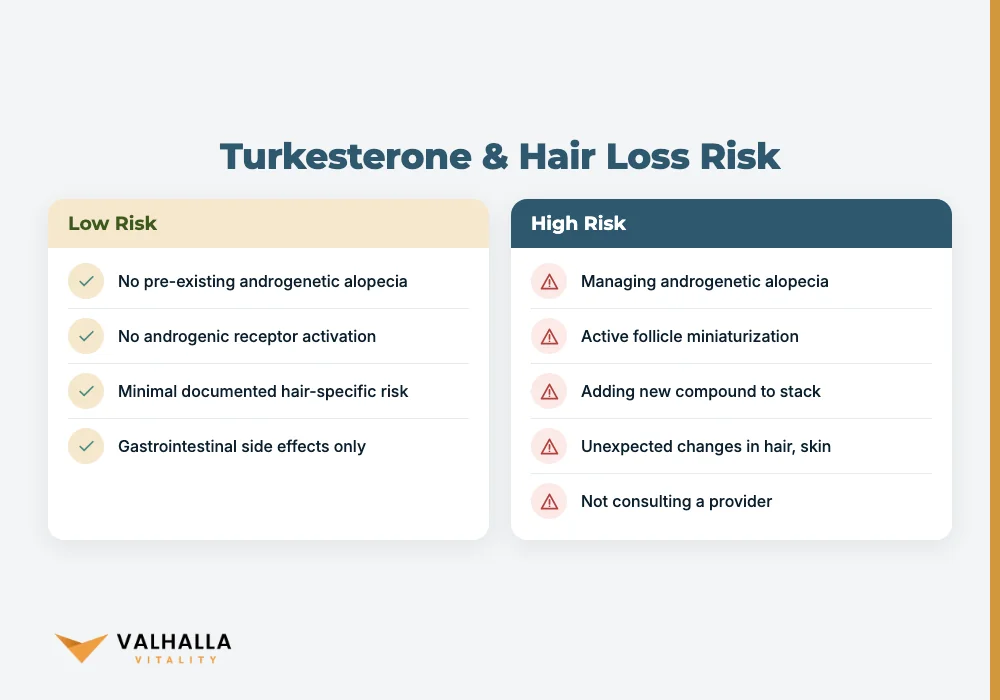
Based on current evidence, turkesterone is unlikely to cause hair loss. The absence of androgenic receptor activation is the primary reason. This conclusion applies to the ecdysteroid class broadly, not just turkesterone in isolation.
For most people without pre-existing androgenetic alopecia, the absence of androgen receptor activation means turkesterone carries minimal documented hair-specific risk. Turkesterone side effects consistently described in user reports are gastrointestinal, not androgenic. This places it in a different risk category from steroids, prohormones, and supplements containing actual androgen precursors.
For people already managing androgenetic alopecia, the evaluation requires more care. Active follicle miniaturization means the hair follicles are already under androgenic pressure. Any new compound added to the stack, however benign its known profile, warrants a provider review. This is not a specific warning about turkesterone hair loss; it is the appropriate standard for physiologically active compounds when you are managing a sensitive ongoing condition.
A practical approach to minimizing turkesterone hair loss risk:
- Establish a baseline androgen panel before starting, including total testosterone, free testosterone, and DHT
- Tell your provider about every supplement in your current stack before adding anything new
- Monitor for unexpected changes in hair, skin, and energy during the first several weeks
- Stop supplementation and consult a provider if hair changes occur, without assuming causation from timing alone
Hair cycles can have a lag between the triggering disruption and visible shedding. Changes noticed shortly after starting a supplement may reflect processes that began long before supplementation. A licensed provider can help distinguish compound-related changes from pre-existing androgenetic alopecia that was already in progress.
For context on how DHT-targeted therapies interact with hair follicle health, including what providers evaluate when these cases come up, understanding DHT therapy and hair follicle interactions covers the relevant clinical considerations.
What a provider evaluates before recommending turkesterone
Since the turkesterone hair loss concern carries a reassuring answer based on available evidence, the practical question becomes: what does a well-considered supplementation decision look like?
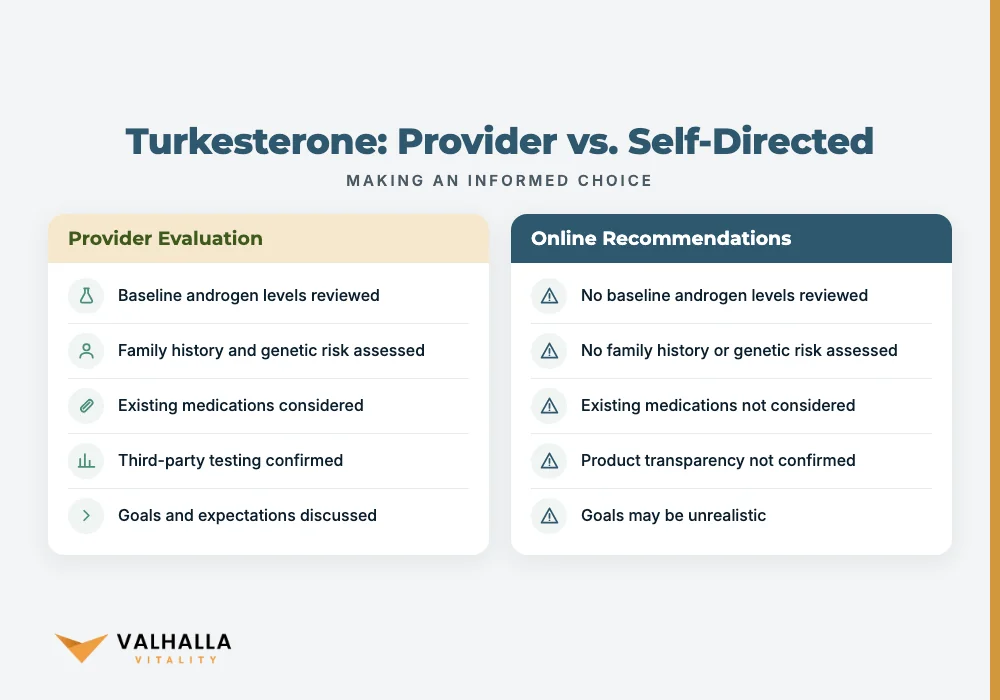
At Valhalla Vitality, a licensed provider reviews your complete intake before any supplement or therapy recommendation is made. For someone specifically concerned about androgenic risk, that evaluation covers several areas:
- Baseline androgen levels: DHT, total testosterone, and free testosterone, establishing your normal range before introducing any new compound
- Family history and genetic risk: androgenetic alopecia has a strong hereditary component, and baseline predisposition shapes how closely any changes should be monitored
- Existing medications and treatments: finasteride, minoxidil, and other DHT-related therapies create a context that must be understood before adding supplements to the mix
- Product transparency: independent third-party testing confirming actual ecdysteroid content and ruling out undisclosed ingredients with androgenic potential
- Goals and realistic expectations: whether the current evidence for turkesterone actually supports the specific outcomes you are pursuing
A licensed provider determines the appropriate approach, including dosing parameters, duration, and any monitoring requirements, after reviewing your individual health data. Self-directed decisions drawn from online community recommendations are not an equivalent process.
The complete evidence review of turkesterone supplements covers what has been studied and what remains uncertain, which is useful preparation for that provider conversation.
Ready to talk through your options?
Book Your Consultation with a licensed provider to review your androgen levels, supplement plans, and any hair concerns before you begin.
FAQ
Does turkesterone cause hair loss?
No current evidence links turkesterone to hair loss. The compound has no documented androgenic activity and has not been shown to raise DHT or testosterone in humans. Anecdotal reports exist, but no controlled research has established a causal link.
Does turkesterone increase DHT levels?
No human studies have found that turkesterone increases DHT. It interacts primarily through estrogen receptor beta rather than androgen receptors, bypassing the hormonal pathway that converts testosterone to DHT and drives hair follicle miniaturization.
Is turkesterone the same as an anabolic steroid?
No. Turkesterone is a phytoecdysteroid, not an anabolic-androgenic steroid. It is plant-derived, does not bind androgen receptors as synthetic androgens do, and is not regulated under anabolic steroid legislation. Its adverse effect profile differs substantially from that of AAS.
Can ecdysterone supplements cause male pattern baldness?
Ecdysterone and related ecdysteroids have not been documented to cause male pattern baldness. They interact with estrogen receptor beta rather than androgen receptors and do not generate the DHT signal that triggers androgenetic alopecia in genetically susceptible individuals.
Should I get labs before starting turkesterone?
A licensed provider may recommend a baseline androgen panel, including DHT, before supplementation begins, particularly if you already have androgenetic alopecia or are using DHT-related therapies. This provides a reference point for detecting any changes over time.
Sources
- Isenmann E, Ambrosio G, Joseph JF, et al. Ecdysteroids as non-conventional anabolic agent: performance enhancement by ecdysterone supplementation in humans. Archives of Toxicology. 2019;93(7):1807–1816.
- Gorelick-Feldman J, MacLean D, Ilic N, et al. Phytoecdysteroids increase protein synthesis in skeletal muscle cells. J Agric Food Chem. 2008;56(10):3532–3537.
- Dinan L, Lafont R. Effects and applications of arthropod steroid hormones (ecdysteroids) in mammals. J Endocrinol. 2006;191(1):1–8.
- Parr MK, Botrè F, Naß A, et al. Ecdysteroids: A novel class of anabolic agents? Biol Sport. 2015;32(2):169–173.
You May Also Like
 Turkesterone
 Muscle Growth: What the Research Shows
Turkesterone muscle growth research reviewed: how this ecdysteroid may support protein synthesis, timelines, safety, and what to ask before starting.
October 30, 2026 ETRead more → Turkesterone
 Bodybuilding: What Athletes Need to Know
Turkesterone bodybuilding explained: how ecdysteroids work, what studies show, results timeline, and why provider review matters before you start.
October 30, 2026 ETRead more → Turkesterone
How Turkesterone Works: Mechanism, Benefits, Safety
How turkesterone works: it triggers PI3K-driven protein synthesis without activating androgen receptors. Mechanism, benefits, and safety covered.
October 30, 2026 ETRead more →