
The following blog post is for entertainment and informational purposes only. It is not intended to provide medical advice or diagnosis. Please consult your doctor before making any health-related decisions.
Turkesterone benefits span muscle protein synthesis support, faster exercise recovery, and adaptogenic stress resistance. This phytoecdysteroid, sourced primarily from the plant Ajuga turkestanica, does not bind to androgen receptors, which gives it a fundamentally different risk profile than synthetic anabolic steroids. A 2024 review in Nutrients confirmed that ecdysteroids including turkesterone carry significant potential in sport and healthy nutrition (Todorova et al.). For a closer look at what separates formulations, our guide to quality phytoecdysteroid supplement products breaks down the key factors.
What is turkesterone?
Turkesterone belongs to the ecdysteroid family, a class of naturally occurring steroidal compounds found in certain plants and insects. It is extracted primarily from Ajuga turkestanica, a plant native to Central Asia. Scientific interest began in Soviet-era Russia, where researchers suspected ecdysteroid compounds contributed to the performance gains of Soviet athletes during Cold War-era competitions. Laboratory work confirmed measurable anabolic activity in animal models, and that initial evidence drove wider research interest through subsequent decades.
The compound appears in older literature as 20-hydroxyecdysone (20HE), though the precise structural distinction depends on hydroxyl group positioning. What all ecdysteroids share is a steroidal backbone resembling insect molting hormones. That resemblance explains why ecdysteroids were first examined as potential pesticides. When research showed they produced no apparent toxicity in mammals, the scientific focus shifted toward potential health applications in humans.
History provides useful framing here. Bodybuilding interest in turkesterone preceded much of the formal clinical research, which means commercial enthusiasm has historically outpaced peer-reviewed evidence. Knowing that gap exists is part of evaluating turkesterone benefits honestly rather than accepting marketing claims at face value.
Turkesterone benefits at a glance
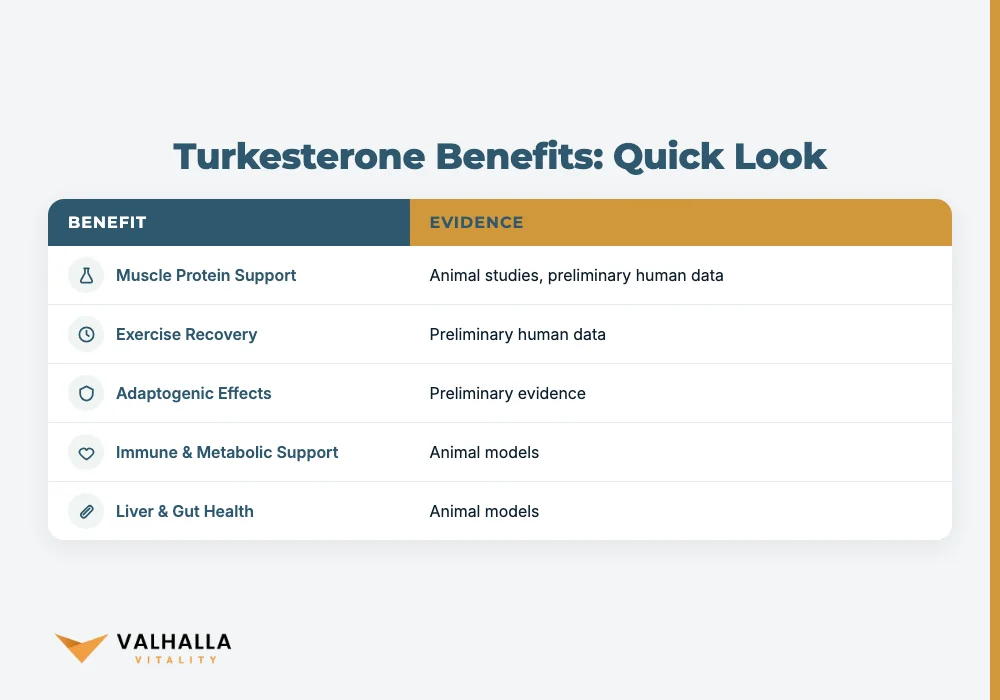
The research identifies five areas where turkesterone benefits are documented or strongly indicated. This summary captures the current evidence stage before the detailed sections:
| Reported benefit | Proposed mechanism | Evidence stage |
|---|---|---|
| Muscle protein synthesis support | MPS optimization, without androgen binding | Animal studies; preliminary human data |
| Exercise recovery | Reduced muscle damage markers | Preliminary human data |
| Adaptogenic effects | Cortisol modulation, neurotransmitter interaction | Preliminary |
| Immune and metabolic support | Ecdysteroid receptor activity | Animal models |
| Liver and gut health | Metabolic efficiency | Animal models |
All five areas draw from the Todorova et al. 2024 Nutrients review. None is backed by a large-scale randomized controlled trial yet. The directional evidence is consistent and promising; definitive effect sizes for trained adults remain to be confirmed.
Does turkesterone actually work?
Yes. The existing evidence shows turkesterone benefits are measurable, though the research is still early. Animal studies consistently demonstrate improved muscle protein synthesis and reduced fatigue markers. Human studies are fewer but directionally positive, which is why the Todorova et al. 2024 Nutrients review described these compounds as having "prominent potential" rather than a confirmed magnitude.
The core mechanism is muscle protein synthesis (MPS) optimization. Turkesterone does not activate androgen receptors. That matters clinically because androgen receptor binding is the pathway through which synthetic steroids cause prostate growth, acne, hair changes, and hormonal suppression. Turkesterone bypasses that pathway entirely, which shapes both its benefit profile and its reported safety record.
Within the ecdysteroid class, turkesterone is considered one of the more active compounds, alongside ecdysterone. The Todorova et al. review noted that structural differences between them translate to slightly different receptor interaction profiles. Understanding the ecdysteroid mechanism in muscle tissue helps clarify why those structural differences matter for supplement selection.
Does turkesterone work at the same magnitude as anabolic steroids? No, and no serious research claims otherwise. The honest framing is that it works through a distinct, lower-risk pathway with real but more modest effects. The precise effect size in trained humans awaits larger trials.
Turkesterone muscle growth: what the evidence shows
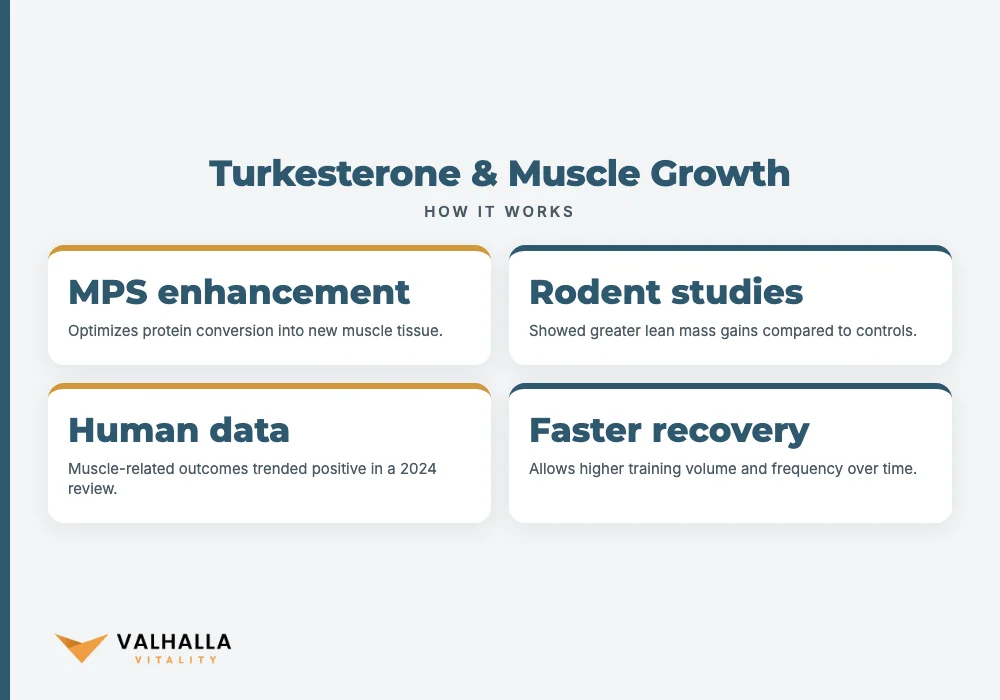
Turkesterone muscle growth effects represent the primary research focus since the compound reached mainstream awareness. The mechanism differs from anabolic steroid pathways. Rather than activating hormone receptors, turkesterone optimizes how efficiently the body converts dietary protein into new muscle tissue through MPS enhancement, without hormonal signaling.
Rodent studies fed ecdysteroid supplements alongside standard diet consistently showed greater lean mass gains compared to controls. Preliminary human data in the Todorova et al. 2024 Nutrients review pointed in the same direction, with muscle-related outcomes trending positive across studied populations.
Protein intake remains the raw substrate for that process. A 2023 analysis in Nutrition and Health found that higher protein intake correlates with a more favorable hormonal environment for muscle development, including testosterone-adjacent markers (Whittaker). Turkesterone's MPS-optimization effect builds on adequate protein rather than substituting for it. The compound's benefit compounds with good nutrition, not despite poor nutrition.
Turkesterone benefits for recovery and training volume
Recovery speed is a secondary but practically significant feature of the turkesterone benefits profile. Reduced muscle damage markers between sessions allow higher training volume over a mesocycle. For athletes focused on bodybuilding training load and volume management, faster intersession recovery is one of the more actionable applications of this compound.
The two effects connect. Faster recovery enables higher training frequency, which is itself a driver of muscle growth. Turkesterone may support gains not just by optimizing MPS directly but by enabling the training volume that makes MPS consistently relevant. That dual pathway is one of the more practically interesting aspects of the reported evidence.
Does turkesterone increase testosterone levels?
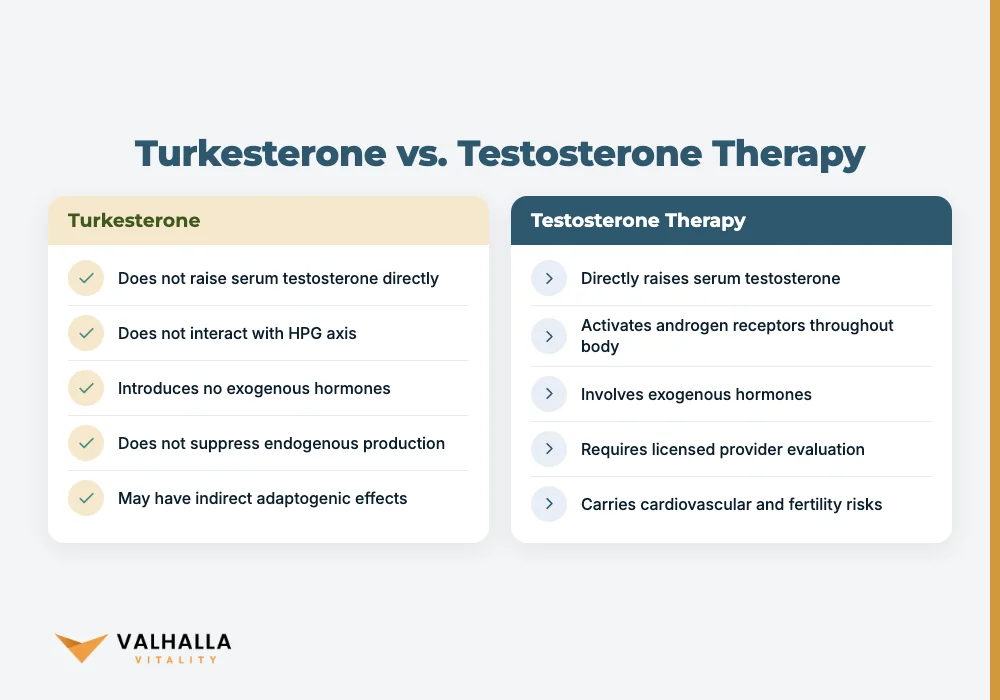
No. Turkesterone does not directly raise serum testosterone. This question surfaces regularly because the muscle-building effects of the compound can resemble what people associate with elevated testosterone, but the mechanisms differ at a structural level.
Testosterone therapy, as defined by Endocrine Society guidelines (Bhasin et al., 2018) and the American Urological Association (Mulhall et al., 2018), involves introducing exogenous hormones that directly raise serum testosterone and activate androgen receptors throughout the body. A licensed provider must evaluate labs and clinical history before prescribing it, because testosterone replacement carries meaningful cardiovascular and fertility risks.
Turkesterone does not interact with the hypothalamic-pituitary-gonadal axis. It introduces no exogenous hormones. It does not suppress endogenous production. Cheng et al. (2024) outline the specific hormonal pathways through which testosterone naturally declines with age; there is no published evidence that turkesterone modifies those pathways in any direct way.
Indirect effects are biologically plausible but unconfirmed. Chronic stress raises cortisol, which competes with testosterone production. An adaptogen that reduces physiological stress burden could allow natural testosterone to function at a healthier baseline. That mechanism is reasonable. No published human study has yet measured serum testosterone directly in turkesterone users to confirm it. Situating turkesterone benefits accurately, not conflating them with direct hormonal effects, is what the current evidence actually supports.
Turkesterone vs testosterone therapy
Comparing the two frames the wrong question. Turkesterone is a phytoecdysteroid supplement with MPS-supporting and adaptogenic properties. Testosterone therapy is a hormone replacement protocol that requires provider oversight, lab evaluation, and ongoing monitoring for a clinically assessed condition. These are different interventions for different situations.
A healthy person optimizing training does not face the same clinical picture as someone with confirmed hypogonadism. Using a supplement in place of prescribed therapy, or vice versa, mismatches the tool to the need. For context on how hormone pathways interact with muscle development from a clinical perspective, our article on enclomiphene's role in hormonal muscle support explains what a provider evaluates.
What are the side effects of turkesterone?
Research has not identified serious turkesterone side effects at studied levels. That finding is consistent across animal model literature and the preliminary human trials summarized in the Todorova et al. 2024 Nutrients review.
The structural explanation matters. Androgenic side effects, including acne, hair changes, hormonal suppression, and mood instability tied to steroid receptor activity, are not expected from a compound that bypasses the androgen receptor entirely. This is a biochemical fact, not a marketing claim. Whether phytoecdysteroid supplements carry any androgenic risks at all is a fair question; our focused article on hair health and phytoecdysteroid supplementation examines that concern directly.
The one practical side effect reported consistently is nausea when the supplement is taken without food. Plant extract capsules can irritate an empty gastrointestinal tract. Taking turkesterone with a main meal, lunch or dinner, resolves this for most users.
A straightforward caveat belongs here. Long-term safety data beyond a few months of supplementation does not exist at the scale needed for definitive multi-year claims. The absence of identified harms is not equivalent to confirmed long-term safety. That distinction matters for anyone making a careful, informed decision.
On the question of turkesterone dosage: optimal amounts vary with individual factors including body weight, metabolic rate, and health status. A licensed provider determines the appropriate regimen after reviewing your intake and labs, rather than applying a standard figure across all individuals.
How long does turkesterone take to work?
Most users report the first noticeable effects within four weeks of consistent daily use. The biochemical changes begin sooner; measurable differences in recovery speed and training output typically accumulate to a perceptible level within three to four weeks.
This timeline is faster than micronutrient deficiency corrections. Restoring depleted iron or B-complex stores often takes two to three months before clinical function improves, because the bottleneck is reserve restoration. Turkesterone is different. It modulates existing physiology with the necessary substrates already present rather than filling a depleted reservoir.
Four weeks marks the beginning, not a plateau. Users who evaluate the full trajectory of turkesterone benefits at eight or twelve weeks tend to report more stable and pronounced differences than at the initial four-week check. Short evaluation windows underestimate the compound's course.
Is turkesterone safe to use daily?
Based on available evidence, daily turkesterone use appears safe for healthy adults. The Todorova et al. 2024 review did not identify toxicity signals in studied populations. Efficient metabolic clearance of ecdysteroids supports the overall favorable safety signal.
That same metabolic efficiency has a practical implication for how you use the compound. Because it clears relatively quickly, consistent daily use maintains the MPS-support effect more reliably than intermittent use would. This differs from compounds where tolerance or receptor desensitization argues for cycling on and off. Consistent daily use is how most people observe turkesterone benefits building to their fullest expression over a sustained multi-week cycle.
When evaluating any supplement's safety, convergence of evidence across independent research groups adds confidence. Multiple teams studying ecdysteroids have reached similar conclusions about the safety profile, and animal toxicity studies, which typically use higher doses over longer periods than human trials, also found no significant adverse signals. That pattern is more reassuring than a single study in isolation.
Whether daily use is appropriate for a specific individual depends on a licensed provider's assessment. Concurrent medications, other supplements, and individual metabolic variation all affect how a phytoecdysteroid supplement performs and whether it is suitable in a given context.
Who may benefit from turkesterone supplementation?
The available evidence points to a few contexts where turkesterone benefits are most likely to register. This is a practical framework based on how the compound works, not a clinical eligibility list.
People with a solid training base and consistent dietary protein intake are the best-positioned to notice a difference. Turkesterone optimizes MPS, which means it amplifies the output of training that already exists. Someone who has not yet established progressive overload, adequate sleep, or protein-sufficient nutrition is unlikely to see much added benefit from a compound that fine-tunes an already-functional system. The value stacks on a strong foundation.
High training loads and recovery demands increase the relevance of the adaptogenic and recovery-support properties. When physiological demand is genuinely high, reduced muscle damage markers and cortisol modulation provide measurable value. Moderate training with ample rest may not generate a strong enough signal for the recovery benefit to register clearly.
Individuals who want anabolic support without the side-effect profile of androgen-based compounds may find turkesterone a reasonable area to explore. The non-androgenic pathway avoids the regulatory and clinical complexity of hormone therapy, though it also produces more modest effects than exogenous androgens. That tradeoff is part of the informed decision.
A practical consideration across all these contexts: individual response varies. Genetics, baseline health, sleep quality, and training age all modulate how any supplement performs. Two people with identical programs and the same protocol may experience meaningfully different outcomes. That variability is normal for any intervention that works through physiological optimization.
Boostavar: a turkesterone formulation designed for absorption
A practical limitation of standard turkesterone capsules is bioavailability. Ecdysteroids do not absorb efficiently in conventional extract form, which reduces the actual benefit relative to the labeled dose. Boostavar addresses this with SENDS (Solubility Enhancement Nano-Delivery System) technology, designed to increase bioavailability by 100x compared to standard capsules.
Boostavar combines three compounds: turkesterone, ecdysterone, and epicatechin. Each targets muscle protein synthesis through a distinct mechanism. The SENDS delivery system ensures that a meaningfully higher proportion of each compound reaches systemic circulation.
Ecdysterone, like turkesterone, is a phytoecdysteroid with MPS-supporting properties documented in the Todorova et al. 2024 Nutrients research. Epicatechin is a flavanol found naturally in dark chocolate and green tea. It inhibits myostatin, the protein that limits muscle fiber growth. Combining these three compounds in a high-bioavailability delivery system addresses the MPS pathway from multiple directions simultaneously.
Valhalla Vitality carries Boostavar as part of its supplement line, alongside provider-reviewed programs covering hormone health, metabolic wellness, and long-term health optimization.
Explore turkesterone benefits with a licensed provider
If you are considering adding a phytoecdysteroid supplement to your routine, discussing it with a licensed provider helps clarify whether it fits your individual health picture and how it interacts with anything else you may be taking. Book Your Consultation to connect with a provider who can review your specific context.
FAQ
Does turkesterone actually work?
Current evidence from animal studies and preliminary human trials shows measurable effects on muscle protein synthesis and exercise recovery. The direction of effect is consistent across the research, though large-scale human trials have not yet confirmed precise effect sizes for trained individuals.
Does turkesterone increase testosterone levels?
No, turkesterone does not directly raise serum testosterone. It works through muscle protein synthesis optimization rather than androgen receptor activation, which is the mechanism behind testosterone therapy.
What are the side effects of turkesterone?
Research has not identified serious side effects from turkesterone at studied levels. The most commonly reported minor effect is nausea when taken without food, which taking the supplement with a main meal typically resolves.
How long does turkesterone take to work?
Most users report noticeable effects within four weeks of consistent daily use. Measurable differences in recovery and training output generally take three to four weeks to accumulate to a perceptible level.
Is turkesterone safe to use daily?
Based on current evidence, daily use appears safe for healthy adults. Long-term safety data beyond several months of supplementation is limited, so a licensed provider review before starting any supplement protocol is advisable.
Sources
- Todorova V et al. (2024). Ecdysterone and Turkesterone-Compounds with Prominent Potential in Sport and Healthy Nutrition. Nutrients. PubMed
- Whittaker J (2023). High-protein diets and testosterone. Nutrition and health. PubMed
- Bhasin S et al. (2018). Testosterone Therapy in Men With Hypogonadism: An Endocrine Society Clinical Practice Guideline. The Journal of clinical endocrinology and metabolism. PubMed
- Mulhall JP et al. (2018). Evaluation and Management of Testosterone Deficiency: AUA Guideline. The Journal of urology. PubMed
- Cheng H et al. (2024). Age-related testosterone decline: mechanisms and intervention strategies. Reproductive biology and endocrinology : RB&E. PubMed
You May Also Like
 Turkesterone
 Muscle Growth: What the Research Shows
Turkesterone muscle growth research reviewed: how this ecdysteroid may support protein synthesis, timelines, safety, and what to ask before starting.
October 30, 2026 ETRead more → Turkesterone
 Bodybuilding: What Athletes Need to Know
Turkesterone bodybuilding explained: how ecdysteroids work, what studies show, results timeline, and why provider review matters before you start.
October 30, 2026 ETRead more → Turkesterone
How Turkesterone Works: Mechanism, Benefits, Safety
How turkesterone works: it triggers PI3K-driven protein synthesis without activating androgen receptors. Mechanism, benefits, and safety covered.
October 30, 2026 ETRead more →