Cycloastragenol cancer research: what the evidence shows

The following blog post is for entertainment and informational purposes only. It is not intended to provide medical advice or diagnosis. Please consult your doctor before making any health-related decisions.
Cycloastragenol cancer research has grown substantially over the past decade, with preclinical studies examining how this triterpene saponin from Astragalus membranaceus may influence telomere dynamics, immune cell longevity, and tumor biology. The compound is best known in longevity medicine as a form of telomere support that activates the enzyme telomerase in healthy somatic and immune cells. The research base is preclinical. Cancer alters the telomere landscape in complex ways, and current studies are working to separate which of CAG's effects may be relevant and under what conditions.
What is cycloastragenol?
Cycloastragenol (CAG) is a triterpene saponin isolated from the root of Astragalus membranaceus, a plant used in traditional Chinese medicine for over 2,000 years. Among the many bioactive compounds found in astragalus root, CAG attracted scientific attention specifically for its capacity to upregulate TERT, the catalytic subunit of telomerase. That connection to telomerase biology eventually drew it into both anti-aging research and, more recently, cancer-adjacent investigation.
The structure of CAG allows it to cross cell membranes more readily than many larger astragalus compounds. Researchers at Geron Corporation identified it as the specific fraction responsible for the telomerase-activating activity previously attributed to astragalus root generally. This identification separated CAG from the polysaccharide fractions of the root and positioned it as a distinct molecular target. Interest in cycloastragenol as an anti-aging supplement initially centered on healthy aging, but that telomerase-focused foundation now directly informs ongoing cycloastragenol cancer research on how selective telomerase activation might influence tumor biology and immune resilience.
Several characteristics distinguish cycloastragenol from the broader astragalus root extract:
- Cycloastragenol is one isolated saponin, while the whole root contains polysaccharides, flavonoids, and over 100 additional saponins with distinct biological activities.
- CAG specifically targets TERT expression, the catalytic component of telomerase, an effect not replicated uniformly by other astragalus fractions.
- Astragalus polysaccharides and other fractions contribute to immune modulation through pathways independent of telomerase, adding depth to the plant's overall anti-cancer research profile.
Telomeres are protective nucleoprotein caps at chromosome ends. Each cell division shortens them incrementally. When telomere length falls below a critical threshold, the cell activates checkpoint signaling and either enters senescence or undergoes apoptosis. This shortening is a core mechanism of biological aging and the foundation of cycloastragenol anti-aging supplement research, which examines whether restoring telomere length in healthy cells translates to measurable longevity benefit.
Valhalla Vitality provides provider-reviewed protocols that include cycloastragenol telomere support, where a licensed provider determines whether the supplement is appropriate based on lab results and intake.
Telomeres, telomerase, and the cancer paradox
Cancer and aging share a root biology. Telomerase activation cancer biology sits at the intersection of both fields, which is precisely why a compound studied for healthy aging requires careful interpretation in oncology contexts. That shared biology creates a genuine paradox when interpreting cycloastragenol cancer research.
In aging tissue, telomere shortening leads to cellular senescence and declining organ function over time. Cancer cells face the same early-stage problem but solve it through a different mechanism. Most cancers reactivate telomerase to override the division limit that shortening would normally impose.
A 2022 analysis in Trends in Cancer identified TERT promoter mutations and epigenetic reprogramming as the main mechanisms by which cancer cells restore telomerase activity (Sharma et al., 2022). A 2020 paper in Current Opinion in Genetics & Development reported that approximately 85 to 90 percent of human cancers depend on telomerase reactivation for unlimited proliferation, with the remaining fraction relying on an alternative lengthening of telomeres (ALT) pathway (Claude et al., 2020).
So in healthy tissue, activating telomerase extends cell life and supports tissue repair. In cancer tissue, telomerase is already constitutively overactive. The enzyme that anti-aging research wants to upregulate is the same one cancer cells have locked permanently on. That is the paradox cycloastragenol cancer research must navigate.
What is the relationship between telomerase and cancer progression?
Telomerase removes the natural ceiling on cell division. Without it, a tumor cannot sustain indefinite growth. Reactivation through mutation gives cancer cells a permanent pass on that biological limit.
The 2022 Trends in Cancer review described telomerase reactivation as a fundamental step in malignant transformation, distinct from the controlled telomerase activity found in stem cells and immune progenitors (Sharma et al., 2022). Normal telomerase activates transiently in response to physiological demand and switches off. Cancer-cell telomerase is mutation-locked and perpetually active, sustaining the endless proliferation that defines malignancy.
That regulatory difference, controlled and transient versus constitutively active, shapes how cycloastragenol cancer research should be read. Studies of telomerase activation in cancer establish that the mutation-driven mechanism is qualitatively different from the physiological activation seen in normal immune and stem cells. CAG's documented preclinical effect is selective stimulation in normal somatic and immune cells. Whether that selectivity holds under cancer conditions is an active research question.
Cycloastragenol cancer research: what preclinical studies show
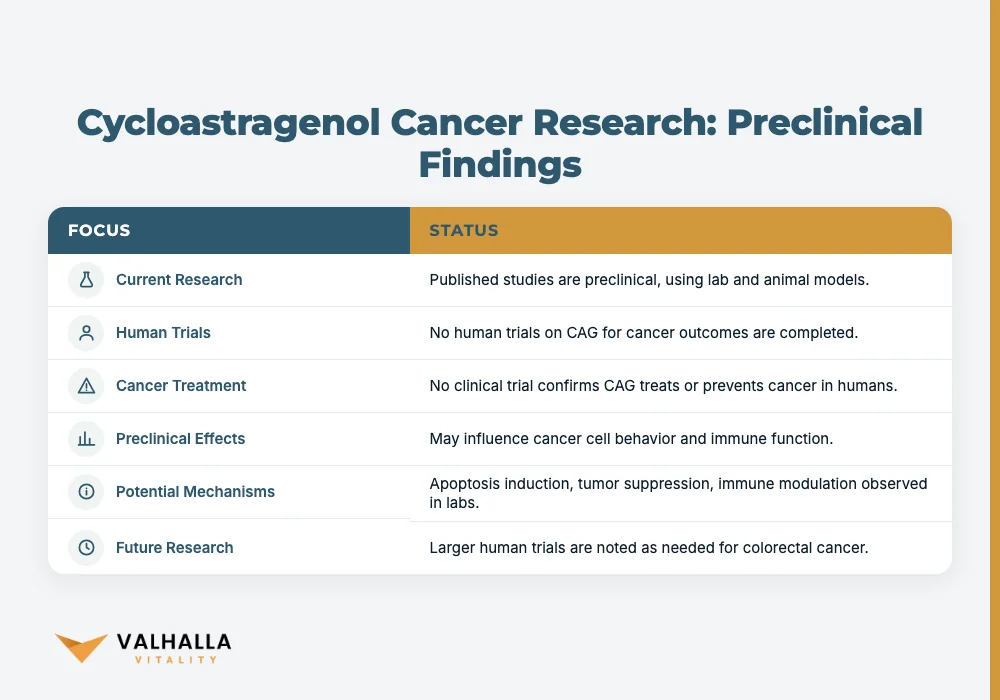
The published cycloastragenol cancer research is preclinical. Laboratory and animal model data exists. Randomized controlled trials specifically testing CAG's effect on cancer outcomes in humans have not been completed. That distinction should frame all interpretation of the evidence.
What the preclinical literature has established is that Astragalus membranaceus compounds, including its saponin fractions, may exert anti-cancer activity through multiple pathways. The astragalus cancer research field has expanded notably in the past five years. For a broad review of the non-cancer longevity literature on this compound, the clinical evidence and published forms of cycloastragenol article covers what the full research base demonstrates.
Does cycloastragenol help with cancer?
No clinical trial has confirmed that cycloastragenol treats or prevents cancer in humans. What preclinical research indicates is that astragalus saponins may influence cancer cell behavior and immune function through several distinct mechanisms.
A 2024 review in Molecules analyzed the anti-cancer effects of Astragalus membranaceus saponins specifically and documented evidence for apoptosis induction in cancer cell lines, suppression of tumor cell proliferation, and modulation of immune checkpoints that tumors exploit to evade immune detection (Sheng et al., 2024). These effects were observed in laboratory models and represent biological plausibility, not confirmed clinical efficacy.
A 2025 review in The American Journal of Chinese Medicine examined Astragalus membranaceus in the context of colorectal cancer, characterizing it as a compound with potential as an adjunct to standard treatment and noting that larger human trials are needed to establish clinical application (Lu et al., 2025). A 2023 paper in Journal of Ethnopharmacology reviewed astragalus preparations used alongside chemotherapy for peritoneal metastatic cancer and found observations of reduced treatment-associated toxicity in clinical practice settings (Li et al., 2023).
Cycloastragenol is one saponin fraction within this complex plant. Attributing observed effects entirely to CAG overstates the evidence. Dismissing the findings because they relate to the broader extract understates the relevance. The preclinical signal is real; its clinical translation remains to be established.
Proposed anti-cancer mechanisms of astragalus saponins
The following mechanisms appear in the preclinical literature. None has been confirmed in large human trials.
| Mechanism | Source | Context |
|---|---|---|
| Apoptosis induction | Sheng et al. (2024), Molecules | Cancer cell lines; in vitro |
| Tumor cell proliferation suppression | Sheng et al. (2024), Molecules | Dose-dependent; preclinical models |
| Immune checkpoint modulation | Preclinical astragalus research | May enhance immune recognition of tumors |
| Telomerase activation in immune cells | Preclinical CAG studies | May extend NK cell and T-cell replicative lifespan |
| Anti-fibrotic activity | Astragalus extract research | Relevant to lung and peritoneal cancer contexts |
| Colorectal cancer anti-tumor activity | Lu et al. (2025), AJCM | Preclinical and early clinical observations |
How does cycloastragenol affect telomeres in cancer patients?
Cancer shortens telomeres in non-malignant cells, particularly peripheral blood immune cells. Chemotherapy and radiation accelerate that erosion, depleting the replicative capacity of T cells and natural killer cells at the same time they target tumor tissue. Patients completing intensive treatment often show measurably shorter leukocyte telomeres than age-matched controls without cancer history. Short immune-cell telomeres translate to reduced immune resilience and a slower return to full function after treatment ends.
Cycloastragenol's documented preclinical action is to activate telomerase in normal, non-malignant cells, restoring telomere length and extending their replicative potential. If that effect holds in human immune cells under the physiological stress of cancer and its treatment, it may theoretically support the maintenance of immune cell populations during and after chemotherapy. That is the primary hypothesis driving research interest in this area.
The concern that CAG might stimulate telomerase in cancer cells is real but context-dependent. Cancer cells that have already maximally reactivated telomerase through mutation may not respond additively to external stimulants the way normal cells do. Whether a net harmful effect on tumor growth is possible remains an open question. Providers must evaluate this risk individually, based on cancer type, current treatment, and telomerase biology specific to that tumor. This risk-benefit question sits at the core of cycloastragenol cancer research, where no definitive clinical data yet resolves whether the net effect favors immune support over potential concern for tumor biology.
Cycloastragenol immune function in cancer
A cancer diagnosis stresses the immune system from multiple directions at once. Tumors actively suppress immune surveillance through checkpoint pathways. Treatment depletes immune reserves by targeting rapidly proliferating cells, including immune progenitors. Between treatment cycles, many patients are functionally immunocompromised.
Cycloastragenol cancer research on T-cell and NK cell resilience
Cycloastragenol immune function research focuses on T lymphocytes and natural killer (NK) cells, the body's primary anti-tumor immune responders. Telomere length in T cells correlates directly with their replicative capacity. Short telomeres limit how many divisions a T cell can complete before becoming exhausted and unable to sustain further responses.
By activating telomerase in these immune populations, CAG may extend their functional lifespan under conditions of stress or depletion. This mechanism is not specific to cancer contexts. It is the same effect that underlies cycloastragenol telomere support interest in aging generally. In cancer, that relevance is heightened because immune cell depletion is an active clinical problem, not just a background process.
The broader astragalus cancer research literature supports this immune angle. Li et al. (2023) reviewed astragalus preparations used alongside chemotherapy for peritoneal metastatic cancer, with some clinical observations suggesting reduced treatment-associated toxicity. Sheng et al. (2024) identified immune checkpoint modulation among the anti-cancer mechanisms documented for astragalus saponins. Together, these findings point toward immune enhancement as a consistent feature of Astragalus membranaceus activity in oncology-adjacent contexts.
These findings are preliminary. Translating preclinical immune enhancement data into clinical recommendations requires adequately powered human trials, and those trials have not been completed for cycloastragenol specifically.
Astragalus root extract benefits: the broader research context
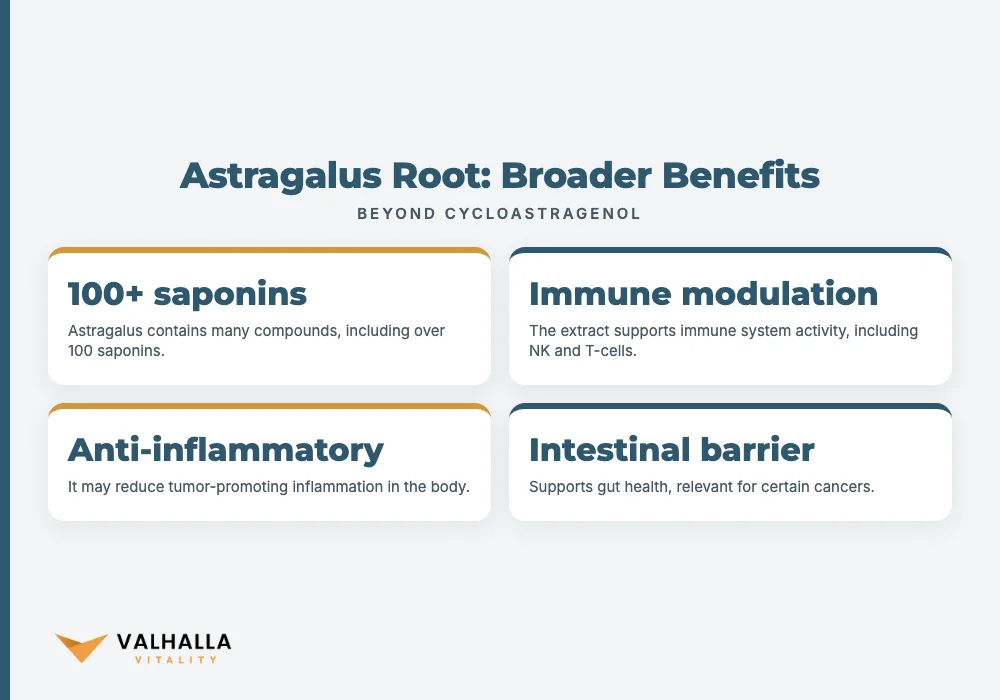
Astragalus membranaceus is pharmacologically complex. It contains polysaccharides, flavonoids, and more than 100 identified saponins. Cycloastragenol is the most studied among them for telomerase-activating properties. Other fractions contribute to immune modulation, anti-inflammatory effects, and direct anti-cancer activity through pathways that do not involve telomerase.
The astragalus root extract benefits most consistently documented in cancer-relevant research include:
- Anti-inflammatory signaling that may reduce tumor-promoting inflammation within the tumor microenvironment.
- Support for intestinal barrier integrity, which is particularly relevant to colorectal and peritoneal cancers (Lu et al., 2025).
- Observations of reduced treatment-associated toxicity when astragalus preparations accompanied chemotherapy in clinical practice settings (Li et al., 2023).
- Enhancement of host immune surveillance through NK cell and T-cell activity, cited across multiple preclinical studies of the broader extract.
These effects are documented for the whole extract or polysaccharide fractions as often as for saponin fractions including cycloastragenol. That shared evidence base adds context to CAG's specific properties rather than competing with them. The compound operates within a larger pharmacological system when the whole root extract is used.
Contextualizing astragalus root extract benefits within cycloastragenol cancer research helps clarify which observed effects belong specifically to the CAG fraction and which are properties of the full plant extract. For a detailed look at how quality differs between astragalus root supplements and what standardization data shows, the guide on standardization and extraction methods for astragalus root supplements covers what to consider when selecting a product.
Can cycloastragenol be taken during chemotherapy?
No human clinical trial has evaluated cycloastragenol alongside standard chemotherapy. That gap in cycloastragenol cancer research is the direct answer, reflecting a broader challenge in integrative oncology where preclinical signals precede clinical validation by years.
Some context matters here. Herbal compounds interact with chemotherapy through several known mechanisms. Some affect cytochrome P450 enzyme activity, which can alter how chemotherapy agents are metabolized, either increasing toxicity or reducing efficacy. Others modulate immune function or tumor cell signaling in ways that could complement or interfere with treatment. Astragalus preparations appear in preclinical models to enhance immune function and reduce toxicity, but the evidence does not yet support clinical recommendations.
The specific pharmacological concern with cycloastragenol during chemotherapy is dual-sided. On one side, CAG may protect immune cells from treatment-induced depletion by supporting their telomere maintenance, which could be beneficial. On the other, if cancer cells respond to CAG's telomerase-stimulating activity, it could theoretically reduce the efficacy of treatment-induced apoptosis. Current research cannot quantify either effect in a human clinical setting.
Before considering any supplement alongside active cancer treatment, a provider review should address:
- The specific chemotherapy agents and whether any are metabolized through CYP450 pathways where herb-drug interactions are documented.
- Current organ function, since liver and kidney capacity affects how supplements are metabolized and cleared.
- Immune cell counts, particularly whether neutropenia or lymphopenia is already present.
- The oncologist's view of the tumor's telomerase profile and whether CAG's theoretical effect on cancer cells represents a meaningful concern for that specific tumor type.
A licensed provider determines whether any supplement is appropriate during active treatment. That evaluation requires the full clinical picture.
Is cycloastragenol safe for cancer patients?
Safety data specifically for cancer patients taking cycloastragenol does not exist in published literature. The cycloastragenol anti-aging supplement evidence base was established in healthy aging populations over short study durations. Cancer patients present a substantially different physiological context.
Treatment may alter liver and kidney function, affecting how cycloastragenol is metabolized and cleared. Concurrent medications create interaction potential that has not been characterized for CAG. Compromised immune status changes the risk profile compared to a healthy person using the supplement for longevity purposes.
The telomerase concern in cancer cells runs throughout this article for good reason. A 2024 review in Medical Oncology that examined telomerase inhibition in breast cancer and breast cancer stem cells highlighted how specific and complex telomerase biology is across tumor subtypes (Yildirim et al., 2024). A compound that broadly activates telomerase does not operate with that tumor-specific selectivity.
Patients in remission with no active malignancy present a different profile than those in active treatment. For patients in remission, the assessment can draw on standard tolerability data from aging studies, where no serious adverse events were attributed to cycloastragenol in published reports. For patients in active treatment, interaction risks are substantially more complex and require direct provider oversight. Cycloastragenol cancer research in this area remains an open field, and any use during active treatment should proceed only under licensed provider guidance.
Cycloastragenol cancer research and survivorship contexts
Cycloastragenol cancer research places meaningfully different weight on the survivorship phase than on active treatment. Patients who have completed primary therapy and show no evidence of active disease represent a materially different risk profile, one where provider-guided evaluation can integrate available tolerability data while accounting for individual treatment history, current laboratory values, and immune recovery trajectory. This distinction matters clinically because survivorship-phase patients face fewer active drug interactions and carry a more tractable risk-benefit calculus than those receiving concurrent cytotoxic agents.
The known safety data on cycloastragenol article covers the existing tolerability literature from non-oncology populations and identifies where evidence gaps exist. It is a starting point for a provider conversation, not a replacement for one.
What a provider evaluates before recommending CAG in oncology contexts
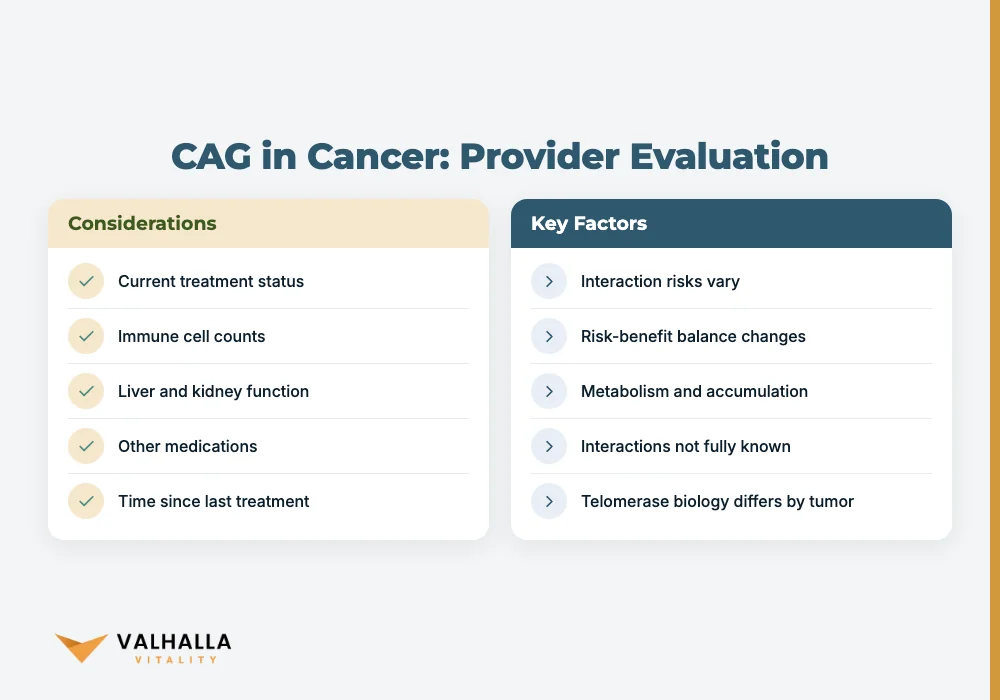
General supplement guidance does not account for the specific evaluation a licensed provider performs when a patient has a cancer history. This practical information is absent from most online discussions of cycloastragenol cancer use.
When a provider considers CAG in an oncology-adjacent context, the evaluation typically addresses:
- Treatment status: Active treatment, maintenance therapy, remission, and survivorship each carry different interaction risks and immune recovery trajectories.
- Immune cell counts: Severe lymphopenia or neutropenia changes the risk-benefit balance and the timing of any supplementation.
- Organ function labs: Liver and kidney function determine how cycloastragenol is metabolized, how long it remains active, and whether accumulation is a concern.
- Concurrent medications: Interactions between CAG and cytotoxic agents, immunosuppressants, or targeted therapies have not been fully characterized and require case-by-case evaluation.
- Cancer type and telomerase profile: Telomerase biology differs substantially across tumor types. Breast cancer stem cells show distinct telomerase regulation that makes broad assumptions about CAG's effects unreliable across tumor categories (Yildirim et al., 2024).
- Time elapsed since last treatment: Immune recovery trajectories vary by regimen and by individual patient, affecting when supplementation may be considered appropriate.
A licensed provider determines the appropriate dose and timing based on lab results and the complete clinical picture. This is the standard of care for translating cycloastragenol cancer research into responsible recommendations, a gap between preclinical data and human clinical evidence that individualized provider assessment must bridge.
Speak with a licensed provider
If you are exploring cycloastragenol as part of a cancer-adjacent health plan, a licensed provider can review your intake and clarify whether this approach fits your current health status and goals. Book Your Consultation to get started.
FAQ
Does cycloastragenol address cancer?
No, cycloastragenol is not an established cancer treatment. Preclinical research on Astragalus membranaceus saponins documents anti-tumor activity in laboratory models, but no human clinical trial has confirmed that cycloastragenol treats or prevents cancer. It is studied as a potential adjunct to conventional care, not a replacement for it.
How does cycloastragenol affect telomeres in cancer patients?
In non-malignant cells, cycloastragenol may activate telomerase to slow telomere shortening and extend immune cell replicative lifespan, potentially supporting immune function during cancer treatment. Cancer cells typically sustain their own constitutively active telomerase through mutation, and whether CAG meaningfully alters their telomere dynamics requires further clinical investigation.
Can cycloastragenol be taken during chemotherapy?
No established clinical protocol exists for combining cycloastragenol with chemotherapy in humans. Interaction risks with drug metabolism, and the balance between protecting immune cells and potentially protecting cancer cells from treatment, have not been resolved in human trials. Any use during active cancer treatment requires direct discussion with the treating oncologist.
What is the relationship between telomerase and cancer?
Cancer cells reactivate telomerase to bypass the natural division limit imposed by telomere shortening, a mechanism present in approximately 85 to 90 percent of human cancers (Claude et al., 2020). In contrast, telomerase in healthy immune and stem cells is tightly regulated and activates only in response to physiological signals, not genetic mutation.
Is cycloastragenol the same as the astragalus herb?
No, cycloastragenol is one triterpene saponin fraction isolated from Astragalus membranaceus root. The whole herb contains polysaccharides, flavonoids, and many additional saponins that contribute to its broader biological effects. Much of the astragalus cancer research covers the full extract or multiple fractions, not cycloastragenol in isolation.
Sources
- Lu Q et al. (2025). Advancements in the Research of Astragalus membranaceus for the Treatment of Colorectal Cancer. The American Journal of Chinese Medicine. PubMed
- Yildirim İ et al. (2024). Telomerase inhibition in breast cancer and breast cancer stem cells: a brief review. Medical Oncology. PubMed
- Sheng F et al. (2024). Research Progress on the Anti-Cancer Effects of Astragalus membranaceus Saponins and Their Mechanisms of Action. Molecules. PubMed
- Sharma S et al. (2022). Emerging mechanisms of telomerase reactivation in cancer. Trends in Cancer. PubMed
- Li Z et al. (2023). Research progress of Astragalus membranaceus in treating peritoneal metastatic cancer. Journal of Ethnopharmacology. PubMed
- Claude E et al. (2020). Telomere maintenance mechanisms in cancer: telomerase, ALT or lack thereof. Current Opinion in Genetics & Development. PubMed
You May Also Like
 Cycloastragenol
 Supplement: Benefits, Dosage, Safety
Cycloastragenol supplement may support telomere health and healthy aging. Explore benefits, dosage, side effects, and the astragaloside IV comparison.
October 31, 2026 ETRead more → Cycloastragenol
 Side Effects: Safety, Risk, and Use
Cycloastragenol side effects are minimal in current research, but data is limited. Learn about TA-65 safety, benefits, and dosage guidance.
October 31, 2026 ETRead more → Cycloastragenol
 Supplement: Benefits and How It Works
Cycloastragenol is an anti-aging telomere supplement that may activate telomerase and slow cellular aging. Discover how this astragalus extract works.
October 28, 2026 ETRead more →