
The following blog post is for entertainment and informational purposes only. It is not intended to provide medical advice or diagnosis. Please consult your doctor before making any health-related decisions.
Spermine supplements are polyamine compounds taken to support the body's cellular renewal and anti-aging processes. Spermine is a naturally occurring compound found in virtually every human cell, and its production declines after age 30. That timeline matters. Supplementing may help sustain the biological functions spermine supports throughout life. For those exploring spermine anti-aging protocols or anti-aging longevity support, understanding this molecule is a useful starting point.
What is spermine and what does it do?
Spermine is a naturally occurring polyamine found in virtually all eukaryotic cells. It was first isolated from male semen, which gave the compound its name, but it is present throughout the body at varying concentrations. Biosynthetically, spermine is produced from spermidine, which itself derives from putrescine. Together, these three polyamines form the body's core polyamine network.
At the cellular level, spermine stabilizes DNA, supports protein synthesis, and regulates gene expression. Cells depend on it for autophagy, the process by which damaged components are cleared and replaced. A 2024 review in the European Journal of Pharmacology described polyamines including spermine as promising candidates for neuroprotection and anti-aging therapy [S1]. Production falls measurably with age. Every system that relies on polyamine signaling is affected by that decline.
What are the benefits of taking spermine?
Spermine benefits documented in peer-reviewed research span several physiological domains:
- Cellular anti-aging. Spermine participates in DNA protection and gene methylation. A 2020 paper in Amino Acids found that a polyamine-rich diet extended lifespan in animal models, attributing this effect directly to spermine-mediated gene methylation [S6].
- Neuroprotection. A 2024 review positioned spermine as a candidate for slowing neurodegeneration, citing its role in RNA stability and reduction of oxidative stress in neural tissue [S1].
- Longevity pathways. A 2026 study in Amino Acids identified polyamine metabolism, including spermine catabolism, as a direct regulator of both cellular and organismal aging [S3].
- Cancer biology research. Two 2022 reviews in the International Journal of Molecular Sciences analyzed spermine's relationship to human malignancies, finding complex pathway-level interactions that merit continued investigation [S4, S5].
- Cardiovascular and metabolic support. Earlier animal and human trials tested spermine in contexts including heart function, obesity, and inflammation, with broadly encouraging results across cohorts.
These spermine benefits are supported by emerging science. Many findings come from animal models or in-vitro work. Large-scale human clinical trials remain limited. Research is accelerating fast.
How do spermine supplements work?
Spermine supplements deliver exogenous polyamines that the aging body produces in declining quantities. Most are plant-derived. Wheat germ extract is the most common active base, since wheat germ contains more spermine than any other widely available food source.
Once absorbed, supplemental spermine enters the same metabolic pathways as endogenous polyamine. It may support cellular autophagy, the renewal process that declines with age and sits at the center of spermine anti-aging research. This link to autophagy explains the sustained interest in spermine for longevity across geroscience. The mechanism is clear.
Spermine dosage is not universal. A licensed provider determines the appropriate amount after reviewing your health history and lab results. Spermine catabolism is regulated by the enzyme spermidine/spermine N(1)-acetyltransferase, whose activity varies considerably between individuals [S4].
What foods are high in spermine?
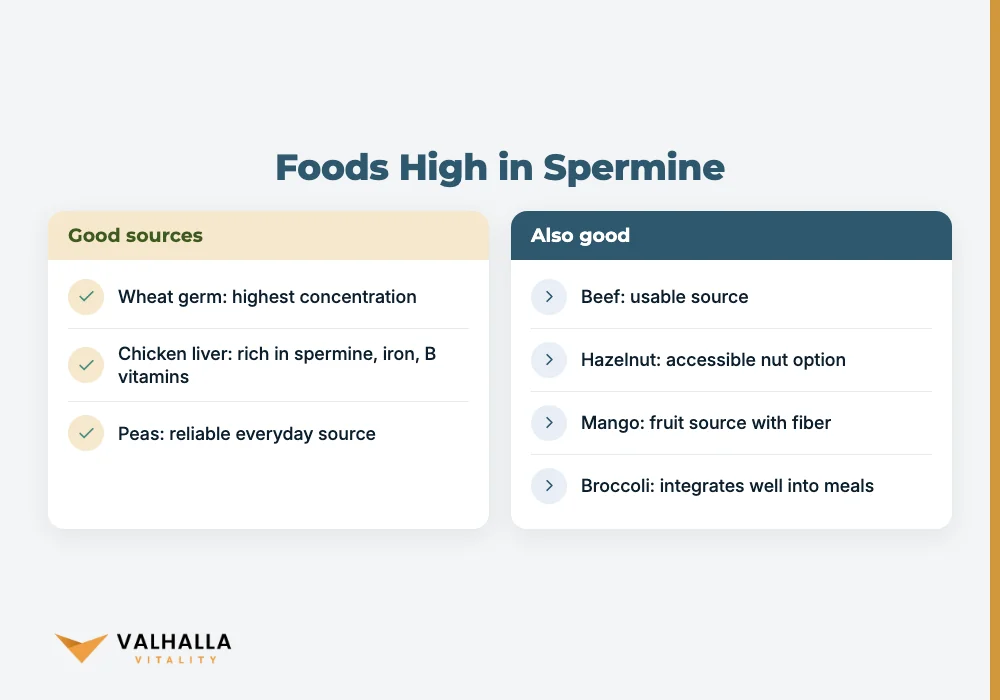
Diet is a meaningful way to raise polyamine intake before or alongside supplementation. Every meal is an opportunity. Key spermine food sources include:
| Food | Notes |
|---|---|
| Wheat germ | Highest spermine concentration of common foods; the base ingredient for most spermine supplements |
| Chicken liver | Rich in spermine alongside iron and B vitamins |
| Peas | A reliable everyday source with no meaningful dietary downside |
| Beef | A usable spermine source; moderate intake is advisable |
| Hazelnut | An accessible nut-based option easy to add to daily snacks |
| Mango | A fruit source with meaningful polyamine content and fiber |
| Broccoli | A vegetable source that integrates well into varied meal plans |
For context on comparing food sources to concentrated supplements, whole-food polyamine intake builds gradually over time. Supplements provide more consistent and measurable delivery.
Are spermine supplements safe?
Spermine side effects are real and worth understanding before starting. Spermine is metabolized in part to acrolein, a reactive compound that generates oxidative stress at elevated concentrations. A 2023 study in Biomolecules characterized the specific toxicity mechanisms through which acrolein produced from spermine catabolism affects cellular function [S2]. This finding underscores why supervised supplementation matters.
Polyamine supplements as a category have an acceptable safety profile at dietary-range intakes. Spermine, spermidine, and putrescine occur naturally in food and in every human cell. Risk rises at high supplemental concentrations or in individuals with conditions affecting polyamine metabolism. Possible spermine side effects include GI discomfort and the oxidative risk from acrolein accumulation. A licensed provider should assess whether supplementation fits your specific situation before you begin. Don't skip that step.
For a useful parallel, spermidine's anti-aging research covers mechanisms shared with spermine, since both compounds are biosynthetically linked and carry overlapping safety profiles.
Spermidine and spermine as polyamine supplements
Spermidine and spermine are the two most studied compounds in the polyamine supplements category. Spermine is produced directly from spermidine via the enzyme spermine synthase. They share metabolic pathways, overlapping research outcomes, and converging longevity interest. Both compounds show promise.
The practical distinction matters. Spermidine has a larger and more recent body of human clinical data. Spermine research is concentrated more heavily in animal models and in-vitro contexts. Products combining both aim to support the full biosynthetic chain. For a cellular-level walkthrough of how spermidine delays aging in the body, the mechanisms described there apply broadly to spermine as well.
Choosing between spermine supplements, spermidine supplements, or a combined polyamine formula depends on your health goals and what a licensed provider recommends after reviewing your intake and labs.
One example of a combined formula is Youthavar, a product from Valhalla Vitality that pairs spermidine with cycloastragenol to target multiple longevity pathways. Both compounds have independent anti-aging research behind them.
Ready to explore your options?
A licensed provider can review your health intake and help you decide whether spermine supplements fit your goals. Book Your Consultation to connect with a professional before you start.
FAQ
What is spermine and what does it do?
Spermine is a naturally occurring polyamine found in virtually every human cell. It supports DNA stability, gene expression, and cellular autophagy, and its production declines measurably with age.
What are the main spermine benefits?
Research suggests spermine may support cellular anti-aging, neuroprotection, and longevity pathways. A 2020 study linked polyamine-rich diets to extended lifespan in animal models through spermine-mediated gene methylation, and a 2024 review identified spermine as a neuroprotective candidate.
How is spermine dosage determined?
A licensed provider determines the appropriate spermine dosage after reviewing your health intake and lab results. Individual metabolism, health status, and goals all affect what amount is appropriate.
Are there spermine side effects I should know about?
Spermine is metabolized partly to acrolein, which may generate oxidative stress at elevated concentrations. GI discomfort is also possible at higher intakes. Provider-supervised supplementation reduces these risks by matching the amount to your specific physiology.
What is the difference between spermidine and spermine?
Spermine is produced directly from spermidine in the polyamine biosynthetic chain. Both are polyamine supplements with anti-aging research interest, but spermidine currently has a larger human clinical dataset. Combined formulas targeting both aim to support the full polyamine pathway.
Sources
- Arthur R et al. (2024). A review on polyamines as promising next-generation neuroprotective and anti-aging therapy. European journal of pharmacology. PubMed
- Kashiwagi K et al. (2023). Molecular Characteristics of Toxicity of Acrolein Produced from Spermine. Biomolecules. PubMed
- Uemura T et al. (2026). Polyamine metabolism as a regulator of cellular and organismal aging. Amino acids. PubMed
- Tse RT et al. (2022). The Association between Spermidine/Spermine N(1)-Acetyltransferase (SSAT) and Human Malignancies. International journal of molecular sciences. PubMed
- Tse RT et al. (2022). The Potential Role of Spermine and Its Acetylated Derivative in Human Malignancies. International journal of molecular sciences. PubMed
- Soda K (2020). Spermine and gene methylation: a mechanism of lifespan extension induced by polyamine-rich diet. Amino acids. PubMed
You May Also Like
 Spermine
 Benefits, Function, Foods, and Side Effects
Spermine benefits span cellular metabolism, antioxidant protection, and longevity support. Learn what spermine is, top food sources, and side effects.
October 27, 2026 ETRead more → Rapamycin
 Dosage for Anti-Aging: What You Need to Know
Rapamycin dosage for anti-aging is set by a licensed provider after labs. Discover how sirolimus protocols work and what the latest research shows.
November 14, 2026 ETRead more → Tirzepatide
 Peptide: Mechanism, Benefits and Side Effects
Tirzepatide peptide targets two receptors to support weight loss and blood sugar control. Learn how it works, its benefits, and what to expect.
November 14, 2026 ETRead more →