
The following blog post is for entertainment and informational purposes only. It is not intended to provide medical advice or diagnosis. Please consult your doctor before making any health-related decisions.
Semaglutide cost varies more than most patients expect before they begin researching. Insurance status, formulation type, and the specific provider you work with all shape what you pay each month. For anyone weighing a GLP-1 therapy program for weight management, that uncertainty can feel like a barrier before treatment even begins. It doesn't have to. Getting a clear picture of what determines semaglutide cost, and what options exist for making it more manageable, is the most practical first step toward any real treatment conversation.
This guide breaks down the main cost drivers behind semaglutide medication options, compares brand-name and compounded formulations, covers what insurance typically does and doesn't cover, and explains what a licensed provider evaluates before prescribing. By the end, you'll know the right questions to ask, wherever you decide to start.
What drives semaglutide cost?
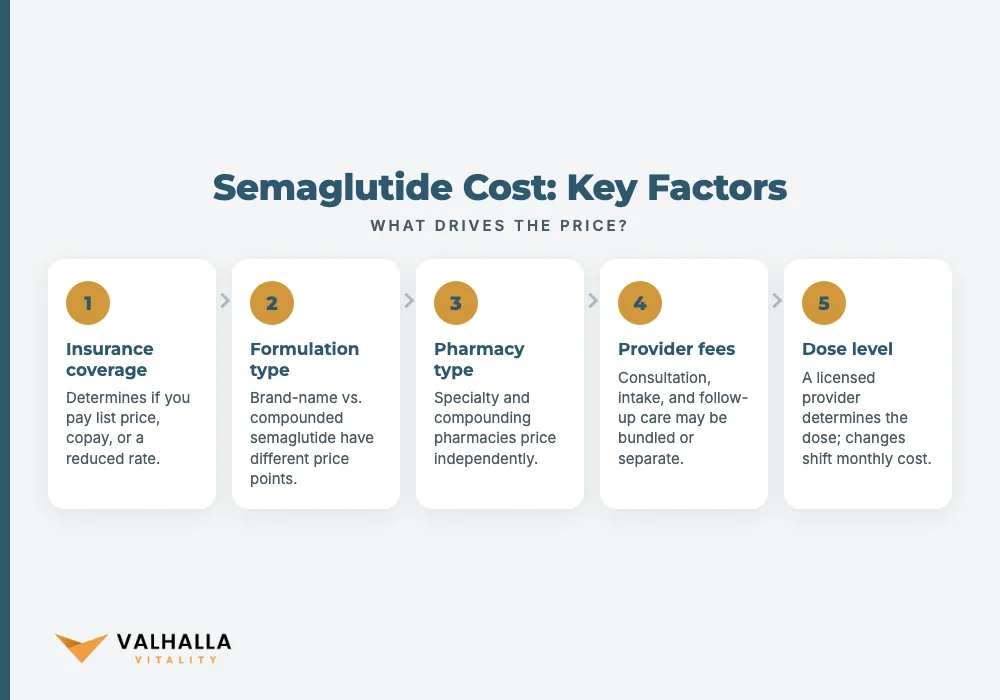
GLP-1 therapy pricing isn't set by a single variable. Several factors interact to produce what you pay each month. Knowing each one helps you evaluate providers more accurately and avoid the common experience of learning the real total only after the first bill arrives.
| Cost factor | Why it matters |
|---|---|
| Insurance coverage | Determines whether you pay list price, a copay, or a reduced rate through a savings program |
| Formulation type | Brand-name vs. compounded semaglutide have structurally different price points |
| Pharmacy type | Specialty pharmacies and 503A/503B compounding pharmacies price independently |
| Provider fees | Consultation, intake review, and follow-up care may be bundled into one monthly figure or billed separately |
| Dose level | A licensed provider determines the dose after reviewing your intake; dose changes can shift the monthly semaglutide cost |
| Geographic availability | Availability varies by state; compounding pharmacy access differs by region |
| Treatment duration | Early treatment phases and maintenance phases often carry different cost structures |
Each row represents a question worth asking any provider before you commit. Getting clear answers upfront prevents the more common experience of unexpected charges on the second or third bill.
The bundled vs. unbundled cost gap
One of the most practical issues when evaluating semaglutide cost is whether your provider includes everything in a single monthly figure or bills components separately. Some programs quote medication cost alone and add consultation fees, lab review charges, and shipping on top. Others bundle them into one number. This structural gap can represent a meaningful portion of the real total.
Bundled pricing doesn't automatically mean the lowest cost. It makes fair comparison possible. When you're evaluating GLP-1 therapy pricing across providers, you can only compare like to like when you know exactly what each provider's number covers.
At Valhalla Vitality, the service structure covers the full bundle: medical intake review, provider approval, and prescription delivery. Provider approval happens within 24 business hours of order placement. Delivery runs approximately 3 to 7 business days from when the prescription reaches the pharmacy. That structure makes the total semaglutide cost knowable before you commit.
How much does semaglutide cost per month?
Monthly semaglutide cost ranges widely. The number that matters most depends on which of three situations applies to you: insured with coverage, insured without coverage, or paying entirely out of pocket.
With insurance coverage. If your plan covers GLP-1 therapy for a qualifying indication, your out-of-pocket semaglutide cost may be limited to a copay or coinsurance amount. The challenge: coverage for weight management is inconsistent across commercial plans. Many require prior authorization, documented medical necessity, and evidence of prior treatment before they'll approve GLP-1 therapy. Even a plan that technically "covers" semaglutide doesn't ensure approval without that process.
Without insurance coverage. Semaglutide price without insurance reflects the full list price of whichever product is prescribed. Brand-name GLP-1 (S) medications carry some of the highest list prices in the weight-care category. Without coverage or an applicable savings program, those costs fall entirely to the patient.
With compounded semaglutide. Compounded semaglutide price is structurally lower than brand-name GLP-1 (S) options. Compounding pharmacies operating under 503A and 503B standards prepare customized formulations without the marketing and distribution overhead of brand manufacturers. For many self-pay patients, this is the most accessible path to GLP-1 therapy.
The most accurate monthly figure comes from a licensed provider who reviews your intake, confirms therapy is appropriate, and details exactly what the full service bundle costs in your state. No estimate from a website, including this one, substitutes for that conversation.
For a stage-by-stage look at semaglutide injection pricing, from initial prescription through ongoing refills, the linked overview covers what patients typically encounter at each point in the cost structure.
Why is semaglutide so expensive?
The high semaglutide cost is structural, not arbitrary. Several reinforcing layers of the pharmaceutical and insurance system produce the prices patients encounter.
Research and development. GLP-1 receptor agonists represent years of large-scale clinical investment before reaching market. Earning separate FDA approvals for type 2 diabetes and for weight management required two distinct clinical programs. That investment is built into the list price of brand-name semaglutide medication options. It doesn't disappear when a patient fills a prescription.
Manufacturing complexity. Peptide-based medications require precision synthesis and cold-chain logistics from production through pharmacy to patient. That process is more resource-intensive than small-molecule drug manufacturing. The added complexity carries through to the final price.
Demand dynamics. As more patients and providers have recognized the clinical profile of semaglutide weight loss injection programs, demand has outpaced manufacturing capacity at points. That imbalance has sustained premium pricing for brand-name formulations. High demand and constrained supply don't combine to lower prices.
Insurance design. When plans exclude GLP-1 therapy from formularies or require extensive prior authorization, the full list price shifts to the patient. Many self-pay patients find brand-name semaglutide cost genuinely prohibitive. That is a primary driver of interest in compounded alternatives and direct-pay telehealth programs that offer a lower entry point.
Where compounding fits in. Compounded semaglutide emerged partly as a market response to brand-name pricing. Compounding pharmacies don't carry the same research amortization, marketing infrastructure, or distribution channels as brand manufacturers. That is both why compounded semaglutide price is lower and why it carries different regulatory considerations than brand-name versions.
Does insurance cover semaglutide for weight loss?
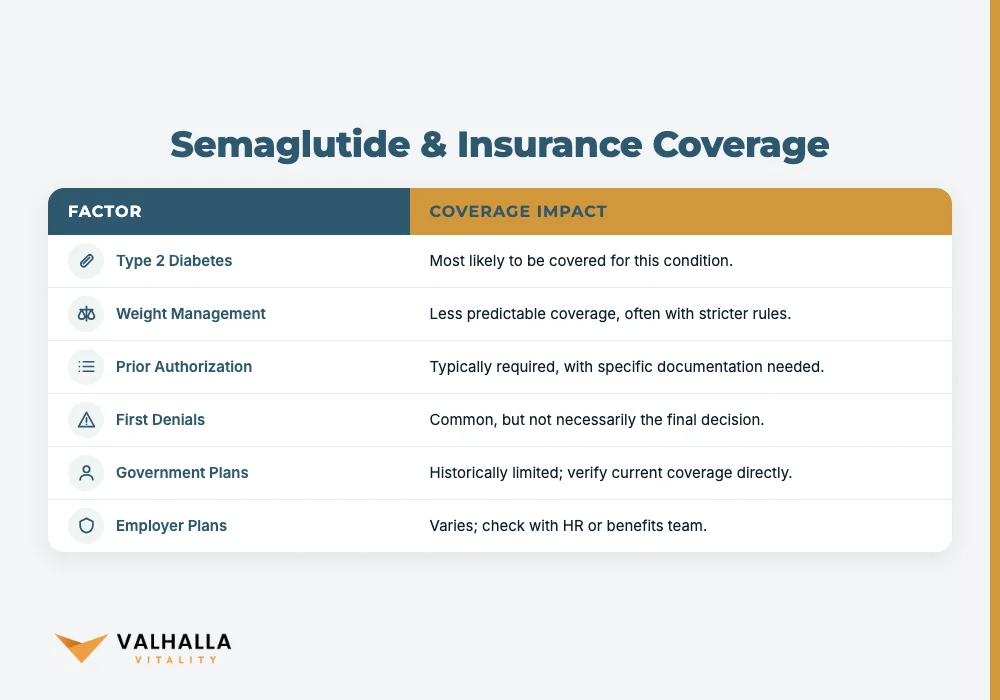
Coverage exists. It is inconsistent and rarely automatic.
Insurance is most likely to cover semaglutide when it is prescribed for type 2 diabetes. For weight management alone, coverage is less predictable. Many commercial insurers treat obesity pharmacotherapy differently from other chronic conditions, with stricter prior authorization requirements and more frequent coverage exclusions.
What prior authorization typically requires:
- Documentation of weight-related health conditions
- Evidence of prior conservative treatment attempts
- Medical necessity certification from the prescribing provider
- Submission through a licensed provider, not the patient directly
First-attempt denials are common. That is not necessarily the end of the road.
Medicare and Medicaid. Coverage of GLP-1 therapy for weight loss under government programs has historically been limited. That landscape continues to shift. Verifying current coverage directly with your plan is the only reliable approach; general descriptions of what these programs cover can become outdated quickly.
Employer-sponsored plans. Some large employers have added GLP-1 medication coverage as part of expanded obesity benefits. Others have explicitly excluded it to control pharmacy spend. If you have employer coverage, your HR or benefits team can confirm whether semaglutide is on the formulary and what the prior authorization process involves for your specific plan.
When a denial isn't the final answer. Coverage decisions can be appealed. A licensed provider who documents clinical necessity can support an appeal that an initial submission couldn't. The process is slow. For patients pursuing brand-name coverage, that extra effort is often worth attempting before defaulting to full out-of-pocket semaglutide cost.
The guide on getting GLP-1 weight-loss medications covered by insurance covers the documentation you need and when to escalate a denial.
Is compounded semaglutide cheaper than brand-name options?
Yes. Compounded semaglutide price is generally lower than brand-name GLP-1 (S) medications. For anyone running an Ozempic Wegovy price comparison, the gap is real and consistent. It is the primary reason self-pay patients often pursue compounded versions when evaluating semaglutide cost against their budgets.
The structural reason compounding pharmacies can price lower: they don't carry the same research amortization, clinical trial investment, marketing spend, or brand distribution overhead as major manufacturers. A 503A compounding pharmacy prepares medication for individual patients based on a valid prescription from a licensed provider. A 503B outsourcing facility produces larger batches under more stringent FDA oversight. Both operate at a lower cost base than branded drug manufacturers.
What you trade for that lower semaglutide cost matters. These differences are real:
Regulatory status. The FDA does not evaluate compounded drug products for safety, effectiveness, or quality the way it does brand-name drugs. That is a material difference in quality assurance, not a hypothetical concern.
Pharmacy variability. Not all compounding pharmacies meet the same standards. Working with a provider who partners only with verified 503A/503B pharmacies reduces variability risk. It doesn't remove it.
Formulation variants. Some compounding pharmacies offer GLP-1 (S) combinations not available in brand-name form. A licensed provider determines which formulation is clinically appropriate. That determination belongs to the provider, not the patient.
Geographic limits. Access to compounded semaglutide options varies by state.
If you're evaluating semaglutide against other GLP-1 therapies on both cost and clinical grounds, the overview of comparing GLP-1 medication options clinically covers how GLP-1 therapies differ in mechanism and what that means for outcomes.
What is the cheapest way to get semaglutide?
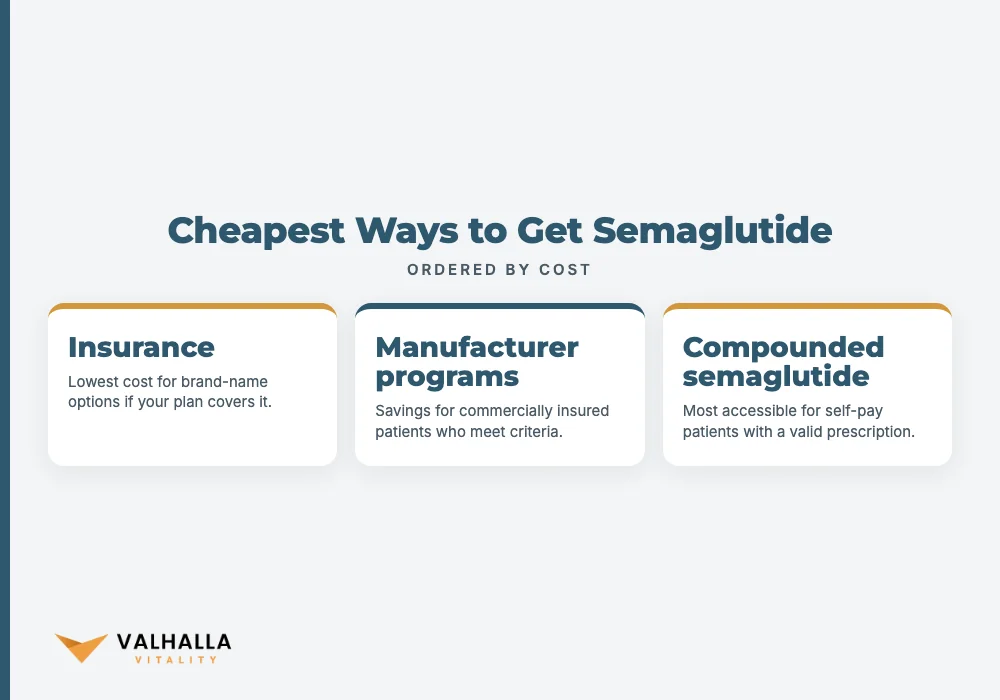
For most self-pay patients, the question of "how to afford semaglutide" leads to the same answer: compounded semaglutide through a licensed 503A or 503B pharmacy is the lowest-cost path to GLP-1 therapy. For insured patients, working through prior authorization is worth attempting before paying out of pocket. Here is the realistic breakdown, ordered roughly by cost.
Insurance with prior authorization. If your plan covers semaglutide for a qualifying diagnosis, this is usually the lowest-cost route for brand-name options. It is slow, it requires documentation, and it may need an appeal. But approved coverage can bring monthly semaglutide cost down to a copay. Worth pursuing before defaulting to full out-of-pocket payment.
Manufacturer savings programs. Brand-name GLP-1 manufacturers offer savings programs for commercially insured patients who meet specific eligibility criteria. These generally don't apply to uninsured patients or those covered by government insurance. If you're commercially insured without plan coverage, check whether a savings card reduces your semaglutide cost before looking elsewhere.
Compounded semaglutide through a licensed provider. For self-pay patients, compounded semaglutide price is typically the most accessible option. This requires a valid prescription from a licensed provider and fills through a pharmacy that meets federal and state standards. Low-cost compounded semaglutide from an unverified source carries quality and consistency risks that undermine the clinical rationale for treatment entirely.
Choose bundled, transparent pricing. One hidden driver of semaglutide cost is patchwork billing. Separate charges for consultation, lab review, prescription handling, and delivery add up materially. Providers offering a bundled service structure make the real monthly cost knowable before you commit, not after.
Budget for the full treatment arc. A licensed provider determines the dose after reviewing your intake and labs. Semaglutide cost is not flat across treatment. Early phases and maintenance phases often carry different cost structures. Planning across a six-month horizon rather than a single month gives a more accurate picture of total GLP-1 therapy spend.
What your provider evaluates before you start
Understanding the clinical intake process clarifies why semaglutide cost covers more than a vial of medication.
Before writing a prescription, a licensed provider reviews your medical history, current medications, any existing conditions, and lab results. They determine whether therapy is clinically appropriate, which formulation fits your situation, and what starting approach makes sense. That is not a formality. It is what makes the prescription valid, legally and clinically.
This applies to all semaglutide medication options, brand-name or compounded. No reputable provider skips it. The cost of that clinical review is embedded in what you pay for a provider-guided program. What you're paying for is not just a vial; it's the licensed judgment that makes the medication appropriate for you specifically.
The telehealth model simplifies access without removing the clinical step. Medical intake happens online. Provider review occurs within a defined window. The prescription routes to a licensed compounding pharmacy. Medication arrives at your door, without an in-person visit.
What doesn't simplify: the determination itself. A licensed provider determines whether a therapy is appropriate after reviewing your intake. That step cannot be replaced by an online questionnaire alone, and no reputable provider treats it as optional.
For patients interested in an oral path alongside or instead of injectable GLP-1 therapy, the oral GLP-1 therapy option explains how pill-based GLP-1 (S) differs from injectable versions and what the clinical and cost considerations look like.
Questions worth asking before you commit
These questions surface the real semaglutide cost you'll face with any provider:
- Does the monthly fee include consultation, medication, and delivery, or are some costs billed separately?
- Does semaglutide cost change as the dose changes, and by how much?
- Which compounding pharmacy fills your prescription, and is it 503A or 503B licensed?
- Can the provider support a prior authorization submission if you want to try insurance first?
- What happens if you need to pause or stop treatment, and are there fees involved?
Transparent, direct answers are a reasonable baseline. If a provider can't or won't answer these before you pay, that tells you something about how they'll communicate throughout treatment.
Ready to understand your options
To get a clear picture of your personal semaglutide cost and whether GLP-1 therapy is appropriate for you, Book Your Consultation with a licensed Valhalla Vitality provider.
FAQ
How much does semaglutide cost per month?
Monthly semaglutide cost varies based on insurance coverage, formulation type, and your provider's pricing structure. Patients with covered insurance may pay a reduced copay; those without coverage pay out of pocket at a price that depends on whether they access brand-name or compounded versions. A licensed provider can give you an accurate estimate after reviewing your intake and confirming what formulations are available in your state.
Does insurance cover semaglutide for weight loss?
Coverage depends on your specific plan and the clinical criteria it applies. Many plans cover GLP-1 (S) for type 2 diabetes but require prior authorization and documented medical necessity for weight management indications. Some employer-sponsored plans include obesity pharmacotherapy; many do not. Checking with your insurer and working with a provider experienced in prior authorization is the most reliable approach.
Why is semaglutide so expensive?
The high semaglutide cost reflects years of pharmaceutical research and clinical development, the complexity of peptide manufacturing, and the significant investment required to earn two separate FDA approvals. High demand across both diabetes and weight-management uses has also sustained premium pricing for brand-name formulations. Compounded semaglutide offers a lower-cost alternative with a different regulatory profile.
What is the cheapest way to get semaglutide?
For most self-pay patients, compounded semaglutide through a 503A or 503B licensed pharmacy is the lowest-cost path to GLP-1 therapy. For insured patients, using the prior authorization process to access covered brand-name options may cost less out of pocket. Manufacturer savings programs may apply to some commercially insured patients who do not qualify for plan coverage.
Is compounded semaglutide cheaper than brand-name options?
Yes, compounded semaglutide price is generally lower than brand-name GLP-1 (S) medications, because compounding pharmacies operate without the same research, marketing, and distribution overhead as brand manufacturers. However, compounded drug products are not FDA-evaluated for safety, effectiveness, or quality in the same way brand-name drugs are, and formulation consistency can vary across pharmacies.
You May Also Like
 Semaglutide
 Peptide: GLP-1 Mechanism, Effects, and Uses
Semaglutide peptide is a GLP-1 receptor agonist that regulates blood sugar and appetite, and may support weight loss. Discover how it works.
November 12, 2026 ETRead more → Semaglutide
 Sodium vs Semaglutide: Key Differences Explained
Semaglutide sodium vs semaglutide: how these GLP-1 formulations compare in structure, side effects, and what a provider weighs before prescribing.
November 5, 2026 ETRead more → Semaglutide
 Injection Cost: What to Expect in 2026
Semaglutide injection cost ranges widely based on insurance, form, and provider. Get the full cost breakdown and learn what to expect each month.
November 3, 2026 ETRead more →