
The following blog post is for entertainment and informational purposes only. It is not intended to provide medical advice or diagnosis. Please consult your doctor before making any health-related decisions.
The semaglutide dose for weight loss is not a number you select from a chart. A licensed provider reviews your health history, current medications, and lab results before building a GLP-1 titration plan that starts at the lowest effective level and increases gradually over several months. Before your first weekly semaglutide injection, understanding how GLP-1 therapy regulates appetite and who qualifies for it sets accurate expectations for what the clinical process actually involves.
How semaglutide works for weight loss
Semaglutide is a glucagon-like peptide-1 (GLP-1) receptor agonist. It mimics a gut hormone the body releases naturally after eating. That signal drives weight loss through several converging mechanisms.
Gastric emptying slows, so food stays in the stomach longer and fullness extends well past the meal itself. Ghrelin, the hormone that triggers hunger between meals, is suppressed. Peptide YY, which signals satiety, increases. The brain's appetite-regulating centers receive signals that reduce the urgency to eat. None of this depends on willpower. The pharmacology is doing the work.
These effects compound over time. A 2026 systematic review and network meta-analysis in Obesity (Silver Spring) found that GLP-1 receptor agonists produced meaningful weight reductions in nondiabetic adults with overweight or obesity, with semaglutide among the agents showing the strongest effect across the trials analyzed. A 2023 systematic review and meta-analysis in The American Journal of Clinical Nutrition reached similar conclusions across randomized controlled trials in non-diabetic individuals.
Beyond weight, GLP-1 therapy also influences metabolic markers. Clinical data from semaglutide studies show reductions in LDL cholesterol and triglycerides alongside increases in HDL cholesterol, changes relevant to the cardiovascular risks that frequently accompany excess weight. In patients with type 2 diabetes, hemoglobin A1c, a measure of average blood glucose over three months, also decreases with GLP-1 agonist use. This broader metabolic picture is part of why providers consider semaglutide for adults with weight-related conditions, not solely as a tool for reducing the number on the scale. The evidence supporting semaglutide dose weight loss also documents these metabolic shifts as part of the clinical rationale for treatment.
Semaglutide's long pharmacological half-life makes once-weekly dosing practical. A single subcutaneous injection maintains a relatively stable drug concentration across the full seven days. That stability underlies the weekly semaglutide injection schedule that clinical dosing guides are built around.
What is the starting dose of semaglutide for weight loss?
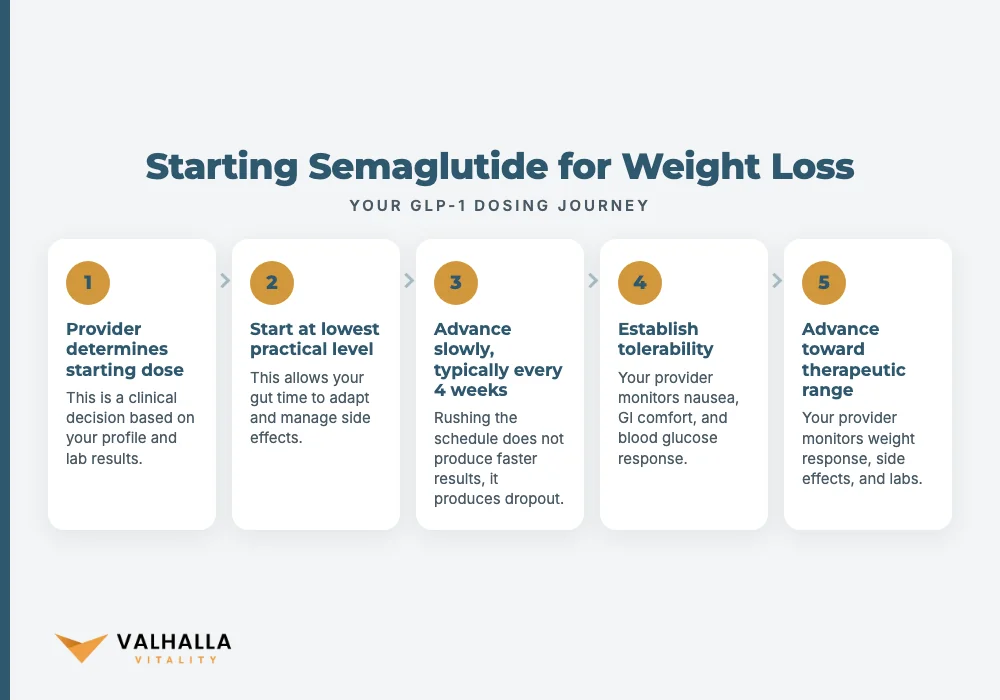
A licensed provider determines the starting dose after reviewing your intake and lab results. This is a clinical decision, not a self-service step. Providers do not apply one universal starting level to all patients. Your metabolic profile, current medications, and tolerance history all inform the choice.
Semaglutide is always initiated at the lowest practical level. This is standard GLP-1 dosing practice, and it reflects biology, not excess caution. The semaglutide dose weight loss process is built around that conservative starting point because tolerance at each level determines how far escalation can ultimately go. The most frequently reported side effect, nausea, is dose-dependent. Starting low and advancing slowly gives the gut time to adapt at each level before the dose increases again.
A 2018 review of once-weekly semaglutide in Expert Review of Clinical Pharmacology documented the relationship between escalation pace and tolerability, concluding that the structured titration schedule is central to patient adherence and long-term clinical outcomes. In other words, rushing the schedule does not produce faster results. It produces dropout.
The semaglutide titration schedule: phase by phase
Your provider's GLP-1 dosing guide moves through three distinct phases. Knowing what each involves helps you track where you are and what comes next.
| Phase | Primary goal | What your provider monitors |
|---|---|---|
| Starting phase | Establish tolerability | Nausea, GI comfort, blood glucose response |
| Dose escalation | Advance toward therapeutic range | Weight response, side effect profile, labs |
| Maintenance | Sustain and optimize results | Metabolic markers, ongoing lab results |
Escalation typically advances every four weeks. Your provider may hold a phase longer if you need more time at an intermediate level. That decision is clinical and based on your actual response. Some patients move through the semaglutide titration schedule in three months. Others take five or six. Both timelines are appropriate. What matters is reaching a dose your body can tolerate sustainably.
Labs may be reviewed before each escalation step. The decision to advance is not automatic. Providers read the full picture before moving forward.
How long does it take to reach the full semaglutide dose?
Reaching a maintenance dose typically takes several months. The exact timeline depends on how well you tolerate each step, your metabolic response, and your provider's assessment at each check-in.
Four weeks at each level is a widely used benchmark. Some patients have good GI tolerance and move through escalation efficiently. Others need extended time at intermediate doses before the body adjusts. Neither pace is a failure. What you are working toward is the dose you can sustain over the long term, not the dose you can reach the fastest.
A 2023 meta-analysis in The American Journal of Clinical Nutrition found that longer treatment duration correlated with greater weight reduction. Consistency on a reliable weekly semaglutide injection schedule across the full escalation period builds better outcomes than rushing the dose and discontinuing due to side effects.
Once at maintenance, the process does not end. Provider check-ins continue. Labs are reviewed at intervals. Dose adjustments are made if your response changes or side effects emerge. GLP-1 therapy for weight management is a long-term intervention, not a defined short course with a clear finish line.
Keeping a record of your semaglutide dose weight loss progress
Tracking your weight, GI tolerance, and energy levels at each phase gives your provider the clearest possible picture when making escalation decisions. Patients who document their semaglutide dose weight loss response between appointments arrive at each check-in with data their provider can act on, rather than estimates.
Why the GLP-1 dosing guide is structured the way it is
The structured semaglutide titration schedule is not arbitrary protocol. The pharmacological rationale behind it is specific and worth understanding before you begin.
GLP-1 receptor agonists slow gastric emptying as part of how they produce satiety. That mechanism works, but it also means the stomach and gut need time to adapt to each new drug concentration. When dose increases happen faster than the gut can accommodate, nausea and vomiting follow. Slower escalation is not a safety formality. It is how the medication becomes tolerable in the first place.
There is also a response lag to account for. Weight loss with semaglutide does not peak immediately after each dose increase. It continues to accumulate over weeks as the appetite suppression compounds. Providers who wait a full interval between increases are reading a more complete picture of your response before advancing. That produces better-calibrated decisions than accelerating on a schedule the gut has not caught up to yet.
The semaglutide dosage chart your provider works from is a clinical tool grounded in this pharmacology. It reflects how GLP-1 receptors behave at different drug concentrations and what the gut requires to remain functional throughout the process. Patients who search for an "ozempic dosage chart" online often find fixed reference tables that do not account for individual tolerance or metabolic response; the semaglutide dose weight loss plan your provider builds is calibrated specifically to your escalation history and lab results.
Can I increase my semaglutide dose faster than recommended?
No. Accelerating the titration schedule beyond what your provider has approved substantially raises the risk of GI side effects. A 2025 systematic review and meta-analysis in Gastroenterology found that GLP-1 receptor agonists are associated with significantly higher rates of nausea, vomiting, diarrhea, and constipation compared to placebo. Those rates are dose-dependent and rise sharply when escalation outpaces the body's ability to adapt.
Pushing the dose faster does not accelerate weight loss. It increases the probability of side effects severe enough to interrupt or end the therapy entirely. Patients who tolerate a slower escalation stay on the medication longer, and longer use is what the evidence links to meaningful, sustained results.
If you feel your weight loss has plateaued and you want to explore a higher dose, bring that to your next scheduled check-in. Your provider will review your current response data and recent labs before deciding whether advancing makes clinical sense. That conversation belongs in a provider review, not in a self-adjustment between appointments.
What happens if I miss a semaglutide dose?
The correct action depends on how much time has passed since your scheduled injection.
If fewer than five days have passed since your regular weekly semaglutide injection day, take the missed dose as soon as you remember and continue your normal schedule from that point.
If more than five days have passed, skip that week entirely. Return to your regular injection day the following week.
Do not take two doses close together to compensate. A double dose pushes drug concentration above the intended level and significantly raises nausea and vomiting risk. One missed injection is far less disruptive than a compensatory double dose followed by several difficult days.
The medication's long half-life means an occasional missed dose is unlikely to meaningfully set back the progress you have made. Still, consistent weekly adherence matters over the months of escalation and maintenance. A recurring phone reminder on the same day each week prevents most missed injections without any additional effort. If you find yourself missing doses frequently, contact your provider. Repeated gaps may warrant a check-in to reassess the plan.
Semaglutide injection side effects: what to expect
The most commonly reported semaglutide injection side effects are gastrointestinal. Nausea leads the list, followed by vomiting, diarrhea, and constipation. These effects are most pronounced during dose escalation and generally diminish as the body adjusts to each new level.
A 2025 meta-analysis in Gastroenterology identified GI adverse events as the leading cause of treatment discontinuation in GLP-1 agonist clinical trials. That context is useful. The effects are real, but active management significantly improves tolerability for most patients. Staying on the medication through the full escalation period is what produces sustained semaglutide dose weight loss results, and tolerability is the variable that determines whether that stay is possible.
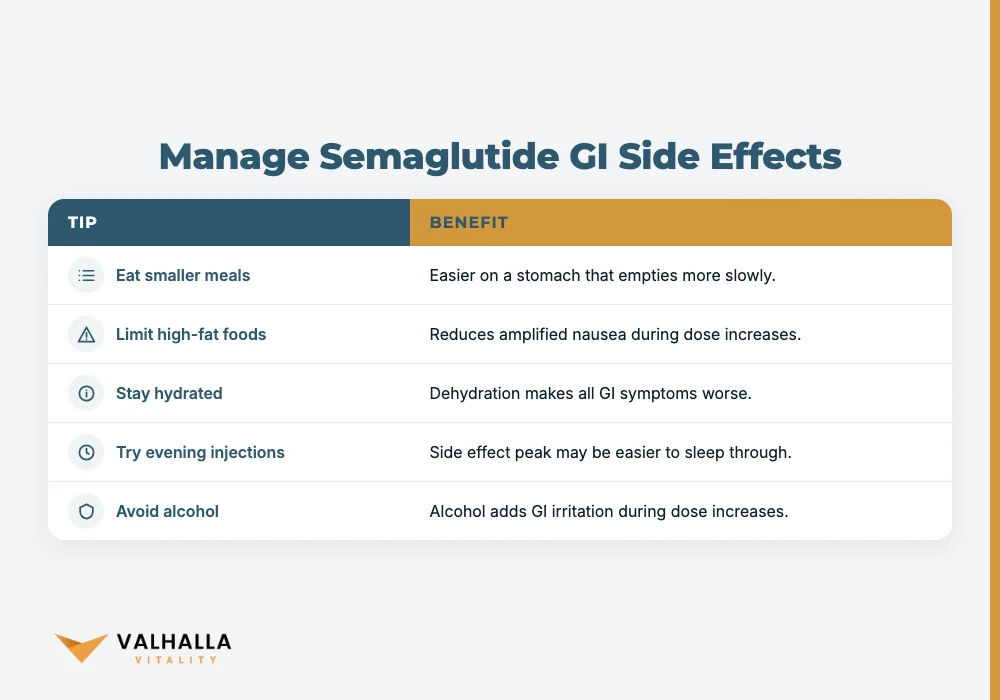
Practical steps to reduce GI side effects during the titration schedule:
- Eat smaller, more frequent meals. Four or five smaller meals replace three larger ones. Large portions are harder on a stomach that is now emptying more slowly.
- Limit high-fat and rich foods during the first week at each new dose. These take longer to process and amplify nausea on top of the medication's effects.
- Stay hydrated throughout the day. Nausea reduces the impulse to drink, but dehydration makes every GI symptom worse.
- Try evening injections. Some patients find the side effect peak easier to sleep through than to manage during a workday.
- Avoid alcohol during escalation periods. Alcohol adds GI irritation on top of what dose increases already cause. For a closer look at how alcohol interacts with GLP-1 therapy, that topic is covered separately.
- Do not skip meals entirely. Going long stretches without food does not relieve semaglutide-induced nausea. Small amounts of bland food, such as plain crackers or rice, are more effective than prolonged fasting.
Side effects tend to be most noticeable in the first one to two weeks after each dose increase, then taper. Knowing that the discomfort is time-limited makes it easier to work through.
More serious adverse events are less common but require prompt provider contact. Severe or persistent abdominal pain may indicate pancreatitis or gallbladder disease, both of which have been documented in GLP-1 agonist clinical data. Patients with a personal or family history of medullary thyroid carcinoma or multiple endocrine neoplasia syndrome type 2 should not use semaglutide. These contraindications are evaluated during the initial intake review, which is one of the reasons that step is not optional.
Semaglutide dose weight loss: is a higher dose more effective?
Yes, within limits. Higher doses in the therapeutic range are generally associated with greater weight reductions. A 2023 systematic review and meta-analysis in The American Journal of Clinical Nutrition found a dose-response pattern across GLP-1 agonist trials in non-diabetic individuals, with higher doses linked to larger effects on body weight.
The relationship has a ceiling, though. Beyond a certain threshold, additional dose increases yield diminishing returns while the side effect burden continues to rise. That inflection point varies between patients.
Your provider does not aim for the maximum dose by default. The clinical goal for semaglutide dose weight loss management is the optimal dose for your physiology, not the highest available. Some patients achieve strong results at moderate doses with minimal side effects. Others need a higher maintenance level for meaningful progress. Only a provider reviewing your individual response data, labs, and current tolerance can make that determination.
Comparing your dose to another patient's is rarely useful. Two people on the same semaglutide dose for weight loss may respond very differently based on differences in metabolism, body composition, gut microbiome, and medication history. The titration process is personalized by design, and those differences are exactly why.
How to start semaglutide: the clinical process

Knowing what happens before and after your first weekly semaglutide injection removes much of the uncertainty from getting started. For telehealth-based GLP-1 therapy, the process typically unfolds as follows.
Complete a medical intake form. You provide your health history, current medications, and weight management goals. The provider reviews this document to assess eligibility and determine a starting dose.
Baseline labs are reviewed. Metabolic panels and thyroid markers inform whether GLP-1 therapy is appropriate. A licensed provider determines whether the therapy is a clinical fit after reviewing your full intake.
Provider approval. If approved, the provider sets your starting dose and escalation schedule. For telehealth services, this typically happens within 24 business hours of completing the intake.
Pharmacy and delivery. The prescription is transmitted to a partner US compounding pharmacy operating under 503A or 503B regulations. Compounded GLP-1 (S) is prepared and shipped to you. Delivery takes approximately 3 to 7 business days from the time the prescription is transmitted.
Injection setup. The medication arrives with administration instructions. Weekly injections are subcutaneous, given in the abdomen, thigh, or upper arm. Rotating injection sites between weeks reduces local tissue buildup and bruising.
Ongoing monitoring. Provider check-ins continue through the escalation phase and into maintenance. Labs are reviewed at defined intervals, dose adjustments are made when warranted, and side effects are addressed throughout the full course of treatment.
Availability varies by state.
For patients comparing options before their first consultation, a detailed look at how semaglutide and tirzepatide differ in mechanism and weight outcomes can help you arrive at that conversation with better-formed questions. For patients who prefer not to inject, oral GLP-1 (O) options follow a different administration and dosing protocol and may be worth discussing during your intake review.
Supporting your treatment with nutrition and exercise
GLP-1 therapy reduces appetite and slows gastric emptying. That combination makes maintaining a caloric deficit more achievable than it would be without pharmacological support. But the quality of your diet still shapes outcomes, and the medication does not substitute for a structured approach.
A practical eating approach during semaglutide treatment typically includes:
- Adequate protein at every meal. Protein preserves lean muscle mass during weight loss, which supports metabolic rate and long-term maintenance after reaching goal weight.
- Moderate portion sizes. Overeating causes more discomfort than usual because gastric emptying is slower. Smaller meals align with the reduced capacity and work with the medication rather than against it.
- Reduced ultra-processed food intake. Highly palatable, calorie-dense foods can partially blunt the appetite suppression GLP-1 therapy provides, reducing its effectiveness over time.
- Consistent meal timing. Eating at regular intervals stabilizes blood glucose and reduces the likelihood of nausea between weekly doses.
For a framework built specifically around how GLP-1 therapy affects digestion and appetite, a structured semaglutide diet plan gives you practical guidance to run alongside your provider's dosing instructions.
Resistance training matters in parallel. As body weight decreases, muscle mass requires active effort to preserve. Your provider may give exercise recommendations calibrated to your cardiovascular health and the results from your intake labs. Those recommendations may shift as your fitness improves through the months of treatment.
Who may not qualify for semaglutide therapy
Not every patient is a clinical fit for a weekly semaglutide injection program. The intake review screens for several conditions that may affect safety or represent formal contraindications.
Kidney disease. Reduced kidney function changes how the body processes GLP-1 agonists and raises the risk of acute kidney injury if dehydration occurs from GI side effects during escalation.
Gallbladder disease. GLP-1 receptor agonists are associated with a higher incidence of gallstones and cholecystitis in clinical data. Existing gallbladder conditions require careful evaluation before any prescription is written.
Pregnancy and breastfeeding. Safety data in these populations are limited. GLP-1 therapy is not recommended during pregnancy or while nursing.
Medullary thyroid carcinoma or MEN2 syndrome. A personal or family history of either condition is a hard contraindication for GLP-1 agonist use.
Prior pancreatitis. A history of pancreatitis requires an individualized risk-benefit review before any GLP-1 therapy can be considered.
The intake review is the mechanism that makes the prescribing process safe. Patients who fall into one of these categories will not be cleared for GLP-1 therapy, and that decision reflects clear medical reasoning. If you are unsure about your own eligibility, a provider review is the only reliable way to find out.
For those who do not qualify for semaglutide, exploring what GLP-1 alternatives may be appropriate is a reasonable next step in the conversation with a provider.
Ready to review your options with a provider?
Book Your Consultation with a licensed provider who can review your health history, run the appropriate labs, and build a semaglutide titration schedule designed for your specific situation.
FAQ
What is the starting dose of semaglutide for weight loss?
The starting dose is set by a licensed provider after reviewing your health history and lab results. Semaglutide is always initiated at the lowest effective level and increased gradually based on your individual tolerability and metabolic response.
How long does it take to reach the full semaglutide dose?
Reaching a maintenance dose typically takes several months, with escalation steps occurring roughly every four weeks. The exact timeline depends on your tolerability, your response at each level, and your provider's clinical assessment at each check-in.
Can I increase my semaglutide dose faster than recommended?
No. Accelerating the titration schedule substantially raises the risk of nausea, vomiting, and other GI side effects. All dose changes should be directed by a licensed provider who has reviewed your current response data and lab results.
What happens if I miss a semaglutide dose?
If fewer than five days have passed since your scheduled injection, take the missed dose and resume your normal weekly schedule. If more than five days have passed, skip that dose and return to your regular injection day the following week. Do not take two doses in the same week.
Is a higher semaglutide dose always more effective for weight loss?
Higher doses are generally associated with greater weight reduction, but the dose-response relationship has limits. Your provider determines the optimal dose based on your response, current labs, and side effect profile. The goal is the best outcome for your physiology, not the highest available dose.
Sources
- Lim M et al. (2026). Weight Loss With GLP-1 Agonists in Nondiabetic Adults: Systematic Review and Network Meta-Analysis. Obesity (Silver Spring, Md.). PubMed
- Coon SA et al. (2018). Semaglutide once-weekly: improved efficacy with a new safety warning. Expert Review of Clinical Pharmacology. PubMed
- Chiang CH et al. (2025). Glucagon-Like Peptide-1 Receptor Agonists and Gastrointestinal Adverse Events: A Systematic Review and Meta-Analysis. Gastroenterology. PubMed
- Liu Y et al. (2023). The Weight-loss Effect of GLP-1RAs in Non-diabetic Individuals with Overweight or Obesity: A Systematic Review with Meta-Analysis and Trial Sequential Analysis of Randomized Controlled Trials. The American Journal of Clinical Nutrition. PubMed
You May Also Like
 Semaglutide
 Sodium vs Semaglutide: Key Differences Explained
Semaglutide sodium vs semaglutide: how these GLP-1 formulations compare in structure, side effects, and what a provider weighs before prescribing.
November 5, 2026 ETRead more → Semaglutide
 Injection Cost: What to Expect in 2026
Semaglutide injection cost ranges widely based on insurance, form, and provider. Get the full cost breakdown and learn what to expect each month.
November 3, 2026 ETRead more → Semaglutide
 Weight Loss: How It Works and What to Expect
Semaglutide weight loss works by reducing appetite and slowing digestion. Learn how this GLP-1 injection works, side effects, and how to get started.
November 1, 2026 ETRead more →