
The following blog post is for entertainment and informational purposes only. It is not intended to provide medical advice or diagnosis. Please consult your doctor before making any health-related decisions.
Semaglutide injection cost is one of the first things people want to know before starting a GLP-1 weight loss program, and the answer is genuinely variable. Your monthly amount depends on whether you use a brand-name product or a compounded formulation, whether your insurance covers the therapy, and how your provider structures the price. For background on how this GLP-1 treatment program works, that guide walks through the full treatment structure from initial intake through ongoing care.
What affects the semaglutide injection cost?
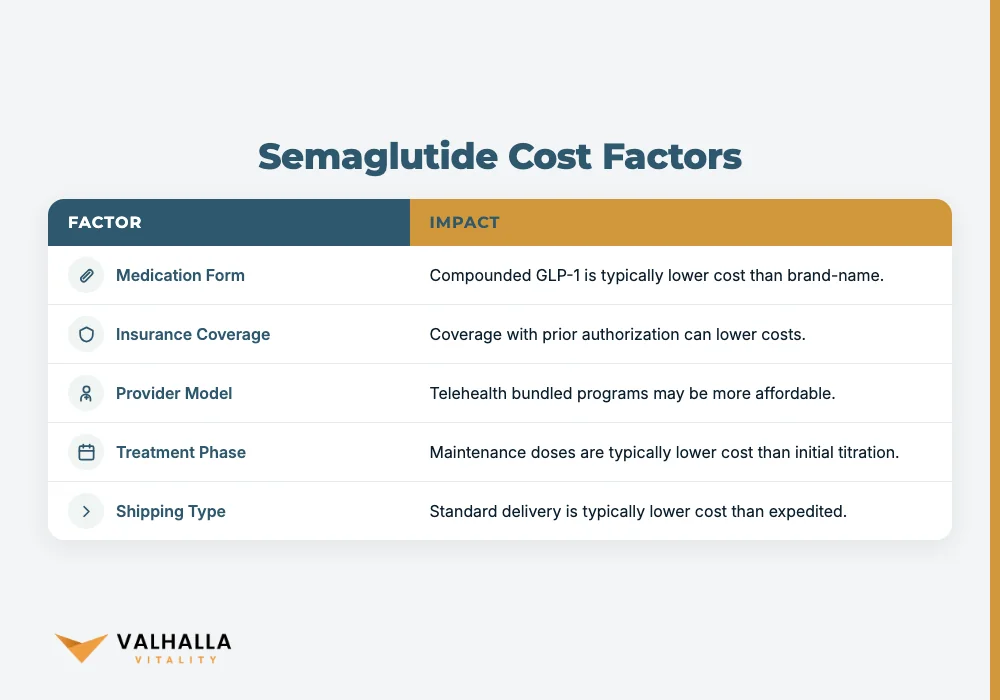
Five main variables shape what you actually pay. Understanding each one makes it possible to compare programs accurately rather than looking at a headline price alone.
| Cost Factor | Typically Lower | Typically Higher |
|---|---|---|
| Medication form | Compounded GLP-1 | Brand-name prescription |
| Insurance coverage | Covered with prior authorization | Self-pay, no coverage |
| Provider model | Telehealth bundled program | In-person specialist visits |
| Treatment phase | Stable maintenance dose | Initial titration period |
| Shipping type | Standard delivery | Expedited cold-chain shipping |
Each row represents a real decision point. The sections below focus on the three that move the needle most.
Brand-name vs. compounded semaglutide
Brand-name semaglutide injections carry a manufacturer-set list price. Without insurance assistance, that list price is steep. With a copay card or manufacturer savings program, commercially insured patients can sometimes bring the monthly out-of-pocket cost down to a program-defined maximum. Those savings programs have strict eligibility rules, and they exclude Medicare and Medicaid enrollees entirely.
Compounded semaglutide is prepared by a licensed 503A or 503B US pharmacy. It typically costs less per month than brand-name products because it bypasses the brand pricing structure. Many telehealth programs bundle the provider consultation, the compounded medication, and delivery into a single monthly fee. That bundling changes how you read cost comparisons. A program that lists only the drug price can look cheaper at a glance. Total cost tells a different story.
For a detailed comparison of how injection and oral delivery formats differ on cost and convenience, a side-by-side review of injection versus oral GLP-1 delivery covers both options in practical terms.
Insurance coverage and prior authorization
Commercial insurance plans frequently cover semaglutide for type 2 diabetes management but apply inconsistent rules to weight management. Many plans require prior authorization, meaning your provider must submit documentation showing you meet specific clinical criteria before the insurer approves the claim. That process adds days to the timeline and sometimes results in a denial before coverage is confirmed.
Medicare Part D covers some semaglutide formulations for diabetes but has not historically covered GLP-1 therapy used solely for weight management. Medicaid rules differ by state. Availability for any semaglutide program varies by state.
Telehealth bundling vs. separate billing
Traditional in-person prescribers bill the office visit separately from the pharmacy charge. Telehealth GLP-1 programs often fold provider review, medication, and delivery into one monthly price. This bundled model can make telehealth programs less expensive in total even when the medication price alone looks comparable to retail options. Before committing to any program, confirm exactly which components are included. Consultation fees, lab work, and shipping can each appear as separate line items at some providers.
How much does semaglutide cost per month?
Monthly semaglutide injection cost varies based on form, insurance status, and program structure. Brand-name options carry list prices that most self-pay patients cannot absorb without some form of assistance. Compounded GLP-1 programs through telehealth typically offer a lower entry point because they bypass brand pricing and often include the provider review in the monthly fee.
At Valhalla Vitality the model is a bundled service: a licensed provider reviews your online intake within 24 business hours of submission, and if they determine the therapy is appropriate, a prescription is sent to a partner US compounding pharmacy. Delivery follows in approximately three to seven business days from the time the prescription is transferred to the pharmacy. The cost you see at checkout covers that full path, not just the medication.
For self-pay patients comparing telehealth programs, bundled pricing is a meaningful advantage. It prevents the sticker shock of separate consultation invoices that arrive after the medication is already in hand.
What is included in the monthly price?
When evaluating semaglutide monthly cost across programs, confirm that the stated price covers three components: provider review, the medication itself, and delivery. Programs that separate these show a lower headline figure but a higher total. Ask: Is the consultation included? Does the price change when the provider adjusts the dose? Are follow-up reviews billed as add-ons? Clear answers to all three make it possible to budget across a multi-month treatment cycle without surprises.
Is semaglutide covered by insurance?
Coverage depends on your plan type, your diagnosis, and whether you meet the plan's clinical approval criteria. Many commercial plans cover semaglutide for type 2 diabetes without difficulty. Coverage for weight management is more limited, more inconsistently applied, and usually requires prior authorization.
People paying for semaglutide without insurance have several cost-reduction paths. Manufacturer savings programs can reduce costs significantly for commercially insured patients but explicitly exclude Medicare, Medicaid, and government-funded insurance plans. Pharmacy discount cards apply to brand-name products at participating pharmacies and still require a valid prescription. Compounded GLP-1 through a telehealth provider operates entirely outside the insurance billing system, making it accessible to self-pay patients regardless of coverage status.
A licensed provider determines whether a therapy is appropriate after reviewing your intake. That clinical review comes before any prescription is issued and before any cost is incurred for the medication.
How much does compounded semaglutide cost?
Compounded semaglutide price is lower than brand-name list pricing because the medication is prepared by a licensed pharmacy to order rather than manufactured by a pharmaceutical company and priced through the standard retail distribution chain. The actual monthly price varies by program, formulation, and the specific pharmacy compounding the medication.
Some programs offer multiple formulation options, including standard GLP-1 preparations and combinations with additional compounds such as B12. The formulation can affect the price. Because compounded semaglutide pricing is set at the program level rather than published at a fixed national rate, completing an intake with a telehealth provider is the only accurate way to see your specific cost.
One requirement applies universally: compounded drug products are not approved or evaluated for safety, effectiveness, or quality by the FDA. That is a legal reality of compounding and applies to all 503A/503B compounding pharmacies, regardless of their standards. Responsible programs disclose this clearly.
What is the cheapest way to get semaglutide?
Three main paths bring down the weight loss shot price for patients managing cost carefully.
- Manufacturer patient assistance programs offer reduced or no-cost access for patients who meet income and insurance eligibility thresholds. Requirements are strict, and the approval process takes time.
- Manufacturer savings programs for commercially insured patients can cap the monthly copay at a fixed low amount. These programs explicitly exclude Medicare, Medicaid, and any government-funded insurance.
- Compounded GLP-1 through a telehealth provider bypasses brand pricing entirely. For self-pay patients with no applicable insurance coverage, this is typically the most cost-accessible route.
Pharmacy discount cards can help. They apply to brand-name products only, still require a valid prescription, and typically leave self-pay patients paying more per month than a bundled compounded program does. Knowing the total cost, not just the drug price, is the only way to make an accurate comparison.
For more on what GLP-1 therapy does in the body and why it may support weight management, the research on GLP-1 therapy and body fat reduction covers that side of the picture.
How much does Wegovy cost without insurance?
Wegovy is a brand-name semaglutide injection approved for chronic weight management. Without insurance coverage or a manufacturer savings program, the GLP-1 weight loss price for Wegovy can reach well over a thousand dollars monthly at the pharmacy counter.
The manufacturer offers a savings program for commercially insured patients. It can reduce the monthly cost to a defined maximum, but it explicitly excludes government insurance enrollees. For people paying entirely out of pocket, a compounded GLP-1 program through a telehealth provider is usually the more financially realistic path. Availability varies by state.
Ozempic cost per month follows the same pricing logic: a high list price, manufacturer savings programs limited to commercially insured patients, and no coverage for Medicare or Medicaid enrollees under weight management indications. Both brand-name drugs contain semaglutide as the active ingredient; the approved indications differ, and those differences drive the coverage rules.
Why semaglutide injection cost changes during treatment
Most cost guides show a single monthly figure. That number is incomplete. Semaglutide injection cost is not fixed for the life of a treatment program.
A licensed provider determines the appropriate dose after reviewing your intake and, in some cases, lab results. They typically start patients at a lower level and adjust as tolerated. Each adjustment can change the monthly price of the fill. During the initial titration period, which may span several weeks, the cost per fill may differ from what you pay on an established maintenance dose.
A 2018 review in Expert Review of Clinical Pharmacology described once-weekly semaglutide as demonstrating improved efficacy compared to earlier weekly injection formats, and a 2026 systematic review in Frontiers in Endocrinology examined GLP-1 weight management outcomes across multiple regimen types (Coon SA et al., 2018; Rasool ZK et al., 2026). Provider-guided titration is central to both the clinical picture and the cost structure. Budget for treatment phases, not for a single static monthly number.
Once a stable maintenance dose is established, the reorder cycle typically settles into a predictable pattern. At Valhalla Vitality that cycle runs approximately four to six months on a maintenance-dose schedule. Planning around that longer cycle gives a far more accurate total-cost picture than looking at the first month alone.
The full cost path: from intake to first injection
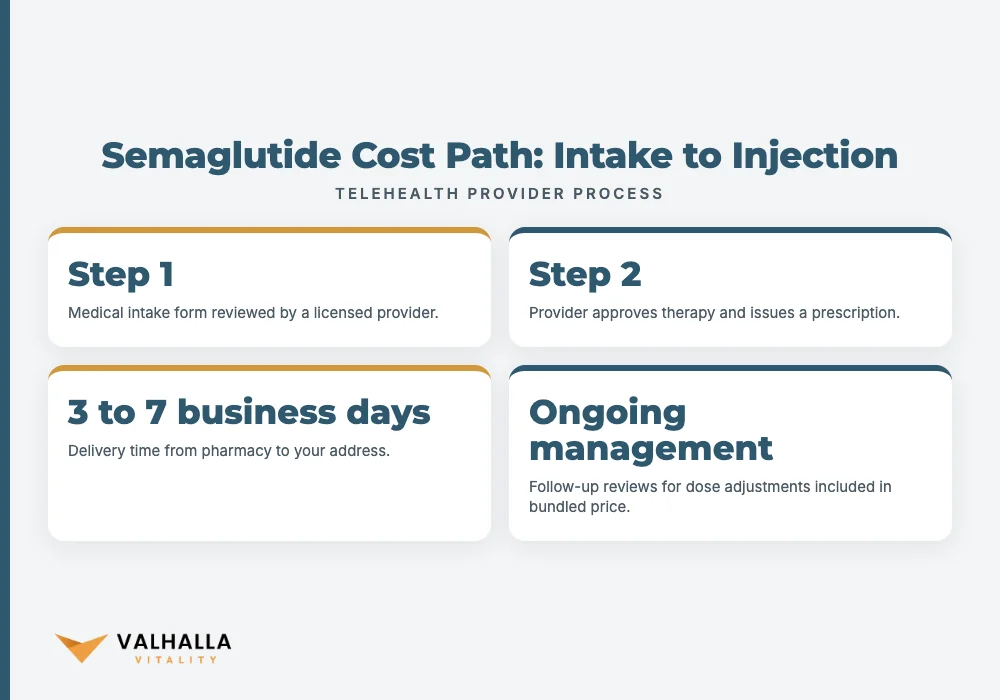
Understanding semaglutide injection cost requires accounting for every step, not only the medication price. Here is how the full cost path typically works through a telehealth provider.
Step 1: Medical intake. You complete an online form covering your health history, current medications, and goals. A licensed provider reviews that form before anything else happens.
Step 2: Provider approval. If the provider determines the therapy is appropriate, a prescription is issued and sent to a partner US compounding pharmacy. No prescription is written without that review.
Step 3: Compounding and shipping. The pharmacy prepares the medication under cold-chain protocols and ships it to your address. Delivery takes approximately three to seven business days from the time the prescription is transferred to the pharmacy.
Step 4: Ongoing management. Follow-up reviews allow dose adjustments as treatment progresses. A well-structured program includes these reviews in the bundled price. Programs that bill separately for each check-in add real cost over a full treatment cycle.
Compare programs at the intake stage, before you pay. Ask about the all-in monthly price, how reorders are handled, and what happens when the provider adjusts the dose. Those answers separate transparent programs from ones where the total cost emerges gradually in ways you did not anticipate.
GLP-1 injection cost in context: diabetes vs. weight management
Semaglutide was first approved by the FDA in 2017 for type 2 diabetes management, and that history shapes how insurance systems treat it today. A 2022 study in Diabetes and Metabolic Syndrome reviewed semaglutide's role in diabetes care and identified cost barriers as a meaningful factor in treatment adherence even when the clinical case is well established (Joshi SR et al., 2022). The same dynamic applies to weight management use: coverage is less consistent, and self-pay patients absorb a larger share of the monthly price.
People using GLP-1 injections for weight management are frequently paying out of pocket, particularly when their insurance plan does not recognize weight management as a covered indication. That reality makes understanding the full GLP-1 weight loss price, across both brand-name and compounded options, directly relevant to whether treatment remains sustainable beyond the first few months. Short-term thinking on cost leads to program dropout more than almost any other factor.
For a broader look at the mechanism behind GLP-1 therapy, how GLP-1 therapy targets both blood sugar and body weight covers that ground in plain terms.
Key questions to ask before choosing a semaglutide program
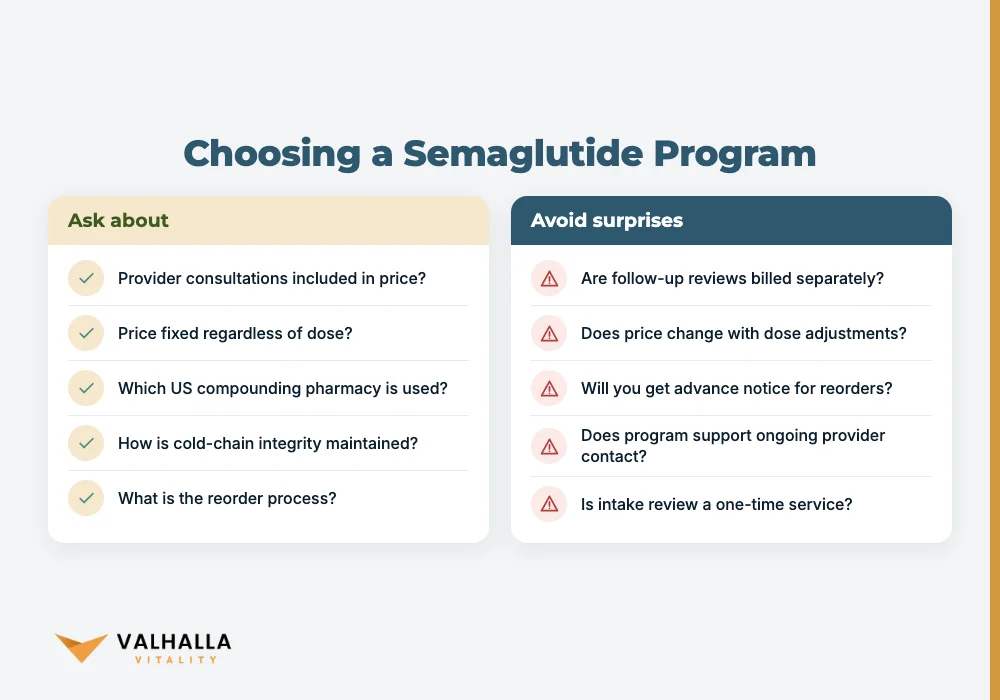
Cost is one dimension of program quality. Before committing, get clear answers to these questions.
- Does the stated monthly price include the provider consultation and follow-up reviews, or are those billed separately?
- Does the price change when the provider adjusts the dose, or is it fixed regardless of the formulation ordered?
- What US compounding pharmacy prepares the medication, and how is cold-chain integrity maintained during shipping?
- What does the reorder process look like, and will you receive advance notice before your supply runs out?
- Does the program support ongoing provider contact, or is the intake review a one-time service?
These questions address the most common reasons patients stop mid-treatment: unexpected fees, supply disruptions, and provider access that disappears after the first order. Clear answers before you start are worth more than any coupon code after you are already in the program. Availability varies by state.
Get started with a licensed provider review
Book Your Consultation to have a licensed provider review your intake and determine whether GLP-1 therapy is appropriate for your situation.
FAQ
How much does semaglutide cost per month?
Monthly semaglutide injection cost depends on the medication form, insurance coverage, and program structure. Brand-name products carry higher list prices than compounded options, and telehealth programs often bundle the provider review and delivery into the stated monthly fee, which makes accurate cost comparison easier once you know what each program actually includes.
Is semaglutide covered by insurance?
Many commercial plans cover semaglutide for type 2 diabetes, but coverage for weight management is inconsistently applied and usually requires prior authorization. Medicare and Medicaid have not historically covered GLP-1 therapy for weight management alone, and availability as well as coverage rules vary by state.
What is compounded semaglutide and why does it cost less?
Compounded semaglutide is prepared by a licensed 503A or 503B pharmacy rather than manufactured by a brand-name drug company, which means it is not subject to brand-name pricing. The monthly cost is typically lower as a result, though compounded drug products are not approved by the FDA for safety, effectiveness, or quality.
What is the cheapest way to get semaglutide?
For self-pay patients without qualifying insurance coverage, compounded GLP-1 through a telehealth provider is typically the most cost-accessible option because it bypasses brand pricing entirely. Manufacturer savings programs can reduce costs for commercially insured patients but explicitly exclude Medicare and Medicaid enrollees.
Does semaglutide injection cost change over time?
Yes. As a licensed provider adjusts the dose based on lab results and clinical response, the monthly fill price may shift. Titration phases often carry a different cost per fill than a stable maintenance dose, so planning across treatment phases gives a more accurate total-cost picture than looking at only the first month.
Sources
- Coon SA et al. (2018). Semaglutide once-weekly: improved efficacy with a new safety warning. Expert review of clinical pharmacology. PubMed
- Joshi SR et al. (2022). The role of oral semaglutide in managing type 2 diabetes in Indian clinical settings: Addressing the unmet needs. Diabetes & metabolic syndrome. PubMed
- Rasool ZK et al. (2026). CagriSema versus Semaglutide 2.4 mg monotherapy for weight management in adults with overweight or obesity, with or without type 2 diabetes: a systematic review, meta-analysis, and trial sequential analysis. Frontiers in endocrinology. PubMed
You May Also Like
 Semaglutide
 Cost: What Affects the Price and How to Plan
Semaglutide cost depends on insurance, formulation, and your provider. Learn what drives GLP-1 therapy pricing and how to plan for long-term access.
November 6, 2026 ETRead more → Semaglutide
 Sodium vs Semaglutide: Key Differences Explained
Semaglutide sodium vs semaglutide: how these GLP-1 formulations compare in structure, side effects, and what a provider weighs before prescribing.
November 5, 2026 ETRead more → Semaglutide
 Dose Weight Loss: A GLP-1 Dosing Guide
Semaglutide dose weight loss guide: learn how the GLP-1 titration schedule works, what side effects to expect, and how providers set your plan.
November 3, 2026 ETRead more →