
The following blog post is for entertainment and informational purposes only. It is not intended to provide medical advice or diagnosis. Please consult your doctor before making any health-related decisions.
Semaglutide fat loss works through a multi-step GLP-1 mechanism, not a single lever. The therapy activates hormone receptors that suppress hunger, slow gastric emptying, and alter how the body manages stored energy. These overlapping effects explain why people who pursue semaglutide for weight loss often see changes in body shape and composition, not just a lower number on the scale. A licensed provider determines whether this approach is appropriate after reviewing your intake and lab results.
How semaglutide fat loss works
GLP-1 is a gut hormone released after eating. It signals fullness to the brain, slows food passage through the stomach, and influences how the body uses energy. Semaglutide mimics this hormone but with a far longer half-life, so the appetite-suppressing signal persists well beyond a single meal.
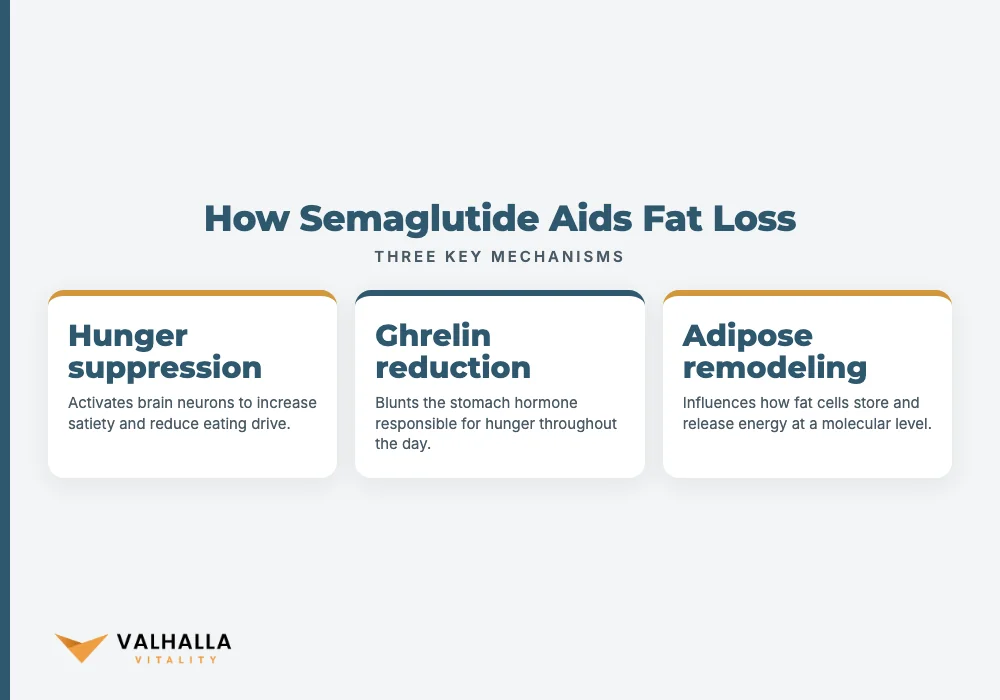
Three mechanisms drive the semaglutide fat loss effect:
- Hunger suppression via POMC neurons. Semaglutide activates proopiomelanocortin (POMC) neurons in the hypothalamus, increasing satiety signals and reducing the drive to eat between meals. This central pathway is the primary GLP-1 weight loss mechanism identified in current research (Moiz et al., 2025).
- Ghrelin reduction. Ghrelin is the stomach hormone responsible for hunger. Semaglutide blunts ghrelin secretion, so baseline hunger is lower throughout the day, not just immediately after a meal.
- Adipose tissue remodeling. GLP-1 receptor activation influences how fat cells store and release energy at the molecular level. A 2026 study found that semaglutide promotes adipose tissue remodeling through mechanisms that extend beyond glucose regulation (Ábel et al., 2026).
These pathways work together to create a sustained caloric deficit. The practical difference from standard dieting is that the deficit is maintained physiologically, not through willpower alone.
Does semaglutide burn fat directly?
No. Semaglutide does not dissolve or destroy fat cells. What it does is create the hormonal and behavioral conditions that allow fat loss to accumulate.
By lowering hunger and slowing gastric emptying, GLP-1 therapy reduces calorie intake consistently. Fat cells shrink as stored lipids are released and metabolized. They do not disappear in large numbers during a treatment cycle, but over time the overall fat mass decreases as each cell holds less stored energy.
A 2026 systematic review in Annals of Internal Medicine found that incretin-based approaches shift body composition by changing the ratio of fat mass to lean mass over time (Batsis et al., 2026). The fat reduction is real. The mechanism is energy balance.
How does semaglutide reduce body fat?
Semaglutide reduces body fat through semaglutide hunger suppression combined with direct effects on energy metabolism. The therapy changes the hormonal environment so that eating less feels manageable rather than forced.
When calorie intake drops consistently, the body preferentially burns stored fat for fuel. This effect is amplified because GLP-1 receptors exist not only in the gut and brain but in adipose tissue itself. A 2025 review in Clinical Nutrition ESPEN documented metabolic effects of semaglutide beyond weight loss, including effects on lipid metabolism and fat tissue behavior (Sokary et al., 2025).
The result is a shift in semaglutide body composition over time. The ratio of fat to lean mass changes, particularly when physical activity is maintained during treatment. Whether you track body fat percentage ranges or waist circumference, the underlying mechanism is the same sustained hormonal effect. The response builds over weeks as the caloric deficit accumulates and the hormonal environment stabilizes.
Does semaglutide speed up metabolism?
Semaglutide does not raise metabolism the way a stimulant does. The semaglutide metabolism boost is more subtle: it works by limiting the metabolic slowdown that typically accompanies calorie restriction.
Weight loss from dieting alone often triggers a drop in resting metabolic rate. The body adapts by burning fewer calories at rest to conserve energy. GLP-1 receptor agonists appear to partially offset this adaptation. Sokary et al. (2025) found that semaglutide's metabolic impact extends to energy expenditure and substrate utilization, not just appetite suppression.
There is also a downstream effect. As insulin sensitivity improves and visceral fat decreases, the metabolic environment shifts toward more efficient fat oxidation. For people who have hit weight loss plateaus on previous diets, this metabolic preservation may be one of the more meaningful aspects of semaglutide treatment. For context on how hormonal status affects metabolic rate, the piece on testosterone and metabolic function covers related ground.
Does semaglutide reduce visceral fat?
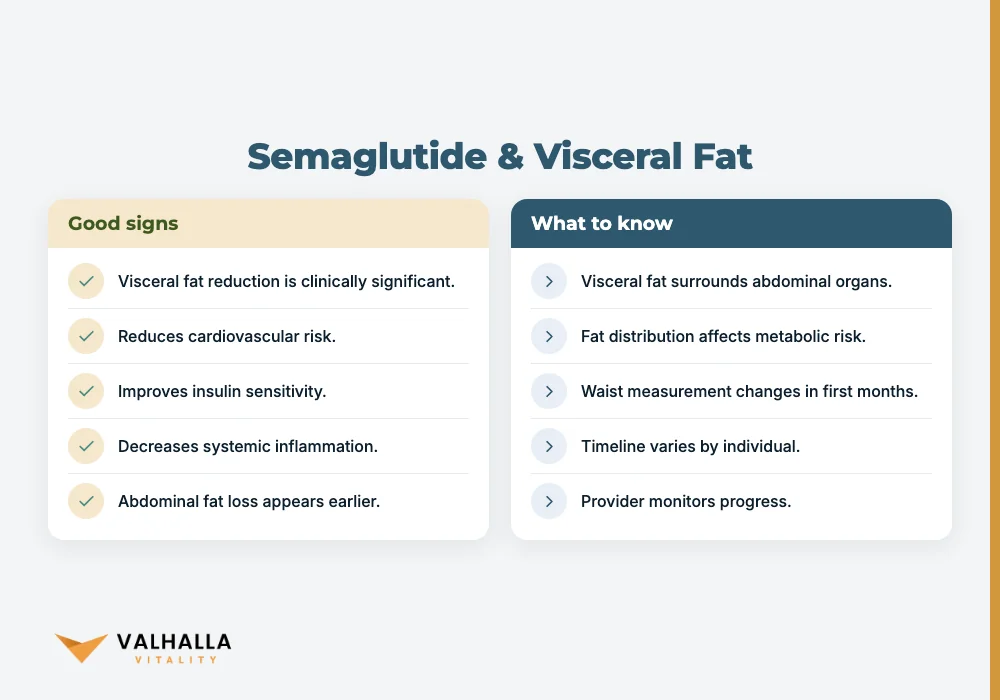
Yes. Semaglutide visceral fat reduction is one of the most clinically significant effects of this therapy.
Visceral fat surrounds the abdominal organs. Unlike subcutaneous fat just under the skin, it is metabolically active in ways that raise cardiovascular risk, impair insulin sensitivity, and drive systemic inflammation. A reduction in semaglutide belly fat typically reflects a meaningful decrease in visceral fat mass specifically, not just surface-level changes.
The semaglutide body composition shift matters because fat distribution determines metabolic risk independently of total body weight. A 2024 paper found that BMI alone misrepresents metabolic risk in many adults (Wu et al., 2024), which is why providers track waist circumference and fat distribution alongside scale weight. The 2026 systematic review by Batsis et al. confirmed that incretin-based weight loss produces effects on abdominal fat distribution that go beyond what total weight reduction alone would predict.
How long does it take semaglutide to burn belly fat?
Changes in waist measurement typically become noticeable within the first few months of treatment. Semaglutide fat loss in the abdominal region tends to appear earlier than reductions in subcutaneous fat elsewhere, because visceral fat is more metabolically responsive to a sustained energy deficit.
The timeline varies by individual physiology, starting body composition, activity level, and dietary habits. A licensed provider sets the dose and monitors progress over time. Body composition changes continue for as long as the caloric deficit is maintained.
Semaglutide fat loss and lean mass
One practical concern with significant weight loss is the risk of losing lean muscle alongside fat. Lean mass loss affects long-term metabolic rate and physical function.
A 2024 systematic review examined the effect of semaglutide on lean mass across clinical trials (Bikou et al., 2024). The finding is nuanced: GLP-1 therapy tends to produce a smaller lean mass loss relative to total weight lost compared with calorie restriction alone, but lean mass preservation still requires active attention to protein intake and resistance exercise. For physically active patients, adequate dietary protein combined with GLP-1 therapy creates conditions that support body recomposition rather than simple scale weight reduction.
Providers assess progress through markers beyond scale weight, including body composition measurements. Understanding what to expect throughout your treatment helps you set realistic benchmarks before you start.
Working with a provider
Semaglutide fat loss is not a self-directed process. The dose is set by a licensed provider after reviewing medical intake, lab results, and health history. How dose decisions are reached depends on clinical factors that differ from person to person.
Treatment begins with an online medical intake covering health history, current medications, and relevant lab values. The provider uses this information to determine eligibility and set an initial dose. The therapy is typically paired with dietary guidance and activity recommendations, because the hormonal changes semaglutide produces are most effective when supported by consistent habits.
At Valhalla Vitality, provider review happens within 24 business hours of completing intake, and prescriptions typically reach their destination within approximately 3 to 7 business days. Availability varies by state. Progress monitoring is ongoing. Body composition changes develop over months, and dose adjustments are made based on response.
Ready to take the next step?
Speak with a licensed provider to find out whether GLP-1 therapy fits your health profile. Book Your Consultation to get started.
FAQ
Does semaglutide target belly fat specifically?
Semaglutide does not target belly fat exclusively, but visceral abdominal fat tends to respond earlier than other fat deposits because it is more metabolically active. Reductions in waist circumference are a common early marker of progress.
Does semaglutide cause muscle loss?
GLP-1 therapy can lead to some lean mass loss alongside fat loss, but clinical reviews suggest the ratio of fat to lean mass lost is more favorable than with calorie restriction alone. Adequate protein intake and resistance exercise support muscle preservation during treatment.
How soon do semaglutide results appear?
Changes in appetite and fullness often become noticeable within the first few weeks of treatment. Measurable shifts in body fat and waist circumference typically become visible over several months of consistent use.
Does semaglutide fat loss last after stopping?
The fat loss achieved with GLP-1 therapy may not be maintained if treatment ends without sustaining the dietary and activity habits developed during it. The therapy makes those habits easier to maintain while active but does not permanently reset the body's baseline.
Sources
- Batsis JA et al. (2026). Effect of Incretin-Based and Nonpharmacologic Weight Loss on Body Composition: A Systematic Review. Annals of Internal Medicine. PubMed
- Ábel T et al. (2026). Semaglutide-Mediated Remodeling of Adipose Tissue in Type 2 Diabetes: Molecular Mechanisms Beyond Glycemic Control. International Journal of Molecular Sciences. PubMed
- Wu Y et al. (2024). Advantages and Limitations of the Body Mass Index (BMI) to Assess Adult Obesity. International Journal of Environmental Research and Public Health. PubMed
- Bikou A et al. (2024). A systematic review of the effect of semaglutide on lean mass: insights from clinical trials. Expert Opinion on Pharmacotherapy. PubMed
- Sokary S et al. (2025). Exploring beyond numeric weight loss: The metabolic effects of semaglutide. Clinical Nutrition ESPEN. PubMed
- Moiz A et al. (2025). Mechanisms of GLP-1 Receptor Agonist-Induced Weight Loss: A Review of Central and Peripheral Pathways in Appetite and Energy Regulation. The American Journal of Medicine. PubMed
You May Also Like
 Semaglutide
 Peptide: GLP-1 Mechanism, Effects, and Uses
Semaglutide peptide is a GLP-1 receptor agonist that regulates blood sugar and appetite, and may support weight loss. Discover how it works.
November 12, 2026 ETRead more → Semaglutide
 Cost: What Affects the Price and How to Plan
Semaglutide cost depends on insurance, formulation, and your provider. Learn what drives GLP-1 therapy pricing and how to plan for long-term access.
November 6, 2026 ETRead more → Semaglutide
 Sodium vs Semaglutide: Key Differences Explained
Semaglutide sodium vs semaglutide: how these GLP-1 formulations compare in structure, side effects, and what a provider weighs before prescribing.
November 5, 2026 ETRead more →