
The following blog post is for entertainment and informational purposes only. It is not intended to provide medical advice or diagnosis. Please consult your doctor before making any health-related decisions.
Tadalafil belongs to the pharmacological category known as phosphodiesterase type 5 (PDE5) inhibitors, and understanding the tadalafil drug class starts with one enzyme. When PDE5 is blocked, a signaling molecule called cyclic guanosine monophosphate (cGMP) accumulates in smooth muscle cells. Blood vessels relax and widen. Blood flow increases to tissues where PDE5 is most concentrated, including the penis, the lungs, and the prostate. If you are researching erectile dysfunction treatment options, knowing where tadalafil fits within its drug class gives you a stronger foundation before speaking with a licensed provider.
What drug class is tadalafil?
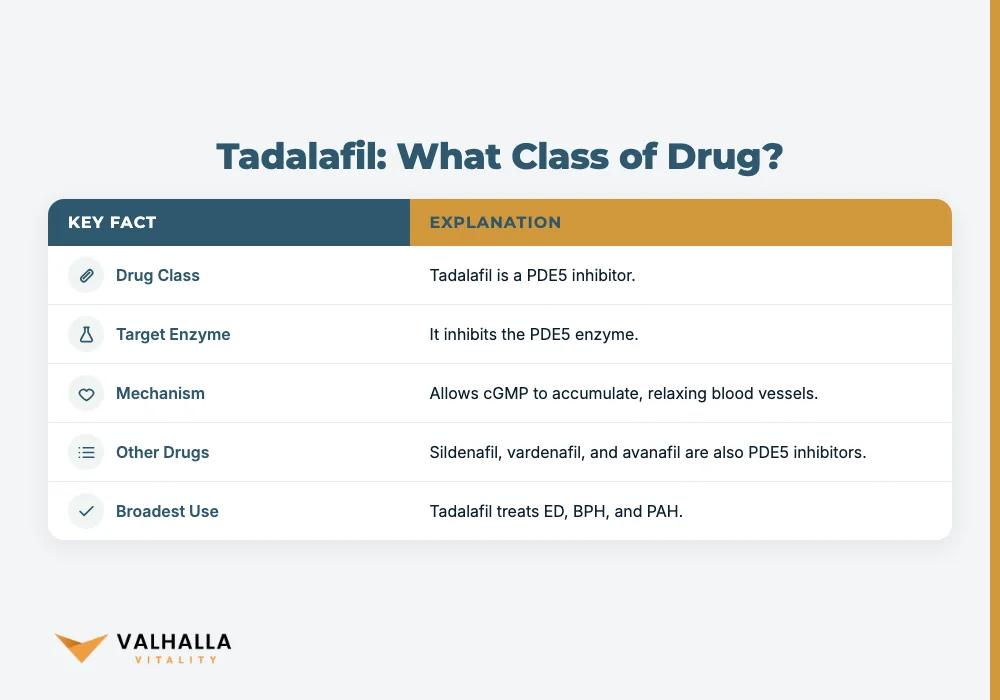
Tadalafil is a PDE5 inhibitor. That classification tells you the drug's biochemical target, its mechanism, and its therapeutic logic all at once.
The PDE5 enzyme is concentrated in smooth muscle cells lining specific blood vessels: those in penile arteries, pulmonary arteries, the prostate, and certain peripheral tissues. By inhibiting this enzyme, drugs in the tadalafil drug class allow cGMP to accumulate. That accumulation keeps blood vessels in those locations relaxed and dilated. The selectivity for PDE5-rich tissues is what makes this class effective for a narrow set of conditions rather than functioning as a broad systemic vasodilator.
Three other drugs share this classification: sildenafil (Viagra), vardenafil (Levitra), and avanafil (Stendra). Together, they form the PDE5 inhibitors list currently approved for clinical use.
Understanding the classification has practical implications beyond pharmacology. When a provider says "PDE5 inhibitor," they are identifying the drug's target enzyme, its mechanism of action, and the conditions for which evidence exists. Patients who know this can ask more focused questions: which PDE5 inhibitor, why that one over others, and how it interacts with their current medications.
The tadalafil drug class within PDE5 inhibitors
| Drug | Common brand | Approved indications |
|---|---|---|
| Tadalafil | Cialis / Adcirca | ED, BPH, PAH |
| Sildenafil | Viagra / Revatio | ED, PAH |
| Vardenafil | Levitra | ED |
| Avanafil | Stendra | ED |
Tadalafil has the broadest approved indication set within the class. This is clinically significant because BPH and ED frequently coexist in older men, and no other PDE5 inhibitor treats both.
Each drug in this list of erectile dysfunction medication types works through the same cGMP pathway. They differ in how long they remain active in the body, how food and other substances affect absorption, and which clinical conditions fall within their approved use.
How does the tadalafil drug class work in the body?
The tadalafil drug class works by interrupting the normal degradation cycle of a key signaling molecule. Here is the sequence that describes the tadalafil mechanism of action.
Sexual stimulation triggers nitric oxide release in blood vessel walls. That nitric oxide activates guanylate cyclase, an enzyme that produces cGMP. The cGMP signals smooth muscle cells to relax. Vessel walls widen. Blood flow increases to the targeted tissue.
Normally, PDE5 would break down cGMP and suppress this effect. Tadalafil blocks PDE5. The cycle stays open longer, and tadalafil blood flow effects persist well past what would occur naturally.
This is not a mechanism that works in isolation. Tadalafil does not cause an erection on its own. Physical or psychological arousal is required to initiate the nitric oxide signal first. Without that signal, there is no cGMP cascade to extend. This distinction matters for patients who sometimes expect the drug to act independent of arousal.
The same mechanism that explains how tadalafil works for ED also explains its effects in other tissues. In pulmonary arteries, reduced PDE5 activity lowers vascular resistance and reduces the pressure the right side of the heart must work against. In the prostate and bladder, smooth muscle relaxation reduces the outflow resistance that causes BPH symptoms. Same drug, same enzyme target, different organs.
A 2025 review in the Journal of the Chinese Medical Association by Lan et al. analyzed tadalafil's effects on the nitric oxide and cGMP pathway in cardiac tissue, finding potential benefits in heart failure with preserved ejection fraction (HFpEF) and reduced exercise tolerance in certain cardiac conditions ([S2]). This extends the mechanistic story well beyond the three currently approved indications and suggests that how tadalafil works in the body is still being fully mapped.
Understanding the biochemistry also explains why certain drug combinations are dangerous, particularly with nitrates. This is covered in detail below.
What conditions does tadalafil treat?
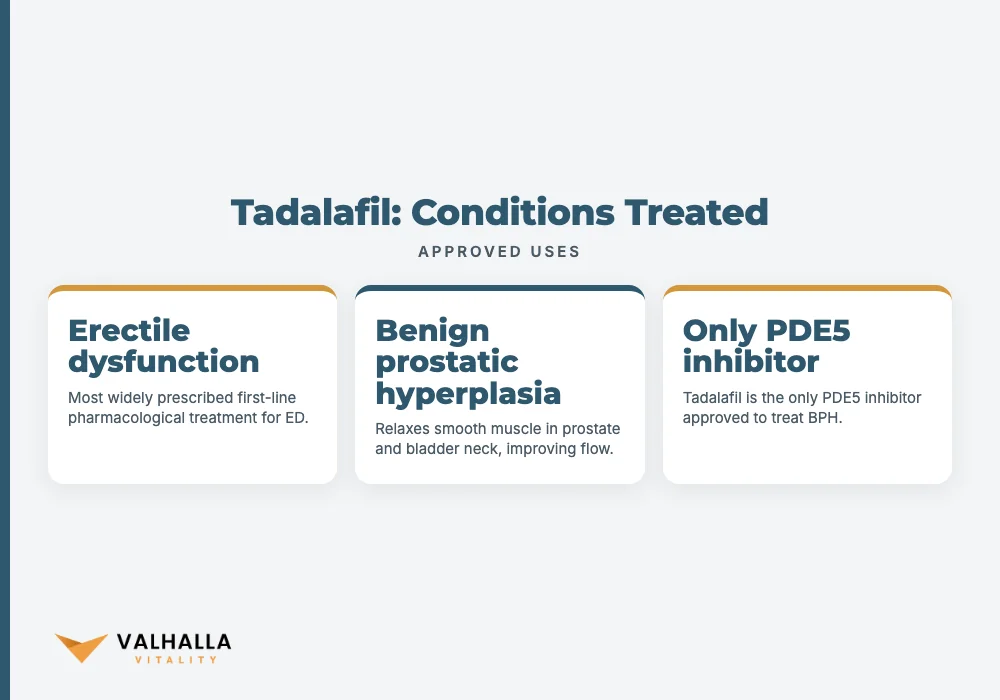
The tadalafil drug class is approved for three conditions and is studied in several others. Each involves a tissue where PDE5 is active and blood flow or vascular resistance is clinically meaningful.
Erectile dysfunction. This is the primary and most established use. PDE5 inhibitors are the most widely prescribed first-line pharmacological treatment for ED. By increasing blood flow to erectile tissue during arousal, tadalafil helps men achieve and maintain erections. A provider reviewing your intake will determine whether ED has an underlying cause that warrants further workup before writing a prescription.
Benign prostatic hyperplasia (BPH). BPH is a non-cancerous enlargement of the prostate gland that commonly develops in men past middle age. The enlarged gland presses against the urethra and causes symptoms such as a weakened urine stream, frequent urination, the urge to wake at night, and the feeling of incomplete bladder emptying. Tadalafil relaxes smooth muscle in the prostate and bladder neck, reducing outflow resistance and improving flow.
Urinary symptoms from BPH and ED often appear in the same patient. Because both conditions involve smooth muscle tissue in the pelvic region and are partly driven by impaired vascular function, treating them with a single agent that acts through PDE5 is clinically logical. Evaluating tadalafil for BPH requires a provider to assess symptom severity, comorbid ED, and the full medication list. Research from Greco et al. (2022) in the International Journal of Molecular Sciences found that tadalafil's effects in prostatic tissue involve interactions with steroid hormones in ways that go beyond vascular relaxation alone ([S4]).
Tadalafil is the only PDE5 inhibitor approved to treat BPH. The long-term evidence for daily tadalafil documents how sustained use may support both urinary function and erectile response over time.
Pulmonary arterial hypertension (PAH). PAH involves elevated blood pressure in the arteries supplying the lungs. It increases right heart workload and reduces exercise tolerance significantly. Tadalafil can reduce pulmonary vascular resistance by relaxing smooth muscle in those arteries. A 2018 Bayesian network meta-analysis published in Drug Delivery by Wang et al. evaluated 18 targeted drugs for PAH and confirmed that PDE5 inhibitors are among the evidence-supported pharmacological options in this condition ([S1]).
Raynaud's phenomenon. This condition causes extreme sensitivity of the fingers and toes to cold, sometimes with painful vasospasms. Tadalafil may reduce the frequency and severity of episodes by improving blood flow to peripheral tissues. Use in Raynaud's is off-label and determined by individual clinical assessment.
Altitude-related conditions. Rapid ascent to high altitude can place unusual strain on the lungs and cardiovascular system as the body adjusts to reduced oxygen. Tadalafil's pulmonary vasodilatory effects have been studied in this context, and the drug may reduce that strain in susceptible individuals.
At Valhalla Vitality, a licensed provider reviews your intake and medical history before determining whether tadalafil is appropriate. Provider approval typically occurs within 24 business hours of order placement.
How is tadalafil different from Viagra?
Both tadalafil and sildenafil (Viagra) belong to the tadalafil drug class of PDE5 inhibitors. Both work through cGMP elevation and smooth muscle relaxation. The clinical differences between tadalafil vs sildenafil lie in their approved indications and practical profiles, not in their shared biochemistry.
Approved indications. Tadalafil is the only PDE5 inhibitor approved to treat BPH. Sildenafil is not approved for BPH. Both have approval for ED and PAH, though they carry different brand names for the PAH indication. For a man experiencing both ED and urinary symptoms from an enlarged prostate, tadalafil is the only single agent in this drug class that may address both conditions.
Clinical decision-making. The tadalafil vs sildenafil decision often comes down to the patient's full condition profile. If BPH is part of the picture, tadalafil is the only option in the class. If the patient has certain cardiac conditions or takes specific medications, the interaction and side-effect profile of each drug may become the deciding factor. Neither is universally superior for ED.
For a comprehensive look at how these two drugs compare on duration, food interaction, and clinical outcomes data, the tadalafil and sildenafil comparison covers the evidence side by side. A provider reviewing your complete health profile can weigh these differences and determine which PDE5 inhibitor, if any, is appropriate.
Is tadalafil safe for daily use?
Daily tadalafil is not an off-label experiment. It is the standard clinical approach for BPH and PAH, where consistent drug levels are therapeutically necessary. For ED, daily use is also an established option for patients who prefer continuous coverage over timing doses in advance.
The safety profile of daily tadalafil has been studied across multiple clinical trials. That said, "safe for daily use" is not a universal claim. It depends on the individual's cardiovascular status, kidney and liver function, and co-medications.
Cardiovascular considerations carry the most weight. Tadalafil produces a modest decrease in blood pressure as a consequence of its vasodilatory mechanism. For most patients with normal cardiovascular function, this is clinically manageable. For those taking nitrates or certain cardiac medications, it represents a contraindication that dose adjustment alone cannot resolve.
Before recommending daily use, a provider typically reviews kidney and liver function, since these govern how tadalafil is metabolized and cleared. Blood pressure and cardiovascular history are assessed. A complete and current medication list is essential, particularly any cardiac medications, antihypertensives, or antifungals affecting the CYP3A4 enzyme.
A 2025 review by Lan et al. in the Journal of the Chinese Medical Association noted signals of beneficial cardiovascular effects with long-term tadalafil use in heart failure research ([S2]). These findings are under investigation and are not currently part of approved clinical guidance.
The safety picture also differs by patient population. Research on tadalafil for women reflects a meaningfully different evidence base and clinical reasoning compared to the established male indications, and provider-guided assessment is essential for any patient outside the established clinical populations.
A licensed provider determines the appropriate regimen after reviewing your complete health picture. That determination considers more than just the absence of a contraindication.
Drug interactions to know before you start
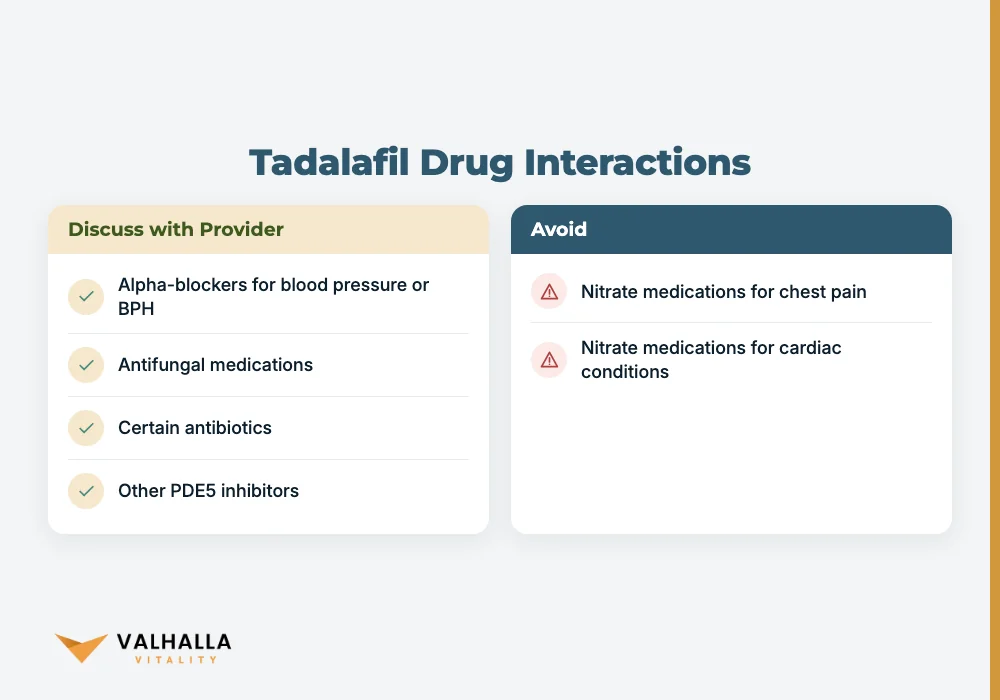
This is one of the most clinically important areas in any tadalafil drug class overview. Certain combinations are genuinely dangerous. Others require adjustment and monitoring. All require disclosure to a licensed provider before the first prescription is written.
The interactions associated with the tadalafil drug class follow logically from its mechanism. Any medication that also dilates blood vessels or reduces blood pressure through a converging pathway creates additive effects. That additive potential is what makes certain combinations dangerous rather than merely inconvenient.
Nitrates. This is the most critical interaction. Nitrate medications, prescribed for chest pain and certain cardiac conditions, also act through the nitric oxide pathway. Combining them with tadalafil produces a potentially severe additive drop in blood pressure. This is a contraindication. The two must not be taken together under any circumstance, regardless of timing or amount.
Alpha-blockers. Alpha-blockers treat both high blood pressure and BPH. Combined with tadalafil, they can compound blood-pressure lowering and cause dizziness, lightheadedness, or fainting. Providers managing patients on alpha-blockers while considering tadalafil need to review the full regimen. In some cases, tadalafil replaces the alpha-blocker as a single-agent approach to BPH, but that transition requires clinical oversight.
Other PDE5 inhibitors. Taking two drugs from the same class simultaneously is not recommended. The benefit does not scale with the combination, while the risk of adverse effects does.
CYP3A4 inhibitors. Some antifungal medications and certain antibiotics inhibit CYP3A4, the liver enzyme primarily responsible for metabolizing tadalafil. When this enzyme is blocked, tadalafil can accumulate to higher blood concentrations than intended, increasing side effect risk. A complete and accurate medication list at intake is essential for this reason.
Grapefruit. Grapefruit and grapefruit juice can interfere with the same metabolic pathway. The practical effect on tadalafil blood levels is variable, but the standard guidance is to avoid grapefruit during treatment.
For the full picture of tadalafil adverse effects and drug interaction risk, including symptoms to watch for and when to contact a provider, the dedicated resource covers what patients need to know.
What current research shows about tadalafil
Scientific investigation of the tadalafil drug class continues to expand beyond its three approved indications. Several threads are worth noting.
Cardiovascular applications. A 2025 review by Lan et al. in the Journal of the Chinese Medical Association examined tadalafil's potential in cardiovascular disease, particularly heart failure with preserved ejection fraction (HFpEF) and exercise tolerance in cardiac patients ([S2]). The nitric oxide and cGMP pathway that explains tadalafil's approved indications appears to have broader cardiac relevance than current labeling captures. This is investigational and has not yet changed clinical guidelines.
Tissue-level hormone interactions. Greco et al. (2022) in the International Journal of Molecular Sciences analyzed tadalafil's interactions with steroid hormones in adipose tissue, bone, and prostate cells ([S4]). Their findings indicate that tadalafil's effects in prostatic tissue involve hormonal signaling pathways in addition to vascular relaxation. The clinical implications for long-term BPH management are still under investigation.
Optimizing PAH treatment. The 2018 network meta-analysis by Wang et al. evaluated 18 targeted agents for PAH and placed PDE5 inhibitors in comparative perspective against other drug classes ([S1]). Current research continues to refine which patients benefit most from PDE5 inhibitors for PAH and how they should be sequenced with other agents.
Alternative delivery formats. Researchers are studying sublingual and topical formulations of tadalafil. These formats may offer faster onset or reduced systemic exposure compared to oral tablets, with potential applications for patients who respond suboptimally to conventional dosing.
Combination approaches. Some studies are exploring tadalafil combined with regenerative therapies for ED, including stem cell applications. The working hypothesis is that tadalafil's vascular effects could support tissue repair in patients with severe vascular contributions to ED. This research is early-stage and is not part of current clinical practice.
As the evidence base grows, clinical applications for the tadalafil drug class may expand. Provider oversight remains essential as new evidence emerges, since each indication involves a different patient population and risk profile.
Ready to find out if tadalafil is right for you?
A licensed provider reviews your intake and determines whether tadalafil is appropriate for your health picture. Book Your Consultation to take the first step.
FAQ
What drug class is tadalafil?
Tadalafil belongs to the PDE5 inhibitors drug class, formally phosphodiesterase type 5 inhibitors. Other drugs in this class include sildenafil (Viagra), vardenafil (Levitra), and avanafil (Stendra), all of which share the same core mechanism of blocking PDE5 to elevate cGMP and relax blood vessel walls.
How does tadalafil work in the body?
Tadalafil blocks the PDE5 enzyme, which prevents it from breaking down cGMP in smooth muscle cells. Elevated cGMP causes vessel walls to relax and widen, increasing blood flow to targeted tissues such as penile arteries and pulmonary vessels. The process requires an initial trigger, such as sexual stimulation, to generate the nitric oxide signal that starts the cGMP cascade.
What conditions does tadalafil treat?
Tadalafil is approved for erectile dysfunction, benign prostatic hyperplasia (BPH), and pulmonary arterial hypertension (PAH). It is also used in clinical practice for Raynaud's phenomenon and altitude-related symptoms. A licensed provider determines whether it is appropriate for a specific individual after reviewing their intake.
How is tadalafil different from Viagra?
Both tadalafil and sildenafil (Viagra) are PDE5 inhibitors working through the same cGMP mechanism. The key clinical difference is that tadalafil is the only PDE5 inhibitor approved to treat BPH as well as ED, making it the preferred choice when both conditions are present. They also differ in duration of action and food interaction profiles.
Is tadalafil safe for daily use?
Daily tadalafil is an established regimen for BPH and PAH management and is also an option for ED when continuous coverage is preferred over on-demand dosing. Safety depends on the individual's cardiovascular health, kidney function, and co-medications. A licensed provider determines whether daily use is appropriate after reviewing your complete health picture.
Sources
- Wang S et al. (2018). A Bayesian network meta-analysis on the efficacy and safety of eighteen targeted drugs or drug combinations for pulmonary arterial hypertension. Drug Delivery. PubMed
- Lan TY et al. (2025). Potential beneficial impacts of tadalafil on cardiovascular diseases. Journal of the Chinese Medical Association. PubMed
- Greco EA et al. (2022). Tadalafil and Steroid Hormones Interactions in Adipose, Bone and Prostate Tissues: Focus on Translational Perspectives. International Journal of Molecular Sciences. PubMed
You May Also Like
 Tadalafil
Avanafil vs Tadalafil: ED Medication Comparison Guide
Avanafil vs tadalafil compared: onset speed, duration, side effects, and when to choose each. See which ED medication fits your needs and lifestyle.
November 12, 2026 ETRead more → Tadalafil
 vs Sildenafil: Duration, Onset, and How to Choose
Tadalafil vs sildenafil: compare onset time, how long each lasts, side effects, and food interactions to find the right ED medication for you.
November 11, 2026 ETRead more → Tadalafil
 Weight Loss: What the Research Actually Shows
Tadalafil weight loss connections run through cGMP, fat cell biology, and insulin sensitivity. Here's what research shows and what it doesn't.
November 11, 2026 ETRead more →