
The following blog post is for entertainment and informational purposes only. It is not intended to provide medical advice or diagnosis. Please consult your doctor before making any health-related decisions.
Both tadalafil and Viagra (sildenafil) treat erectile dysfunction by blocking the same enzyme, yet the tadalafil vs Viagra choice comes down to one practical question: how long do you want the medication to remain active? Tadalafil can stay effective for up to 36 hours; sildenafil's window runs four to five hours. That duration gap shapes timing, spontaneity, and whether a daily tadalafil approach makes clinical sense for a given person. Neither drug is universally superior, because a licensed provider weighs health history, concurrent medications, and lifestyle before recommending either.
Tadalafil vs Viagra at a glance
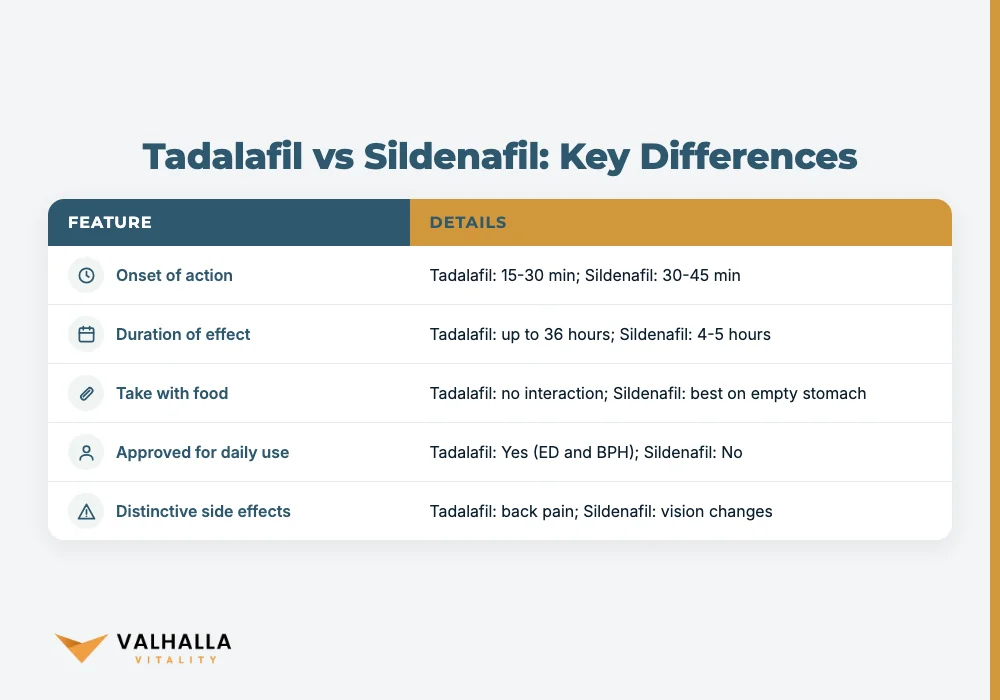
Before going deeper, the table below summarizes the most useful clinical differences. Doses are not listed because a licensed provider determines the appropriate dose after reviewing labs and intake.
| Feature | Tadalafil (generic Cialis) | Sildenafil (generic Viagra) |
|---|---|---|
| Year approved | 2003 | 1998 |
| Onset of action | 15 to 30 minutes | About 30 to 45 minutes |
| Duration of effect | Up to 36 hours | 4 to 5 hours |
| Take with food | No significant interaction | Best on an empty stomach |
| Approved for daily use | Yes (ED and BPH) | No |
| Generic available in US | Yes | Yes |
| Drug class | PDE5 inhibitor | PDE5 inhibitor |
| Distinctive added side effects | Back pain, muscle aches | Vision changes, nasal congestion |
The cialis vs viagra differences shown above provide a starting frame, but the full picture includes drug interactions, off-label research, and what each molecule does beyond ED treatment.
How do PDE5 inhibitors work?
Tadalafil and sildenafil both belong to a drug class called phosphodiesterase type 5 (PDE5) inhibitors. PDE5 is an enzyme that breaks down a key signaling molecule in the walls of arterial smooth muscle. When PDE5 is blocked, that signaling molecule accumulates, arterial smooth muscle in the penis relaxes, and blood flow increases enough to support an erection when arousal is present. Neither drug produces an erection on its own. Arousal comes first. The drug amplifies the physiological response already under way.
Sildenafil received regulatory approval for erectile dysfunction in March 1998, the first drug of its class. Tadalafil followed in November 2003. A 2019 review in the International Journal of Impotence Research documented how PDE5 inhibitors transformed ED care from a surgical or injection-dependent specialty into an outpatient concern within roughly a decade, with tadalafil's extended duration marking the most clinically significant pharmacological advance within the class (Gonzalez-Cadavid et al., 2019).
The duration difference comes from how long each drug lingers in the body. Tadalafil has a substantially longer half-life than sildenafil, which is why sildenafil's effects fade within four to five hours while tadalafil can remain active for up to 36. That longer persistence also makes continuous daily tadalafil pharmacologically viable: the compound maintains a steady therapeutic level in the bloodstream without needing to spike before each encounter.
One structural note matters specifically for side effects. Tadalafil also inhibits an enzyme found in skeletal muscle called PDE11, which explains the back and muscle aches some men report with tadalafil but rarely with sildenafil. Sildenafil has modest activity against a retinal enzyme called PDE6, which explains the mild visual changes (a blue tint or increased light sensitivity) more common with sildenafil than with tadalafil. These selectivity differences are not minor; they are the mechanical reason the two drugs produce somewhat different side effect profiles despite sharing the same primary target.
Is tadalafil better than Viagra for erectile dysfunction?
Neither drug is objectively better. Both produce similar erection response rates in clinical comparisons, and both appear as first-line treatments in major urology guidelines. The tadalafil vs Viagra debate is not about which one works; it is about which one fits a particular person's life.
Tadalafil offers one clear practical advantage: flexibility. Because it stays active for up to 36 hours, there is no need to plan sex around a narrow dosing window. For couples with unpredictable schedules, that removes a low-grade planning pressure many men find distracting. The option of continuous daily dosing takes that convenience a step further still.
Sildenafil's advantage is onset. It can begin working within 30 minutes in most men, while tadalafil takes 15 to 30 minutes at minimum and can take longer to reach peak effect. If sex is planned within the hour, sildenafil may feel more reliably "on demand." It also carries the longer real-world track record, having been in widespread clinical use since 1998.
No honest answer exists to the question of which is the best ED medication for men as a universal statement. A man with early ED who plans encounters in advance may find sildenafil entirely sufficient. A man with both ED and benign prostatic hyperplasia who wants one medication to address both conditions has a clinical argument for tadalafil. Provider review captures nuances that any comparison article cannot.
How long does tadalafil last compared to Viagra?
Tadalafil can remain clinically effective for up to 36 hours after a single dose, a window wide enough that patients often call it "the weekend pill." Sildenafil works for four to five hours. That gap is the most cited difference in the tadalafil vs Viagra comparison, in both clinical literature and patient conversations.
The gap reflects how differently each drug is cleared from the body, not a difference in peak potency. Food creates a related asymmetry. A high-fat meal can delay sildenafil's time to peak concentration, cutting into an already-narrow effective window; tadalafil's absorption runs at essentially the same rate whether taken with or without food. Sildenafil's prescribing literature specifically recommends taking it on an empty stomach or with a light meal. Tadalafil carries no such instruction.
The practical implication of that duration gap matters for men with busy or variable schedules. Sildenafil users need to track time carefully: too early and the drug peaks before activity; too late and the effective window may already be fading. Tadalafil's 36-hour window is wide enough that the same dose, taken in the evening, can remain active the following afternoon, removing the guesswork.
Alcohol adds a similar layer. Sildenafil's blood pressure-lowering activity is enhanced by alcohol more than tadalafil's, which matters for both safety and reliability of effect in real-world conditions.
For men thinking about how duration connects to the vascular research on long-term tadalafil use, the clinical literature adds another dimension beyond the question of when to take the next dose.
What is the difference between tadalafil and sildenafil?
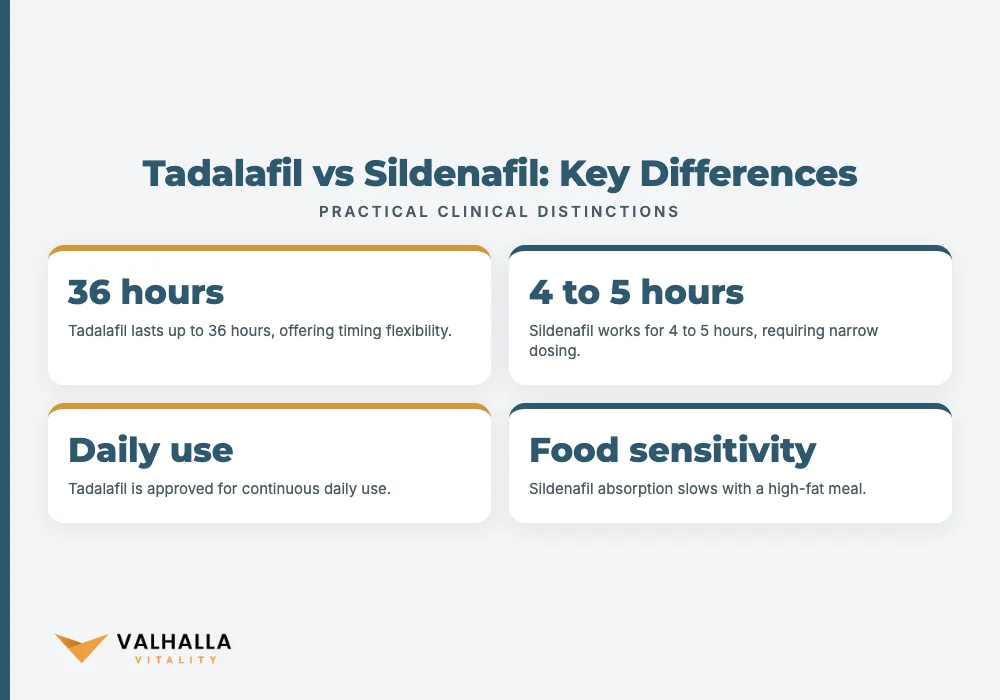
Tadalafil and sildenafil are both PDE5 inhibitors that treat erectile dysfunction, but they differ in duration, food requirements, and approved uses. Tadalafil lasts up to 36 hours and can be taken daily; sildenafil works for four to five hours and requires dosing on an empty stomach. The sildenafil vs tadalafil distinction continues from chemistry into everyday practice. Understanding those structural differences is what makes the tadalafil vs Viagra duration gap predictable rather than arbitrary.
Both molecules inhibit PDE5, but they are structurally distinct with different binding affinities and different metabolic pathways. Tadalafil is metabolized primarily through the CYP3A4 liver enzyme; sildenafil uses both CYP3A4 and a secondary pathway. That metabolic difference changes which drugs can interfere with each when taken together and can influence how a provider manages interactions for a given patient.
Generic versions of both are now available in the United States, which has dramatically reduced costs for cash-pay patients compared to the original branded versions. For a detailed look at how the branded and generic versions compare in terms of formulation and bioequivalence, there is additional coverage on this site.
The practical clinical differences include:
- Timing flexibility: tadalafil's long duration means no narrow dosing window; sildenafil should be taken 30 to 45 minutes before sexual activity
- Food sensitivity: sildenafil's absorption slows meaningfully with a high-fat meal; tadalafil has no meaningful food restriction
- Daily use approval: tadalafil carries a recognized indication for continuous daily use in addition to as-needed use; sildenafil has only as-needed approval
- Approved conditions: tadalafil is approved for erectile dysfunction, benign prostatic hyperplasia, and pulmonary arterial hypertension; sildenafil is approved for erectile dysfunction and pulmonary arterial hypertension
- Side effect type: tadalafil is more associated with back pain and muscle aches; sildenafil more commonly causes blue-tinted vision and nasal congestion
Both drugs carry the same absolute contraindication: neither should be combined with nitrate medications (used for chest pain or heart disease), as the combination can cause a severe drop in blood pressure. Alpha-blocker use requires caution with both.
Can I take tadalafil daily instead of as needed?
Yes. Tadalafil has two recognized use patterns: a higher as-needed dose taken before anticipated sexual activity, and a continuous daily dose taken at the same time each day. Daily dosing maintains a steady therapeutic concentration so that sexual activity can occur at any point without coordinating it with pill timing. It removes the event-linked ritual entirely.
The daily tadalafil benefits extend beyond convenience. Among the most practical tadalafil vs Viagra distinctions, daily dosing stands out as a feature sildenafil cannot match. For men with both erectile dysfunction and benign prostatic hyperplasia, daily tadalafil addresses both simultaneously. A 2023 systematic review and meta-analysis in the American Journal of Men's Health compared tamsulosin combined with tadalafil to tamsulosin alone in men with BPH and found that the combination significantly improved both ED outcomes and lower urinary tract symptoms (Zhou et al., 2023). Tadalafil is currently the only PDE5 inhibitor with a recognized indication to address BPH.
For men who have ED without BPH, daily dosing changes the psychological frame of treatment. The medication becomes part of a routine rather than a signal that sex is planned. This can reduce anticipatory pressure in men whose anxiety about timing itself contributes to performance difficulties. That psychological shift is not trivial; for some men it represents a meaningfully different relationship with treatment.
Sildenafil is not viable for daily use. Its shorter duration would require far more frequent dosing to maintain steady therapeutic levels, raising side effect frequency substantially without clear clinical benefit over as-needed use.
A licensed provider determines whether daily tadalafil is appropriate after reviewing intake, existing medications, and baseline health markers.
Tadalafil vs Viagra: which has fewer side effects?
Neither drug has significantly fewer overall side effects; the difference is in the type. Both inhibit PDE5 throughout the vascular system, producing headache, flushing, indigestion, and dizziness from generalized vasodilation. Neither is free of side effects.
The tadalafil side effects comparison with sildenafil shows a divergence in the specific additional effects each tends to produce.
Tadalafil and back pain. Tadalafil's additional PDE11 inhibition in skeletal muscle accounts for the back and muscle aches reported more often with tadalafil than with sildenafil. The pain tends to be mild and resolves within a day or two in most cases. Men with pre-existing lumbar issues may find this side effect disproportionately disruptive, and switching to sildenafil is often an option worth discussing with a provider.
Sildenafil and vision changes. Mild inhibition of a retinal enzyme causes the characteristic blue-green color tint or increased light sensitivity that some men notice for a few hours after taking sildenafil. These effects are transient and dose-related. Any sudden or severe vision change that feels different from the mild familiar tint warrants prompt medical evaluation.
Nasal congestion is more frequent with sildenafil than with tadalafil. Flushing (warmth or redness in the face and chest) tends to occur with both but is often reported as more pronounced with sildenafil.
Neither drug is "safer" in an absolute cardiovascular sense. Both carry the same nitrate contraindication and the same blood pressure risk. A man with existing back problems may tolerate sildenafil better. A man troubled by vision changes may do better with tadalafil. The comparison helps frame the conversation with a provider, not replace it.
Beyond erectile dysfunction: other uses for PDE5 inhibitors
Both tadalafil and sildenafil have approved and studied uses beyond ED. These are relevant to the tadalafil vs Viagra comparison because they illustrate how differently researchers and regulators view each molecule outside of sexual medicine.
Tadalafil carries approval for three distinct indications: erectile dysfunction, benign prostatic hyperplasia, and pulmonary arterial hypertension (branded as Adcirca for the last indication). The BPH approval specifically reflects tadalafil's ability to relax smooth muscle in the prostate and bladder neck, reducing urinary obstruction symptoms alongside the vascular effects. No other PDE5 inhibitor currently holds that BPH indication.
Sildenafil carries approval for erectile dysfunction and pulmonary arterial hypertension (branded as Revatio). Researchers have explored it in several off-label contexts. A 2019 review found evidence suggesting sildenafil may reduce premature ejaculation by improving ejaculatory latency time, though this application remains off-label (Krishnappa et al., 2019). In a different direction, a 2025 systematic review and meta-analysis found that sildenafil use across multiple observational datasets was associated with a lower risk of Alzheimer's disease (Chua et al., 2025). That is an early observational finding, not a clinical recommendation for dementia prevention, but it reflects the breadth of ongoing research into this compound.
For a deeper look at both compounds' clinical profiles across therapeutic areas, additional coverage is available on this site.
Practical factors that shape a provider's recommendation
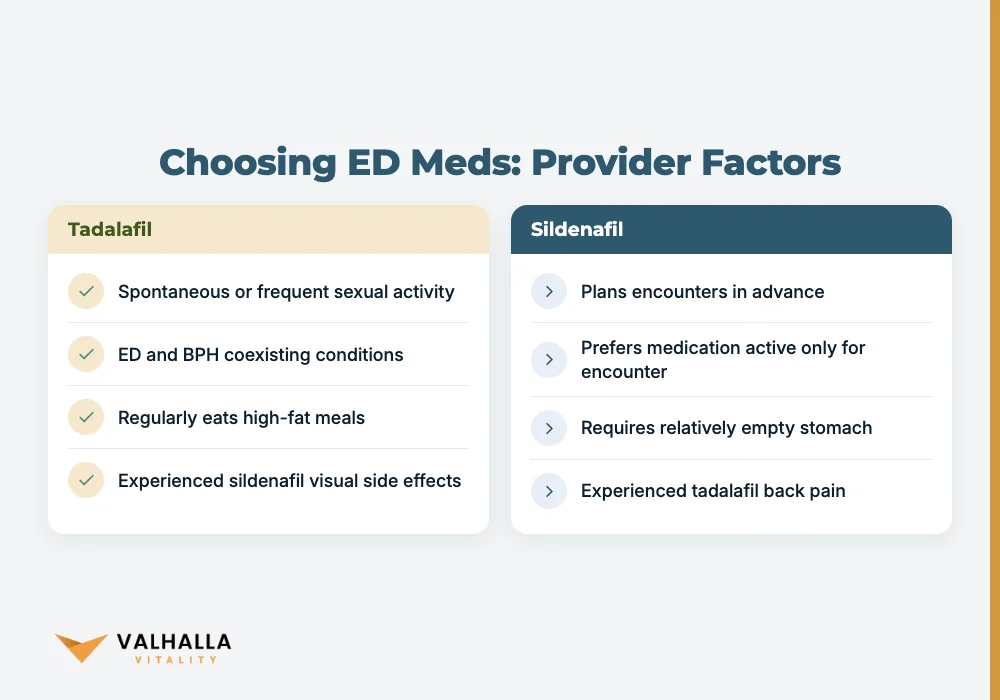
When a provider walks through the tadalafil vs Viagra decision with a patient, the conversation usually touches on several domains that general online comparisons skip.
Frequency and predictability of sex. Men with spontaneous or frequent sexual activity fit the daily tadalafil model well. Men who plan encounters in advance and prefer not to have medication active beyond the encounter may find sildenafil's narrower window more precise.
Coexisting conditions. Men with both ED and BPH have a specific clinical argument for tadalafil, since it addresses both. Men with cardiovascular disease require extra caution with either drug, particularly if they use any nitrate-containing medication. The sildenafil vs tadalafil conversation changes substantially for men on complex cardiac regimens.
Other medications. Both drugs can interact with strong inhibitors of the CYP3A4 liver enzyme, including certain antifungal and HIV medications. A licensed provider determines whether a therapy is appropriate after reviewing intake and all concurrent medications, and adjusts before prescribing.
Diet and eating habits. A patient who regularly eats high-fat meals and finds it difficult to coordinate eating with medication timing will likely find tadalafil more practical. No food restriction applies to tadalafil. Sildenafil requires a relatively empty stomach, which is a real scheduling constraint for some men.
Side effect history. A man who experienced troublesome back pain on tadalafil can often switch to sildenafil with similar efficacy. Someone who found sildenafil's visual side effects distracting may tolerate tadalafil well. Provider-patient dialogue after an initial trial is a normal part of optimizing ED treatment, not a sign that the first choice failed.
Cost. Both drugs are now generic and significantly cheaper than their original branded versions. Out-of-pocket costs vary by pharmacy. At Valhalla Vitality, the telehealth pathway connects patients with licensed providers and licensed compounding pharmacies. Availability varies by state.
The sildenafil vs tadalafil decision is ultimately clinical. The practical factors above are a guide to what that conversation involves, not a substitute for it.
Ready to find the right fit?
When you are ready to move from comparison to a clinical conversation, Book Your Consultation with a licensed Valhalla Vitality provider, who reviews your intake within 24 business hours and determines which therapy, if any, is appropriate for you.
FAQ
Is tadalafil better than Viagra for erectile dysfunction?
Neither drug is objectively better. Both are first-line treatments for ED with similar efficacy in clinical comparisons. Tadalafil suits men who want flexibility and long duration; sildenafil suits men who prefer faster onset and do not need effects beyond five hours.
How long does tadalafil last compared to Viagra?
Tadalafil can remain clinically effective for up to 36 hours; sildenafil works for four to five hours. The difference comes from tadalafil's significantly longer half-life, which allows it to stay active well past the next day.
What is the difference between tadalafil and sildenafil?
Tadalafil and sildenafil are both PDE5 inhibitors, but tadalafil lasts much longer, can be taken daily, has no food interaction, and is more likely to cause back pain. Sildenafil works faster, requires an empty stomach, and more commonly causes visual side effects and nasal congestion.
Can I take tadalafil daily instead of as needed?
Yes, tadalafil carries a recognized indication for continuous daily use. Daily dosing maintains a steady blood level so there is no need to time each dose before sex. A licensed provider determines whether daily use is appropriate after reviewing your intake.
Which ED medication has fewer side effects?
Both share the same core PDE5-related side effects (headache, flushing, indigestion). Tadalafil more commonly causes back pain; sildenafil more commonly causes visual changes and nasal congestion. Neither is safer overall; the best choice depends on which side effects are more tolerable for the individual.
Sources
- Zhou R et al. (2023). A Systematic Review and Meta-Analysis of the Efficacy and Safety of Tamsulosin Plus Tadalafil Compared With Tamsulosin Alone in Treating Males With Lower Urinary Tract Symptoms Secondary to Benign Prostrate Hyperplasia. American Journal of Men's Health. PubMed
- Krishnappa P et al. (2019). Sildenafil/Viagra in the treatment of premature ejaculation. International Journal of Impotence Research. PubMed
- Chua WY et al. (2025). Sildenafil and risk of Alzheimer disease: a systematic review and meta-analysis. Aging. PubMed
- Gonzalez-Cadavid NF et al. (2019). The two phases of the clinical validation of preclinical translational mechanistic research on PDE5 inhibitors since Viagra's advent. International Journal of Impotence Research. PubMed
You May Also Like
 Tadalafil
 Tablets: How They Work, Uses, and Side Effects
Tadalafil tablets treat erectile dysfunction, BPH, and pulmonary hypertension. Learn how they work, what to expect, and when to talk to a provider.
November 22, 2026 ETRead more → Tadalafil
 Pill: How It Works, Duration, and Daily Use
Tadalafil pill treats erectile dysfunction with up to 36-hour effect. Learn how it works, daily use, side effects, and how it compares to sildenafil.
November 22, 2026 ETRead more → Tadalafil
 Erectile Dysfunction: What You Need to Know
Tadalafil erectile dysfunction treatment: how PDE5 inhibition works, daily vs as-needed dosing, side effects, and how it compares with sildenafil.
November 18, 2026 ETRead more →