
The following blog post is for entertainment and informational purposes only. It is not intended to provide medical advice or diagnosis. Please consult your doctor before making any health-related decisions.
Tadalafil for women is prescribed off-label for female sexual arousal disorder, a condition in which genital blood flow response is blunted during sexual activity. The drug belongs to the PDE5 inhibitor class. Understanding how tadalafil works at the tissue level is useful context before pursuing it. No cleared indication exists for women, and a licensed provider determines whether this approach fits your presentation after reviewing your full intake.
How PDE5 inhibitors affect female physiology
PDE5 (phosphodiesterase type 5) is an enzyme that regulates vascular tone. When nitric oxide signals blood vessels to dilate, PDE5 normally degrades the chemical messenger that holds them open. Inhibiting that enzyme extends the dilation signal.
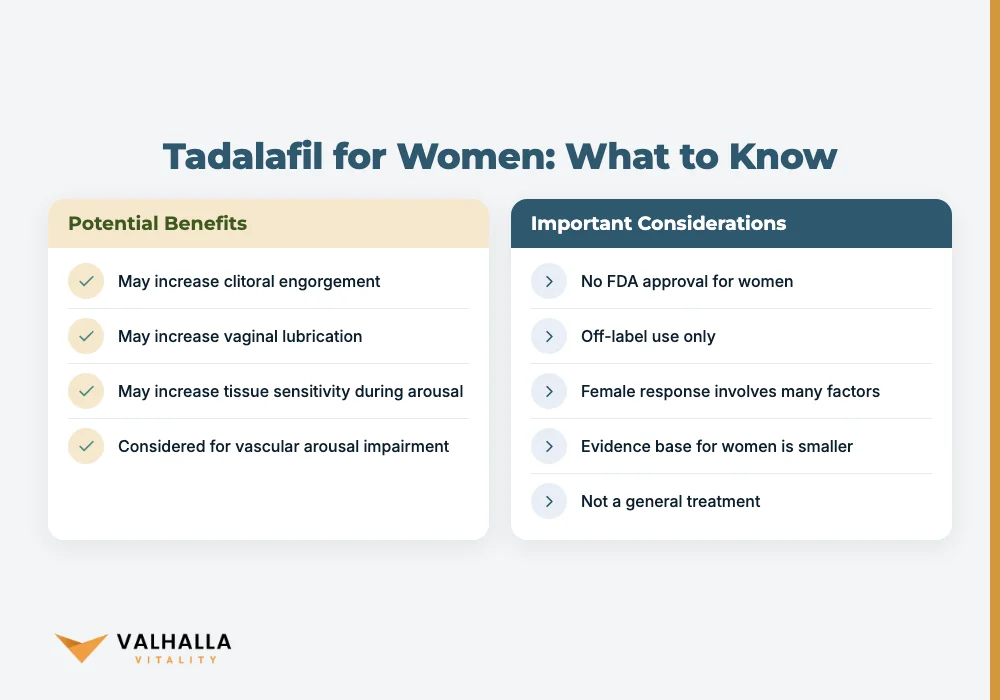
In men, the result is well-documented. Women have PDE5 receptors in clitoral tissue, vaginal walls, and the broader pelvic vascular bed. Blocking the enzyme may increase clitoral engorgement, vaginal lubrication, and tissue sensitivity during arousal. The basic physiology is parallel.
The clinical translation is not. Female sexual response involves hormonal, psychological, and vascular factors acting simultaneously. No single pathway dominates. The connection between PDE5 inhibitors and female arousal response is real at the tissue level, but whether that translates into meaningful clinical benefit depends on what is driving the dysfunction in the first place.
Why clinicians consider tadalafil for women with arousal disorder
Tadalafil for women enters clinical discussion when vascular arousal impairment is the dominant presenting concern. Research on PDE5 inhibitors and female arousal has expanded considerably since the initial erectile dysfunction trials, though the evidence base for women remains smaller. That specificity is what makes this a targeted option rather than a general treatment.
Quick reference: tadalafil for women
| Feature | What the evidence shows |
|---|---|
| Drug class | PDE5 inhibitor (same class as sildenafil, vardenafil) |
| FDA approval for women | None. Off-label use only. |
| Conditions studied | Female sexual arousal disorder, low libido, postmenopausal sexual dysfunction |
| Primary mechanism | Increased genital blood flow and tissue engorgement |
| Known contraindications | Nitrate medications, significant cardiovascular disease, severe hepatic or renal impairment |
| Provider review required | Yes, before any use |
Does tadalafil work for women?
The clinical evidence says: in some women, yes. Studies in premenopausal women with sexual arousal disorder have reported improvements in genital sensation, lubrication, and orgasmic function compared to placebo. Some data also points toward benefit in postmenopausal populations, though sample sizes in existing trials remain small.
Measurement is not straightforward. A 2018 meta-analysis in Obstetrics and Gynecology documented that placebo response rates in female sexual dysfunction trials are substantially higher than in many other therapeutic areas, which makes it genuinely difficult to isolate any drug's true effect size (Weinberger et al., 2018). That does not mean tadalafil has no effect. It means the signal is harder to measure and requires careful trial design to detect.
Research from the original evidence base found improvements in orgasmic function in women with documented low sex drive, though the effect on overall desire and global satisfaction with sexual life was less consistent. Genital sensation improvements compared to placebo appeared in both premenopausal and postmenopausal women.
These findings suggest that tadalafil for women can produce measurable physiological change. What they do not resolve is whether that change translates reliably into what individual women care most about in their experience.
What the data does not yet establish: which clinical characteristics predict the strongest response, how long the benefit persists over months or years, and whether outcomes hold consistently across different hormonal environments. These remain open questions.
For women who have already explored non-pharmacological options without adequate relief, tadalafil for women represents a reasonable next discussion point with a provider. It is not a first-line answer for all types of female sexual dysfunction treatment. It is a targeted vascular tool for specific presentations.
Is tadalafil approved for use in women?
No. Tadalafil has three approved indications. Two apply to men only: erectile dysfunction and benign prostatic hyperplasia. The third, pulmonary arterial hypertension, applies to adults of any sex. No indication covers female sexual dysfunction.
Using tadalafil for female sexual arousal disorder or related conditions is off-label prescribing. This is legal. It is also standard practice across many areas of medicine when available evidence supports a clinical use and the provider documents the rationale. The responsibility for the risk-benefit assessment belongs entirely to the prescribing clinician.
Two medications hold FDA approval specifically for female sexual dysfunction. Flibanserin targets central neurotransmitter pathways involved in desire and is approved for premenopausal women with hypoactive sexual desire disorder. Bremelanotide works through melanocortin receptors and is approved for the same indication. Both target desire pathways, not vascular arousal. Tadalafil addresses a completely different mechanism.
Cialis female arousal use follows the same evidence base as generic tadalafil, since Cialis is the brand name for the same molecule. Can women take Cialis? In the same off-label context that applies to generic tadalafil, yes. The clinical question is about mechanism, not the product name on the label.
The absence of a formal female indication reflects the research gap, not a final determination that the drug does not work. Women were systematically underrepresented in early PDE5 inhibitor trials when these drugs were developed. That gap is slowly narrowing but has not closed.
Can women take tadalafil for low libido?
Possibly, but it depends entirely on the type of sexual concern present. Low libido and female sexual arousal disorder are related but distinct, and that distinction determines how useful tadalafil is likely to be.
Low libido refers to reduced desire to initiate or participate in sexual activity. Female sexual arousal disorder refers to difficulty achieving adequate genital response during activity, even when desire is present. Some women experience both simultaneously. Others have one without the other.
Tadalafil addresses the arousal side. It does not act on desire pathways in the brain. For women whose concern is primarily a desire-layer issue, a PDE5 inhibitor is unlikely to be the right tool. For women whose desire is intact but whose genital response is blunted, it may help significantly.
When providers assess tadalafil for women in this context, the distinction between desire and arousal becomes clinically decisive. A vascular tool is most useful when the vascular pathway is the one that needs support.
As a women low libido medication, tadalafil occupies a narrow clinical niche. The connection between poor arousal and reduced desire over time is real. Some women report that restoring genital responsiveness changes how they experience their own interest in sex. But that secondary effect is not the same as directly treating desire.
A 2024 systematic review and meta-analysis in the American Journal of Obstetrics and Gynecology found that pelvic floor muscle training significantly improved sexual dysfunction outcomes across multiple domains, including desire, arousal, and pain (Jorge et al., 2024). This matters for context. Pharmacological options exist alongside non-pharmacological ones, and providers often recommend combining approaches rather than relying on a single intervention.
Who should not take tadalafil
Not every woman is a candidate. These profiles represent contraindications or high-risk situations that require careful provider evaluation:
- Women taking nitrate medications, including nitroglycerin or isosorbide compounds, face a potentially life-threatening drop in blood pressure if they combine these with any PDE5 inhibitor. This combination is contraindicated without exception.
- Women on certain alpha-blockers or antihypertensives may experience additive blood pressure reduction, particularly with specific drug combinations.
- Women with significant heart disease, recent heart attack or stroke within the prior six months, or unstable angina face hemodynamic risks from vasodilation that may outweigh any potential benefit.
- Women with severe liver or kidney impairment metabolize tadalafil poorly, leading to higher drug exposure and amplified or prolonged effects.
- Women with low blood pressure at baseline face a heightened risk of dizziness and fainting from the drug's vasodilatory action.
- Women taking HIV protease inhibitors experience significantly elevated tadalafil blood levels due to CYP3A4 inhibition, multiplying both effect and risk.
- Women with a history of non-arteritic anterior ischemic optic neuropathy (NAION), a form of sudden vision loss, face a risk of recurrence with PDE5 inhibitors.
- Pregnant or breastfeeding women have no established safety data for tadalafil, and the benefit-risk calculation does not support its use in these populations.
This list is a framework for a provider conversation, not a self-clearance tool. Some conditions on it are only identifiable through lab results or clinical history review.
What are the side effects of tadalafil in women?
The side effect profile observed in clinical studies of tadalafil for women is consistent with what is documented across the PDE5 inhibitor class generally, since the vascular mechanism is the same regardless of sex. The most common effects include headache, facial flushing, back pain, indigestion, and dizziness. More serious but rare reactions include sudden vision changes and chest discomfort.
Common reported effects in more detail:
- Headache is the most frequently reported effect, typically mild and resolving within a few hours.
- Facial flushing and body warmth usually appear within an hour of taking the medication and reflect systemic vasodilation.
- Nasal congestion or runny nose may persist for several hours post-dose.
- Indigestion, stomach discomfort, or mild nausea can accompany the drug's effects on smooth muscle.
- Back pain and muscle aches, particularly in the lower back, are reported by some users and typically resolve within 24 to 48 hours.
- Dizziness may occur, especially when moving quickly from lying or sitting to standing.
Less common but serious reactions require immediate medical contact. Sudden changes in vision, including blurred vision or unusual color perception, can signal a vascular event affecting the optic nerve. Sudden hearing changes are also associated with PDE5 inhibitor use in rare cases. Chest discomfort or significant shortness of breath during or after use should not be ignored.
A 2023 systematic review in BMC Gastroenterology found that PDE5 inhibitors, including tadalafil, can alter esophageal motility in some patients (Shafiee et al., 2023). Women who already experience acid reflux or difficulty swallowing should raise this with a provider before starting the drug. It does not make tadalafil unusable in those cases, but it adds a clinical consideration worth discussing.
Drug interactions expand the risk profile further. For a closer look at how reactions compare across different user populations, including data on rarer events that only emerge through longer monitoring windows, the documented side-effect data provides useful context before starting any PDE5 inhibitor.
What is the correct tadalafil dosage for women?
There is no standardized approved dose. Because tadalafil carries no approved female indication, the dosing guidelines that exist for erectile dysfunction and benign prostatic hyperplasia do not apply by definition.
A licensed provider determines the dose after labs. That means cardiovascular status, liver and kidney function, your complete medication list, and the clinical context all factor into the decision before any prescription is written.
This matters practically. A woman taking a strong CYP3A4 inhibitor may experience significantly amplified tadalafil effects at an amount that would be routine for someone on no interacting medications. Individualized clinical judgment replaces the standard protocol that exists for male indications. No source offering a universal starting dose for women is working within the available evidence.
What a licensed provider evaluates before prescribing
The intake process for off-label tadalafil typically covers several clinical domains:
Cardiovascular status: Blood pressure, resting heart rate, and any history of arrhythmia, recent cardiac events, or structural heart disease. PDE5 inhibition causes mild systemic vasodilation. A cardiovascular system under significant stress may not tolerate it safely.
Medication review: The CYP3A4 liver pathway is central here. Drugs that inhibit this enzyme raise tadalafil exposure. Alpha-blockers and antihypertensives require specific attention due to blood pressure interactions. A complete list, including supplements and herbal preparations, is necessary input.
Liver and kidney function: Both affect drug processing and clearance. Abnormal values may change the clinical risk profile enough to alter the dose or contraindicate use.
Hormonal context: Estrogen and testosterone both influence genital tissue health and sexual response. Low estrogen following menopause can produce vaginal atrophy and reduced lubrication that is not primarily vascular in origin. Low testosterone affects desire and energy.
Women with hormonal imbalances may find that testosterone therapy for women addresses underlying sexual dysfunction drivers more effectively than a PDE5 inhibitor alone. These options are not mutually exclusive, but the clinical priority matters and shapes the prescription decision.
Type and history of dysfunction: Whether the presentation is primarily an arousal concern, a desire concern, a pain disorder, or a combination directly determines whether tadalafil is likely to help. Duration of symptoms and treatments already tried also shape the clinical picture.
Psychological and relationship factors: Sexual dysfunction rarely exists in isolation from these elements. A vascular drug cannot substitute for psychological support when that is the primary driver of the concern.
This level of evaluation is why telehealth consultations for this topic involve a detailed intake form. The answers guide the provider toward the right tool for the right presentation.
The broader landscape of female sexual dysfunction treatment
Female sexual dysfunction encompasses desire disorders, arousal disorders, orgasmic disorders, and genitopelvic pain. Treatment matching depends on which subtype or combination is present.
Tadalafil most directly targets sexual arousal disorder and potentially the arousal component of mixed presentations. The PDE5 inhibitor class (which includes sildenafil, tadalafil, and vardenafil) operates on vascular biology. Drugs like flibanserin operate on brain neurochemistry. These are not interchangeable tools; they address different layers of a complex problem.
In practice, prescribers evaluating tadalafil for women in the broader treatment landscape consider how vascular arousal impairment interacts with any coexisting hormonal or psychological factors before determining the right path forward.
The question of which women benefit most from tadalafil is still being answered. Research so far suggests that those with identifiable vascular arousal impairment and no significant hormonal dysregulation may respond best. Women with predominantly desire-layer concerns, significant hormonal deficits, or pelvic floor dysfunction as the main driver may need a different approach first, or alongside.
Women whose sexual concerns relate to hormonal shifts during perimenopause or postmenopause may also benefit from evaluating hormonal options alongside PDE5 therapy. The overlap between hormone-driven changes and vascular function is real. Addressing one without the other sometimes leaves significant symptoms unresolved.
A 2022 review in Sexual Medicine Reviews documented the breadth of off-label PDE5 inhibitor use across both sexes, noting that clinical demand consistently exceeds the formal approval landscape (Mostafa et al., 2022). That gap between clinical use and regulatory approval is exactly where the consultation process becomes the patient's most important protection.
At Valhalla Vitality, provider-guided telehealth connects patients with licensed providers who review a full medical intake before determining whether any therapy is appropriate. The process applies whether tadalafil or any other option is under consideration. Availability varies by state.
Ready to explore whether tadalafil for women fits your situation?
Book Your Consultation with a licensed provider who reviews your intake and determines whether this approach may be appropriate for you.
FAQ
Does tadalafil work for women?
Studies in women with sexual arousal disorder have reported improvements in genital sensation, lubrication, and orgasmic function compared to placebo, though the evidence base is smaller than for men. A 2018 meta-analysis in Obstetrics and Gynecology found high placebo response rates in female sexual dysfunction trials, complicating direct measurement of drug effects (Weinberger et al., 2018). A provider who reviews your specific presentation can assess whether your situation matches the cases where benefit has been documented.
What is the correct tadalafil dosage for women?
There is no standardized approved dose because tadalafil carries no approved female indication. A licensed provider determines the appropriate amount after reviewing your lab results, cardiovascular status, and full medication list. Any source offering a universal starting dose for women is working outside the available evidence.
Can women take tadalafil for low libido?
Tadalafil may help when low libido is partly driven by poor genital arousal response rather than functioning as a purely desire-based condition. If the core issue is a desire disorder without an arousal component, a PDE5 inhibitor is unlikely to be effective. A provider evaluation distinguishes between these presentations before recommending a path.
What are the side effects of tadalafil in women?
Common effects include headache, facial flushing, back pain, indigestion, nasal congestion, and dizziness. Serious but rare reactions, including sudden vision or hearing changes and chest discomfort, require immediate medical contact. The full risk profile depends on your existing medications and baseline health conditions.
Is tadalafil approved for use in women?
No. Tadalafil is approved for erectile dysfunction and benign prostatic hyperplasia in men, and for pulmonary arterial hypertension in adults of any sex. Its use for female sexual dysfunction is off-label, meaning a licensed provider applies the drug outside its labeled indication based on clinical evidence and professional judgment.
Sources
- Weinberger JM et al. (2018). Female Sexual Dysfunction and the Placebo Effect: A Meta-analysis. Obstetrics and Gynecology. PubMed
- Jorge CH et al. (2024). Pelvic floor muscle training as treatment for female sexual dysfunction: a systematic review and meta-analysis. American Journal of Obstetrics and Gynecology. PubMed
- Shafiee A et al. (2023). Phosphodiesterase 5 (PDE-5) inhibitors (sildenafil, tadalafil, and vardenafil) effects on esophageal motility: a systematic review. BMC Gastroenterology. PubMed
- Mostafa T et al. (2022). Recreational Use of Oral PDE5 Inhibitors: The Other Side of Midnight. Sexual Medicine Reviews. PubMed
You May Also Like
 Tadalafil
 Half Life: Duration, Dosing, and What to Expect
Tadalafil half life averages 17.5 hours, keeping one dose active for up to 36 hours. See how this shapes daily vs on-demand dosing schedules.
November 24, 2026 ETRead more → Tadalafil
 Tablets: How They Work, Uses, and Side Effects
Tadalafil tablets treat erectile dysfunction, BPH, and pulmonary hypertension. Learn how they work, what to expect, and when to talk to a provider.
November 22, 2026 ETRead more → Tadalafil
 Pill: How It Works, Duration, and Daily Use
Tadalafil pill treats erectile dysfunction with up to 36-hour effect. Learn how it works, daily use, side effects, and how it compares to sildenafil.
November 22, 2026 ETRead more →