
The following blog post is for entertainment and informational purposes only. It is not intended to provide medical advice or diagnosis. Please consult your doctor before making any health-related decisions.
Tadalafil weight loss research is biologically grounded but clinically incomplete. By blocking phosphodiesterase-5 (PDE5) and raising cyclic guanosine monophosphate (cGMP) levels, tadalafil shifts how fat cells develop, how muscles use energy, and how the body responds to insulin. These are real mechanisms. But tadalafil is not a weight loss drug, and reviewing the metabolic effects of daily tadalafil gives necessary context before any conversation with a licensed provider.
Tadalafil was developed for erectile dysfunction and pulmonary arterial hypertension. The PDE5 pathway it targets happens to run through fat tissue and metabolic signaling. That biological overlap drew researchers toward the tadalafil weight loss question. It is not coincidence, but it is not proof of a treatment effect either.
Does tadalafil help with weight loss?
Tadalafil does not currently hold an approved or established role in weight loss. The mechanisms it activates do, however, intersect with fat metabolism in ways that have generated real scientific interest.
cGMP, the molecule tadalafil raises by inhibiting PDE5, appears to influence adipocyte differentiation: the cellular process by which precursor cells become mature fat cells. When cGMP signaling rises, early evidence from animal and cell-culture studies suggests this differentiation process may slow. Fewer new fat cells forming is not the same as burning existing fat. But it matters for long-term tadalafil body composition trends.
Vasodilation adds a second pathway. Tadalafil improves blood flow broadly, including to working muscle tissue. Greater circulation during physical activity means those muscles can sustain higher metabolic output for longer. This indirect metabolic contribution does not operate in isolation from diet and activity level, but it is a documented pharmacological effect.
Some early research also suggests that cGMP elevation may influence appetite-related signaling, with preliminary studies noting reduced food cravings in treated subjects. This angle remains poorly characterized in controlled human data and should not be treated as a confirmed effect.
The honest framing: tadalafil may contribute to a metabolic environment less favorable to fat accumulation. Whether that translates to measurable weight change in humans under clinical conditions is a question ongoing research has not yet answered.
How does tadalafil affect metabolism and fat burning?
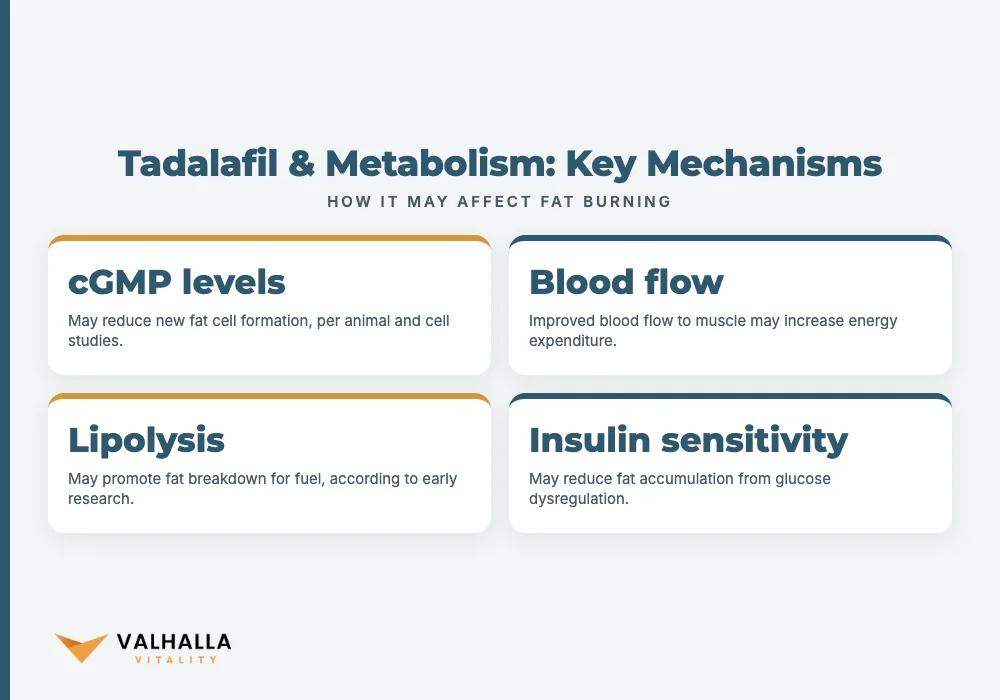
Tadalafil affects metabolism primarily by raising cGMP levels, which influences fat cell behavior, insulin sensitivity, and blood flow to working muscles. The clearest pathway runs through cGMP acting as a signaling molecule across multiple tissue types, well beyond vascular smooth muscle.
A 2023 systematic review of PDE-5 inhibitors published in BMC Gastroenterology confirmed that the smooth-muscle effects of tadalafil and similar agents extend across various tissue systems through the same molecular mechanism. That reach helps explain why researchers connect tadalafil and metabolism beyond its primary cardiovascular and urological indications.
Here is a summary of the proposed mechanisms in current tadalafil weight loss research:
| Mechanism | Proposed effect | Evidence stage |
|---|---|---|
| PDE5 inhibition raises cGMP | May reduce new fat cell formation | Animal and cell studies |
| Improved blood flow to muscle | May increase energy expenditure during activity | Indirect inference |
| Lipolysis stimulation | May promote fat breakdown for fuel | Early research |
| Enhanced insulin sensitivity | May reduce fat accumulation from glucose dysregulation | Early research |
The insulin sensitivity connection deserves attention. Insulin resistance drives fat storage. Some research suggests the tadalafil weight loss hypothesis partly runs through improved insulin signaling: a body that processes glucose more efficiently stores less of it as fat. This is consistent with why tadalafil has been studied in patients with type 2 diabetes and metabolic syndrome, where glucose dysregulation sits at the center of the metabolic problem.
The question of whether tadalafil burns fat oversimplifies the biology. Tadalafil may shift cellular conditions in ways that make fat accumulation less likely and fat utilization somewhat more efficient. That is a narrower claim than "direct fat burning," and it also requires the right activity and nutrition context to have practical effect.
What does research say about tadalafil and adipose tissue?
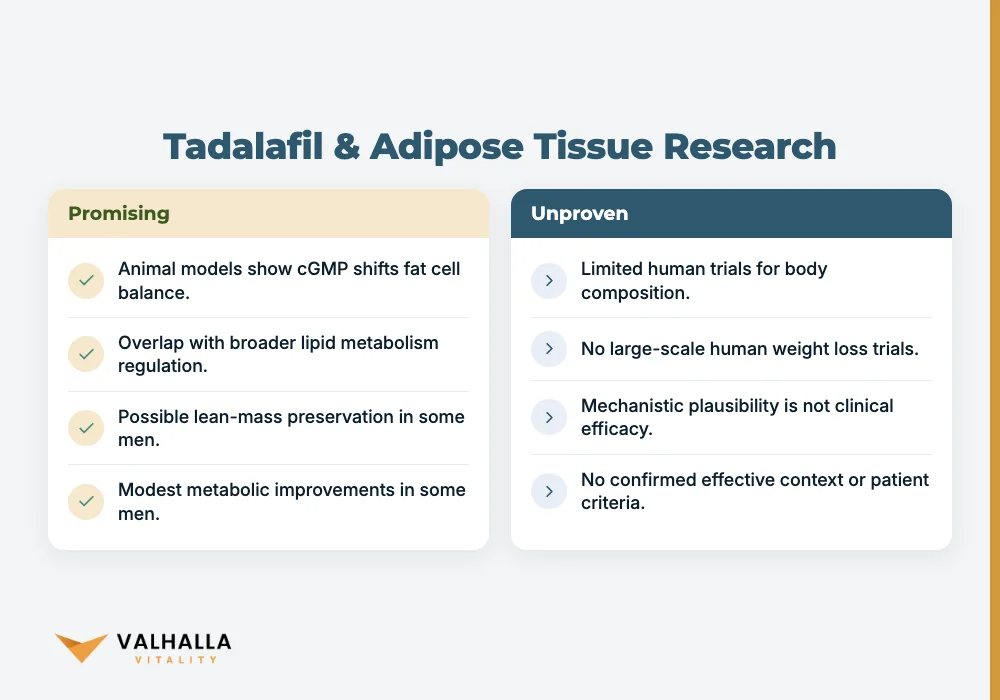
Most mechanistic research on tadalafil and adipose tissue has been conducted in animal models or in vitro cell systems. Human clinical trials designed to measure tadalafil body composition as a primary outcome are limited.
Animal model data shows that elevated cGMP in adipose tissue can shift the balance between fat cell creation and fat cell breakdown. The signaling cascades involved overlap with lipid metabolism regulation more broadly.
Understanding tadalafil body composition research also benefits from comparison with other hormone-related pathways. The research on enclomiphene and weight management shows how testosterone-axis interventions reach similar metabolic questions through a different biological route.
Human trial data is more cautious. Trials measuring body composition as a secondary endpoint in patients using tadalafil for erectile dysfunction or benign prostatic hyperplasia have noted possible lean-mass preservation trends and modest metabolic improvements in men with concurrent metabolic dysfunction. These are hypothesis-generating findings, not clinical proof.
No large-scale human trial has used tadalafil as a primary weight loss intervention. That gap matters. Mechanistic plausibility is not clinical efficacy, and whether cialis fat loss signals in preclinical research translate to meaningful weight outcomes in humans remains an open question.
The absence of human trial data also means there is no established profile for tadalafil weight loss use: no confirmed effective context, no defined patient criteria. A licensed provider determines whether a therapy is appropriate after reviewing your intake and labs.
Is tadalafil effective for reducing body fat?
By current clinical standards: no. No regulatory agency has approved tadalafil as a weight loss treatment. No controlled head-to-head trial has tested whether PDE5 inhibitor fat loss effects compare meaningfully to dedicated weight management therapies.
Men already taking tadalafil for an approved indication who also have metabolic concerns may benefit from discussing these secondary effects with their provider. As a standalone strategy, the evidence does not support tadalafil weight loss potential as a primary approach.
Many men asking whether tadalafil can help them lose weight, or whether cialis help lose weight in any clinically relevant way, are really asking whether the metabolic changes they may notice while on the medication are real. Some secondary metabolic effects appear biologically plausible. Controlled human data to quantify them is thin.
The absence of a confirmed effect does not make the question unimportant. It means the question requires more evidence before clinical recommendations can follow.
For men exploring medically supervised weight management, GLP-1 therapy for fat loss works through a fundamentally different and better-established mechanism. Tadalafil's metabolic effects, if confirmed in future human trials, would likely position it as an adjunct tool, not a primary driver of weight change.
Tadalafil weight loss potential: risks and what to consider
The documented risk profile of tadalafil shapes how any tadalafil weight loss discussion should proceed. Headaches, flushing, and blood pressure changes are among the known adverse reactions from the prescribing literature. Drug interactions with nitrates and certain antihypertensive medications add caution for a wider group of patients.
Reviewing tadalafil's documented adverse reactions in full is practical groundwork before any provider conversation. Someone pursuing tadalafil weight loss potential without a concurrent approved indication takes on this side-effect profile in exchange for an unproven benefit. That risk calculation requires medical judgment, not self-directed experimentation.
Lifestyle factors do not get replaced by any medication. A 2024 paper in Trends in Endocrinology and Metabolism examining how fasting patterns influence metabolic function reinforced what broader research consistently shows: medication effects are substantially shaped by diet, activity level, and sleep. Any metabolic signal from tadalafil operates within those constraints, not independently of them.
A licensed provider determines the dose after reviewing labs and health history. At Valhalla Vitality, that process begins with an online intake, provider review within 24 business hours, and a prescription to a US partner compounding pharmacy when appropriate. Availability varies by state.
Ready to explore your options with a provider?
If you have questions about tadalafil's effects on metabolism or want to explore medically supervised weight management, Book Your Consultation with a licensed provider who can review your specific intake and advise based on your health history.
FAQ
Does tadalafil help with weight loss?
Tadalafil is not an approved weight loss medication, and clinical evidence for it as a primary fat loss tool is limited. The mechanisms it activates may support a metabolic environment less conducive to fat accumulation, but that is distinct from a proven treatment effect.
Can cialis cause weight loss?
Cialis has not been shown to cause clinically significant weight loss in human trials. Some men may notice secondary body composition changes from improved circulation and potentially enhanced insulin sensitivity, but these effects have not been confirmed in controlled human studies.
How does tadalafil affect metabolism and fat burning?
Tadalafil raises cGMP by inhibiting PDE5, and elevated cGMP appears to reduce adipocyte differentiation and may stimulate lipolysis in early research. Improved blood flow to muscle tissue may also raise energy expenditure modestly during physical activity.
Does tadalafil burn fat directly?
No human trial has demonstrated that tadalafil directly burns fat. The more accurate framing is that it may shift conditions within fat tissue and energy metabolism in directions that make fat accumulation less likely, based on early-stage animal and cellular research.
Is tadalafil a weight loss medication?
Tadalafil is approved for erectile dysfunction, pulmonary arterial hypertension, and benign prostatic hyperplasia. It is not approved or prescribed as a weight loss medication, and a licensed provider must review your intake before prescribing it for any indication.
Sources
- Shafiee A et al. (2023). Phosphodiesterase 5 (PDE-5) inhibitors (sildenafil, tadalafil, and vardenafil) effects on esophageal motility: a systematic review. BMC Gastroenterology. PubMed
- Marko DM et al. (2024). Intermittent fasting influences immunity and metabolism. Trends in Endocrinology and Metabolism. PubMed
You May Also Like
 Tadalafil
 vs Sildenafil: Duration, Onset, and How to Choose
Tadalafil vs sildenafil: compare onset time, how long each lasts, side effects, and food interactions to find the right ED medication for you.
November 11, 2026 ETRead more → Tadalafil
 Tamsulosin Interaction: Risks and Benefits
Tadalafil tamsulosin interaction: understand hypotension risks, clinical safety data, and when combining both drugs for BPH and ED treatment is safe.
November 11, 2026 ETRead more → Tadalafil
 and alcohol: safety, risks, and what to know
Tadalafil and alcohol together can cause a dangerous blood pressure drop. Learn the risks, safe limits, and how the combination affects ED medication.
November 11, 2026 ETRead more →