
The following blog post is for entertainment and informational purposes only. It is not intended to provide medical advice or diagnosis. Please consult your doctor before making any health-related decisions.
Tadalafil and alcohol can lower blood pressure more than either substance does on its own, and that additive drop can cause dizziness, flushing, or in serious cases, fainting. Both compounds dilate blood vessels: tadalafil works through PDE-5 inhibition, while alcohol widens vessels through direct vascular effects and simultaneously suppresses the compensatory reflexes that would normally correct for the drop. If you are exploring treatment options for erectile dysfunction or benign prostatic hyperplasia, the interaction with alcohol is one of the first clinical topics a licensed provider will raise.
What tadalafil does in the body
Tadalafil is a phosphodiesterase-5 (PDE-5) inhibitor. It works by blocking PDE-5 enzymes, which allows cyclic guanosine monophosphate (cGMP) to remain active in smooth muscle cells, widening blood vessels and increasing blood flow. That action improves erectile function and reduces urinary symptoms in BPH. Tadalafil is also prescribed for pulmonary arterial hypertension, a condition involving elevated pressure in the lung arteries. That use illustrates how significant its vasodilatory effects are beyond the pelvic region.
The vasodilation is not tissue-specific. It affects blood vessels throughout the body. That system-wide action is exactly why the interaction with alcohol creates risks that are cardiovascular, not just sexual.
How tadalafil and alcohol interact in your body
The interaction is pharmacodynamic: two compounds with overlapping mechanisms act on the same physiological system at the same time. Tadalafil drives vasodilation through the nitric oxide/cGMP pathway. Alcohol also promotes vasodilation and simultaneously blunts the baroreceptor reflexes that would otherwise correct for a pressure drop. The body cannot compensate as quickly when both are present, which is why symptoms can appear even with a moderate amount of alcohol.
| Effect | Why it happens |
|---|---|
| Blood pressure drop | Both compounds dilate blood vessels simultaneously |
| Tadalafil side effects dizziness | Reduced cerebral blood flow; CNS depression from alcohol |
| Reduced drug effectiveness | Alcohol delays absorption and may alter tadalafil's hepatic metabolism |
| Flushing and nausea | Peripheral vasodilation combined with ethanol-induced gastric effects |
| Prolonged interaction window | Tadalafil's half-life keeps it active for up to 36 hours |
The alcohol blood pressure drop can be meaningful even at two or three standard drinks, depending on individual cardiovascular status and what other medications are present. This is not a threshold that only activates at high intoxication. The same mechanism underlies the Cialis alcohol interaction, since Cialis is the brand name for tadalafil.
Can you drink alcohol while taking tadalafil?
You can drink in modest amounts, but not without caution. Prescribing guidance for tadalafil explicitly cautions against combining it with significant quantities of alcohol, because the additive hypotensive effect is not trivial. For an otherwise healthy adult with no cardiovascular complications and no other blood-pressure-lowering medications, one to two standard drinks consumed with food is unlikely to cause a severe reaction.
Binge drinking is a different matter. It delivers a sharp alcohol blood pressure drop, blunted baroreceptor response, and reduced ability to recognize or react to early warning signs. That combination is what makes drinking on ED medication risky rather than a measured glass of wine with dinner.
Timing also matters. Drinking shortly after taking tadalafil, when blood levels are rising toward peak, creates the most pronounced overlap. Drinking many hours later reduces but does not fully address the interaction. And a large pour of a high-alcohol wine or a craft beer above 7% ABV can easily exceed one standard drink even when the volume appears modest.
The vasodilatory overlap between PDE-5 inhibitors and alcohol is not unique to tadalafil. For context on how the same risk applies with another drug in this class, see how vardenafil and alcohol interact.
What happens if you mix tadalafil and alcohol?
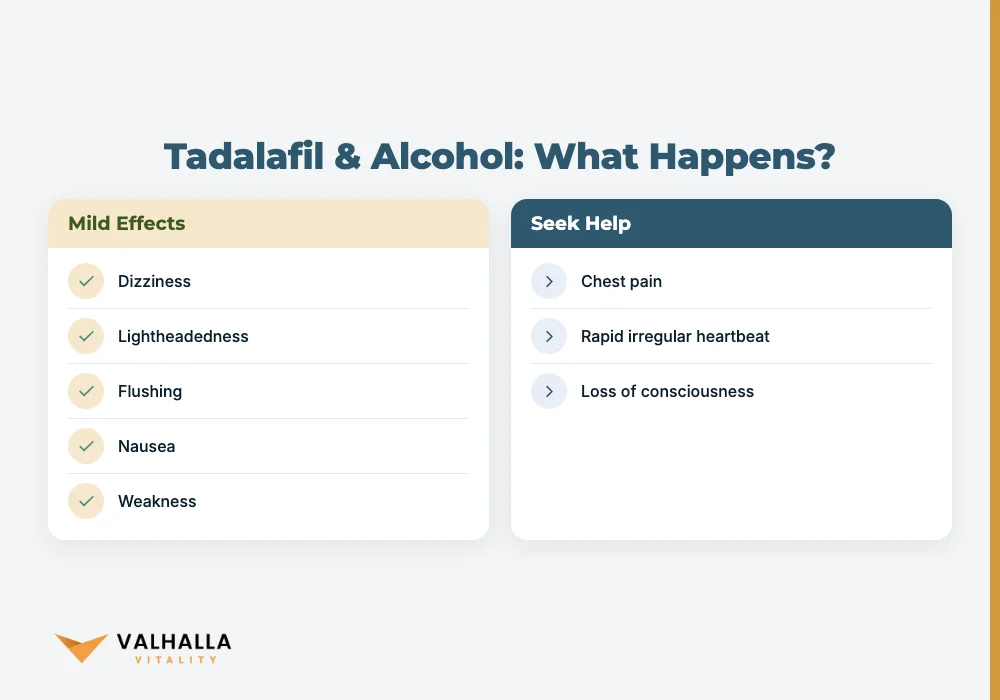
The most common immediate effect is a blood pressure drop that produces recognizable cardiovascular symptoms. Dizziness comes first. Lightheadedness follows. If pressure continues to fall, flushing, nausea, rapid heartbeat, and weakness appear as the cardiovascular system struggles to compensate.
How hypotension develops
Hypotension from tadalafil and alcohol can unfold in two ways. It can appear suddenly when alcohol is already present at the time of dosing, or it can develop more gradually as a person continues drinking after taking the medication. Either path produces the same outcome: systolic blood pressure falls, perfusion to the brain drops, and symptoms follow.
People taking antihypertensives, ACE inhibitors, alpha-blockers, or diuretics face compounded risk. Each of those medication classes lowers blood pressure through its own mechanism. Stacking them alongside tadalafil and alcohol can produce drops that become clinically dangerous rather than merely uncomfortable. Older adults face additional vulnerability because age-related changes in vascular tone and baroreceptor sensitivity leave less buffer before symptoms appear.
If you experience dizziness or lightheadedness after combining tadalafil and alcohol, sit or lie down to prevent a fall and drink water. If symptoms include chest pain, rapid irregular heartbeat, or loss of consciousness, seek emergency medical attention. Do not wait to see whether symptoms resolve on their own.
Alcohol and erectile dysfunction
There is a separate layer here beyond the acute blood pressure effect. Alcohol and erectile dysfunction have a well-documented relationship that exists independently of any medication.
At high blood alcohol levels, ethanol impairs nitric oxide signaling in penile endothelial cells. That is precisely the pathway tadalafil is designed to support. Heavy drinking can therefore partially work against the drug's mechanism at a cellular level, not just slow its absorption. This is why a heavy-drinking night can feel like the medication simply did not work, even when taken correctly.
Chronic heavy alcohol use adds another dimension. It is associated with peripheral nerve damage, disrupted hormone signaling, and vascular deterioration that contribute to erectile dysfunction becoming structural rather than situational. A 2024 systematic review by Dilixiati et al. in Frontiers in Endocrinology identified vascular damage and neurological disruption among the key mechanisms through which chronic metabolic and lifestyle exposures impair erectile function. A 2025 Lancet review by Rehm et al. documented that alcohol use disorders carry wide-ranging physiological harm, with cardiovascular and reproductive function prominent among the affected systems.
Occasional moderate drinking does not defeat tadalafil. Heavy or habitual drinking works against the same biology the drug supports. For context on how daily tadalafil and cardiovascular health relate over time, see research on regular tadalafil use and cardiovascular health.
Other physical reactions
Beyond the blood pressure drop, combining tadalafil and alcohol can produce a range of additional symptoms:
- Headache, sometimes severe and lasting several hours
- Flushing: warmth and redness in the face, neck, and chest
- Nasal congestion from vasodilation in the nasal passages
- Indigestion, bloating, and abdominal discomfort
- Back pain and muscle aches, partly from dehydration since alcohol is a diuretic
- Vision changes including blurred vision and increased light sensitivity
- Fatigue and reduced coordination
Each of these appears in tadalafil's standard side effect profile independent of alcohol, and alcohol amplifies the probability and intensity of most of them. For a detailed breakdown of what to watch for, see this overview of dizziness and other side effects from tadalafil.
Does alcohol make tadalafil less effective?
Yes. Alcohol reduces tadalafil's effectiveness through two mechanisms that operate in parallel. First, it reduces overall blood flow to target tissue, limiting how much of the drug can act where it is needed. Second, alcohol slows absorption and extends the time to peak plasma concentration, pushing back the onset of effect. At higher levels of intoxication, these effects can substantially blunt the clinical response.
Moderate intake is unlikely to substantially reduce the effect for most people. The challenge is that individual variation is wide. Body weight, food intake, hydration, and alcohol tolerance all influence how a given amount of alcohol interacts with drug pharmacokinetics. Someone who rarely drinks may notice a more pronounced reduction in effect at two drinks than a frequent drinker, even though the cardiovascular risk of the blood pressure drop does not scale the same way.
The practical guidance is straightforward: avoid alcohol when possible around the time of dosing. If you do drink, stay well below intoxication. If the medication consistently seems less effective when alcohol is involved, that is worth reviewing with a licensed provider alongside other contributing factors.
How much alcohol is safe with tadalafil?
There is no single figure that applies to everyone, but prescribing guidance consistently describes one to two standard drinks per session as the practical ceiling for people who choose to drink while taking tadalafil. A standard drink in the United States contains approximately 14 grams of pure alcohol, which corresponds to a 12-ounce regular beer, a 5-ounce glass of wine, or a 1.5-ounce shot of spirits.
What constitutes one drink in practice matters. A large pour of a high-alcohol wine, a craft beer above 7% ABV, or an oversized mixed drink can easily exceed one standard drink while appearing to be a single beverage. Tracking actual alcohol content rather than the number of glasses gives a more accurate picture for anyone taking tadalafil regularly.
Exceeding one to two drinks raises the probability of a clinically meaningful alcohol blood pressure drop. Slower consumption and food both reduce peak blood alcohol levels and blunt the vasodilatory impact. Those strategies reduce risk. They do not address all of it. A licensed provider determines the appropriate level of caution after reviewing your intake, cardiovascular history, and concurrent medications.
How long after tadalafil can you drink alcohol?
Tadalafil has a significantly longer half-life than other PDE-5 inhibitors. Measurable concentrations can persist in the body for up to 36 hours after a dose. During that entire window, alcohol still carries the risk of an additive blood pressure drop, even if the medication's visible effects on erection quality have faded.
This point often surprises people. Drinking the morning or afternoon after taking tadalafil the previous evening is not equivalent to drinking without the drug present. Some degree of vasodilatory background remains, even if attenuated.
For people who take tadalafil daily rather than on demand, there is no clean gap at all. The drug reaches a steady-state concentration with regular use, which means every occasion where you drink alcohol occurs against an ongoing baseline of vasodilation. For daily users, the question is not "when can I drink" but "how much is appropriate given the drug is always present." For context on how tadalafil affects the cardiovascular system in its own right, see tadalafil's effect on blood pressure.
Who should be especially careful
Certain groups face meaningfully higher risk from combining tadalafil and alcohol and should consult a provider before drinking at all while on this medication.
People taking antihypertensives, ACE inhibitors, alpha-blockers, nitrates, or diuretics carry compounded risk because each of those drug classes also lowers blood pressure. The combined effect with tadalafil and alcohol can produce dangerous drops rather than merely uncomfortable ones. Older adults face additional vulnerability because age-related changes in vascular tone and baroreceptor sensitivity mean the body responds more slowly and has less cardiovascular reserve to draw on.
People with a history of hypotension, cardiac arrhythmia, or structural heart disease need provider guidance before drinking at all while on tadalafil. The same applies to anyone whose alcohol consumption is heavier than occasional social drinking.
A 2025 Lancet review by Rehm et al. documented that alcohol use disorders require clinical management and can interact meaningfully with many prescribed medications. If your drinking is more than occasional, that context belongs in a conversation with a provider, not a self-assessment from a web article.
Valhalla Vitality reviews each patient's full medication list, cardiovascular background, and lifestyle factors as part of the clinical intake before any prescription is written. That individualized review is what places your personal caution line in the right location.
Talk to a provider
A licensed provider can review your intake, medication history, and cardiovascular background to clarify how tadalafil and alcohol interact in your specific situation. Book Your Consultation.
FAQ
Can you drink alcohol while taking tadalafil?
You can drink in limited amounts, but combining tadalafil and alcohol causes both to lower blood pressure simultaneously. That increases the risk of dizziness, flushing, and in more severe cases fainting. One to two standard drinks with food is the common reference point; heavier drinking raises the risk substantially.
How much alcohol is safe with tadalafil?
Prescribing guidance points to one to two standard drinks per session as a practical ceiling, consumed slowly and with food. A standard drink in the US contains approximately 14 grams of pure alcohol. Beyond that range, the chance of a clinically meaningful alcohol blood pressure drop rises significantly.
Does alcohol make tadalafil less effective?
Yes. Alcohol reduces blood flow and delays the drug from reaching peak concentration, both of which weaken the clinical effect. Moderate consumption may preserve enough effectiveness for many people, but heavy drinking can substantially blunt the response.
What happens if you mix tadalafil and alcohol?
The most common effect is a blood pressure drop that causes dizziness, lightheadedness, flushing, or headache. More pronounced drops may cause nausea, chest discomfort, or fainting. People taking other blood pressure medications are at higher risk of a severe reaction.
How long after tadalafil can you drink alcohol?
Tadalafil remains measurably active for up to 36 hours after a dose, so drinking the following day still carries some interaction risk. For people taking tadalafil daily, the drug is effectively always present, and every drinking occasion occurs against an ongoing baseline of vasodilation.
"Can you drink on Cialis?"
Cialis is the brand name for tadalafil, so the guidance is the same: modest amounts, one to two standard drinks consumed slowly and with food, are generally considered acceptable for otherwise healthy adults. Avoid heavier intake, as the blood pressure drop from combining tadalafil and alcohol is real regardless of which name is on the package.
Sources
You May Also Like
 Tadalafil
Avanafil vs Tadalafil: ED Medication Comparison Guide
Avanafil vs tadalafil compared: onset speed, duration, side effects, and when to choose each. See which ED medication fits your needs and lifestyle.
November 12, 2026 ETRead more → Tadalafil
 Drug Class: Mechanism, Uses, and Comparisons
Tadalafil drug class belongs to PDE5 inhibitors. Learn how tadalafil works in the body, what conditions it treats, and how it differs from sildenafil.
November 12, 2026 ETRead more → Tadalafil
 vs Sildenafil: Duration, Onset, and How to Choose
Tadalafil vs sildenafil: compare onset time, how long each lasts, side effects, and food interactions to find the right ED medication for you.
November 11, 2026 ETRead more →