
The following blog post is for entertainment and informational purposes only. It is not intended to provide medical advice or diagnosis. Please consult your doctor before making any health-related decisions.
Stopping enclomiphene causes the hormonal signals that drive testosterone production to subside, and testosterone levels often decline toward pre-treatment values within days to weeks. Fatigue, reduced libido, and mood changes may return as the body readjusts. If you are thinking about coming off enclomiphene, or a licensed provider has raised the question, understanding what the process involves helps you prepare and respond quickly. A provider familiar with how enclomiphene raises testosterone can advise on whether stopping, tapering, or transitioning to another therapy fits your clinical picture.
How enclomiphene works: the quick version
Enclomiphene is a selective estrogen receptor modulator (SERM). It blocks estrogen receptors in the hypothalamus and pituitary gland. That block removes the brake on gonadotropin-releasing hormone (GnRH), which raises LH and FSH. Higher LH then prompts the testes to produce more testosterone.
The whole cascade depends on the drug remaining active. A 2016 review in Expert Opinion on Pharmacotherapy noted that enclomiphene restores HPG axis signaling in men with secondary hypogonadism by acting on those receptors. Once the drug clears, the receptors are no longer occupied. The signal weakens. How quickly and by how much testosterone falls depends on the underlying function of the HPG axis before treatment began.
What changes after stopping enclomiphene: a quick reference
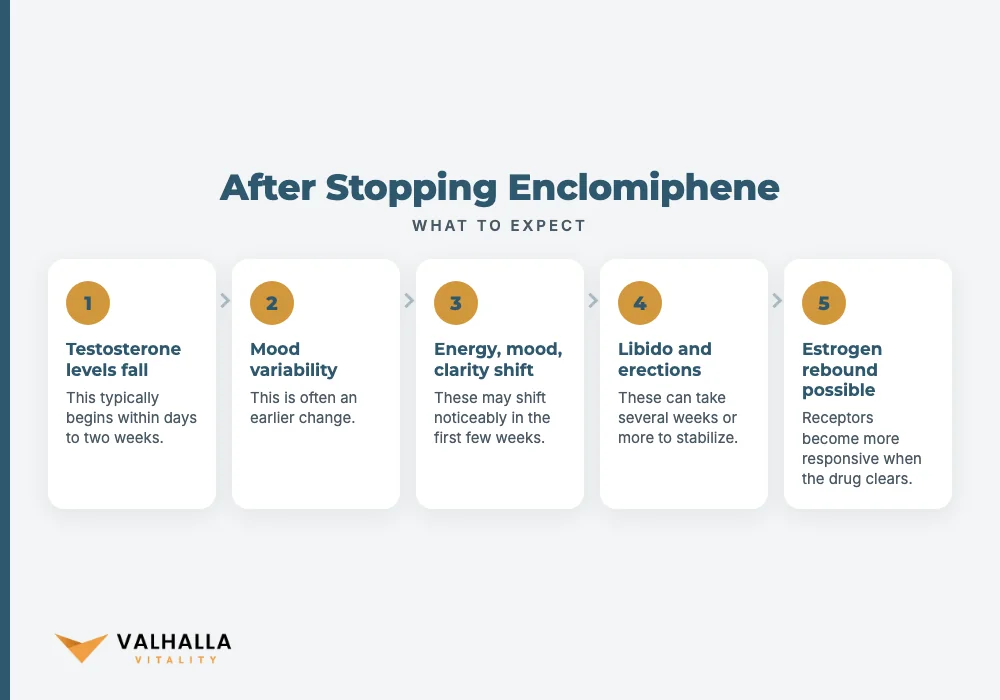
Research on enclomiphene discontinuation, along with data on related SERMs, points to a consistent set of changes that may appear after coming off treatment. Not all of them appear at once, and individual experience varies considerably.
- Testosterone levels typically begin to fall within days to two weeks as LH and FSH output decreases.
- Energy, mood, and mental clarity may shift noticeably in the first few weeks as testosterone declines.
- Libido and erectile function can take longer to stabilize, sometimes several weeks or more.
- Estrogen rebound is possible in the short term: receptors that were blocked by enclomiphene become more responsive when the drug clears.
- Body composition may gradually shift toward higher body fat or reduced muscle tone if testosterone stays low for an extended period.
- Bone density is not an immediate concern but may be affected over months to years if low testosterone persists.
- Mood variability is often among the earlier changes, appearing before the full testosterone drop registers on a lab panel.
The severity of each change depends on age, baseline hormone health, and duration of treatment.
What happens when you stop taking enclomiphene?
Stopping enclomiphene removes the pharmacological driver of testosterone production. Without the drug blocking estrogen receptors in the brain, the hypothalamus and pituitary reduce their output of GnRH, LH, and FSH. Lower LH means fewer signals reaching the Leydig cells in the testes. Testosterone output falls.
This does not happen identically in every person. A 2025 systematic review and meta-analysis published in Archives of Endocrinology and Metabolism found that enclomiphene significantly raises testosterone, LH, and FSH compared to placebo in men with hypogonadism, but most trials did not include a formal washout follow-up period. What the evidence does confirm is that the drug's effect is present only while it is active. Enclomiphene does not reprogram the HPG axis permanently.
In practical terms, men whose secondary hypogonadism was severe before treatment are more likely to return toward a suppressed testosterone baseline after stopping. Men whose underlying cause was partly functional, such as excess body weight or elevated chronic stress, may find that testosterone partly stabilizes after stopping enclomiphene, particularly if those factors have since been addressed. A licensed provider reviews labs before, during, and after treatment, which is why there is no universal stop date independent of individual testing.
Can you stop enclomiphene cold turkey?
Stopping enclomiphene cold turkey is not acutely dangerous in the way that abruptly stopping certain cardiac or psychiatric medications can be. There is no seizure risk, no adrenal crisis analog, and no documented severe rebound syndrome specific to enclomiphene discontinuation. That said, abrupt stopping is generally not recommended.
The reason comes down to speed. An abrupt stop can drop testosterone faster than a gradual taper, giving the body and its regulatory systems less time to adjust. If testosterone was already borderline before treatment, a sudden drop may produce symptoms more abrupt and disruptive than a stepped reduction would: sharper fatigue, more pronounced mood instability, and a faster return of libido changes. These are not medically dangerous in themselves, but they can significantly affect daily functioning and quality of life in the short term.
Gradual tapering is the standard approach. A licensed provider determines the schedule after reviewing current testosterone, LH, FSH, and estradiol levels alongside symptom status. No universal protocol exists because how the HPG axis responds after stopping enclomiphene varies widely between individuals. Some men recover quickly. Others may find that testosterone stays low for months.
Stopping cold turkey also produces a more pronounced estrogen rebound than a gradual taper would, because the receptors go from fully blocked to fully accessible at once rather than readjusting incrementally. If coming off enclomiphene is on the table, the timing and method are worth discussing with your provider before making any changes unilaterally.
What are enclomiphene withdrawal symptoms?
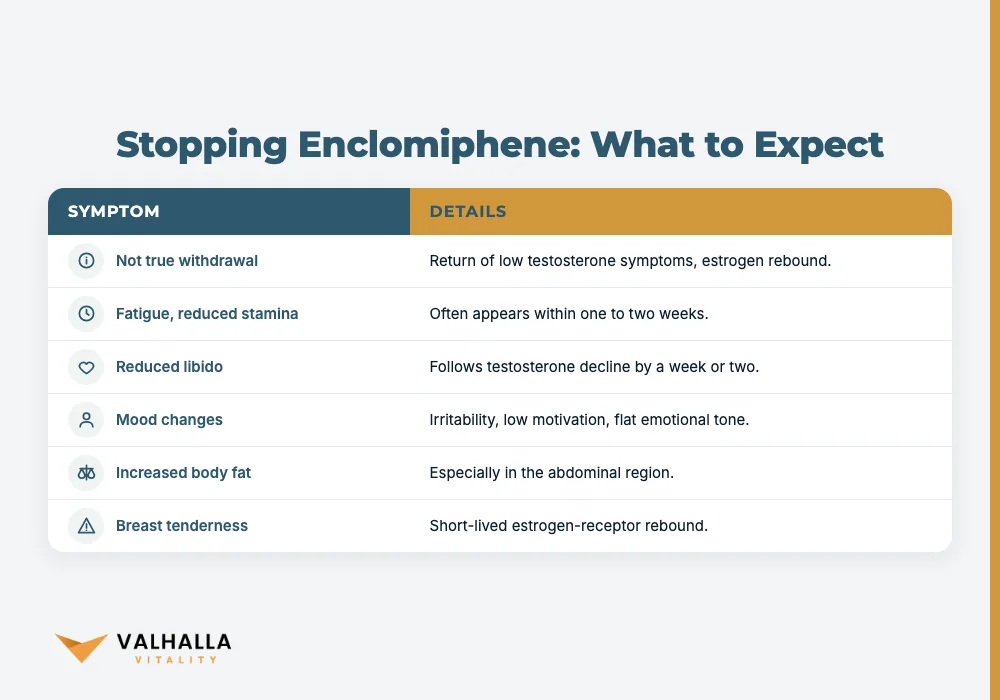
The phrase "enclomiphene withdrawal symptoms" is widely used, but it is worth clarifying what it actually means. Enclomiphene does not create pharmacological dependence. What men describe as withdrawal is typically the return of low testosterone symptoms that the drug was suppressing, combined in some cases with a brief estrogen-sensitivity rebound.
Common changes reported after stopping enclomiphene include:
- Fatigue and reduced stamina, often among the first symptoms, typically appearing within the first one to two weeks
- Reduced libido, which tends to follow the testosterone decline by a week or two
- Mood changes, including irritability, low motivation, or a flat emotional tone
- Difficulty concentrating, sometimes described informally as cognitive fog
- Reduced muscle tone, noticeable over weeks to months if testosterone remains low
- Increased body fat, particularly in the abdominal region, as the testosterone-to-estrogen ratio shifts
- Breast tenderness or fullness, a short-lived symptom reflecting the estrogen-receptor rebound
- Water retention, for similar reasons, typically resolving within a few weeks as the system readjusts
The intensity of enclomiphene side effects after stopping depends on how much of a person's testosterone production was drug-dependent versus naturally maintained. A provider can estimate this by comparing pre-treatment baseline labs with on-treatment labs and post-taper levels. Without that comparison, it is difficult to determine whether any given symptom reflects the drug's absence or an underlying condition that predated treatment.
Does stopping enclomiphene cause rebound low testosterone?
Yes, in many cases. Rebound low testosterone is one of the most clinically relevant concerns around enclomiphene discontinuation, and it helps to understand the two distinct mechanisms driving it.
The first mechanism is straightforward. Enclomiphene works by artificially elevating LH and FSH. When the drug is removed, those stimulating hormones decline. If the testes were producing testosterone primarily in response to drug-elevated LH rather than a naturally recovered hypothalamic-pituitary signal, testosterone can fall quickly and substantially after stopping.
The second mechanism involves estrogen. While on enclomiphene, estrogen receptors in the hypothalamus are blocked, which keeps estrogen's negative feedback on GnRH suppressed. When enclomiphene clears, those receptors become fully available again. Estrogen's feedback resumes at full strength. In some men, this briefly suppresses GnRH, LH, and testosterone below even the pre-treatment baseline before the system re-equilibrates, which is why some men feel worse in the first few weeks after stopping than they did before they ever started treatment.
Not every man experiences a sharp rebound. Men with mild secondary hypogonadism, or those whose underlying cause has been addressed, may find that testosterone stabilizes reasonably well after stopping. However, men who were substantially hypogonadal before starting treatment are at higher risk of a significant post-discontinuation drop. Regular labs in the weeks after stopping enclomiphene are the only reliable way to track what is actually happening, since symptoms alone are not sufficient to gauge the extent of any decline.
How long does testosterone recover after stopping enclomiphene?
Recovery time varies. It depends on baseline HPG axis function, age, duration of treatment, and whether the root cause of low testosterone has changed since treatment began. No single timeline applies across the board.
The available evidence offers a partial picture. A 2025 systematic review in Archives of Endocrinology and Metabolism confirmed that enclomiphene significantly raises testosterone during treatment, but most trials did not include formal post-treatment follow-up periods. Data from studies of clomiphene, enclomiphene's parent compound, reviewed in the 2016 Expert Opinion on Pharmacotherapy paper, suggest that some men maintain elevated testosterone for weeks after stopping, while others see a decline within days of the last dose.
The hormonal sequence works roughly as follows. LH and FSH begin to fall within days of the last dose. Testosterone usually follows within one to two weeks. Whether testosterone then stabilizes at a clinically adequate level, or continues to decline, depends on the underlying function of the hypothalamus, pituitary, and testes. A structurally intact axis responding to a temporary, reversible suppressor is more likely to recover. An axis with a structural deficit is not going to self-correct once the drug is stopped.
Several individual factors influence recovery speed. Age matters: the HPG axis in older men typically responds less strongly once pharmacological support is removed. Duration of treatment may matter as well, though the evidence specific to enclomiphene on this point is not conclusive. Metabolic health, sleep quality, and body composition all contribute to where testosterone ultimately settles after stopping.
Some men find that testosterone levels stabilize within two to three months of coming off enclomiphene, particularly if they were younger or had milder hypogonadism at baseline. Others remain below their pre-treatment levels for longer. A subset will require ongoing treatment, whether that means resuming enclomiphene, transitioning to testosterone replacement therapy, or pursuing another approach. The only way to know which path is appropriate is through lab monitoring after stopping.
Low testosterone after enclomiphene: what to watch for
Knowing the signs of low testosterone to track after stopping treatment is practical for anyone coming off enclomiphene. The symptoms that appeared before treatment began are the most likely to return, often in the same pattern and roughly the same order.
Physical changes worth tracking include persistent fatigue that does not respond to rest, a noticeable drop in morning erections or libido, and difficulty maintaining muscle mass with consistent exercise. Cognitive changes include reduced sharpness, lower motivation, and difficulty sustaining concentration. These often appear before the full testosterone drop registers on a lab panel, making symptom tracking alongside lab work a useful combination during the transition period.
A common error after stopping enclomiphene is waiting too long to recheck labs. If symptoms return, getting a comprehensive hormone panel early, including total testosterone, free testosterone, LH, FSH, and estradiol, allows a provider to assess whether the drop is temporary and whether any intervention is needed. Waiting months before testing can mean months of avoidable symptoms when management options exist.
Stopping enclomiphene gradually: what providers recommend
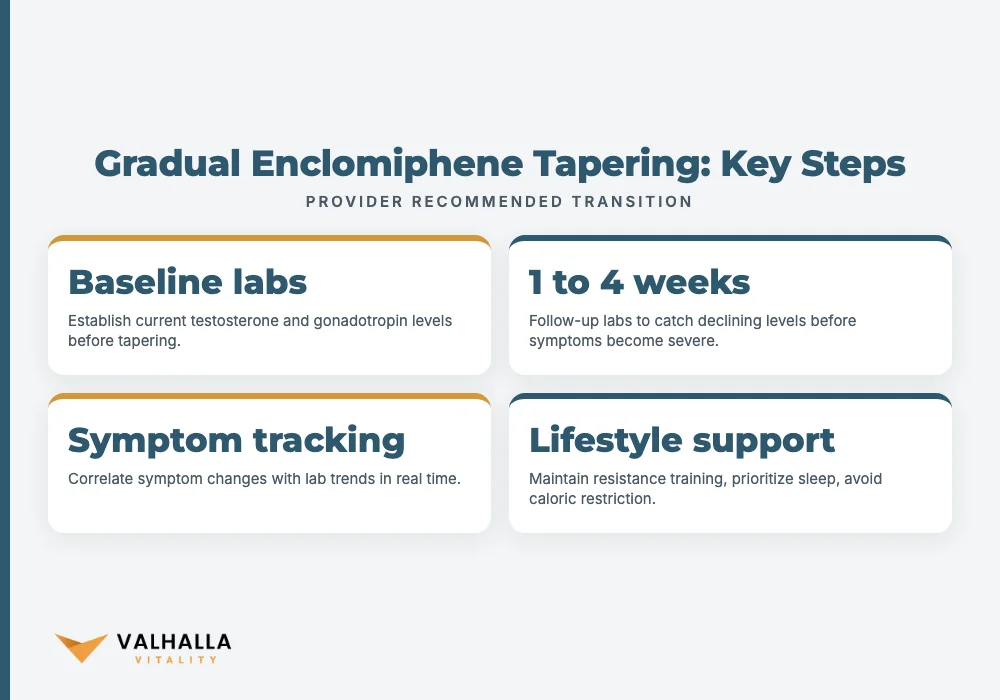
The transition off enclomiphene is typically managed through a gradual reduction rather than an abrupt stop. A licensed provider determines the specific schedule after reviewing current testosterone, LH, FSH, and estradiol levels alongside symptoms. No universal protocol exists because the rate at which testosterone falls after stopping enclomiphene differs meaningfully between individuals.
Practical elements that most transition plans include:
- Baseline labs before tapering to establish where testosterone and gonadotropins currently stand
- Follow-up labs at one to four weeks post-taper to catch declining levels before symptoms become severe
- Symptom tracking so the provider can correlate symptom changes with lab trends in real time
- Lifestyle support: maintaining resistance training, prioritizing sleep quality, and avoiding chronic caloric restriction during the transition period
- A clear decision point: if testosterone falls below a provider-determined threshold, the plan should specify whether to extend, resume, or transition to a different therapy
If testosterone does not stabilize after stopping enclomiphene, the next step depends on age, lab results, fertility goals, and underlying diagnosis. Testosterone replacement therapy (TRT) delivers testosterone directly rather than stimulating the body to produce it, which resolves the dependency on a functioning HPG axis. However, TRT suppresses natural testosterone production and, in many cases, sperm production. That distinction matters for men whose fertility goals were a reason to choose enclomiphene over TRT in the first place. A provider walks through these trade-offs as part of any transition planning conversation.
Enclomiphene side effects after stopping: the estrogen picture
Coming off enclomiphene does not only affect testosterone. Estrogen dynamics shift meaningfully in the days and weeks after stopping, and understanding this helps distinguish a normal short-term rebound from something that warrants further evaluation.
While on enclomiphene, estrogen receptors in the hypothalamus and pituitary are occupied and blocked. Estrogen's negative feedback on GnRH production is suppressed. When the drug clears, those receptors become available again. In some men, the receptors respond more strongly to circulating estrogen than they ordinarily would, because they were effectively turned off during treatment. This produces a temporary increase in estrogenic effects even if circulating estrogen levels are not substantially elevated.
Symptoms of this rebound can include mild breast tenderness, water retention, and mood instability in the first one to four weeks after stopping. These typically resolve as the receptor population re-equilibrates. They can, however, be uncomfortable and are sometimes misread as signs of a more persistent problem rather than a transitional one.
Monitoring estradiol alongside testosterone and LH after stopping enclomiphene gives a more complete hormonal picture. If estradiol rises substantially or does not normalize within a few weeks, a provider may consider additional management options.
It is also worth noting that the side effects reported during enclomiphene use differ from those that appear after stopping. Both phases carry risks worth tracking, and they are not interchangeable.
When stopping enclomiphene is the right decision
Not every man on enclomiphene should continue indefinitely, and knowing when stopping makes clinical sense matters as much as knowing what to expect when you stop.
Providers typically consider enclomiphene discontinuation when:
- The underlying cause of secondary hypogonadism has been identified and addressed, such as meaningful weight loss improving the HPG axis or treatment of a correctable pituitary condition
- Testosterone has been stable in a healthy range for a sustained period and natural recovery seems plausible based on the clinical picture
- A patient chooses to stop treatment and understands the risk of symptom return
- Side effects during treatment are not manageable with adjustments and the risk-benefit picture has shifted
Stopping enclomiphene is not necessarily permanent. Some providers use cyclical protocols, pausing treatment and resuming if testosterone falls substantially. Others transition patients to an alternative therapy. The decision is individualized and should be grounded in current labs, symptom status, and the person's goals rather than a fixed treatment duration. A thorough review of the clinical picture before making any change is the baseline expectation.
Ready to plan your transition?
If you are considering stopping enclomiphene or are already navigating what comes after, a licensed provider at Valhalla Vitality can review your current labs and help you build a personalized transition plan. Book Your Consultation to get started.
FAQ
What happens when you stop taking enclomiphene?
When you stop taking enclomiphene, the drug no longer blocks estrogen receptors in the hypothalamus and pituitary, which reduces GnRH, LH, and FSH output. Lower LH leads to decreased testosterone production in the testes. Symptoms of low testosterone that the drug was suppressing may return over the following days to weeks.
Can you stop enclomiphene cold turkey?
Stopping enclomiphene cold turkey is not acutely dangerous, but it is not the recommended approach. An abrupt stop tends to produce a faster testosterone decline and a more pronounced estrogen rebound compared to a gradual taper. A licensed provider determines the safest tapering approach based on current labs and symptom status.
How long does testosterone recover after stopping enclomiphene?
Recovery time varies considerably depending on age, duration of treatment, and baseline HPG axis function. Some men see testosterone stabilize within weeks; others remain below pre-treatment levels for several months. Regular lab monitoring after stopping enclomiphene is the only reliable way to track individual progress.
What are enclomiphene withdrawal symptoms?
Enclomiphene does not cause pharmacological dependence, but the return of low testosterone symptoms is common after stopping. These may include fatigue, reduced libido, mood changes, difficulty concentrating, and reduced muscle tone. A brief estrogen rebound can also cause breast tenderness and water retention in the first few weeks.
Does stopping enclomiphene cause rebound low testosterone?
Yes, in many cases. When enclomiphene clears, LH and FSH decline, and testosterone production can fall toward or below pre-treatment levels. A temporary estrogen-receptor rebound can also suppress testosterone further in the short term. Whether testosterone recovers on its own depends on the underlying function of the HPG axis and factors such as age and metabolic health.
Sources
- Hohl A et al. (2025). Clomiphene or enclomiphene citrate for the treatment of male hypogonadism: a systematic review and meta-analysis of randomized controlled trials. Archives of endocrinology and metabolism. PubMed
- Rodriguez KM et al. (2016). Enclomiphene citrate for the treatment of secondary male hypogonadism. Expert opinion on pharmacotherapy. PubMed
You May Also Like
 Enclomiphene
Enclomiphene Hair Loss: DHT, Follicles, and the Evidence
Enclomiphene hair loss is not a listed side effect, but testosterone raises DHT, which can affect follicles. Here is what clinical research shows.
October 12, 2026 ETRead more → Enclomiphene
Enclomiphene for Gyno: Causes, Prevention & Treatment
Enclomiphene for gyno: how this SERM may help reduce gynecomastia by rebalancing estrogen and testosterone levels. Talk to a licensed provider today.
October 11, 2026 ETRead more → Enclomiphene
Enclomiphene vs Tamoxifen for PCT and Testosterone
Enclomiphene vs tamoxifen: compare how each SERM supports testosterone recovery, PCT protocols, and side effect profiles before talking to a provider.
October 11, 2026 ETRead more →