
The following blog post is for entertainment and informational purposes only. It is not intended to provide medical advice or diagnosis. Please consult your doctor before making any health-related decisions.
Enclomiphene for gyno is a non-surgical hormonal option that targets the estrogen-to-testosterone imbalance behind male breast tissue growth. As a selective estrogen receptor modulator (SERM), it blocks estrogen signaling in breast tissue while prompting the body's own testosterone production. Preliminary clinical observations suggest this dual mechanism may reduce gynecomastia in some men. A licensed provider reviews your labs and intake before determining whether enclomiphene is appropriate.
What causes gynecomastia hormone imbalance?
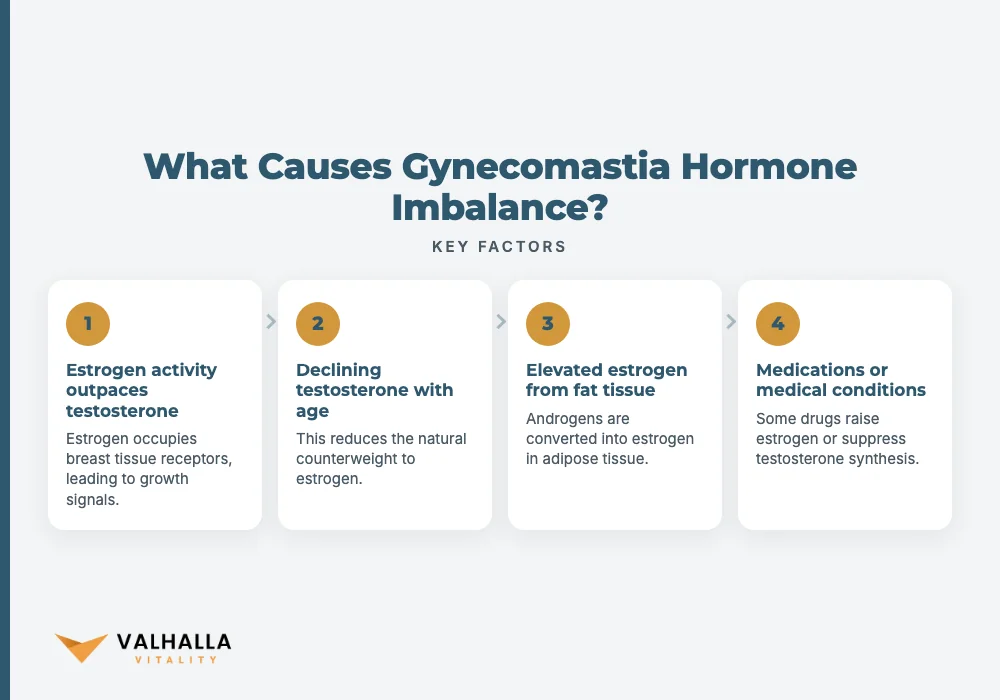
Gynecomastia develops when estrogen activity in male breast tissue outpaces testosterone's counterbalancing effect. Breast tissue in men contains estrogen receptors. When estrogen occupies those receptors unchecked, growth signals follow.
The condition affects men across a wide range of ages, and its prevalence rises with metabolic changes, age-related hormone shifts, and certain medications.
Several factors can push the hormonal balance toward estrogen:
- Declining testosterone output with age, which reduces the natural counterweight to estrogen
- Elevated estrogen from adipose tissue, where androgens are enzymatically converted into estrogen
- Medications that raise estrogen or suppress testosterone synthesis
- Conditions disrupting the pituitary-testicular signaling axis, lowering the hormonal drive behind testosterone production
The condition is common. It is rarely life-threatening, but the physical and psychological effects are real. Many men report chest tenderness, persistent self-consciousness, and reduced confidence. Addressing the underlying hormonal driver is the central goal of medical treatment.
How does enclomiphene affect estrogen levels?
Enclomiphene works at two points in the hormonal chain. First, it occupies estrogen receptors in certain tissues, including breast tissue, so estrogen can no longer bind and trigger growth signals.
Second, it acts on the hypothalamus and pituitary gland, prompting the release of LH and FSH, which in turn signal the testes to produce testosterone. For a closer look at this process, see enclomiphene and estrogen balance in men.
This two-pronged effect is what makes enclomiphene gynecomastia treatment conceptually sound. Blocking estrogen alone does not address low testosterone. Enclomiphene shifts both sides of the ratio at once.
As an enclomiphene estrogen blocker, the compound limits estrogen activity without suppressing it entirely. Estrogen is necessary in men for bone density, mood, and cardiovascular function. The goal is balance, not elimination.
Enclomiphene testosterone levels in clinical observations have typically risen within weeks of starting treatment. Individual response depends on baseline hormonal status and how well the pituitary-testicular axis responds to stimulation.
Does enclomiphene reduce gynecomastia?
Enclomiphene for gyno shows promise in preliminary observations, but large-scale controlled trials remain limited. Available data suggest the compound may reduce breast tissue size and relieve associated tenderness and swelling in men whose gynecomastia is rooted in hormonal imbalance. Some case-level observations note measurable male breast tissue reduction following enclomiphene therapy.
Several factors shape how well a given case responds:
- Duration: Early-stage gynecomastia is more likely to respond to hormonal correction. Long-standing cases may involve fibrotic tissue that does not regress with hormone normalization alone.
- Hormonal profile: Men with clearly low testosterone and elevated estrogen tend to show more consistent improvements.
- Concurrent medications: Other compounds that independently raise estrogen may reduce enclomiphene's effectiveness or complicate hormone monitoring.
Enclomiphene is not specifically approved to address gynecomastia. A licensed provider evaluates its use case by case after reviewing hormone labs.
Can enclomiphene cause gyno?
Enclomiphene itself is unlikely to cause gynecomastia. The compound blocks estrogen receptors and promotes testosterone production. Both actions move against the hormonal conditions that drive male breast tissue growth.
Individual variation exists. A man also taking medications or supplements that independently raise estrogen could experience a net hormonal effect different from what enclomiphene produces on its own.
Drug interactions, personal metabolic differences, and baseline hormone levels all factor into the outcome. Monitoring hormone levels during treatment is the standard way a provider detects and corrects unexpected shifts early.
When prescribed and monitored by a licensed provider, enclomiphene is not expected to cause gynecomastia. Unsupervised use alongside estrogen-raising compounds carries a different risk profile. A thorough medication review is standard before any prescribing decision.
Can enclomiphene prevent gynecomastia?
Enclomiphene for gyno may have a preventive dimension as well. By restoring the estrogen-to-testosterone balance, it may reduce the likelihood of breast tissue development or progression in men with an established hormonal imbalance.
Prevention-specific evidence is thinner than treatment evidence. Most available data come from observations of men already experiencing gynecomastia, not from prospective prevention trials. Whether enclomiphene can reliably prevent gynecomastia in high-risk men is still an open question.
If your labs show elevated estrogen relative to testosterone, a licensed provider can evaluate whether a SERM for gynecomastia represents a reasonable proactive step in your case.
What is the best SERM for gyno?
No single SERM is universally best for every man with gynecomastia. Compounds in this class differ in how selectively they bind to estrogen receptors across different tissues, which affects both efficacy and side-effect profile.
Enclomiphene is the active isomer of clomiphene. That structural distinction matters: it may concentrate the estrogen-blocking action while reducing the off-target hormonal effects seen with the full clomiphene compound. To understand exactly how enclomiphene differs from clomiphene as a SERM, that article covers the structural and clinical differences.
The right choice for any man depends on hormone levels, medical history, and concurrent medications. A licensed provider makes that determination after reviewing labs. Selecting a SERM without lab context risks disrupting, not restoring, hormonal balance.
Working with a provider on enclomiphene for gyno
The research on enclomiphene gynecomastia is still building. Current observations suggest the mechanism is relevant to gynecomastia, but definitive data on patient selection and response timelines is still limited. Provider oversight fills that gap.
A provider-led process starts with labs. Testosterone, estrogen, LH, and FSH levels together map where the hormonal disruption originates and whether enclomiphene is likely to shift the ratio in a useful direction. Before your first appointment, you can review what to expect during enclomiphene treatment.
A licensed provider determines the dose after reviewing your lab results. No standard formula applies across individuals. Follow-up labs confirm the hormonal shift is moving in the expected direction.
At Valhalla Vitality, licensed providers typically review intake within 24 business hours, and prescriptions reach the partner pharmacy within 3 to 7 business days after approval.
Availability varies by state.
Talk to a provider about your options
If you have questions about enclomiphene for gyno or want to explore whether your hormone profile may respond to SERM-based treatment, Book Your Consultation with a licensed provider.
FAQ
Does enclomiphene reduce gyno?
Enclomiphene may reduce gynecomastia in men whose breast tissue growth is driven by a hormonal imbalance between estrogen and testosterone. Clinical evidence is preliminary, and outcomes depend on the duration and stage of the condition. A licensed provider can assess whether this is a suitable option after reviewing your labs.
Can enclomiphene cause gynecomastia?
Enclomiphene is unlikely to cause gynecomastia on its own, since it blocks estrogen receptors and promotes testosterone production. Interactions with other medications or supplements that independently raise estrogen could shift the hormonal balance unexpectedly. A provider review of your full medication list is a key safeguard.
What is the best SERM for gynecomastia?
The best SERM for gynecomastia depends on individual hormone levels, medical history, and tolerability. Enclomiphene is one option in this class, distinguished by its selectivity and its ability to raise testosterone alongside blocking estrogen. A licensed provider reviews your profile and labs to recommend the most appropriate compound.
How does enclomiphene affect estrogen levels in men?
Enclomiphene occupies estrogen receptors in breast and other tissues, limiting estrogen's ability to drive growth signals. Simultaneously, it triggers pituitary hormones that stimulate natural testosterone production. The net effect is a more favorable estrogen-to-testosterone ratio for men experiencing gynecomastia hormone imbalance.
Can enclomiphene prevent gynecomastia from developing?
Enclomiphene may reduce the risk of gynecomastia progression in men with elevated estrogen relative to testosterone, though prevention-specific evidence remains limited. Most observations involve men already experiencing the condition rather than controlled prevention populations. A licensed provider can evaluate whether proactive intervention makes sense for your risk profile.
Sources
You May Also Like
 Enclomiphene
 Before and After: Physical Changes Explained
Enclomiphene before and after: what physical changes to expect, how the results timeline unfolds, and why provider monitoring matters for outcomes.
October 21, 2026 ETRead more → Enclomiphene
 Vision Side Effects: Eye Floaters & More
Enclomiphene vision side effects include eye floaters, blurry vision, and light sensitivity. Know the warning signs and when to contact your provider.
October 21, 2026 ETRead more → Enclomiphene
 Drug Test: Detection, WADA, and Disclosure
Enclomiphene drug test detection depends on the test type. Learn how workplace panels, military screening, and WADA rules treat this SERM.
October 21, 2026 ETRead more →