
The following blog post is for entertainment and informational purposes only. It is not intended to provide medical advice or diagnosis. Please consult your doctor before making any health-related decisions.
Oral testosterone supplements can raise testosterone toward a balanced range in men with clinically confirmed deficiency, provided the formulation is appropriate and taken consistently with food. They come as capsules or pills, making injections unnecessary. A licensed provider reviews labs and medical history before prescribing any oral TRT protocol. For a thorough breakdown of how oral testosterone pills work across current formulations and who typically benefits, that guide covers the mechanisms and patient considerations in detail.
Testosterone is involved in energy regulation, muscle maintenance, bone density, mood stability, and sexual function in both men and women. Levels decline with age, and when that decline becomes clinically significant, a provider may recommend testosterone replacement therapy. Oral testosterone supplements are one available delivery route, and interest in testosterone pills effectiveness has grown alongside wider access to established oral formulations in recent years.
This article addresses oral TRT effectiveness, testosterone bioavailability across delivery routes, realistic timelines, side effects, and what a provider evaluates before prescribing.
Key facts at a glance
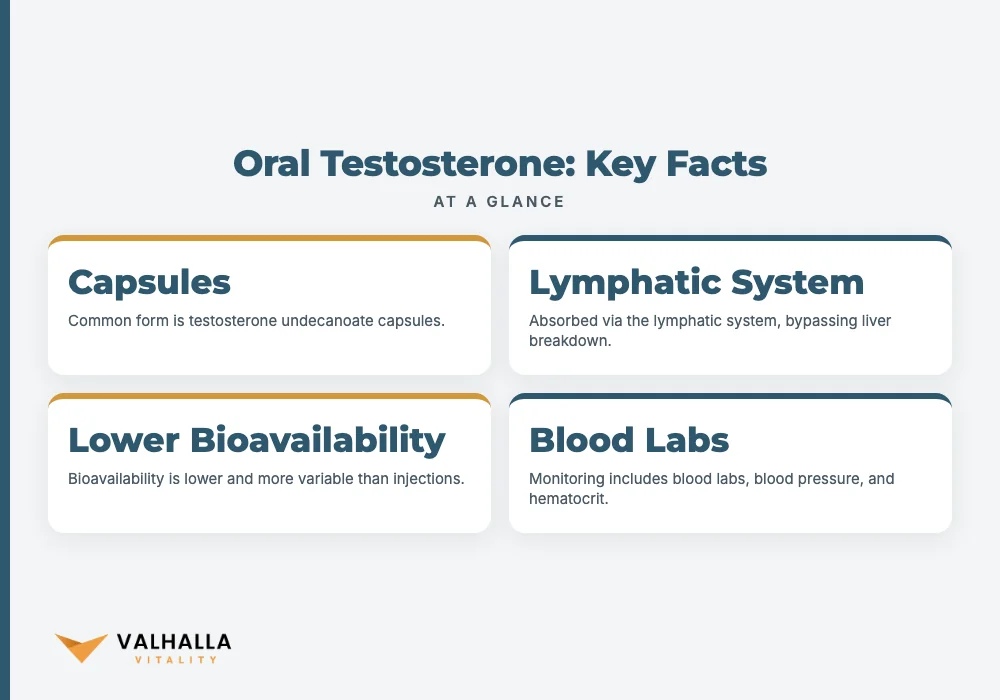
| Factor | What to know |
|---|---|
| Common form | Testosterone undecanoate capsules |
| Absorption route | Lymphatic system, reducing first-pass liver breakdown |
| Bioavailability vs. injections | Lower and more variable |
| Typical monitoring | Blood labs, blood pressure, hematocrit |
| Fertility consideration | May suppress sperm production |
| Availability | Varies by state |
Do oral testosterone supplements actually work?
The question "does TRT work orally?" has a clear clinical answer. Yes, oral testosterone supplements can work for people with confirmed hypogonadism when prescribed and monitored by a licensed provider. A 2022 review by Wang et al. in Endocrinology and Metabolism Clinics of North America found that TRT consistently addresses core symptoms of hypogonadism, including fatigue, reduced libido, and mood disruption, when hormone levels are genuinely deficient. The oral route achieves this through lymphatic absorption rather than direct liver processing, which modern formulations have made clinically viable.
Response is not uniform. Testosterone pills effectiveness depends on baseline hormone levels, the specific formulation, how consistently treatment is followed, and how well the protocol is calibrated through lab-guided follow-up.
What determines whether oral TRT is effective?
Several variables interact to shape results:
- Baseline lab values. A provider reviews total testosterone, free testosterone, LH, FSH, and other markers before recommending any TRT route. Confirmed deficiency is a clinical prerequisite.
- Consistency of intake. Irregular dosing creates fluctuating hormone levels, which reduces therapeutic benefit and makes monitoring harder to interpret accurately.
- Individual metabolism. Age, body composition, liver function, and genetic variation all influence how oral testosterone is absorbed and converted.
- Underlying health conditions. Cardiovascular disease, liver impairment, or sleep apnea shift the risk-benefit calculation considerably. A provider factors these in before prescribing.
- Ongoing protocol calibration. A licensed provider determines the dose after reviewing labs and adjusts the approach based on follow-up bloodwork, not a fixed calendar.
- Combination approaches. In some cases, a provider may recommend combining delivery methods to address individual pharmacokinetic variation more precisely.
What is the bioavailability of oral testosterone?
Testosterone bioavailability refers to the share of an ingested dose that actually reaches systemic circulation in active form. This number matters because it directly determines whether a dose produces the intended hormonal effect.
Standard oral medications pass through the liver immediately after gut absorption. This is called first-pass metabolism, and it is the reason older oral testosterone formulations performed poorly. The liver broke down most of the hormone before it could enter the bloodstream, leaving very little active testosterone available. That history gave oral TRT a poor reputation for decades.
Modern oral testosterone undecanoate is formulated with a fatty ester, which triggers absorption through the lymphatic system rather than the portal circulation. The lymphatic route largely bypasses first-pass liver metabolism.
As Bond et al. documented in their 2022 Frontiers in Endocrinology review of how androgens work and their associated risks, this pathway substantially improves bioavailability compared to earlier oral designs.
Even with this improvement, testosterone bioavailability from oral supplementation remains more variable than from intramuscular injections, where nearly the full dose enters circulation directly. Food intake matters here. The lymphatic absorption route is activated by dietary fat, so oral testosterone must be taken with a meal at every dose. Taking the capsule on an empty stomach sharply reduces absorption and can produce subtherapeutic levels that skew follow-up lab results.
How long does oral testosterone take to work?
Hormone levels begin shifting within the first few weeks of consistent use. Initial changes in energy and sleep quality are often the first improvements people notice. These respond relatively early because they reflect the most acute aspects of hormonal imbalance.
Libido and mood typically take longer to shift. Meaningful improvement in these areas often appears within six to eight weeks of consistent treatment, though some people need several months before results stabilize. Body composition changes, including shifts in lean muscle mass or fat distribution, are the slowest to develop. They generally require at least three to six months of consistent therapy and dose calibration to become clearly apparent.
Results take time. Managing expectations from the start helps people remain consistent through the period when clinical benefits are still accumulating.
Lab monitoring is what determines clinical progress, not the calendar. A provider orders repeat bloodwork at set intervals, often at six weeks and again at three months during the early phase, to confirm that testosterone levels are in the therapeutic range and to check for any markers requiring adjustment. If levels remain below target after the first assessment, a licensed provider determines the next step after reviewing the full panel.
Is oral testosterone as effective as injections?
In terms of testosterone bioavailability and peak hormone levels, intramuscular injections outperform oral supplementation. Injections achieve close to complete bioavailability, while oral formulations remain sensitive to food timing and individual digestive variation.
Evaluating a trt pill vs injection involves more than comparing peak levels, however. For a structured look at how these delivery routes differ clinically, the oral and injectable TRT delivery comparison covers pharmacokinetics, monitoring differences, and practical trade-offs side by side.
Oral TRT has practical advantages that affect long-term adherence. No injections, no cold-chain storage, and a simpler daily routine reduce treatment friction. Higher adherence over time often produces more stable outcomes, even when peak bioavailability is lower per dose.
Injections tend to create more pronounced peaks and troughs in circulating testosterone levels. Oral forms taken consistently produce a flatter daily curve. Which profile suits a given person better is part of the provider's assessment, not a universal answer.
What are the side effects of oral testosterone supplements?
Oral testosterone supplements share most side effects with other TRT routes. Some risks differ in degree or require route-specific monitoring.
Common effects across TRT routes
These effects may occur with any form of testosterone replacement therapy:
- Acne or oily skin, often most pronounced early in treatment
- Fluid retention, which may produce temporary weight increase
- Mood changes, most likely during periods of significant hormone fluctuation
- Elevated red blood cell count (erythrocytosis), requiring periodic hematocrit checks
- Changes in cholesterol profile, particularly HDL levels
Liver function and blood pressure
Because oral testosterone still contacts the digestive tract during absorption, providers monitor liver function and blood pressure throughout treatment. Bond et al. (2022) identified blood pressure elevation as a known risk associated with oral testosterone formulations, making cardiovascular baseline assessment important before prescribing. People with pre-existing liver disease should discuss the oral route carefully with their provider, as hepatic exposure, though reduced by lymphatic absorption, is not entirely eliminated.
Fertility considerations
A 2025 review by Naelitz et al. in Nature Reviews Urology confirmed that testosterone replacement therapy suppresses the hypothalamic-pituitary-gonadal axis, reducing sperm production in reproductive-age men. This applies across all TRT delivery routes, including oral supplements. Men who may want to preserve fertility should raise this during intake. A provider can discuss approaches that support spermatogenesis alongside hormonal treatment.
Drug interactions
People taking blood thinners, corticosteroids, diabetes medications, or thyroid treatments should review potential interactions with their provider before starting oral testosterone supplements. Interactions can affect how well both the testosterone and existing medications perform, and some combinations require additional monitoring.
Who may be a candidate for oral testosterone supplementation?
Oral testosterone supplements may be appropriate for people with confirmed hypogonadism who prefer an oral route and do not have contraindications such as significant liver disease or uncontrolled cardiovascular conditions.
Before prescribing, a provider typically evaluates:
- Fasting total and free testosterone levels, usually confirmed with two separate morning draws to rule out transient variation
- Complete blood count and metabolic panel, including liver enzymes
- Prostate-specific antigen (PSA) in men above a certain age
- Resting blood pressure and cardiovascular history
- Symptom history, existing medications, and overall health status
Oral testosterone dosage is determined by the provider after reviewing these results. No fixed number applies universally. The goal is reaching the therapeutic range that resolves symptoms without producing side effects.
Valhalla Vitality's telehealth process includes licensed provider review within 24 business hours of intake submission. Prescriptions are routed to a partner compounding pharmacy, with delivery typically within 3 to 7 business days. Availability varies by state.
Monitoring and ongoing treatment
Treatment does not end at the first prescription. Regular provider check-ins are built into the protocol from the beginning. Bloodwork confirms that hormone levels are in the therapeutic range. Hematocrit checks catch elevated red blood cell counts before they become clinically significant. Blood pressure is reviewed at each monitoring visit.
If levels remain below the therapeutic target, a licensed provider adjusts the approach after reviewing the labs. If side effects develop, the protocol is modified or a different delivery route is considered. Monitoring is what makes long-term TRT clinically safe.
Consistency matters on both sides: taking each dose with food at the right time, and attending every follow-up appointment. Stopping and restarting unpredictably disrupts the hormonal baseline and makes lab results harder to interpret.
Lifestyle factors interact with treatment outcomes. A 2016 review by Kovac et al. in American Journal of Men's Health found that dietary and lifestyle interventions could support testosterone levels alongside pharmacological therapy in hypogonadal men. For a detailed look at how providers calibrate protocols over time, the oral testosterone dosage guide walks through the clinical decision-making process from baseline labs through ongoing adjustment.
Effects on bone, mood, and body composition
Testosterone acts across multiple systems beyond energy and libido, and oral TRT may support each of them over time.
Bone density. Clinically low testosterone is associated with reduced bone mineralization. TRT may help maintain bone density and reduce the risk of fracture over the long term. In appropriate patients, bone scans are used periodically to track this response.
Mood and cognition. Testosterone receptors are distributed throughout the brain. Men with hypogonadism commonly report irritability, low motivation, and difficulty concentrating. TRT's effects on these symptoms vary considerably between individuals, and a provider sets realistic expectations during intake rather than making outcome predictions.
Body composition. Adequate testosterone may support lean muscle maintenance and contribute to a more favorable body composition by reducing fat accumulation over time. These changes are gradual, typically requiring at least three to six months of consistent treatment to become clearly apparent, and they develop alongside regular physical activity rather than independently of it.
Ready to explore your options?
Book Your Consultation to connect with a licensed provider who can review your labs and help determine whether oral testosterone supplementation is appropriate for your situation.
FAQ
Do oral testosterone supplements actually work?
Oral testosterone supplements can effectively raise testosterone levels in people with confirmed hypogonadism when the correct formulation is taken consistently with food and the protocol is monitored by a provider. Testosterone pills effectiveness varies with the individual's metabolism, baseline labs, and how consistently treatment is followed. Outcomes are assessed through repeat lab testing, not fixed timelines.
What is the bioavailability of oral testosterone?
Oral testosterone undecanoate is absorbed through the lymphatic system, which improves on older oral formulations but delivers more variable bioavailability than intramuscular injections. Absorption depends on consistent food co-ingestion at each dose, since dietary fat activates the lymphatic route. A provider accounts for this variability when reviewing follow-up labs and making protocol adjustments.
What are the side effects of oral testosterone supplements?
Testosterone capsules side effects may include acne, fluid retention, mood changes, elevated red blood cell count, and blood pressure increases. Liver function is monitored throughout treatment because oral testosterone still contacts the digestive tract. A provider reviews health history and baseline markers before prescribing and tracks these throughout the course of treatment.
How long does oral testosterone take to work?
Initial improvements in energy and sleep may appear within the first few weeks of consistent use. Meaningful changes in libido, mood, or body composition typically take two to six months, depending on individual response and whether dose adjustments are needed. Lab results, rather than calendar milestones, guide the provider's assessment of progress.
Is oral TRT safe for long-term use?
Oral testosterone replacement therapy can be used long term under ongoing provider supervision with regular monitoring of hormone levels, hematocrit, blood pressure, liver function, and PSA. Long-term safety depends on the individual's baseline health and how actively the protocol is managed. A provider reassesses suitability at each scheduled monitoring visit.
Sources
- Wang C et al. (2022). Testosterone Replacement Therapy in Hypogonadal Men. Endocrinology and Metabolism Clinics of North America. PubMed
- Bond P et al. (2022). Anabolic-androgenic steroids: How do they work and what are the risks? Frontiers in Endocrinology. PubMed
- Naelitz BD et al. (2025). Testosterone replacement therapy and spermatogenesis in reproductive age men. Nature Reviews Urology. PubMed
- Kovac JR et al. (2016). Dietary Adjuncts for Improving Testosterone Levels in Hypogonadal Males. American Journal of Men's Health. PubMed
You May Also Like
 Oral testosterone
Oral Testosterone Therapy: Energy, Side Effects & Results
Oral testosterone therapy may improve energy and ease fatigue in men with low T. Learn how it works, what side effects to expect from treatment.
October 7, 2026 ETRead more → Oral testosterone
Oral Testosterone Fertility: How TRT Affects Sperm
Oral testosterone fertility: TRT typically reduces sperm production. Learn what the research shows and how to protect your reproductive options.
October 7, 2026 ETRead more → Oral testosterone
Oral Testosterone Therapy: Options, Benefits, and Risks
Oral testosterone therapy delivers TRT in pill form. Learn how testosterone undecanoate capsules work, who qualifies, and key side effects to watch.
October 6, 2026 ETRead more →