
The following blog post is for entertainment and informational purposes only. It is not intended to provide medical advice or diagnosis. Please consult your doctor before making any health-related decisions.
Spermidine food sources range from wheat germ and natto to aged cheese, legumes, and mushrooms. Concentrations vary widely by food category. A 2026 review in Food Chemistry (Liu et al.) confirmed that fermented and grain-based foods consistently lead other categories in dietary polyamine content. To understand how these dietary sources compare to supplement options, it helps to examine each food group with the research in view.
What is spermidine and why do food sources matter more with age?
Spermidine is a polyamine, meaning it carries multiple amino groups that bind with molecules involved in cell growth, DNA stability, and cellular recycling. Its primary function is regulating autophagy, the process by which cells identify, break down, and repurpose damaged components. That matters because cellular damage accumulates with age and needs active clearance.
A 2025 study in Nutrition Research Reviews (Borsky et al.) found that spermidine specifically promotes mitophagy, the targeted clearance of dysfunctional mitochondria. When damaged mitochondria accumulate without clearance, cellular function degrades more quickly. Beyond mitophagy, spermidine's influence on broader autophagy regulation makes dietary polyamines relevant to aging research across multiple cellular processes.
Rzeski et al. (2026) in Nutrients describe spermidine as one of a small group of natural bioactive compounds that simultaneously target multiple hallmarks of aging, including loss of proteostasis, mitochondrial dysfunction, and impaired cellular signaling. That multi-target profile distinguishes it from single-pathway nutrients.
The body produces spermidine on its own. Output falls gradually after roughly age 30. The decline is slow, but it compounds over decades as cellular repair capacity decreases alongside it. Dietary polyamines drawn from consistent food choices become progressively more relevant with each passing year.
What foods are highest in spermidine?
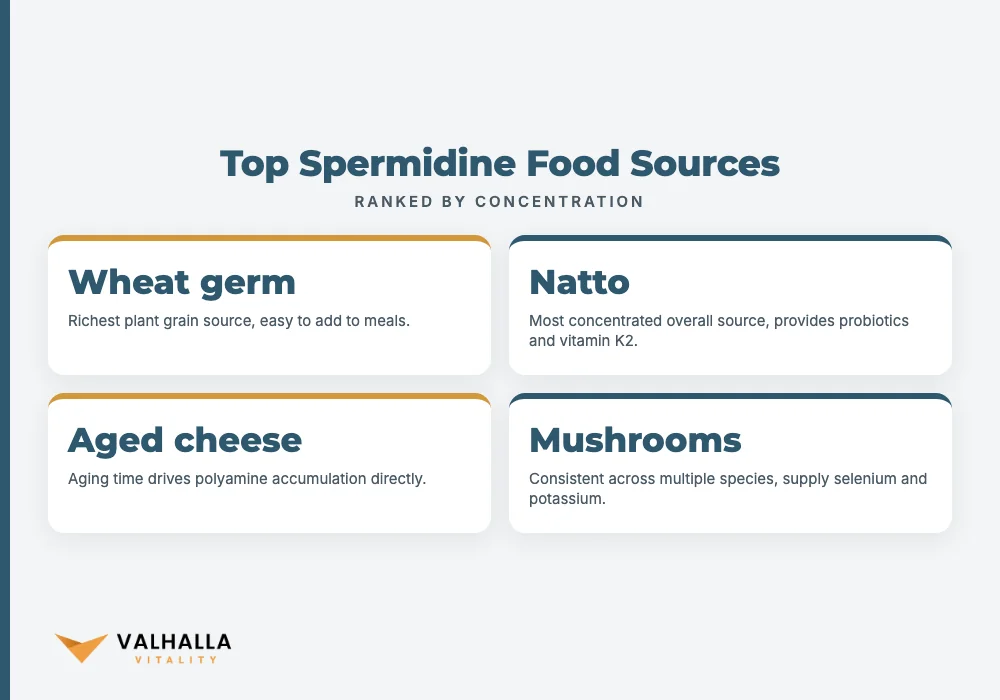
Wheat germ and natto lead all food categories by a notable margin, according to Liu et al. (2026). Behind them, aged cheese, mushrooms, soybeans, chicken liver, peas, and cruciferous vegetables all contribute meaningfully to daily polyamine intake. Plant sources with fermentation or germination activity concentrate dietary polyamines most efficiently.
Top spermidine food sources ranked by typical polyamine concentration:
- Wheat germ: the richest plant grain source; adds easily to yogurt, oatmeal, and smoothies
- Natto: fermented Japanese soybeans and the most concentrated overall source per gram; also provides probiotics and vitamin K2
- Aged and mature cheese: cheddar, parmesan, gouda, and blue cheese; aging time drives polyamine accumulation directly
- Mushrooms: consistent across multiple species; also supply selenium, potassium, and phosphorus
- Soybeans and soy products: edamame, miso, tempeh, and tofu all carry notable spermidine levels
- Chicken liver: supplies spermidine alongside iron, vitamin A, and vitamin B9
- Peas: a practical and affordable legume with strong protein and fiber alongside polyamine content
- Cauliflower and broccoli: cruciferous vegetables with broad micronutrient profiles that include spermidine
- Hazelnuts: the standout nut source; most other nuts sit at only moderate polyamine levels
- Mangos: a lower-calorie fruit option that contributes spermidine alongside vitamins A and C
- Beef: a periodic protein source with meaningful polyamine content alongside iron and zinc
Does natto contain spermidine?
Yes. Natto contains some of the highest spermidine concentrations documented in any food. The fermentation uses Bacillus subtilis, a bacterial culture that synthesizes polyamines actively during the extended breakdown of soybeans. This microbial activity explains why natto spermidine content typically far exceeds that of fresh soy equivalents, and why Liu et al. (2026) position natto among the global leaders in dietary polyamine density.
Natto's polyamine concentration pairs with complementary bioactives. It supplies probiotics, nattokinase, and vitamin K2, each connected to cardiovascular and bone health research. That combination makes natto a natural anchor for a spermidine longevity diet focused on multiple body systems at once.
The flavor is strong and the texture unfamiliar to many outside Japan. Starting with small portions over rice or mixed into grain dishes is a practical approach. Miso and tempeh offer fermented soy alternatives with meaningful, if somewhat lower, spermidine content and considerably more culinary flexibility.
Aged cheese spermidine and fermented foods
Fresh cheeses fall at the low end of the polyamine spectrum. Microbial activity in cheese intensifies as aging continues, accumulating polyamines as a metabolic byproduct. Longer ripening equals higher concentration, consistently. Cheddar, parmesan, gouda, and blue cheese all sit in the higher ranges by virtue of their extended aging periods.
Aged cheese spermidine content challenges the assumption that all cheese is nutritionally equivalent. Mature varieties supply calcium, protein, and fat-soluble vitamins alongside their polyamine contribution. Regular, moderate inclusion of aged cheeses can address several nutritional goals simultaneously.
Fermented foods spermidine extends to miso, kimchi, sauerkraut, and kefir. Bacteria and fungi synthesize spermidine as part of their own metabolic activity, so fermented products arrive with elevated polyamine levels before any human digestive process begins. Miso integrates into soups, dressings, and marinades without difficulty. Kimchi and sauerkraut function as condiments alongside most protein-based meals. These additions require little preparation effort once the habit is established.
Plant-based spermidine food sources: mushrooms, legumes, and cruciferous vegetables
Mushrooms spermidine content holds steady across common species and remains accessible year-round. They fit into soups, grain bowls, stir-fries, and salads without materially shifting a meal's caloric profile. Their selenium, potassium, and phosphorus contribution extends their nutritional value well beyond polyamines alone.
Soybeans lead the legume category for spermidine, but peas, lentils, and chickpeas all contribute meaningfully. Peas stand out for their combination of polyamine content, protein, and fiber in a widely available and affordable form. Edamame, miso, tempeh, and tofu extend the access points for soy-based spermidine without requiring the same preparation as natto.
Cauliflower and broccoli deliver spermidine alongside calcium, magnesium, potassium, sulfur compounds, folate, and vitamins A, E, C, K, and B. Preparation method matters less than frequency. Raw, steamed, or roasted, cruciferous vegetables contribute polyamines in any form. Hazelnuts separate from other nuts by delivering noticeably higher concentrations. Most nuts provide moderate levels at best. A small daily portion, whether as a snack or a salad addition, adds spermidine without requiring dedicated meal planning.
Animal sources: chicken liver, beef, and dietary polyamine density
Animal products contribute to spermidine food sources in ways that complement plant-based options. Chicken liver is one of the more nutrient-dense animal choices available. It delivers spermidine alongside iron, vitamin A, and vitamin B9, giving it a nutritional density that few other proteins match on a calorie-for-calorie basis. Simple to roast and quick to prepare, it fits naturally into a monthly meal rotation.
Beef offers a solid periodic contribution. It provides spermidine alongside heme iron, zinc, and B12, nutrients that align with the broader demands of a longevity-focused diet. Neither chicken liver nor beef requires daily inclusion to contribute meaningfully. Several servings per month can cover gaps that plant-based sources may leave, particularly for those who do not regularly consume fermented soy.
Dietary polyamines as a family include spermidine, spermine, and putrescine. Many of the same foods that supply spermidine also carry spermine and putrescine. A whole-food diet built around fermented products, organ meats, legumes, and whole grains tends to deliver the full polyamine family rather than a single compound in isolation.
How much spermidine can you get from food per day?
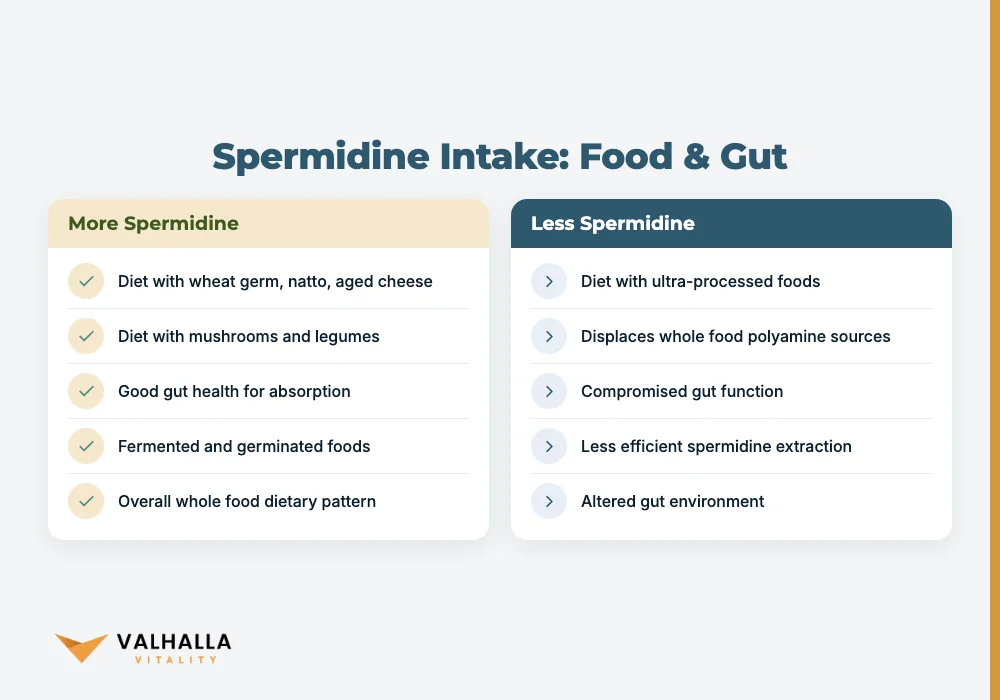
Daily intake from spermidine food sources depends entirely on dietary pattern. A diet centered on wheat germ, natto, aged cheese, mushrooms, and legumes can deliver substantially more spermidine than a diet dominated by ultra-processed foods. Levy et al. (2024) in The Proceedings of the Nutrition Society showed that ultra-processed food consumption displaces the whole foods that supply polyamines and other bioactive compounds.
Gut health also affects how much spermidine the body actually absorbs. Singh et al. (2025) in the World Journal of Gastroenterology found that ultra-processed diets compromise gastrointestinal function, which is where polyamine absorption occurs. A gut environment altered by these dietary patterns is less capable of extracting spermidine efficiently, regardless of what foods are technically on the plate.
No universally agreed daily reference value exists for dietary spermidine. Research continues to characterize typical population exposure across different dietary patterns. What Liu et al. (2026) establish is that food matrices affect both raw concentration and absorption efficiency. Fermented and germinated sources tend to show higher bioavailability alongside higher starting content. Spermidine is also synthesized endogenously from dietary precursors, as Liu et al. note in their biosynthesis analysis, meaning the overall dietary pattern influences polyamine levels through more than one pathway.
Can you get enough spermidine from diet alone?
For many adults, a diet built consistently around the top sources above can raise polyamine intake substantially. Whether that is sufficient depends on three variables: how far endogenous production has declined, how consistently the right foods appear in the diet, and what health goals are in view.
Rzeski et al. (2026) describe spermidine as targeting multiple aging hallmarks simultaneously. Their analysis suggests sustained intake over years matters more than any short-term optimization. Consistency across multiple food categories each day outperforms occasional inclusion of one high-concentration source.
People whose diets regularly include fermented foods, legumes, and whole grains can cover a meaningful portion of what the body can no longer produce on its own after 30. Those whose diets lack these consistently face a harder climb through food alone. Exploring quality supplement options alongside dietary changes provides a fuller picture of what is available for closing that gap.
Building a spermidine longevity diet
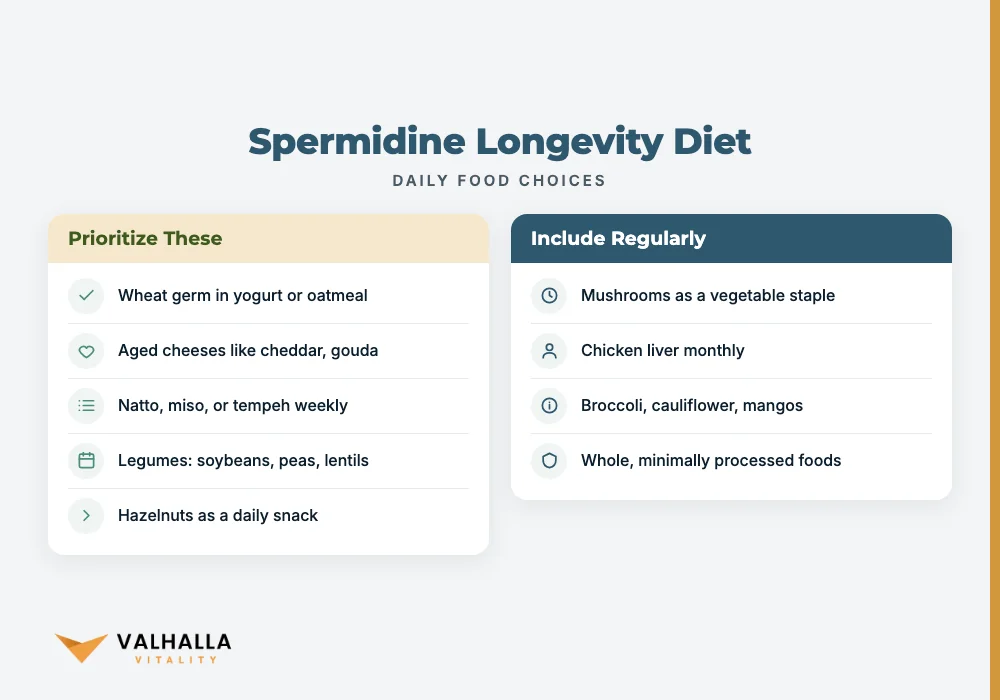
A spermidine longevity diet is a consistent daily pattern across several polyamine-rich food categories. No single food carries the full load. The practical approach:
- Add wheat germ to yogurt, smoothies, or oatmeal several times per week, wheat germ spermidine levels rank highest among plant grain sources
- Choose aged cheddar, gouda, or parmesan over fresh cheeses as a default
- Incorporate natto, miso, or tempeh into weekly rotations as a fermented protein source
- Build two or more meals per week around legumes: soybeans, edamame, peas, or lentils
- Use mushrooms as a vegetable staple rather than an occasional garnish
- Keep hazelnuts as a daily snack instead of processed alternatives
- Add chicken liver to the monthly meal plan for its dense polyamine and micronutrient profile
- Include broccoli, cauliflower, and mangos for consistent plant-based contributions across multiple food categories
The common thread is prioritizing whole, minimally processed food at every meal. Valhalla Vitality supports this approach with provider-guided guidance for those addressing longevity more comprehensively.
Understanding how spermidine supports longevity at the cellular level provides useful context for why these food choices matter across decades, not just individual meals.
When spermidine food sources fall short
Not everyone reaches adequate polyamine levels through diet alone. Absorption efficiency varies by individual, endogenous production decline differs in pace, and real-world dietary adherence over years is imperfect. Spermidine supplements are designed to address these gaps directly.
How spermidine functions in the body is relevant here: it influences cell growth, DNA stability, and autophagy regulation. When food-based intake has been consistently low, a more concentrated and reliable source may support what dietary changes alone cannot close quickly.
Food still provides what supplements cannot replicate: co-factors. Natto brings probiotics and K2. Chicken liver brings heme iron and B vitamins. Broccoli brings antioxidants and sulfur compounds. Isolated supplements deliver concentrated spermidine without that surrounding nutritional context. Both approaches address different parts of the same problem.
A licensed provider reviews lab results and intake history to assess whether supplementation is appropriate and determine the right approach. That evaluation is the right starting point before any decision.
Book your consultation
If you want to understand where your spermidine intake stands and how dietary choices fit a broader longevity plan, Book Your Consultation with a licensed provider who can review your labs and guide the next steps.
FAQ
What is the best natural source of spermidine?
Wheat germ and natto consistently rank as the most concentrated natural spermidine food sources, as documented by Liu et al. (2026) in Food Chemistry. Wheat germ is the richest plant grain source, and natto leads among fermented foods. Both integrate readily into regular meal patterns without significant preparation.
Does spermidine decline with age?
The body's own spermidine production falls gradually starting around age 30. This means dietary intake and, where appropriate, supplementation become progressively more relevant over time. Consistent consumption of polyamine-rich foods is one practical strategy to offset this natural decline.
How do fermented foods compare to fresh foods for spermidine?
Fermented foods typically contain significantly higher spermidine concentrations than unfermented equivalents. Microbial activity during fermentation generates polyamines as a metabolic byproduct, which is why natto, aged cheese, miso, and kimchi consistently outperform fresh soybeans and young cheeses.
Can a spermidine-rich diet replace supplements?
A diet built around wheat germ, natto, aged cheese, mushrooms, and legumes can raise daily polyamine intake substantially. Whether that level is sufficient depends on individual factors such as the rate of endogenous production decline, which a provider can assess through lab work. Food and targeted supplementation often complement rather than replace each other.
Is spermidine the only dietary polyamine in food?
Spermidine belongs to a family of dietary polyamines that also includes spermine and putrescine. Most foods that supply spermidine, including soybeans, aged cheese, mushrooms, and wheat germ, also contribute the related polyamines. A whole-food diet centered on these categories tends to deliver the full polyamine family rather than one compound in isolation.
Sources
- Liu S et al. (2026). Spermidine in food and health: biosynthesis, dietary sources, production, and biological functions. Food Chemistry. PubMed
- Rzeski W et al. (2026). Natural Bioactive Compounds Targeting Key Hallmarks of Aging: Functional Food Potential of Spermidine, Fisetin, Berberine, and Urolithin A. Nutrients. PubMed
- Borsky P et al. (2025). Distinct roles of urolithin A and spermidine in mitophagy and autophagy: implications for dietary supplementation. Nutrition Research Reviews. PubMed
- Singh AK et al. (2025). Ultra-processed foods: Implications for gastrointestinal health. World Journal of Gastroenterology. PubMed
- Levy RB et al. (2024). How and why ultra-processed foods harm human health. The Proceedings of the Nutrition Society. PubMed
You May Also Like
 Spermidine
 Supplement Forms: Pills, Tablets & Tincture
Spermidine supplement forms include pills, tablets, and tinctures. Compare bioavailability, side effects, and how a provider picks the right form for you.
October 30, 2026 ETRead more → Spermidine
 Benefits: Science, Safety, and How It Works
Spermidine benefits include autophagy, cardiovascular support, hair growth, and longevity support. Learn what the science shows and how to start.
October 29, 2026 ETRead more → Spermidine
Best Spermidine Supplement Guide: What the Research Shows
Best spermidine supplement selection starts with understanding autophagy, food sources, and key quality criteria. Here is what the research shows.
October 29, 2026 ETRead more →