
The following blog post is for entertainment and informational purposes only. It is not intended to provide medical advice or diagnosis. Please consult your doctor before making any health-related decisions.
Spermine benefits your health at the cellular level by regulating metabolism, stabilizing DNA, and supporting natural cellular renewal. It is a compact, positively charged polyamine produced in every eukaryotic cell in the human body. These effects touch anti-inflammatory, antioxidant, and longevity-linked pathways. For a fuller picture of how spermine and its close relative spermidine connect to healthy aging, this guide to spermine and spermidine for healthy aging covers both compounds in depth.
What is spermine?
Spermine is a biogenic polyamine that forms naturally inside eukaryotic cells. Cells produce it by extending the spermidine chain through the addition of an aminopropyl group, making spermine a downstream product of both putrescine and spermidine. It is found at all physiological pH values as a polycation, carrying multiple positive charges at normal body chemistry.
Those charges are how it works. Spermine binds tightly to negatively charged DNA and RNA, stabilizing helical structures and supporting efficient gene expression and protein synthesis. It is present in millimolar concentrations in the cell nucleus, and levels are especially high in sperm cells, which is where the name comes from.
Spermine function is distinct from how the body uses most vitamins or minerals. Rather than being consumed and replaced, it cycles through a tightly regulated biosynthetic pathway as cellular demands shift.
What is spermine used for?
Spermine function centers on cellular regulation. The compound supports controlled cell growth, modulates RNA translation rates, and helps initiate autophagy, the internal process by which cells clear damaged components and recycle them. A 2022 study by Tse et al. in the International Journal of Molecular Sciences examined how spermine and its acetylated derivative interact with cell proliferation pathways, identifying the compound's regulatory role in cancer biology.
The enzyme spermidine/spermine N1-acetyltransferase (SSAT) converts spermine back into smaller polyamines, maintaining homeostasis. Disrupting that balance has consequences. A separate 2022 paper by Tse et al. in the same journal found that SSAT activity connects to several human malignancies, underscoring why polyamine equilibrium matters in a medical context.
What foods are high in spermine?
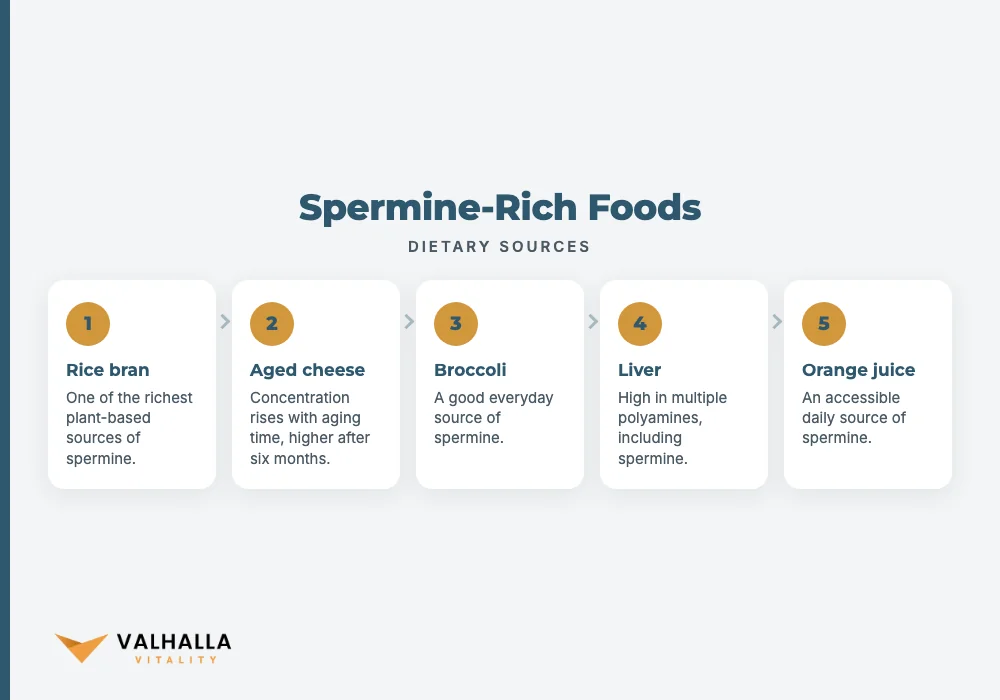
Diet is one of the main routes through which the body replenishes polyamines alongside internal biosynthesis. The spermine food sources in the table below are well documented.
| Food | Notes |
|---|---|
| Rice bran | One of the richest plant-based sources |
| Wheat germ | High polyamine content |
| Aged cheese | Concentration rises with aging time |
| Broccoli | Good everyday source |
| Lentils | Reliable plant-based option |
| Liver | High in multiple polyamines |
| Pear | Moderate natural source |
| Grapefruit | Also provides vitamin C |
| Orange juice | Accessible daily source |
Aged cheese earns special mention. Concentration climbs steadily with maturation time, and six or more months of controlled aging produces noticeably higher polyamine levels than fresh varieties. Fat content also rises with aging, so keeping portions moderate makes sense if you are tracking caloric intake.
These foods also supply protein, iron, potassium, and B-vitamins, so adjusting your diet toward them delivers spermine benefits and broader nutritional value simultaneously. For a structured comparison of polyamine-rich food sources and how they differ from supplements, that overview breaks the numbers down by category.
Key spermine benefits
Spermine benefits several interconnected biological systems. Research across multiple pathways points to consistent effects.
Cellular metabolism and renewal. Spermine supports protein synthesis and helps regulate the autophagy cycle, through which cells remove and recycle worn-out components. Consistent autophagy is linked to cellular longevity in model organisms across multiple research programs.
Anti-inflammatory effects. Spermine and related polyamines may help modulate inflammatory pathways that contribute to chronic conditions. Evidence suggests these effects depend on concentration.
Antioxidant protection. Adequate polyamine levels may help protect cells against oxidative stress, which accumulates over time and is a central driver of cellular aging.
Cardiovascular and metabolic health. Some evidence suggests spermine may support heart tissue function and metabolic efficiency, though this area remains actively studied.
Longevity. Autophagy induction is the mechanism most commonly associated with polyamine-linked longevity effects. Both spermine and spermidine share this pathway. The article on spermidine anti-aging mechanisms and how they relate to aging research covers that connection in detail.
Taken together, these spermine benefits span from molecular stabilization to whole-cell renewal. They are potential effects, not certain outcomes. A licensed provider can assess your health profile to determine where polyamine support might fit.
How does spermine differ from spermidine?
Spermidine vs spermine is one of the more common questions when someone begins exploring polyamine supplements. Both compounds share the same biosynthetic origin: putrescine. The difference is structural. Spermine carries one additional aminopropyl group, which gives it four positive charges compared to spermidine's three, making it a stronger DNA-binding agent.
Spermine also differs in its cellular distribution. Prokaryotic cells rarely produce it, while eukaryotes, including all human cells, generate it routinely. Spermidine is widespread across most forms of life; spermine is more specifically eukaryotic.
In commercial polyamine supplements, spermidine tends to be the primary active compound, partly because wheat germ extract provides a high and consistent source. Spermine typically appears in smaller quantities as a secondary component. A 2022 paper by Tse et al. suggested that the ratio between spermine and its metabolites may matter as much as absolute levels, pointing to balance across the entire polyamine pathway as the more meaningful measure.
What are the side effects of spermine?
Spermine side effects from dietary intake at normal food-based levels are not well documented in healthy individuals. The compound is endogenous, meaning your body already produces it, and typical dietary amounts stay within physiological ranges.
The more relevant concern involves enzymatic breakdown. When spermine is catabolized, one byproduct is acrolein. It is a reactive aldehyde. Research by Kashiwagi et al. published in Biomolecules in 2023 identified acrolein from spermine catabolism as a significant contributor to cellular toxicity in conditions where polyamine breakdown is elevated. This effect is primarily associated with disease states, not healthy individuals eating a varied diet.
Excess supplementation is a different concern. No compound is harmless without limit. A licensed provider determines the appropriate approach after reviewing your health history and lab results. Self-directed supplementation without oversight carries real risk, particularly when influencing pathways as central as polyamine homeostasis.
Can you take spermine as a supplement?
The spermine benefits discussed above have drawn increasing interest in the longevity supplement space. Most commercial polyamine products lead with spermidine, since wheat germ extract offers a reliable and well-studied source. Spermine tends to appear as a secondary component. Knowing what a product contains before purchasing matters. This guide to what spermine supplements contain and how they are formulated covers the key differences in detail.
Youthavar is one such product, developed by Valhalla Vitality. It combines spermidine with cycloastragenol to support cellular renewal and healthy aging. A detailed breakdown of Youthavar's spermidine formula and the science behind combining these compounds is available for anyone who wants to understand the ingredients before deciding. As with any supplement that affects cell-level processes, a conversation with a provider before starting is straightforward good practice.
Talk to a licensed provider
If spermine benefits have you wondering whether polyamine support belongs in your health plan, a licensed provider can review your labs and health history to give you a clear, personalized answer. Book Your Consultation.
FAQ
What is spermine used for?
Spermine regulates cellular metabolism, stabilizes DNA and RNA structures, and supports controlled cell turnover and autophagy. It also modulates protein synthesis rates by binding directly to RNA.
What are the side effects of spermine?
At normal dietary intake levels, documented side effects are uncommon in healthy individuals. Research has identified acrolein, a byproduct of spermine catabolism, as a potential contributor to cellular toxicity in disease states where polyamine breakdown is elevated, which is distinct from typical food-based exposure.
What foods are high in spermine?
Rice bran, wheat germ, aged cheese, broccoli, lentils, and liver are among the best spermine food sources. Aged cheese increases in polyamine concentration the longer it matures, making it one of the more concentrated dietary options.
How does spermine differ from spermidine?
Spermine is biosynthetically derived from spermidine and carries four positive charges compared to spermidine's three. Both are polyamines found in eukaryotic cells, but spermine binds DNA more strongly and is rarely present in prokaryotic cells.
Can you take spermine as a supplement?
Most polyamine supplements use spermidine as the primary active compound, with spermine present in smaller amounts as a secondary component. A licensed provider can assess whether polyamine supplementation is appropriate for your individual health profile.
Sources
- Tse RT et al. (2022). The Potential Role of Spermine and Its Acetylated Derivative in Human Malignancies. International Journal of Molecular Sciences. PubMed
- Tse RT et al. (2022). The Association between Spermidine/Spermine N(1)-Acetyltransferase (SSAT) and Human Malignancies. International Journal of Molecular Sciences. PubMed
- Kashiwagi K et al. (2023). Molecular Characteristics of Toxicity of Acrolein Produced from Spermine. Biomolecules. PubMed
You May Also Like
 Spermine
 Supplements: Benefits, Safety & What to Know
Spermine supplements may support anti-aging, cellular health, and longevity. Learn the benefits, food sources, and what research actually shows.
October 28, 2026 ETRead more → Rapamycin
 Dosage for Anti-Aging: What You Need to Know
Rapamycin dosage for anti-aging is set by a licensed provider after labs. Discover how sirolimus protocols work and what the latest research shows.
November 14, 2026 ETRead more → Tirzepatide
 Peptide: Mechanism, Benefits and Side Effects
Tirzepatide peptide targets two receptors to support weight loss and blood sugar control. Learn how it works, its benefits, and what to expect.
November 14, 2026 ETRead more →