
The following blog post is for entertainment and informational purposes only. It is not intended to provide medical advice or diagnosis. Please consult your doctor before making any health-related decisions.
Tirzepatide vs semaglutide, often framed as "Mounjaro vs Ozempic" by patients familiar with brand names, is the defining question for many adults exploring GLP-1 for weight loss today. Both are weekly injectable therapies, but tirzepatide targets two hormonal receptors where semaglutide targets one. Real-world evidence from Thomsen et al. (2025) suggests tirzepatide produces greater average weight reduction. The right choice still depends on your health profile and what a licensed provider determines after reviewing your intake.
How they compare at a glance
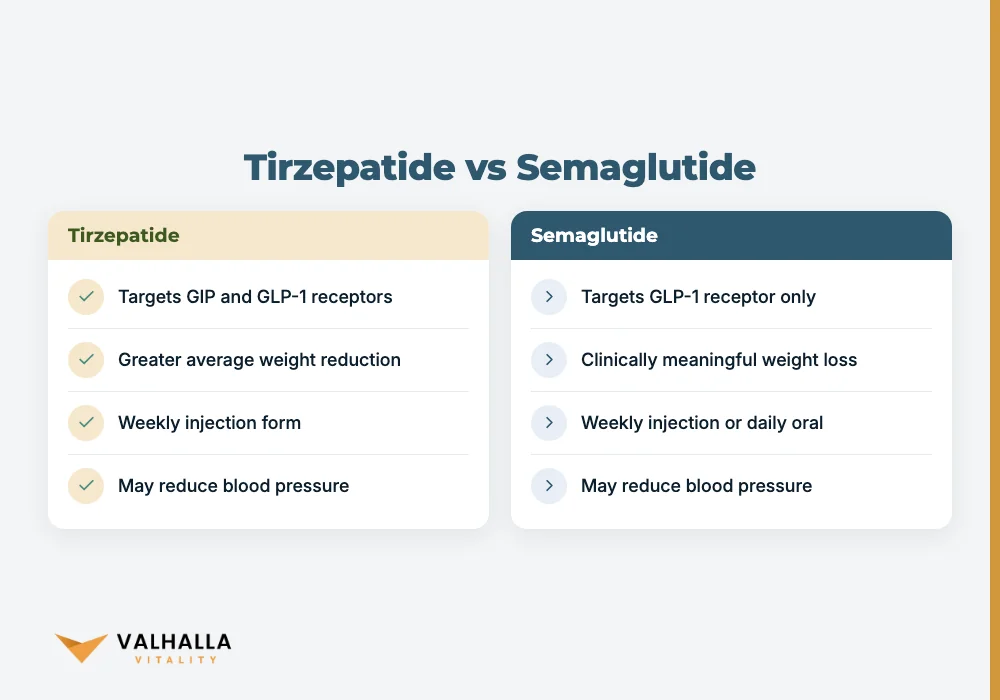
| Tirzepatide | Semaglutide | |
|---|---|---|
| Receptor targets | GIP + GLP-1 (dual agonist) | GLP-1 only |
| Forms available | Weekly injection | Weekly injection or daily oral tablet |
| Relative weight loss | Greater average reduction (real-world data) | Clinically meaningful; less than tirzepatide |
| Common side effects | Nausea, vomiting, diarrhea | Nausea, vomiting, diarrhea |
| Blood pressure | May reduce systolic and diastolic BP | May reduce systolic and diastolic BP |
| Dosing | Provider-determined after labs | Provider-determined after labs |
Is tirzepatide stronger than semaglutide?
Yes, in terms of hormonal mechanism. Tirzepatide activates both the GIP and GLP-1 receptors. Semaglutide targets only the GLP-1 receptor. Davies (2025) in Nursing Standard describes this dual-agonist structure as the reason tirzepatide exerts broader effects on insulin secretion, glucagon suppression, and appetite signaling.
That structural difference carries into outcomes. A 2025 real-world analysis in Diabetes, Obesity & Metabolism (Thomsen et al.) found tirzepatide users achieved greater body weight reduction than semaglutide users in non-diabetic populations with obesity. The gap is consistent across multiple real-world datasets reviewed in that study.
Greater potency does not automatically mean better tolerability. A licensed provider weighs both before recommending either option.
Which is more effective for weight loss, tirzepatide or semaglutide?
Tirzepatide generally produces greater weight reduction. That holds across real-world data.
Both medications slow gastric emptying and suppress appetite through GLP-1 pathways. Tirzepatide adds a second mechanism. Its GIP receptor activation improves insulin sensitivity and produces anti-inflammatory effects that semaglutide does not replicate. A 2026 systematic review in Reviews in Endocrine & Metabolic Disorders (Masson et al.) confirmed tirzepatide is associated with measurable reductions in inflammatory markers. This finding is rarely highlighted in a weight loss injection comparison, but it is relevant for patients managing metabolic syndrome alongside obesity.
Semaglutide weight loss results are well-established across clinical and real-world settings. It has a longer track record and is available in both injectable and oral forms. For a detailed look at how semaglutide works for weight loss, that guide covers the mechanisms in full.
How much weight can you lose on tirzepatide vs semaglutide?
More, on average, with tirzepatide. Thomsen et al. (2025) found this pattern consistent across non-diabetic adults with obesity in their real-world comparative dataset.
Diet plays a role. Wang et al. (2026) in Advances in Nutrition found that adequate dietary fiber intake may amplify GLP-1 receptor agonist effects, suggesting that nutritional habits during treatment can shape individual results. Neither medication works in isolation from lifestyle context.
No specific outcome can be predicted in advance. A licensed provider monitors response and adjusts the plan based on lab results over time.
What are the side effects of tirzepatide compared to semaglutide?
Tirzepatide side effects and those of semaglutide overlap substantially. Nausea, vomiting, diarrhea, and constipation are most common for both, and they tend to be most pronounced in the early weeks of treatment.
A 2025 systematic review and meta-analysis in Annals of Saudi Medicine (Safwan et al.) compared gastrointestinal safety of both agents against placebo in non-diabetic adults with obesity. Both drugs produced more GI events than placebo, but their profiles relative to each other were broadly comparable. Provider-supervised dose titration is the primary strategy for managing early GI burden.
Blood pressure is a shared benefit. A 2026 meta-analysis in Endocrine (Chen et al.) found both tirzepatide and semaglutide may reduce systolic and diastolic blood pressure, with tirzepatide showing a numerically greater effect. This matters for patients managing hypertension alongside excess weight.
For practical guidance on starting a GLP-1 injection program, that resource covers what to expect week by week.
What is the cost difference between tirzepatide and semaglutide?
Tirzepatide generally costs more than semaglutide without insurance coverage. Cost is a meaningful variable in the tirzepatide vs semaglutide decision. Neither drug is reliably covered by standard insurance for weight management alone, and out-of-pocket costs at retail pharmacies can be significant.
Pricing structure matters as much as the base cost. Some programs layer consultation, medication, and delivery fees separately. At Valhalla Vitality, the weight care model bundles these into a single all-inclusive cost, removing stacking fees from the equation. Availability varies by state.
Choosing between tirzepatide and semaglutide: what a provider evaluates
This is not a self-directed decision. A licensed provider reviews medical history, current medications, metabolic labs, and treatment goals before recommending either option.
Several factors shape that conversation:
- Tolerance history: patients who tolerated semaglutide without significant side effects may be candidates for tirzepatide as a step-up toward greater effect.
- Administration preference: semaglutide's oral tablet form matters for patients who prefer not to inject.
- Metabolic profile: tirzepatide's dual-receptor action may offer additional benefit for patients with insulin resistance or elevated inflammatory markers, based on Masson et al. (2026).
- State availability: both therapies are subject to provider and pharmacy coverage that varies by state.
The best GLP-1 medication for weight loss is the one that aligns with your individual health profile. For a detailed side-by-side breakdown, see the tirzepatide and semaglutide comparison guide.
Start with a licensed provider review
Whether tirzepatide vs semaglutide is the right fit depends on your full health picture, so Book Your Consultation with a licensed provider to review your intake.
FAQ
Which produces more weight loss, tirzepatide or semaglutide?
Real-world data from Thomsen et al. (2025) shows tirzepatide users achieve greater average body weight reduction than semaglutide users. The difference is tied to tirzepatide's dual GIP and GLP-1 receptor activation. Individual results depend on adherence, lifestyle factors, and the dose titration a provider determines.
Are the side effects of tirzepatide and semaglutide the same?
Both drugs produce similar gastrointestinal side effects, primarily nausea, vomiting, and diarrhea, most pronounced during early titration. Safwan et al. (2025) found the GI profiles of both agents broadly comparable in non-diabetic adults with obesity. Provider-supervised titration helps manage these effects in both cases.
Is semaglutide available as a pill?
Yes. Semaglutide is available in both an oral tablet and a weekly injectable form. Tirzepatide is injectable only. A licensed provider considers administration preference as part of your intake review.
Does insurance cover tirzepatide or semaglutide for weight loss?
Coverage for both medications used specifically for weight management is limited and varies by plan. Many patients pay out of pocket, making the total cost structure of a program an important consideration. A licensed provider can outline what to expect before you commit to treatment.
Sources
- Thomsen RW et al. (2025). Real-world evidence on the utilization, clinical and comparative effectiveness, and adverse effects of newer GLP-1RA-based weight-loss therapies. Diabetes, obesity & metabolism. PubMed
- Davies C (2025). Use of tirzepatide in type 2 diabetes management: an overview. Nursing standard. PubMed
- Masson W et al. (2026). Anti-inflammatory effects of tirzepatide: a systematic review and meta-analysis. Reviews in endocrine & metabolic disorders. PubMed
- Safwan M et al. (2025). Gastrointestinal safety of semaglutide and tirzepatide vs. placebo in obese individuals without diabetes: a systematic review and meta-analysis. Annals of Saudi medicine. PubMed
- Chen QX et al. (2026). Effect of tirzepatide and semaglutide on blood pressure: A systematic review and meta-analysis. Endocrine. PubMed
- Wang Y et al. (2026). Dietary Fiber and Glucagon-Like Peptide-1 Receptor Agonists in Obesity Management. Advances in nutrition. PubMed
You May Also Like
 Semaglutide
 Cost: What Affects the Price and How to Plan
Semaglutide cost depends on insurance, formulation, and your provider. Learn what drives GLP-1 therapy pricing and how to plan for long-term access.
November 6, 2026 ETRead more → Semaglutide
 Sodium vs Semaglutide: Key Differences Explained
Semaglutide sodium vs semaglutide: how these GLP-1 formulations compare in structure, side effects, and what a provider weighs before prescribing.
November 5, 2026 ETRead more → Semaglutide
 Injection Cost: What to Expect in 2026
Semaglutide injection cost ranges widely based on insurance, form, and provider. Get the full cost breakdown and learn what to expect each month.
November 3, 2026 ETRead more →