Spermine vs Spermidine: Key Differences & Benefits

The following blog post is for entertainment and informational purposes only. It is not intended to provide medical advice or diagnosis. Please consult your doctor before making any health-related decisions.
Understanding spermine vs spermidine starts with one structural fact: both are polyamines produced in the same biosynthetic pathway, but spermidine forms first and converts to spermine, making spermine the larger downstream molecule. Spermidine is more abundant in the body and better studied for triggering cellular autophagy and supporting longevity. Both molecules decline with age. Age accelerates this loss. That decline is why they attract growing research attention.
Spermine vs spermidine at a glance
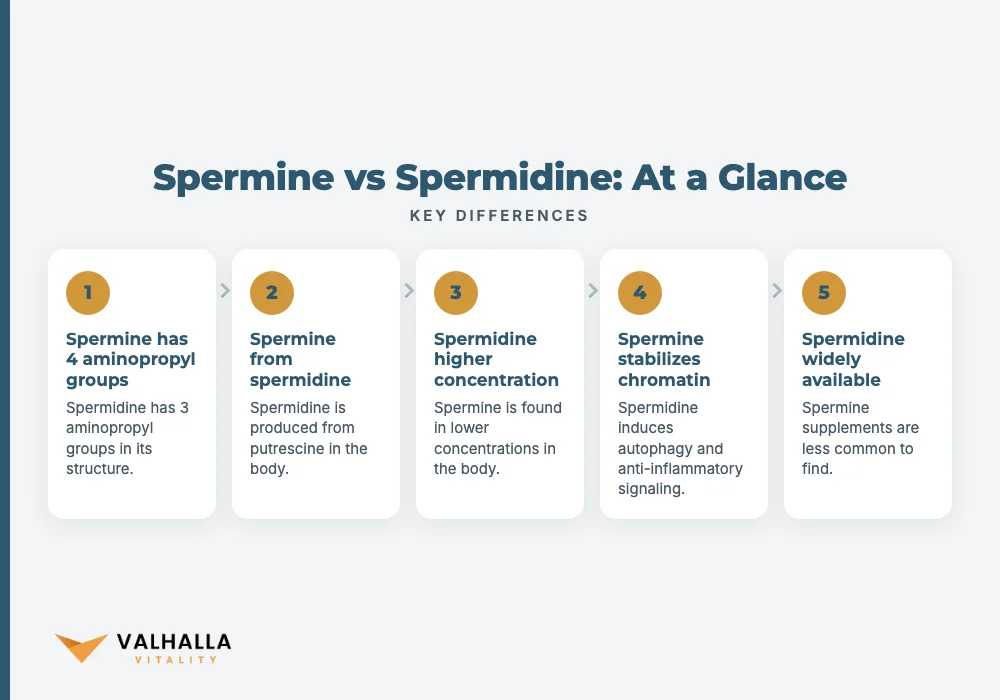
| Property | Spermine | Spermidine |
|---|---|---|
| Structure | 4 aminopropyl groups | 3 aminopropyl groups |
| Biosynthetic order | Produced from spermidine | Produced from putrescine |
| Body concentration | Lower | Higher |
| Primary roles | Chromatin stabilization, cell growth | Autophagy induction, anti-inflammatory signaling |
| Key food sources | Asparagus, poultry, seafood | Wheat germ, soybeans, aged cheese, mushrooms |
| Supplement availability | Less common | Widely available |
What is the difference between spermine and spermidine?
The spermine vs spermidine difference comes down to a single aminopropyl group. Spermidine carries three; spermine has four. Putrescine converts to spermidine first, and spermidine then converts to spermine in a stepwise biosynthetic pathway.
Both molecules carry a positive charge at physiological pH, which lets them bind negatively charged DNA, RNA, and proteins. That binding underpins their roles in chromosome stabilization, translation control, and cell-cycle regulation.
Spermine is present at lower concentrations than spermidine in most human tissues. A 2022 review in the International Journal of Molecular Sciences by Tse et al. noted that the enzyme SSAT governs back-conversion of spermine to acetyl-polyamines, linking polyamine balance to broader cellular health outcomes. Enzyme ratios matter here.
One metabolic detail is relevant for supplementation. Spermine catabolism produces acrolein, a reactive aldehyde. A 2023 study in Biomolecules by Kashiwagi et al. found that acrolein generated from spermine can damage cellular proteins, DNA, and lipid membranes. Normal dietary intake likely carries limited risk, but concentrated supplementation requires individual evaluation.
What does spermidine do for the body?
Spermidine activates autophagy, the cellular process that breaks down and recycles damaged proteins and organelles. A 2025 review in Nutrition Research Reviews by Borsky et al. confirmed that spermidine is a direct autophagy inducer with a mechanism distinct from other dietary autophagy-stimulating compounds. Autophagy declines with age. Restoring it is the most studied mechanism linking spermidine autophagy to longevity biology. That changes everything.
Beyond autophagy, spermidine may support several other systems:
- Anti-inflammatory signaling: A 2026 paper in the International Journal of Rheumatic Diseases by Chen et al. found that spermidine modulates immune pathways implicated in chronic inflammatory conditions such as rheumatoid arthritis.
- Brain health: A 2026 review in Molecular Biology Reports by Pandolfi et al. summarized preclinical evidence that spermidine may help slow age-related neurodegeneration, though the authors noted that large-scale human trials remain needed.
- Protein synthesis regulation: Spermidine drives hypusination of eIF5A, a translation factor essential for producing proteins that regulate cell division and the stress response.
These overlapping functions explain why "what does spermidine do" is among the most searched questions in longevity nutrition.
What foods are naturally high in spermidine?
Wheat germ, natto (fermented soybeans), aged cheese, and mushrooms are the richest natural spermidine food sources. Including a range of these foods regularly is the most practical dietary approach to maintaining polyamine intake.
Top sources include:
- Wheat germ (one of the most concentrated dietary sources)
- Natto and other fermented soy products
- Aged hard cheeses, with concentration rising with aging time
- Mushrooms, particularly shiitake
- Green peas, corn, and legumes
- Chicken liver
For a comparison of natural food sources and supplement approaches side by side, dietary diversity across these categories provides the most reliable polyamine foundation.
Spermine occurs in asparagus, poultry, and seafood, typically at lower concentrations than spermidine in plant-based sources. Cooking reduces polyamine content, so minimal processing preserves more. Gut bacteria also synthesize polyamines from fiber fermentation, giving diet an indirect influence on total polyamine levels beyond direct food intake. Gut health counts too.
How does spermidine support healthy aging?
Spermidine supports healthy aging primarily by restoring autophagy, modulating inflammation, and supporting mitochondrial quality control. Research into spermidine for longevity has grown precisely because these three pathways converge in the biology of aging. Compounds that address all three simultaneously are rare. Few compounds do this.
A 2026 review in Molecular Biology Reports by Pandolfi et al. noted that spermidine concentrations in the brain decrease with age and that dietary or supplemental spermidine may help preserve cognitive function in preclinical models. The reviewers emphasized that robust human clinical data is still emerging and that larger controlled trials are needed.
Polyamine supplements designed for longevity support vary considerably in formulation and bioavailability. For those looking beyond diet alone, spermidine supplement benefits can differ meaningfully depending on how the compound is prepared and delivered. A licensed provider can help assess whether supplementation is appropriate given your individual health picture.
Is spermine safe to take as a supplement?
At normal physiological concentrations, spermine is generally well tolerated and contributes antioxidant and chromatin-stabilizing functions. Spermine health benefits include roles in nitric oxide production, DNA organization, and cell growth support. As a supplement, though, it is far less common than spermidine, and the safety picture is more nuanced.
The 2023 Biomolecules study by Kashiwagi et al. showed that acrolein produced from spermine catabolism can damage proteins, DNA, and lipid membranes at elevated concentrations. Food-derived spermine at normal intake levels is a different matter, but high-dose supplementation warrants careful individual assessment. Dosage defines safety.
A 2023 review in Expert Reviews in Molecular Medicine by Kahraman et al. evaluated polyamine supplements among longevity-oriented nutritional compounds and found them generally well tolerated in research contexts, while noting that individual metabolic variation matters. A licensed provider determines the appropriate approach after reviewing your health history and labs.
For those comparing options, understanding available spermidine supplement forms is a useful starting point before making a decision.
The spermine vs spermidine picture ultimately favors spermidine for supplementation, given its stronger research base around autophagy and brain aging. Spermine plays important structural roles in cell biology but carries more open questions about concentrated use. Valhalla Vitality's licensed providers can help evaluate both compounds alongside your personal health picture.
Ready to explore your options?
If you want personalized guidance on polyamine supplementation, Book Your Consultation with a licensed provider who can review your individual needs.
FAQ
What is the main structural difference between spermine and spermidine?
Spermidine has three aminopropyl groups while spermine has four, making spermine the larger molecule. Both are derived from putrescine in the same metabolic pathway, with spermidine synthesized first and spermine produced from it.
Does spermidine actually trigger autophagy?
Yes. A 2025 review in Nutrition Research Reviews confirmed that spermidine is a direct autophagy inducer with a mechanism distinct from other dietary autophagy-stimulating compounds. Autophagy declines naturally with age, and spermidine's ability to restore autophagic activity is its most studied longevity mechanism.
Which foods are richest in spermidine?
Wheat germ, natto, aged cheese, and mushrooms are consistently the highest spermidine food sources in the research literature. Including a variety of these foods regularly may support adequate polyamine intake without supplementation.
Can lifestyle habits affect polyamine levels naturally?
Eating polyamine-rich foods and maintaining a fiber-rich diet that supports gut bacteria are the main natural strategies. Whether these measures are sufficient depends on individual metabolism, dietary patterns, and health goals; a provider can assess your specific situation.
Is spermine safe as a supplement?
At normal dietary intake levels, spermine is generally considered safe, but a 2023 study in Biomolecules flagged acrolein from spermine catabolism as a potentially toxic metabolite at elevated concentrations. A licensed provider reviews your health history and labs before recommending any supplementation protocol.
Sources
- Kashiwagi K et al. (2023). Molecular Characteristics of Toxicity of Acrolein Produced from Spermine. Biomolecules. PubMed
- Chen Y et al. (2026). Therapeutic Potential of Spermidine in Rheumatoid Arthritis: Mechanisms and Future Directions. International journal of rheumatic diseases. PubMed
- Borsky P et al. (2025). Distinct roles of urolithin A and spermidine in mitophagy and autophagy: implications for dietary supplementation. Nutrition research reviews. PubMed
- Kahraman C et al. (2023). Toxicology of pharmaceutical and nutritional longevity compounds. Expert reviews in molecular medicine. PubMed
- Tse RT et al. (2022). The Association between Spermidine/Spermine N(1)-Acetyltransferase (SSAT) and Human Malignancies. International journal of molecular sciences. PubMed
- Pandolfi S et al. (2026). Spermidine in the aging brain: mechanisms, preclinical evidence, and clinical perspectives. Molecular biology reports. PubMed
You May Also Like
 Rapamycin
 Dosage for Anti-Aging: What You Need to Know
Rapamycin dosage for anti-aging is set by a licensed provider after labs. Discover how sirolimus protocols work and what the latest research shows.
November 14, 2026 ETRead more → Tirzepatide
 Peptide: Mechanism, Benefits and Side Effects
Tirzepatide peptide targets two receptors to support weight loss and blood sugar control. Learn how it works, its benefits, and what to expect.
November 14, 2026 ETRead more → Rapamycin
 Supplement: Benefits, Side Effects, and Dosage
Rapamycin supplement may slow aging by inhibiting mTOR. Learn the benefits, side effects, dosing approach, and how to access it safely under provider care.
November 14, 2026 ETRead more →