
The following blog post is for entertainment and informational purposes only. It is not intended to provide medical advice or diagnosis. Please consult your doctor before making any health-related decisions.
Enclomiphene male fertility treatment works by prompting the body to produce its own testosterone rather than supplying it from outside. As a SERM, it blocks estrogen receptors in the hypothalamus, which signals the pituitary to release LH and FSH, the hormones that drive both testosterone synthesis and spermatogenesis. Low testosterone and fertility concerns often share this hormonal root, and that is exactly where enclomiphene acts. A licensed provider review is the starting point for any man exploring this path.
How enclomiphene works as a SERM for male fertility
The body regulates testosterone through a negative feedback loop. When estrogen rises, the hypothalamus signals the pituitary to reduce LH and FSH output. Less LH means less testosterone. Less FSH means fewer sperm.
Enclomiphene blocks the estrogen receptors in the hypothalamus. The brain reads this as a low-estrogen state and releases more gonadotropins. More LH drives Leydig cells in the testes to produce testosterone. More FSH drives spermatogenesis.
This is fundamentally different from testosterone replacement therapy (TRT). TRT introduces testosterone directly, which suppresses the HPG axis and often reduces sperm production. Enclomiphene for men works upstream, preserving the natural signaling chain. That distinction matters most when fertility is a priority.
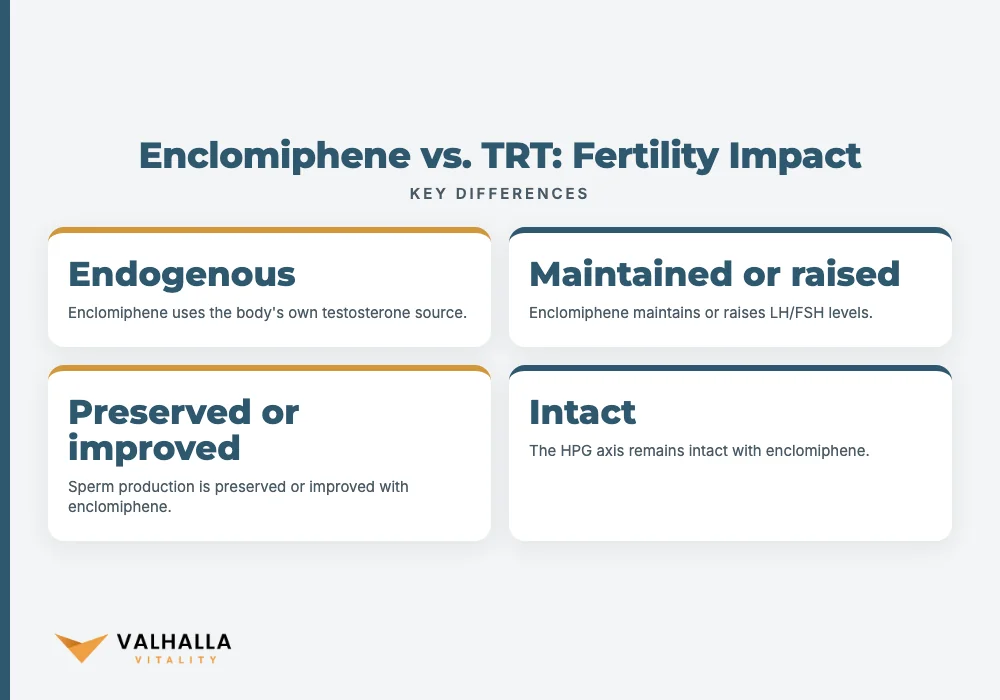
Enclomiphene vs. TRT: key differences for fertility
| Factor | Enclomiphene | TRT |
|---|---|---|
| Testosterone source | Endogenous (testes) | Exogenous (external) |
| LH/FSH levels | Maintained or raised | Suppressed |
| Sperm production | Preserved or improved | Often reduced |
| HPG axis | Intact | Suppressed |
Enclomiphene was originally developed as a female fertility agent, where it induces ovulation through the same estrogen-receptor-blocking mechanism. Its clinical application expanded to men with secondary hypogonadism as evidence accumulated. A 2016 review in Expert Opinion on Pharmacotherapy by Rodriguez et al. examined enclomiphene citrate specifically for that indication, the condition where the testes are functional but do not receive sufficient hormonal signals from the brain.
Does enclomiphene improve male fertility?
Yes, current evidence suggests enclomiphene may support male fertility in men with secondary hypogonadism. By raising LH and FSH, it supports both endogenous testosterone production and active spermatogenesis. The enclomiphene male fertility evidence base expanded significantly with a 2025 systematic review and meta-analysis by Hohl et al., published in Archives of Endocrinology and Metabolism, which evaluated randomized controlled trial data for both clomiphene and enclomiphene in male hypogonadism.
One pharmacological point matters here. Clomiphene is a mixture of two isomers: the trans-isomer (enclomiphene) and the cis-isomer (zuclomiphene). Zuclomiphene accumulates in the body and carries estrogenic activity, which may undercut the intended hormonal benefit. Enclomiphene, as the isolated trans-isomer, avoids that accumulation.
Individual responses vary. Age, testicular function, the severity of hypogonadism, and other underlying conditions all influence how a man responds.
How does enclomiphene increase sperm count?
Enclomiphene male fertility improvements begin with the drug's effect on FSH and intratesticular testosterone. FSH is the primary driver of spermatogenesis, and LH-driven intratesticular testosterone is the local environment that supports it. Raise both, and sperm production gains on two fronts at once.
The effect extends across enclomiphene sperm parameters beyond total count. Sperm motility, the ability of sperm to move efficiently through the reproductive tract, also benefits when the hormonal environment improves. Higher count combined with better motility increases the probability of successful fertilization.
This is why male fertility treatment options that preserve HPG axis function tend to be preferred when sperm production is a concern. For context on why delivery route matters, see how oral testosterone affects sperm production.
Can enclomiphene raise testosterone without harming fertility?
Yes. For enclomiphene male fertility cases, this is the decisive clinical argument over TRT. The drug raises serum testosterone by stimulating the testes through the intact HPG axis, not by replacing what the testes would otherwise produce. LH and FSH remain active. Spermatogenesis continues.
An enclomiphene testosterone boost achieved this way avoids the gonadotropin suppression that makes TRT incompatible with sperm production goals. Men who want testosterone support without trading away fertility represent the group most likely to benefit from this approach.
For a closer look at how low testosterone connects to reproductive health, the hormonal link between low T and fertility covers that relationship in more detail.
What is the recommended enclomiphene dosage for fertility?
There is no standard self-directed dose. A licensed provider determines the appropriate dose after reviewing baseline labs, including serum testosterone, LH, FSH, and often a semen analysis. The protocol is individualized and monitored with follow-up bloodwork throughout treatment.
This is not a therapy suited to self-management. Restoring the hormonal environment that supports sperm production requires provider oversight from the first prescription through ongoing lab monitoring.
How long does enclomiphene take to improve sperm parameters?
Spermatogenesis spans several weeks from start to finish. Changes in semen analysis results take time to appear after any hormonal intervention. Clinical evaluations of SERM male fertility treatments typically schedule semen analysis checkpoints at three months or later for this reason.
Testosterone levels often respond more quickly, since serum T reflects immediate Leydig cell activity rather than the full sperm maturation cycle. A provider monitoring both markers can track progress at intermediate lab checkpoints before a repeat semen analysis.
Enclomiphene male fertility: who is a candidate
Enclomiphene for men is most clinically relevant in secondary hypogonadism, where the testes are capable of producing testosterone and sperm but are not receiving adequate hormonal signals. Primary hypogonadism, where testicular function itself is impaired, is a different clinical picture.
Candidates typically include men with low testosterone and fertility concerns who want to preserve or support sperm production. Men who have experienced reduced spermatogenesis from prior testosterone use represent another group where restoring sperm health after testosterone therapy may be clinically relevant.
A provider evaluates the full hormonal picture before recommending any path. That intake process includes labs, medical history, and a review of the patient's specific goals.
Availability varies by state.
Ready to explore your male fertility treatment options?
If you are weighing SERM male fertility support or have questions about whether enclomiphene may fit your situation, Book Your Consultation to receive a licensed provider review within 24 business hours.
FAQ
Does enclomiphene improve male fertility?
Enclomiphene male fertility support may be most relevant in men with secondary hypogonadism, where the testes are functional but hormonal signaling is insufficient. A 2025 systematic review by Hohl et al. examined randomized controlled trial evidence supporting this mechanism. Results depend on the underlying cause and severity of the fertility concern.
How does enclomiphene differ from testosterone replacement therapy?
Enclomiphene works through the brain's hormonal signaling pathway, preserving LH, FSH, and sperm production. TRT introduces testosterone directly, which suppresses the HPG axis and often reduces sperm count. Men with fertility goals typically find enclomiphene more compatible with maintaining spermatogenesis.
What is the recommended enclomiphene dosage for fertility?
A licensed provider determines the dose after reviewing baseline bloodwork that includes testosterone, LH, and FSH. There is no single standard protocol; dosing is individualized and adjusted based on lab response over time.
How long does enclomiphene take to improve sperm parameters?
Spermatogenesis spans several weeks, so changes in semen analysis results typically appear at the three-month mark or later. Testosterone levels may respond sooner, reflecting immediate Leydig cell output rather than the full sperm maturation cycle.
Is enclomiphene safe for long-term use in men?
Long-term data continues to accumulate. The 2025 systematic review by Hohl et al. evaluated both efficacy and safety evidence from randomized controlled trials. A licensed provider monitors lab values throughout treatment and adjusts the plan based on individual response.
Sources
- Rodriguez KM et al. (2016). Enclomiphene citrate for the treatment of secondary male hypogonadism. Expert Opinion on Pharmacotherapy. PubMed
- Hohl A et al. (2025). Clomiphene or enclomiphene citrate for the treatment of male hypogonadism: a systematic review and meta-analysis of randomized controlled trials. Archives of Endocrinology and Metabolism. PubMed
You May Also Like
 Enclomiphene
Enclomiphene for Gyno: Causes, Prevention & Treatment
Enclomiphene for gyno: how this SERM may help reduce gynecomastia by rebalancing estrogen and testosterone levels. Talk to a licensed provider today.
October 11, 2026 ETRead more → Enclomiphene
Enclomiphene vs Tamoxifen for PCT and Testosterone
Enclomiphene vs tamoxifen: compare how each SERM supports testosterone recovery, PCT protocols, and side effect profiles before talking to a provider.
October 11, 2026 ETRead more → Enclomiphene
Enclomiphene Heart Palpitations: What Men Need to Know
Enclomiphene heart palpitations occur in some men on therapy. Learn how the drug affects blood pressure, cholesterol levels, and cardiovascular risk.
October 11, 2026 ETRead more →